If you’ve found yourself searching for the “ICD-9 code for ankle sprain,” you likely have a medical document, an old insurance form, or perhaps a historical record that uses this older classification system. While the medical world has moved on, understanding these codes remains important for dealing with past records or understanding your medical history.
This guide is designed to be your ultimate, one-stop resource. We’ll provide the precise ICD-9 codes you need, but more importantly, we’ll explain what they mean, why the system changed, and how it relates to the codes used today. Our goal is to give you not just an answer, but the context to make that answer truly useful.
Whether you’re a patient deciphering a bill, a medical student studying coding evolution, or a professional handling legacy data, this article will provide clear, accurate, and comprehensive information.
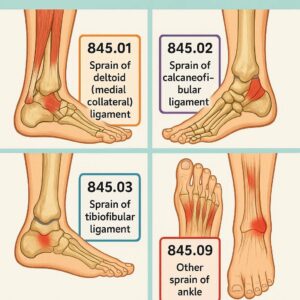
ICD-9 Codes for Ankle Sprains
Understanding the Basics: What is an ICD Code?
Before we dive into the specific numbers, let’s establish a foundation. ICD stands for the International Classification of Diseases. It’s a globally used system, maintained by the World Health Organization (WHO), that gives a unique alphanumeric code to every known disease, disorder, injury, and health condition.
Think of it as a universal medical language. Instead of writing out “a sprain of the lateral ligaments of the left ankle,” a doctor or coder can simply use a specific code. This standardization is crucial for:
-
Billing and Insurance: Insurance companies require these codes to process claims and determine coverage.
-
Medical Records: Codes create concise, searchable patient histories.
-
Public Health Tracking: Governments and health organizations use aggregated code data to track disease outbreaks, injury rates, and health trends (e.g., how many ankle sprains occur in a region annually).
A Brief History: From ICD-9 to ICD-10
The ICD-9-CM (Clinical Modification) system was used in the United States from 1979 until October 1, 2015. On that date, the U.S. healthcare system underwent a massive transition to ICD-10-CM, a much more detailed and modern system.
Key Quote: “The transition from ICD-9 to ICD-10 was not just an update; it was a necessary expansion. ICD-9 codes had become insufficient for describing the complexity and specificity of modern healthcare,” explains a veteran medical coder with over 25 years of experience.
Why does this matter for your search? If you are dealing with a medical record or bill from before October 2015, it will use ICD-9 codes. Anything after that date should use ICD-10 codes. The code for an ankle sprain is different in each system.
The Specific ICD-9 Codes for Ankle Sprain
Here is the precise information you are looking for. In the ICD-9-CM system, ankle sprains are categorized under the broader category of “Injury and poisoning” and more specifically under “Sprains and strains of joints and adjacent muscles.”
The core ICD-9 code category for an ankle sprain is: 845.0
However, this is not a complete code on its own. ICD-9 required an additional digit to specify which ankle was affected. This is where the fifth digit comes into play.
Breakdown of ICD-9 Codes 845.0x
The complete, valid ICD-9 codes for an ankle sprain are as follows:
| ICD-9 Code | Code Description |
|---|---|
| 845.00 | Ankle sprain, unspecified |
| 845.01 | Ankle sprain, left ankle |
| 845.02 | Ankle sprain, right ankle |
| 845.09 | Ankle sprain, other specified sites |
Understanding the Descriptions:
-
845.00 (Unspecified): This code was used when the medical documentation did not specify whether the left or right ankle was injured. While using this code was common, it was less ideal for precise record-keeping.
-
845.01 (Left Ankle) & 845.02 (Right Ankle): These are the specific codes for each side. They provide clearer data.
-
845.09 (Other): This was a catch-all for sprains of specific ankle joints not covered by the laterality codes, though it was rarely used for typical lateral or medial ankle sprains.
Important Note for Readers: If you are looking up an old record and see 845.0 without a fifth digit, it is an incomplete code. The actual billed code would have been one of the four listed above (00, 01, 02, or 09).
Why Specificity Matters: The Limitations of ICD-9
The ICD-9 system, while revolutionary in its time, was notably limited in its specificity. The code 845.01 tells us only two things: a sprain and the left ankle. It does not provide any information about:
-
The specific ligament injured: Was it the anterior talofibular ligament (ATFL), the calcaneofibular ligament (CFL), or the deltoid ligament?
-
The severity of the sprain: Was it a Grade I (mild), Grade II (moderate), or Grade III (severe/complete tear) sprain?
-
The encounter type: Is this the initial visit, a follow-up, or a visit for sequela (a residual condition like chronic instability)?
-
The cause of the injury: The mechanism of injury was not part of the code.
This lack of detail was a primary driver for the global shift to ICD-10. It hampered clinical precision, epidemiological research, and could even lead to billing ambiguities.
A Visual Comparison: ICD-9 vs. ICD-10 for Ankle Sprain
The table below highlights the dramatic increase in detail between the two systems for the same condition.
| Feature | ICD-9-CM (Old System) | ICD-10-CM (Current System) |
|---|---|---|
| Code Format | 3-5 digits, mostly numeric | 3-7 characters, alphanumeric |
| Example Code for Left Ankle Sprain | 845.01 | S93.412A (Sprain of left ankle, initial encounter) |
| Specificity of Laterality | Yes (separate codes for Left/Right) | Yes (included in code) |
| Specificity of Ligament | No | Yes. Different codes for specific ligaments (e.g., deltoid ligament vs. other ligaments). |
| Specificity of Severity | No | Implied through more specific descriptions. |
| Encounter Specificity | No | Yes. 7th character indicates: A (Initial), D (Subsequent), S (Sequela). |
| Total Possible Codes | Approximately 4 for ankle sprain | Dozens of possible combinations for different ligaments, sides, and encounter types. |
As you can see, ICD-10 provides a much richer and more clinically accurate picture of the patient’s condition.
Navigating Legacy Data: When You Still Need ICD-9 Codes
Even though ICD-9 is obsolete for current billing, there are several legitimate reasons you might need to look up these codes today:
-
Understanding Old Medical Records: Your personal health history may span the 2015 transition. Understanding old diagnoses requires knowing ICD-9.
-
Researching Historical Health Data: Public health studies tracking long-term trends (e.g., ankle injury rates in athletes over 30 years) must reconcile data from both coding eras.
-
Handling Older Insurance Claims: Disputes or audits related to care provided before October 2015 will reference ICD-9 codes.
-
Academic and Legal Contexts: Medical students, historians, and legal professionals may encounter these codes in old documents.
A Helpful List: Steps to Decode an Old ICD-9 Ankle Sprain Record
If you have an old record with code 845.0x, here’s how to interpret it:
-
Locate the full code. Ensure you have all digits (e.g., 845.02, not just 845.0).
-
Identify laterality. Check the fifth digit: 01=Left, 02=Right, 00=Unspecified.
-
Cross-reference with documentation. The physician’s notes (if available) will describe the injury in plain language—look for words like “inversion injury,” “swelling,” “tenderness,” etc.
-
For current needs, convert to ICD-10. If you need to use this information for something current, you must map it to the appropriate ICD-10 code. This requires a coder’s expertise, as the ICD-10 code requires more specific information not present in the ICD-9 code.
Mapping Forward: From ICD-9 to ICD-10 for Ankle Sprain
While automatic one-to-one mapping is often unreliable due to ICD-10’s granularity, here is a general guide to how those old codes translate into the new system. This demonstrates why medical coders are essential.
| Old ICD-9 Code | General ICD-10-CM Mapping (Examples) | Why It’s More Complex |
|---|---|---|
| 845.01 (Left Ankle) | S93.412A (Sprain of ligaments of left ankle, initial encounter) | The coder must review documentation to choose the correct 7th character (A, D, or S) and, if documented, a more specific code for a particular ligament. |
| 845.02 (Right Ankle) | S93.411A (Sprain of ligaments of right ankle, initial encounter) | Same as above. The code changes based on the encounter stage. |
| 845.00 (Unspecified) | S93.409A (Sprain of unspecified ligament of unspecified ankle, initial encounter) | Using this unspecified ICD-10 code is often discouraged and may lead to billing delays, as it lacks laterality. It highlights the poor documentation behind the original ICD-9 code. |
Important Note: “Patients should never try to self-code or map codes for current medical visits. This table is for educational purposes only to show the evolution of coding. Always rely on your healthcare provider and their certified coding staff for accurate diagnosis coding,” advises a healthcare administration consultant.
Beyond the Code: Essential Facts About Ankle Sprains
Since you’re interested in the coding, understanding the medical condition itself adds valuable context.
What is an Ankle Sprain?
An ankle sprain is an injury to the tough bands of tissue (ligaments) that surround and connect the bones of the ankle. It occurs when these ligaments are stretched or torn, usually due to the ankle rolling, twisting, or turning in an awkward way.
Common Causes:
-
Inversion Injury: The foot rolls inward, damaging the outer (lateral) ligaments. This is the most common type (~85%).
-
Eversion Injury: The foot rolls outward, damaging the inner (medial/deltoid) ligament.
-
High Ankle Sprain (Syndesmotic): Injury to the ligaments connecting the two leg bones (tibia and fibula) above the ankle. Common in high-impact sports.
Grade-Based Severity:
-
Grade I (Mild): Slight stretching, minimal tearing. Mild tenderness, swelling, and stiffness.
-
Grade II (Moderate): Partial tearing of the ligament. More significant swelling, bruising, moderate pain, and some difficulty bearing weight.
-
Grade III (Severe): Complete tear or rupture of the ligament. Major swelling, bruising, instability, and inability to bear weight.
This clinical detail is precisely what the ICD-10 system attempts to capture more effectively through its expanded code set.
Conclusion
Searching for the ICD-9 code for an ankle sprain leads you to the now-historical codes 845.00, 845.01, 845.02, and 845.09. While these codes provided a basic framework for decades, their lack of specificity necessitated the shift to the detailed ICD-10 system. Understanding these codes today is key to interpreting pre-2015 medical records, but for all current healthcare needs, the comprehensive and precise language of ICD-10 is now the essential standard.
Frequently Asked Questions (FAQ)
Q: Can a doctor still use an ICD-9 code for my ankle sprain today?
A: No. As of October 1, 2015, all healthcare providers covered by the Health Insurance Portability and Accountability Act (HIPAA) in the U.S. are required to use ICD-10-CM codes for diagnosis coding. Using an ICD-9 code on a current claim would result in immediate rejection.
Q: I have an old bill with code 845.02. What does that mean for my current health?
A: The code itself simply indicates you were diagnosed with a right ankle sprain at that time. For your current health, the significance depends on whether you have any ongoing symptoms like pain, weakness, or instability. You should discuss your full injury history with your current doctor.
Q: How do I find the exact ICD-10 code for my recent ankle sprain?
A: You do not need to find it yourself. Your healthcare provider (doctor, orthopedic specialist, urgent care) will diagnose your injury and their certified medical coder will assign the appropriate ICD-10 code based on the physician’s detailed documentation. This code will appear on your bill (Explanation of Benefits) and medical records.
Q: Why are there so many more ICD-10 codes? Is it just to make things complicated?
A: While the volume of codes seems overwhelming, the increased detail serves important purposes: it improves patient care by clarifying exact conditions, enhances public health tracking of specific injuries, and reduces ambiguity in the billing process between providers and insurers.
Q: Where can I look up official ICD-10 codes?
A: The official source is the Centers for Disease Control and Prevention (CDC) ICD-10-CM browser. You can search codes there for educational purposes: CDC ICD-10-CM Tools. Remember, actual coding requires formal training.
Disclaimer: This article is for informational and educational purposes only. It is not a substitute for professional medical advice, diagnosis, or treatment, nor is it a guide for medical coding. Always seek the advice of your physician or other qualified health provider with any questions you may have regarding a medical condition. For accurate coding, consult a certified professional coder or official ICD code manuals. Information is current as of the date of publication (January 06, 2026).