If you’re searching for the ICD-9 code for congestive heart failure, you’ve likely encountered a medical record, a billing form, or a piece of historical data that still uses this older coding system. While the healthcare world has moved on to ICD-10-CM, understanding these legacy codes remains crucial for decoding past records and grasping the evolution of medical classification.
This guide will provide you with a clear, detailed, and practical understanding of the specific ICD-9 codes used for congestive heart failure, their clinical nuances, and their place in medical history. We’ll navigate this topic with simple, accessible language, ensuring you walk away with reliable knowledge.
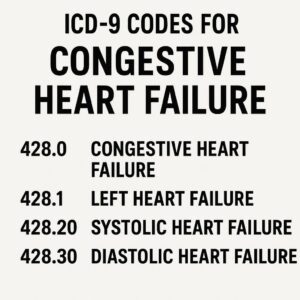
ICD-9 Codes for Congestive Heart Failure
Understanding the ICD-9 Coding System: A Brief History
Before we dive into the specific codes, let’s set the stage. The International Classification of Diseases, 9th Revision, Clinical Modification (ICD-9-CM) was the standard system used in the United States to code diagnoses and procedures from 1979 until October 1, 2015.
“ICD-9 served as the backbone of medical billing, epidemiology, and health records for over three decades. Its transition to ICD-10 was a monumental shift towards greater clinical detail.”
Think of ICD-9 as a detailed library of medical conditions, where each book (code) represented a specific disease or symptom. Its primary purposes were:
-
Billing and Reimbursement: Insurance companies used these codes to determine payment for services.
-
Medical Recordkeeping: Standardizing patient diagnoses in charts.
-
Public Health Tracking: Monitoring disease prevalence and outbreaks.
On October 1, 2015, the U.S. officially transitioned to ICD-10-CM, a far more granular and modern system. However, any healthcare encounter prior to that date—and many older patient records—will reference ICD-9 codes.
The Primary ICD-9 Code for Congestive Heart Failure
In the ICD-9-CM system, congestive heart failure (CHF) falls under the broader category of “Diseases of the circulatory system.” The foundational code is:
ICD-9 Code 428.0: Congestive heart failure, unspecified.
This was the most general code, used when a provider documented “congestive heart failure” without specifying the underlying mechanism or type. It served as a catch-all for many cases.
However, the true utility of ICD-9 came from its ability to specify further through fourth and fifth digits. CHF was not a single code but a family of codes that painted a clearer clinical picture.
Detailed Breakdown of CHF ICD-9 Codes and Their Meanings
The following table breaks down the entire family of ICD-9 codes related to heart failure, providing their specific clinical descriptions.
Complete ICD-9 Code Set for Heart Failure
| ICD-9 Code | Code Description | Clinical Meaning & Context |
|---|---|---|
| 428 | Heart failure | This is the parent, 3-digit category. It was rarely used alone; a more specific 4th or 5th digit was required. |
| 428.0 | Congestive heart failure, unspecified | Used for typical CHF with fluid backup (edema, pulmonary congestion) where the type isn’t specified. |
| 428.1 | Left heart failure | Specifically indicates failure of the left ventricle. This often leads to pulmonary edema (fluid in the lungs) and symptoms like shortness of breath. It includes codes for acute pulmonary edema. |
| 428.2 | Systolic heart failure | Also known as heart failure with reduced ejection fraction (HFrEF). The heart muscle loses its ability to contract forcefully. |
| 428.20 | Unspecified systolic heart failure | |
| 428.21 | Acute systolic heart failure | |
| 428.22 | Chronic systolic heart failure | |
| 428.23 | Acute on chronic systolic heart failure | |
| 428.3 | Diastolic heart failure | Also known as heart failure with preserved ejection fraction (HFpEF). The heart muscle stiffens and can’t relax properly to fill with blood. |
| 428.30 | Unspecified diastolic heart failure | |
| 428.31 | Acute diastolic heart failure | |
| 428.32 | Chronic diastolic heart failure | |
| 428.33 | Acute on chronic diastolic heart failure | |
| 428.4 | Combined systolic and diastolic heart failure | The patient has elements of both types (HFrEF and HFpEF). |
| 428.40 | Unspecified combined heart failure | |
| 428.41 | Acute combined heart failure | |
| 428.42 | Chronic combined heart failure | |
| 428.43 | Acute on chronic combined heart failure | |
| 428.9 | Heart failure, unspecified | A broader term than 428.0, used when the documentation simply states “heart failure” without mention of congestion or specific type. |
Important Note for Readers: If you are coding a current medical encounter or billing for services provided after October 1, 2015, you must use ICD-10-CM codes. The information above is for historical reference, understanding old records, or academic purposes.
How ICD-9 CHF Codes Were Used in Practice
A coder or healthcare professional would review the physician’s documentation in the chart to select the correct code. Here’s a practical example:
-
Scenario 1: A patient’s discharge summary states: “Admitted with acute shortness of breath and hypoxemia due to acute systolic congestive heart failure.”
-
ICD-9 Code Assigned: 428.21 (Acute systolic heart failure) and potentially 428.0 for the congestive aspect if not implied.
-
-
Scenario 2: A clinic note reads: “Patient with long-standing history of chronic diastolic heart failure, well-managed on current medications.”
-
ICD-9 Code Assigned: 428.32 (Chronic diastolic heart failure).
-
-
Scenario 3: An ER note states: “Patient presents with acute pulmonary edema secondary to left heart failure.”
-
ICD-9 Code Assigned: 428.1 (Left heart failure), as this code encompasses acute pulmonary edema.
-
The Transition from ICD-9 to ICD-10-CM for CHF
The shift to ICD-10-CM was driven by the need for greater specificity. ICD-9’s CHF codes offered some detail, but ICD-10-CM provides a vastly expanded landscape. This specificity improves patient care management, clinical research, and quality tracking.
Let’s compare how a common condition translates between the two systems.
ICD-9 vs. ICD-10-CM for Heart Failure
| Aspect | ICD-9-CM | ICD-10-CM |
|---|---|---|
| Basic Code for Unspecified CHF | 428.0 (Congestive heart failure, unspecified) | I50.9 (Heart failure, unspecified) |
| Specificity | Moderate. Distinguished systolic, diastolic, combined, acute/chronic. | Very High. Adds details like acuity, laterality, and associated conditions. |
| Example of Specific Coding | 428.22 (Chronic systolic heart failure) | I50.22 (Chronic systolic (congestive) heart failure) I50.23 (Acute on chronic systolic (congestive) heart failure) I50.42 (Combined systolic and diastolic heart failure, chronic) |
| Number of Codes | Approximately 15 codes in the 428.x family. | Over 50 codes in the I50.x family, with many more considering associated factors. |
| Additional Detail | Limited. | ICD-10 can specify heart failure as a complication of other diseases (e.g., hypertensive heart disease, pregnancy), and can denote the type of ventricular failure more precisely. |
The most significant takeaway is that ICD-10-CM requires and enables precise clinical documentation. The generic term “CHF” is no longer sufficient for accurate coding.
Why This Historical Knowledge Matters Today
You might wonder why learning about an obsolete system is valuable. Here are key reasons:
-
Decoding Historical Medical Records: Many active patient charts contain diagnoses coded in ICD-9. Understanding these codes is essential for continuity of care and understanding a patient’s full medical history.
-
Research and Data Analysis: Epidemiological studies or historical clinical research covering periods before 2015 rely on ICD-9 data. Accurate interpretation is critical.
-
Billing Audits and Appeals: Older claims or audits may still reference ICD-9 codes. Knowledge of the system helps in resolving disputes or understanding past billing decisions.
-
Educational Foundation: Understanding ICD-9’s limitations helps clinicians and coders appreciate the rationale and improved capabilities of ICD-10-CM and the upcoming ICD-11.
Common Pitfalls and Considerations with ICD-9 CHF Codes
When reviewing old ICD-9 codes, keep these points in mind:
-
Lack of Specificity: Code 428.0 was often overused because documentation habits were less rigorous. The true clinical picture (systolic vs. diastolic) might be in the narrative notes but not captured in the code.
-
Acute vs. Chronic Status: While ICD-9 had codes for acute, chronic, and “acute on chronic,” documentation sometimes failed to make this distinction clear, leading to assumptions by coders.
-
Combined Conditions: Patients with CHF often have comorbidities like hypertension (401.9) or chronic kidney disease (585.9). In ICD-9, the relationship between these conditions (e.g., hypertensive heart failure) was less explicitly linked than in ICD-10.
“The greatest limitation of ICD-9 was its inability to keep pace with clinical medicine. It forced conditions into broad categories, while modern treatment demands precision.”
Key Differences Between Heart Failure and Congestive Heart Failure in ICD-9
It’s a subtle but important distinction:
-
Heart Failure (428.9): A broader term indicating the heart’s inability to pump adequately. It may not always involve fluid congestion.
-
Congestive Heart Failure (428.0): A subset of heart failure where the pumping problem has led to a backup of fluid in the lungs, legs, abdomen, or other organs.
In practice, “CHF” was often used interchangeably with “heart failure,” but coders would look for keywords like “edema,” “pulmonary congestion,” or “volume overload” to assign 428.0 over 428.9.
Conclusion
Navigating the ICD-9 codes for congestive heart failure requires understanding its now-historical framework, centered on code 428.0 with more specific child codes like 428.2x for systolic and 428.3x for diastolic failure. While this system was retired in 2015, its legacy lives on in millions of patient records, making this knowledge essential for interpreting medical history. The transition to ICD-10-CM underscored the need for greater clinical detail, moving healthcare from general categorization to precise patient-specific documentation.
Frequently Asked Questions (FAQ)
Q: What is the most common ICD-9 code for CHF?
A: The most commonly used code was 428.0 (Congestive heart failure, unspecified). It served as the default when more specific documentation was lacking.
Q: Can I use ICD-9 codes for medical billing today?
A: No. For all healthcare services provided on or after October 1, 2015, you are legally required to use ICD-10-CM codes for diagnosis reporting in the United States. Using ICD-9 will result in claim denials.
Q: How do I convert an old ICD-9 code for CHF to ICD-10?
A: There is no simple one-to-one conversion. You must review the patient’s current clinical documentation and select the appropriate, more specific ICD-10-CM code. General equivalency mappings exist, but they are for guidance only. For example, ICD-9 428.0 maps roughly to ICD-10 I50.9, but a clinician’s note might support a more precise code like I50.22 or I50.32.
Q: Where can I find official, historical ICD-9 code information?
A: The U.S. Centers for Disease Control and Prevention (CDC) maintains archives of the ICD-9-CM official guidelines and codes. The National Center for Health Statistics (NCHS) website is a reliable resource.
Q: Did ICD-9 have a code for right heart failure?
A: Not as a distinct code under the 428 series. Right heart failure was typically indexed to code 428.0 (Congestive heart failure) or, if specified as secondary to left heart failure, it would be coded as 428.1 (Left heart failure). Isolated right heart failure from other causes (like lung disease) had different primary codes.
Additional Resource
For the complete and current official guidelines and codes for the ICD-10-CM system, which is now in use, visit the Centers for Disease Control and Prevention (CDC) ICD-10-CM page: https://www.cdc.gov/nchs/icd/icd-10-cm.htm
Disclaimer: This article is for informational and educational purposes only. It is based on historical coding data and is not a substitute for current medical coding guidelines, professional coding advice, or clinical judgment. Medical coding is complex and regulated. Always consult the most current official ICD-10-CM coding manuals, guidelines from the CDC and CMS, and a certified professional coder for all billing and diagnostic coding purposes. The author and publisher are not responsible for any errors, omissions, or consequences resulting from the use of this historical information.
Date: January 12, 2026
Author: The Web Health Archives Team