If you’re searching for the “ICD-9 code for eye pain,” you’re likely navigating medical records, insurance forms, or historical data. While the ICD-9 system is officially retired, understanding its codes remains crucial for interpreting past documents and bridging the gap to modern healthcare terminology. This comprehensive guide will not only provide the specific code you need but will also explain its context, limitations, and its successor in today’s medical coding world.
We’ll explore why a simple symptom like eye pain requires precise coding, how the transition to ICD-10 improved diagnostic accuracy, and what you need to know to handle these codes correctly. Whether you’re a medical professional, a student, a billing specialist, or a patient researching an old record, this article is your essential reference.
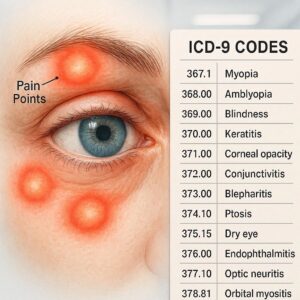
ICD-9 Codes for Eye Pain
Understanding the ICD-9-CM Coding System
The International Classification of Diseases, Ninth Revision, Clinical Modification (ICD-9-CM) was the standard diagnostic coding system used in the United States for decades until its retirement on October 1, 2015. Its primary purpose was to translate diagnoses and symptoms into universal alphanumeric codes. This translation was vital for:
-
Medical Billing and Reimbursement: Insurance companies used these codes to determine coverage for procedures and visits.
-
Epidemiological Tracking: Public health officials relied on aggregated code data to track disease prevalence and outbreaks.
-
Clinical Documentation: Codes provided a shorthand for patient conditions in medical records.
However, the ICD-9 system had significant limitations. With only about 17,000 codes, it often lacked the specificity needed for modern medicine. Describing “eye pain” is a perfect example—while a common symptom, its underlying cause is critical for treatment, and ICD-9’s structure sometimes struggled to capture these nuances effectively.
The Transition to ICD-10-CM
On October 1, 2015, the U.S. healthcare system officially adopted ICD-10-CM, a far more detailed and robust classification system. ICD-10-CM contains approximately 68,000 codes, allowing for remarkable specificity regarding laterality, etiology, and severity.
Why does this matter for a search about ICD-9?
Many active medical records, insurance claims, and research studies predate 2015. Furthermore, understanding the evolution from ICD-9 to ICD-10 helps clarify why a single, general code has been replaced with a more precise and clinically useful array of options. When you encounter an old ICD-9 code, knowing its ICD-10 equivalent is essential for current understanding and action.
The Specific ICD-9 Code for Eye Pain
In the ICD-9-CM system, the general code for eye pain is:
379.99 – Other disorders of the eye and adnexa, unspecified
This code was categorized under “Disorders of the eye and adnexa” (category 379). It served as a catch-all for various ocular symptoms and conditions that didn’t have a more specific code, with eye pain (otalgia) being one of the most common uses.
Important Limitations of Code 379.99
It is crucial to understand what this code does not tell you:
-
It Does Not Specify a Cause. The code indicates the symptom of pain only. It does not distinguish between pain from a corneal abrasion, uveitis, glaucoma, a migraine, or dry eye syndrome.
-
It Does Not Indicate Laterality. The code does not specify if the pain is in the right eye, left eye, or both.
-
It Is Unspecified by Nature. As an “unspecified” code, it represents the lowest level of diagnostic certainty.
In clinical practice, if a definitive diagnosis was made, a more specific code would be used. For instance, acute conjunctivitis had its own code (372.03), and acute angle-closure glaucoma had code (365.22). Code 379.99 was often used for initial encounters or when a precise diagnosis was pending.
ICD-9-CM vs. ICD-10-CM: A Comparative Table for Eye Pain
The transition to ICD-10-CM transformed how symptoms like eye pain are documented. The table below illustrates the dramatic increase in specificity.
| Aspect | ICD-9-CM (Historical) | ICD-10-CM (Current) |
|---|---|---|
| Primary Code | 379.99 – Other disorders of the eye and adnexa, unspecified | H57.1 – Ocular pain |
| Specificity | Very low. One general code for various unspecified disorders. | High. A dedicated code for the symptom of ocular pain. |
| Laterality | Not specified. | Must be specified: • H57.11 – Ocular pain, right eye • H57.12 – Ocular pain, left eye • H57.13 – Ocular pain, bilateral |
| Coding Best Practice | Often used as a placeholder. | Used when a more definitive diagnosis is not yet established. The focus is on coding to the highest specificity known. |
| Example of a Specific Diagnosis | 365.22 – Acute angle-closure glaucoma | H40.211 – Acute angle-closure glaucoma, right eye H40.212 – Acute angle-closure glaucoma, left eye H40.213 – Acute angle-closure glaucoma, bilateral |
As evident, ICD-10-CM requires the coder to specify which eye is affected, instantly providing more actionable clinical data.
Navigating from an Old ICD-9 Code to ICD-10
If you have an old record with code 379.99, the corresponding ICD-10-CM codes would be in the H57.1- series (Ocular pain), with the appropriate laterality suffix. However, the medical coder or provider would need to review the full record to determine if a more specific diagnosis code (like for glaucoma, uveitis, etc.) is warranted.
Common Diagnoses Associated with Eye Pain and Their Codes
Eye pain is rarely a standalone condition. It is a symptom of an underlying issue. Here is a list of common causes and how they were/are coded.
1. Corneal Abrasion
-
ICD-9-CM: 918.1 – Superficial injury of cornea
-
ICD-10-CM: S05.0- – Injury of conjunctiva and corneal abrasion without foreign body (with laterality and encounter specifics).
2. Acute Conjunctivitis (Pink Eye)
-
ICD-9-CM: 372.03 – Other mucopurulent conjunctivitis
-
ICD-10-CM: H10.0- – Mucopurulent conjunctivitis (with laterality).
3. Uveitis (Inflammation of the Middle Eye Layer)
-
ICD-9-CM: 364.3 – Unspecified iridocyclitis
-
ICD-10-CM: H20.0- – Acute and subacute iridocyclitis (with laterality).
4. Acute Angle-Closure Glaucoma
-
ICD-9-CM: 365.22 – Acute angle-closure glaucoma
-
ICD-10-CM: H40.21- – Acute angle-closure glaucoma (with laterality).
5. Migraine with Aura (causing ocular pain)
-
ICD-9-CM: 346.0 – Migraine with aura
-
ICD-10-CM: G43.1- – Migraine with aura (with intractable/status specifics).
Note for Readers: This list is for educational comparison. Accurate medical coding requires a physician’s final diagnosis and adherence to official coding guidelines. Never self-diagnose based on a code.
The Critical Importance of Accurate Medical Coding
“In the world of healthcare, accurate coding is not just about numbers—it’s about creating a clear, actionable story of the patient’s health that drives appropriate care and ensures the sustainability of medical practices.” – Industry Expert Perspective.
Using the correct code, whether in the past or present, has real-world consequences:
-
Patient Care: Specific codes help create accurate health histories, flag potential risks, and ensure continuity of care.
-
Financial Health of Practices: Incorrect or unspecified codes can lead to claim denials, delayed payments, and audits.
-
Public Health Research: Aggregated code data informs where to allocate research funding, track pandemic trends, and understand disease patterns. A generic “eye pain” code provides far less insight than specific diagnostic codes.
A Helpful Checklist for Handling Historical ICD-9 Codes
If you encounter an ICD-9 code like 379.99 in a document:
-
Confirm the Date of Service. If it was before October 1, 2015, ICD-9 was the appropriate system in use.
-
Do Not Use it for Current Billing. It is invalid for any services after the transition date.
-
Seek the Underlying Diagnosis. Look for accompanying notes that clarify the actual diagnosis (e.g., “corneal ulcer,” “scleritis”).
-
Map to ICD-10 for Understanding. Use a reliable ICD-9 to ICD-10 bridge or General Equivalence Mappings (GEMs) file to find the modern equivalent code family, remembering that a one-to-one match is rare.
-
Consult a Professional. For billing, legal, or critical medical purposes, consult a certified medical coder or healthcare provider.
Frequently Asked Questions (FAQ)
Q1: Can I still use ICD-9 codes for medical billing today?
A: No. As of October 1, 2015, the use of ICD-9-CM codes for billing services provided in the United States is prohibited. All claims must use ICD-10-CM codes.
Q2: I found “379.99” on an old medical bill. What does it mean?
A: It means your healthcare provider billed for an encounter related to an unspecified disorder of the eye, with the most common symptom being eye pain. The medical records associated with that bill should contain the physician’s notes describing the specific reason for your visit.
Q3: Is “H57.1” (ICD-10 for ocular pain) billable?
A: Yes, it is a valid, billable code in ICD-10-CM. However, payers often expect the highest level of specificity. If a definitive diagnosis (like blepharitis or a foreign body) is made, that more specific code should typically be used instead.
Q4: Why is it so important to specify right vs. left eye?
A: Specifying laterality is crucial for accurate treatment, surgical planning, tracking disease progression in one eye versus the other, and for epidemiological studies. It removes ambiguity and enhances patient safety.
Q5: Where can I find official coding resources?
A: The U.S. Centers for Medicare & Medicaid Services (CMS) and the National Center for Health Statistics (NCHS) are the official publishers of the ICD-10-CM system. Their websites host the complete code sets and guidelines.
Conclusion
Navigating the world of medical codes, from the historical ICD-9 to the current ICD-10, is key to understanding healthcare documentation. While ICD-9 code 379.99 was the general marker for eye pain, the modern ICD-10-CM H57.1x series offers precise, laterality-specific coding that improves clinical care and data accuracy. Always remember that these codes represent a language of healthcare, evolving to provide clearer pictures of patient health and drive better outcomes.
Additional Resource: For the official ICD-10-CM code set and guidelines, visit the Centers for Disease Control and Prevention (CDC) ICD-10 page: https://www.cdc.gov/nchs/icd/icd10cm.htm
Disclaimer: This article is for informational and educational purposes only. It does not constitute medical or coding advice. Always rely on the official ICD-10-CM coding guidelines and consult with qualified healthcare professionals and certified medical coders for diagnosis, treatment, and accurate billing code assignment.
Date: January 20, 2026
Author: The Web Health Reference Team