If you work in oncology medical billing, you already know that precision is everything. One small coding error can lead to claim denials, delayed payments, and unnecessary administrative headaches.
Imfinzi (durvalumab) is a common immunotherapy drug. It treats specific types of lung cancer and biliary tract cancers. But what happens when you need to bill for it?
You need the right Imfinzi CPT code, the correct HCPCS code, and a solid understanding of administration codes.
This guide walks you through everything you need to know. No fluff. No unrealistic claims. Just practical, honest information to help your practice bill accurately and get reimbursed fairly.
What Is Imfinzi? A Quick Overview
Before we jump into codes, let us make sure we are on the same page about the drug itself.
Imfinzi is the brand name for durvalumab. It belongs to a class of medications called PD-L1 inhibitors. These drugs work by blocking a protein that helps cancer cells hide from your immune system. When you block that protein, your immune system can find and attack the cancer cells more effectively.
Doctors commonly prescribe Imfinzi for:
- Unresectable stage III non-small cell lung cancer (NSCLC) after chemoradiation
- Extensive-stage small cell lung cancer (ES-SCLC) in combination with other drugs
- Locally advanced or metastatic biliary tract cancer
The drug is given as an intravenous (IV) infusion. A typical session lasts around 60 minutes for the first dose. Later doses may be shorter if you tolerate it well.
Now, let us talk about the codes you will need.
The Main HCPCS Code for Imfinzi (Durvalumab)
Here is the most important code to remember.
J9173 – Injection, durvalumab, 10 mg
This is the HCPCS Level II code. You will use it to bill for the drug itself. The code represents 10 milligrams of durvalumab.
Most patients receive 10 mg per kilogram of body weight. Others receive a fixed dose of 1,500 mg every four weeks. Your dosing schedule depends on the patient’s diagnosis and treatment plan.
How to Calculate Units for J9173
Let us break this down with an example.
A patient weighs 70 kg. The prescribed dose is 10 mg/kg. That equals 700 mg total.
J9173 represents 10 mg. So you divide 700 by 10. That gives you 70 units.
You would bill 70 units of J9173.
For a fixed dose of 1,500 mg, the math is 1,500 ÷ 10 = 150 units.
Important note: Always verify the specific dosing regimen in the patient’s chart. Dosing can vary by indication, body weight, and clinical trial protocols.
CPT Administration Codes for Imfinzi Infusions
The drug code is only half the picture. You also need to bill for the IV infusion service itself.
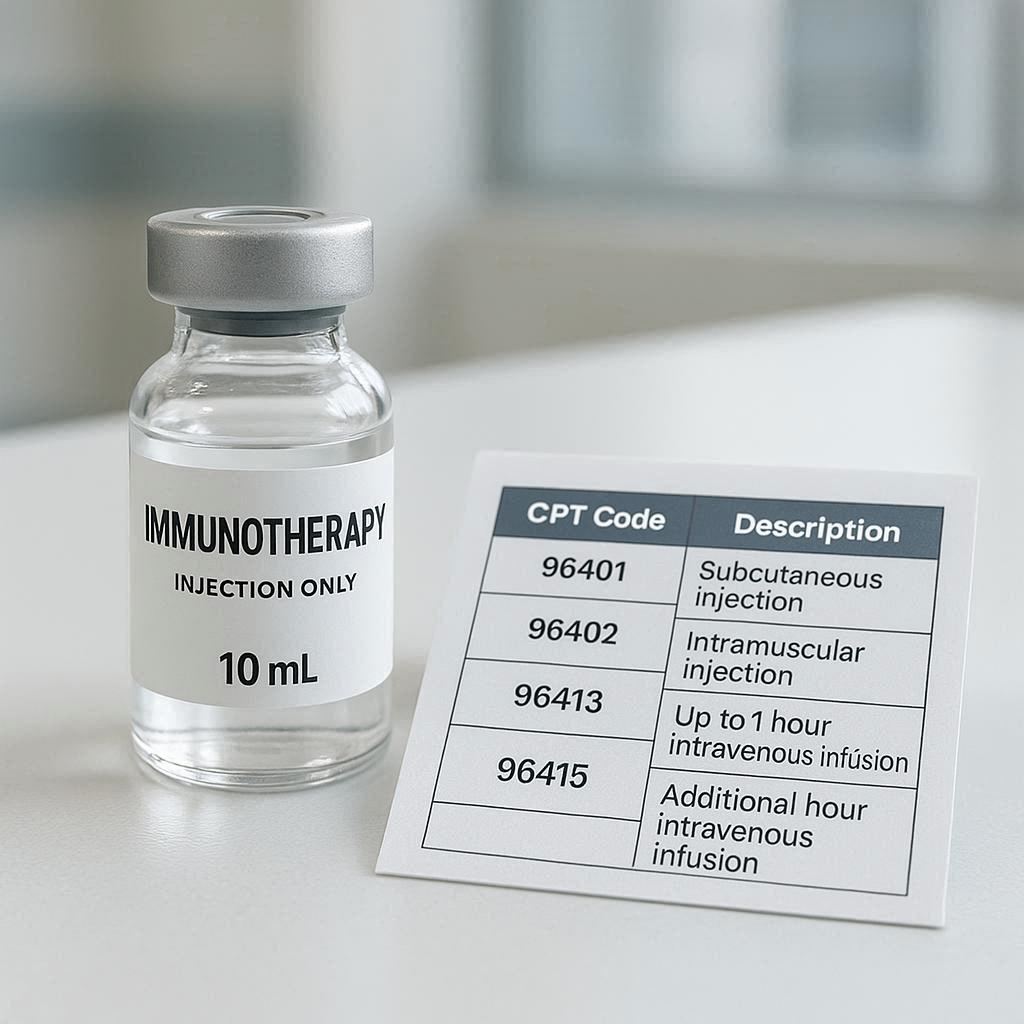
CPT administration codes depend on the time spent infusing the drug. Here are the most common ones you will use.
| CPT Code | Description | Typical Use for Imfinzi |
|---|---|---|
| 96413 | IV infusion, chemotherapy or other highly complex drug; first hour | First hour of infusion |
| 96415 | Each additional hour (beyond first hour) | For infusions longer than 60 minutes |
| 96365 | IV infusion, initial, up to 1 hour (non-chemo drug) | Less common for Imfinzi but possible |
| 96366 | Each additional hour (non-chemo drug) | Extension beyond initial hour |
Most payers classify Imfinzi as a chemotherapy or “highly complex” drug. So you will likely use 96413 and 96415.
What About the First Dose?
The first dose of Imfinzi often takes about 60 minutes. In that case, you bill 96413 for the first hour.
If the infusion runs longer than 60 minutes – say 90 minutes – you bill 96413 for the first hour and 96415 for the second 30 minutes. Note that 96415 is billed per additional hour. You can report it in increments.
Subsequent Doses
If the patient tolerates the first dose well, subsequent infusions may last only 30 minutes. For a 30-minute infusion, you would not use an hourly administration code. Instead, use 96360 (IV push) if appropriate, or check payer guidelines. Some payers accept 96413 for any infusion lasting 16 minutes or more.
Always check your local payer policies. They vary.
Additional CPT Codes You Might Need
Sometimes an Imfinzi infusion is not a standalone visit. You may need to bill for other services on the same day.
Initial Office Visit or E/M Code
If the patient comes in specifically for the infusion, you may still need an evaluation and management (E/M) code. This applies if you provide significant, separately identifiable work.
Examples include:
- Assessing new symptoms before treatment
- Reviewing lab results that change the treatment plan
- Managing infusion-related reactions
In these cases, append modifier 25 to the E/M code. That tells the payer you performed a significant, separate service on the same day as the procedure.
Common E/M codes include 99212 through 99215 for established patients. For new patients, use 99202 through 99205.
Hydration or Other Infusions
Imfinzi is often given alone. But sometimes a patient needs hydration before or after. You can bill hydration codes (96360, 96361) if the hydration is medically necessary and not part of the drug infusion.
You cannot bill hydration during the same time you are infusing Imfinzi. The time must be separate.
Prolonged Service Codes
If your infusion runs very long due to a slow rate or adverse reaction, you might use a prolonged service code. However, this is rare for standard Imfinzi infusions.
Imfinzi Coding Scenarios: Real Examples
Let us look at three common clinical scenarios. These will help you see how the codes work together.
Scenario 1: First Dose – 60 Minutes
- Patient weight: 80 kg
- Dose: 10 mg/kg = 800 mg
- J9173 units: 800 ÷ 10 = 80 units
- Infusion time: 60 minutes
What you bill:
- J9173 x 80 units
- 96413 (first hour)
Scenario 2: Subsequent Dose – 30 Minutes (Tolerated Well)
- Patient weight: 80 kg
- Dose: 10 mg/kg = 800 mg
- J9173 units: 80
- Infusion time: 30 minutes
What you bill:
- J9173 x 80 units
- 96413 (many payers allow this for infusions 16 minutes or longer; check your local policy)
Alternative: Some payers prefer 96360 (IV push, up to 1 hour). Verify before billing.
Scenario 3: Fixed Dose 1,500 mg – 60 Minutes
- Dose: 1,500 mg
- J9173 units: 150
- Infusion time: 60 minutes
What you bill:
- J9173 x 150 units
- 96413
Scenario 4: Extended Infusion Due to Reaction – 90 Minutes
- Dose: 1,500 mg
- J9173 units: 150
- Infusion time: 90 minutes
What you bill:
- J9173 x 150 units
- 96413 (first hour)
- 96415 x 1 (additional hour, even if only partially used)
Payer-Specific Policies You Must Know
Here is a reality check. Not all payers handle Imfinzi coding the same way.
Medicare and most commercial plans follow similar rules. But there are differences.
Medicare
Medicare covers Imfinzi for FDA-approved indications. You will bill J9173 through a Medicare Administrative Contractor (MAC). Each MAC has its own local coverage determination (LCD).
Check your MAC’s LCD for:
- Required documentation
- Accepted dosing schedules
- Frequency limits
- Medical necessity criteria
Most MACs also require you to report the NDC number for Imfinzi on your claim. The NDC for Imfinzi is typically 0310-4600-10 (500 mg vial) or 0310-4600-12 (120 mg vial). Use the NDC that matches what you actually administered.
Commercial Payers
Private insurers often follow Medicare rules but not always. Some require prior authorization for Imfinzi. Others have specific coding edits that reject 96413 for certain infusion durations.
Always check the payer’s medical policy. You can usually find it on their provider portal.
Medicaid
Medicaid coverage varies by state. Many states follow Medicare’s lead. But some have their own fee schedules and prior authorization requirements.
Documentation Best Practices
Good documentation is your best defense against denials and audits.
Here is what your medical record should include for every Imfinzi infusion.
Before the infusion:
- Signed consent form
- Baseline vital signs
- Weight (for weight-based dosing)
- Lab results (e.g., liver function, thyroid)
- Note about any recent treatment changes
During the infusion:
- Start and stop times (very important for CPT codes)
- Infusion site condition
- Any adverse reactions
- Rate adjustments
After the infusion:
- Final vital signs
- Tolerance statement
- Follow-up plan
Why Time Matters So Much
The difference between billing 96413 and 96366 can come down to minutes. So you need accurate start and stop times.
Do not guess. Do not round. Use actual clock times.
A simple note like “Infusion started at 09:05, completed at 10:10” is much stronger than “Infusion took about an hour.”
Common Billing Errors and How to Avoid Them
Even experienced billers make mistakes. Here are the most common errors with Imfinzi claims.
1. Wrong Units for J9173
J9173 is per 10 mg. Some billers accidentally use 1 mg units. That leads to a massive overbilling error.
Fix: Always divide total mg by 10. Double-check your math.
2. Using 96415 Without 96413
You cannot bill an additional hour code without an initial service code on the same date.
Fix: Make sure 96413 is on the claim before adding 96415.
3. Billing Hydration During Drug Infusion
You cannot bill hydration (96360) for the same time as the drug infusion. Hydration must be a separate, distinct period.
Fix: Document separate start and stop times for hydration before or after the drug.
4. Missing NDC Number
Many payers now require the NDC. Without it, they may deny the drug portion of your claim.
Fix: Always include the 11-digit NDC format with the correct unit of measure.
5. No Medical Necessity Documentation
Payers will audit Imfinzi claims. If you cannot prove medical necessity, they will take back payment.
Fix: Include diagnosis codes that match FDA-approved indications. Link them clearly to the drug order.
Diagnosis Codes That Support Imfinzi Billing
Medical necessity starts with the right ICD-10 code.
Here are common diagnosis codes for Imfinzi.
| Diagnosis | ICD-10 Code | Notes |
|---|---|---|
| Malignant neoplasm of bronchus or lung | C34.90 | NSCLC |
| Small cell lung cancer | C34.80 | ES-SCLC |
| Malignant neoplasm of intrahepatic bile duct | C22.1 | Biliary tract cancer |
| Malignant neoplasm of gallbladder | C23 | Biliary tract cancer |
You must link the diagnosis code to the drug line. Do not just list it at the claim level. Most payers want to see a clear connection between the drug and the disease.
What About Imfinzi in Clinical Trials?
Some patients receive Imfinzi as part of a clinical trial. Billing for clinical trial drugs can be tricky.
In general, routine costs of a clinical trial – including the administration of the drug – may be billable to insurance. The drug itself is often provided free by the sponsor.
But you cannot bill J9173 if the sponsor supplies the drug at no charge. You can, however, bill the administration codes (96413, etc.) as usual.
Always check the clinical trial agreement. It will tell you who pays for what.
Reimbursement Rates for J9173 (2026 Estimates)
I cannot give you exact prices. Rates vary by payer, region, and contract.
But I can give you a realistic range.
Medicare pays for J9173 based on the Average Sales Price (ASP) plus 6%. The ASP changes every quarter. In recent quarters, the ASP for durvalumab has been roughly 5to7 per 10 mg.
That means 1,500 mg (150 units) might reimburse between 750and1,050 for the drug alone.
Commercial plans often pay more – sometimes significantly more. But they may also have stricter prior authorization rules.
Administration codes (96413) typically reimburse between 70and130 for the first hour. Additional hours (96415) pay less, often 40to80.
Note: These are rough estimates. Always check your current fee schedule.
Prior Authorization and Appeals
Many insurers require prior authorization for Imfinzi. Do not skip this step.
What You Need for Prior Authorization
- Clinical notes supporting the diagnosis
- Pathology report
- Imaging results
- Previous treatment history
- Performance status (ECOG)
- Planned dosing schedule
Start the prior authorization process at least one week before the first infusion. Some payers take longer.
If Denied
Denials happen. Do not panic. You have options.
Common denial reasons for Imfinzi:
- Off-label use without supporting evidence
- Missing documentation
- Incorrect coding
Write a clear appeal letter. Include the missing information. Reference any relevant clinical guidelines or peer-reviewed literature. Be polite but persistent.
Frequently Asked Questions (FAQ)
1. Is Imfinzi a chemotherapy or immunotherapy?
Imfinzi is an immunotherapy. But for coding purposes, most payers classify it as a “chemotherapy or highly complex drug.” That means you use chemotherapy administration codes (96413, 96415) rather than standard infusion codes (96365).
2. Can I bill for a same-day E/M visit with Imfinzi infusion?
Yes, but only if the E/M service is significant and separately identifiable. Append modifier 25 to the E/M code. Document the extra work clearly in your note.
3. What is the difference between J9173 and C9399?
J9173 is the permanent, established code for durvalumab. C9399 is a temporary code sometimes used for new drugs before they receive a permanent J-code. For Imfinzi, always use J9173.
4. How do I bill for Imfinzi if the patient has a port?
You still use the same administration codes (96413, etc.). Port access is not separately billed. It is included in the infusion service.
5. Does Medicare cover Imfinzi for small cell lung cancer?
Yes, for extensive-stage SCLC. But verify your local MAC’s policy. Some require specific staging documentation.
6. What modifiers should I use with J9173?
Modifiers are rarely needed for the drug code itself. But you may use modifier JW to report discarded drug. For example, if you open a vial but do not use all of it, you bill J9173 for the amount administered and J9173-JW for the amount wasted.
7. How long do I keep Imfinzi billing records?
Keep all records for at least seven years. Some payers or audits may go back further. Check your state’s medical record retention laws.
Additional Resources for Imfinzi Coders
You do not have to figure this out alone. Use these reliable sources.
- CMS HCPCS Quarterly Updates – Official changes to J-codes and billing rules.
- Your Local MAC’s Website – LCDs, articles, and billing tips specific to your state.
- FDA Imfinzi Labeling – Approved indications, dosing, and safety information.
- American Society of Clinical Oncology (ASCO) – Coding and reimbursement resources.
👉 Recommended link: CMS.gov HCPCS Search Tool – Use this to verify J9173 status and quarterly pricing.
Important Notes for Readers
- This guide reflects coding practices as of early 2026. Codes, rules, and rates change. Always verify with your payer and current CPT manual.
- Do not bill for services you did not provide. Fraud laws are strict. Honest errors still cost time and money, but intentional miscoding carries serious penalties.
- When in doubt, ask your payer directly. Many offer coding hotlines or secure messaging for provider questions.
- Consider hiring a certified oncology coder if your practice handles high volumes of immunotherapy claims. The investment often pays for itself in reduced denials.
Conclusion
Billing for Imfinzi does not have to be overwhelming. Remember these three core points.
First, use HCPCS code J9173 for the drug itself, calculated per 10 mg. Second, choose the correct administration code based on actual infusion time – typically 96413 for the first hour. Third, document thoroughly, including start and stop times, patient weight, and medical necessity.
With accurate coding, clear documentation, and an understanding of payer policies, you can submit clean claims and focus on what really matters: supporting patients through their cancer treatment.
Disclaimer: This article is for educational purposes only. It does not constitute legal or medical advice. Coding guidelines, payer policies, and reimbursement rates vary by location and change over time. Always consult current CPT, HCPCS, and payer guidelines before submitting claims.