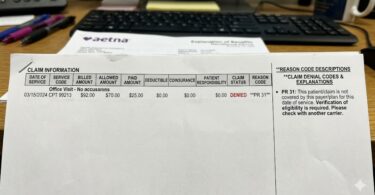
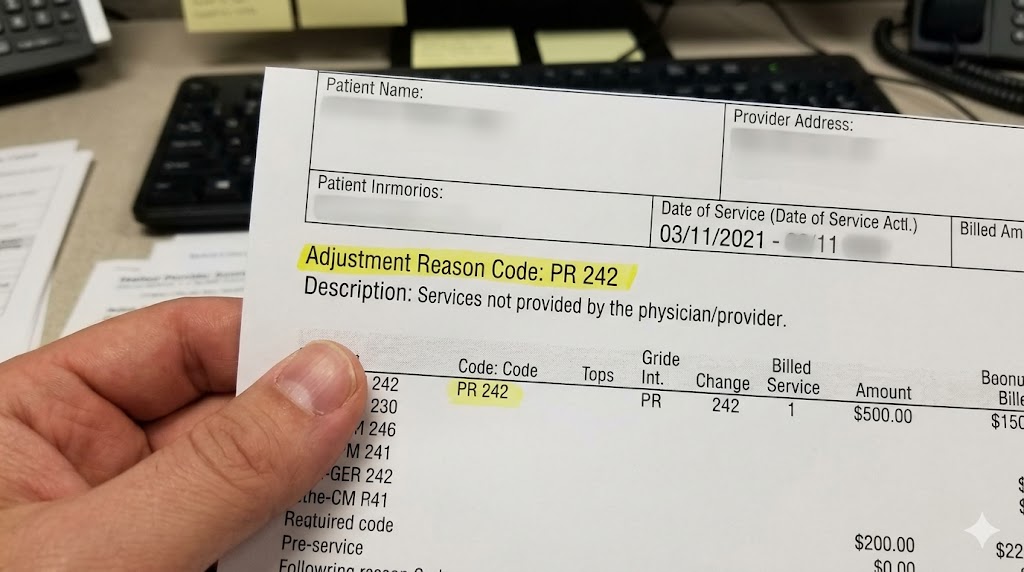
You open the explanation of benefits, review the remittance advice, and there it is. A string of codes that instantly causes a headache: PR 242. The claim you submitted weeks ago has not been paid. The dollars you anticipated are now sitting in a denied claims queue, threatening your practice’s cash flow.
If this scenario feels familiar, take a deep breath. You are far from alone. The PR 242 denial code is a common yet often misunderstood obstacle in medical billing. It belongs to a specific family of denials that have nothing to do with medical necessity or coding errors. Instead, it points directly to a fundamental administrative issue: the provider’s status with the payer.
This guide walks you through every single aspect of this denial. We will explore what it means, why it happens, the financial impact it can have, and most importantly, the concrete steps you must take to overturn it and ensure it never returns. Consider this your definitive resource for mastering the PR 242 denial.
Decoding the Language of Denial Codes
Before we dive into the specifics of the code 242, we must first understand the broader system it operates within. Medical claim denials come with standardized codes designed to explain why a payer did not process a claim as expected. These codes are not random. They follow a strict logic established by the Claim Adjustment Reason Codes (CARC) and Remittance Advice Remark Codes (RARC) systems.
The CARC System: The Foundation
The Claim Adjustment Reason Code, or CARC, is the backbone of any denial. It describes why the payment was adjusted. This could be a full denial, a reduction in payment, or a shift of financial responsibility to the patient. CARCs are grouped into broad categories, each starting with a specific letter that immediately tells you who is financially liable for the adjustment.
- CO (Contractual Obligation): These are the most common adjustments. They represent the difference between the billed amount and the contracted allowed amount. The provider writes this off, and the patient is not liable.
- OA (Other Adjustment): These adjustments are taken by the payer for reasons not specified by CO or PI codes. Again, the patient is not responsible for these amounts.
- PI (Payer Initiated Reductions): These occur when the payer reduces the payment, often during an audit or review. Crucially, the patient can be billed for these amounts if the review finds that the initial payment was excessive.
- PR (Patient Responsibility): This is the category we are focused on today. These codes indicate that the financial liability for the service falls squarely on the patient, not the insurance plan. Common examples include deductibles, coinsurance, non-covered services where a waiver was signed, and, as we will see, a specific type of credentialing gap.
When you see a “PR” at the start of a denial code, your billing team’s immediate next step is to determine if the patient can and should be billed. But when the code is PR 242, rushing to send a patient statement is a catastrophic error.
The Narrative Behind the Numbers
Each code has a brief official description. However, the true meaning often requires reading between the lines. A denial for a deductible (PR 1) is straightforward. A denial for a service deemed experimental (PR 62) can be contested. The PR 242 code is deceptively simple in its wording but complex in its resolution. It tells a story that the payer’s system doesn’t recognize you, the provider, for the service you performed on the date you performed it.
What Exactly is the PR 242 Denial Code?
The official description for PR 242 is direct: “Services not provided by network/primary care physicians.” On the surface, this sounds like the payer believes the patient went outside their network for care. While that is one possible interpretation, the reality is often far more nuanced and concerning for the provider.
In most cases, this denial is not an accusation that you are out-of-network. It is an assertion that, in the payer’s system, you are not a provider at all for the specific date of service in question. The database has a gap. The enrollment has lapsed. The credentialing file is incomplete. The payer’s computer sees a claim from a provider who, according to its digital logic, doesn’t have an active contract to perform that service on that day.
This code means the payer has classified the service as unauthorized or outside the plan’s benefits because the rendering provider’s status could not be verified. The financial liability then shifts to the patient, which is a dangerous position that can damage patient relationships and your practice’s reputation if handled incorrectly.
The Anatomy of a Credentialing Denial
To truly fix a PR 242 denial, you must visualize the process that creates it. Imagine a massive, constantly updating digital ledger at the insurance company. This ledger contains the profile of every contracted provider. Each profile has a “begin date” and an “end date” for every single service line, location, and tax identification number combination they are approved to bill under.
When a claim arrives electronically, the payer’s automated adjudication system performs thousands of checks in milliseconds. It validates the member’s eligibility, checks for duplicate claims, applies medical necessity edits, and, crucially, performs a provider match. The system asks a simple question: “On the date of service from this claim, was the rendering provider at the noted service location an active, participating provider in our network for the submitted service type?”
If the answer is “no” for any reason, the system defaults to a denial. It doesn’t know that your re-credentialing paperwork is sitting in a mailroom. It doesn’t care that there’s a one-day gap between your previous contract’s end date and the new one’s start date. It sees a void, and it generates a PR 242.
Common Scenarios That Trigger This Code
Understanding the specific triggers will help you pinpoint the root cause in your own billing office. The following scenarios represent the vast majority of PR 242 denials.
The Expiring Contract Gap
Your group’s contract had a hard stop on May 31st. The new contract was signed and effective June 1st. However, the payer’s credentialing system took five business days to load the new contract and update the effective date in the provider file. Every claim with a date of service between June 1st and June 5th is denied. The computer sees the old contract as terminated and the new one as not yet active.
The Location Mismatch
A practice opens a new satellite office. The providers are fully credentialed, but the new physical address has not been added to their payer profiles. Claims billed under the new location’s National Provider Identifier (NPI) and service facility address are denied because the system cannot match the provider to that place of service.
The Incomplete Re-credentialing Application
Re-credentialing cycles occur every three years. If the application was missing a signature, an updated attestation, or a copy of a license, the file remains in a “pending” status. When the current credentials expire, the system automatically reverts the provider to a non-participating status, triggering a PR 242 on all subsequent claims.
The Retroactive Termination
A provider leaves a group practice. The practice notifies the payer, and the payer sets a termination date. If a claim is submitted for a service that occurred even a single day after that termination date, the denial is immediate and correct. The provider was no longer associated with that group at that time.
Tax Identification Number (TIN) Confusion
A provider is credentialed under the group’s TIN. A claim is accidentally submitted under the individual provider’s TIN, or vice-versa. The payer’s system cannot link the NPI to the TIN on the claim, so it defaults to seeing the provider as non-contracted.
The Immediate Financial Ripple Effect
A PR 242 denial is not a simple write-off. It is a direct threat to your revenue integrity. When you see a “PR” code, the payer is explicitly stating that the patient is responsible. This puts your billing staff in an immediate ethical and practical dilemma.
The Patient Relationship Paradox
The single most damaging action you can take upon receiving a PR 242 is to automatically generate a patient statement. Imagine a loyal, long-term patient receiving a bill for thousands of dollars for their routine visit. The statement says, “Services not provided by network physician.” The patient panics. They thought they were visiting an in-network doctor. They call your office, confused and sometimes angry. They now question your practice’s professionalism and billing competence.
In almost every instance, a true PR 242 is a practice-side failure, not a patient responsibility. Billing the patient for your credentialing gap is an unfair and often legally risky practice, especially if you have a contract with the payer that holds you harmless for these types of administrative errors. Your focus must be on fixing the root cause and demanding reprocessing from the payer, not on forcing the patient to pay for a systemic error.
Cash Flow Disruption
Beyond the patient relation crisis, there is the simple math of delayed revenue. Consider this table illustrating the cost of a single, month-long delay on a denied claim.
| Stage of Denial | Time Elapsed | Financial Status | Cash Flow Impact |
|---|---|---|---|
| Claim Submission | Day 1-5 | Claim enters system. Revenue is anticipated. | Neutral. A/R is in normal cycle. |
| PR 242 Denial Received | Day 30-45 | Payment is zero. Patient liability is incorrectly stated. | Negative. Anticipated payment is now zero. |
| Internal Discovery & Review | Day 45-60 | Biller pauses to research code meaning. The claim is held. | Severely Negative. No work is done. A/R days begin to climb. |
| Credentialing Verification | Day 60-75 | Biller contacts credentialing department. Discovers a gap in provider file. | Stalled. The problem is identified but not solved. |
| Payer Submission for Resolution | Day 75-90 | A corrected application, updated file request, or appeal is sent to the payer. | Stalled. The claim waits on the payer’s provider data management queue. |
| Provider File Updated by Payer | Day 90-120 | Payer confirms provider is now active. Effective date may or may not be retroactive. | Uncertain. The fix is in place, but the original claim is still denied. |
| Claim Reconsideration/Appeal | Day 120-150 | A formal appeal with proof of retroactive effective date is submitted. | Minimal. The clock resets on a 30-45 day appeal process. |
| Final Adjudication | Day 150-180 | Claim is reprocessed and paid, or a final denial is upheld. | Resolution or write-off. If paid, it’s a full 5-6 months late. |
This table shows a stark reality. A simple credentialing gap that takes 30 days to notice can easily turn into a 180-day delay in payment. For a high-dollar surgical claim, this can be devastating to a practice’s monthly revenue cycle.
Step 1: The Diagnostic Deep Dive — Root Cause Analysis
Before you can appeal, you must become a detective. Accepting the denial at face value is not an option. You need to unearth the exact administrative mismatch that caused the payer’s system to reject the claim. This requires a systematic, three-part investigation that moves from the claim to your internal records, and finally to the payer’s data.
Examine the Claim and the Remittance Advice
Your first clues are right in front of you. Pull the original claim form, either the CMS-1500 or electronic equivalent, and the Remittance Advice (RA) detail. Compare the provider information on both documents line by line.
- Box 24J (Rendering Provider NPI): Confirm the individual provider’s NPI is correct. A single transposed digit is all it takes.
- Box 33 (Billing Provider Info): Check the billing NPI, the tax ID (TIN), and the complete billing address. Does this combination match exactly what the payer has on file for your group contract?
- Box 32 (Service Facility Location): This is a critical field. If the service was performed at a location other than the main billing address, this field must be completed. Is the address exactly the same as what the payer approved for this provider?
- Claim-Level Adjustments: Look at the RA. Are there other denials on the same claim? Sometimes, a primary denial for registration or eligibility can mask a secondary credentialing denial. If the member was ineligible on the date of service, the system might generate a PR 242 for the provider as well, because the entire visit is deemed outside the plan’s coverage.
Conduct an Internal Credentialing Audit
With the claim data in hand, you must now interrogate your own records. This step requires close collaboration with your credentialing or provider enrollment department. You are trying to prove that the provider was, in fact, fully credentialed to provide the service at the specific location on the specific date.
Pull the physical or digital credentialing file. Look for these essential documents:
- The Final Approval Letter: Every payer sends a formal letter when a provider is approved to join the network. This letter states the provider’s name, the group name, and, most importantly, the effective date. This date is your most powerful piece of evidence.
- The Signed Contract: The contract itself will have an effective and termination date. It confirms the legal agreement was in place.
- CAQH ProView Profile: Check the provider’s Council for Affordable Quality Healthcare (CAQH) database profile. Is it attested and up-to-date? Many payers rely on this data. An expired attestation can cause a provider to appear non-credentialed in a payer’s system even if the hard-copy file is complete.
- License and DEA Expiration Dates: A lapsed state medical license or DEA registration is a common, silent killer of active credentialing status. Payers run monthly checks. If your license expired last month and you renewed it this week, there was a gap that triggered a system-wide hold on your provider file.
Cross-Reference with the Payer’s Provider Portal
Your final investigative step is to see what the payer sees. Do not call the provider services line yet. First, log into the payer’s online provider portal.
Search for the provider using the exact NPI and TIN from the denied claim. Look at the provider’s directory profile. Does it show them as “Accepting New Patients”? Is the service location address listed accurately? Some payers will display the effective date. If the portal shows the provider as “Not In-Network” or if the address is missing, you have found the precise point of failure. Take a screenshot. This is evidence that the payer’s own system confirms the mismatch, and it will be a powerful attachment for your later appeal.
Important Note for Billing Managers: Train your team not to skip this portal-check step. A five-minute portal review can save hours of hold time on the phone and provide a clear, undeniable target for your resolution process.
The Strategic Path to Resolution: A Tiered Approach
With the root cause identified, you can now move from diagnosis to treatment. The resolution strategy for a PR 242 denial is not a single path. It must be chosen based on whether the denial was erroneous or whether a legitimate credentialing gap existed.
Tier 1: Fixing an Erroneous Denial (The Clean Case)
This is the scenario where you have the payer’s approval letter showing an effective date of January 1st, and your claim has a date of service of March 15th, yet you still received the denial. The payer’s system simply did not process the provider file update correctly.
In this case, you are not asking for a favor or an exception. You are demanding correction of a pure administrative error. A standard claim reconsideration request is often insufficient for this type of systemic error. You need to push for a direct provider data file update and subsequent claim reprocessing.
Your Action Plan for a Clean Case:
- Prepare a Reconsideration Packet: This packet must include a cover letter, a copy of the original claim, the remittance advice showing the denial, and the definitive proof of credentialing.
- Craft a Laser-Focused Cover Letter: The letter must be polite but firm. State clearly: “This claim was denied with code PR 242 for a credentialing mismatch. However, the attached approval letter from [Payer Name], dated [Date on Letter], confirms that [Provider Name] (NPI: [Number]) was an in-network participating provider for the [Group Name] (TIN: [Number]) with an effective date of [Effective Date]. The date of service on the claim is [Date], which falls well after the confirmed effective date. This denial was made in error due to a data loading failure in [Payer Name]’s provider file. Please correct the provider file to reflect the correct effective date and reprocess the attached claim for immediate payment.”
- Send Via a Traceable Method: Always use certified mail or a fax with a confirmed transmission report. An electronic appeal through the portal is acceptable if it allows for the attachment of detailed supporting documents. Keep a copy of everything you send.
Tier 2: Resolving a True Credentialing Gap
This is the more delicate and challenging scenario. Your internal audit reveals a mistake. The credentialing application was indeed stuck in processing, or the re-credentialing was completed one week late, creating a gap between the old contract’s end date and the new one’s start date. You are at fault, but the goal is to have the payer grant a retroactive effective date to cover the denied services.
This request is an appeal for an exception. Your success depends on your ability to demonstrate that the error was administrative, the provider was otherwise in good standing, and the services were medically necessary.
Your Action Plan for a Credentialing Gap:
- Acknowledge and Explain the Gap: Do not be defensive, but state the facts clearly. “Our internal review identified that a processing delay during our re-credentialing cycle led to a three-day gap in [Provider Name]’s active status from [Gap Start Date] to [Gap End Date]. The attached documentation confirms that the complete and correct re-credentialing application was received by [Payer Name] on [Date], 45 days before the contract expiration.”
- Argue for a Retroactive Effective Date: This is the central request. “We respectfully request that the effective date of the new contract be backdated to [Gap Start Date] to eliminate this administrative gap. The provider was actively treating patients under the good-faith assumption that the credentialing process was proceeding normally. Disruption of care and financial liability for our mutual patients is an avoidable outcome.”
- Provide a “Clean Bill of Health” Evidence: Support your request by proving the provider was fully qualified and without any quality issues during the gap period. Include proof of continuous, unbroken liability insurance coverage during the gap dates. Include the renewed, unencumbered state medical license. Include a letter from the medical director or practice administrator, on letterhead, explaining the administrative nature of the delay.
- Leverage Continuity of Care Provisions: Many state laws and payer contracts have continuity of care rules. If the patient was in an active course of treatment with the provider before the gap, you have an even stronger case. Frame your appeal around the disruption of patient care. “Denying coverage for this established patient, who was in an active post-operative period, creates an undue burden on the patient and contravenes continuity of care standards.”
The Art of the Effective Appeal Letter
A template appeal letter will fail. Your letter must be a custom-built argument for your specific case. A powerful appeal letter for a PR 242 denial does more than just state facts; it guides the reviewer to the inescapable conclusion that payment must be made.
Below is a comparative table that contrasts the elements of a weak, generic appeal letter with those of a strong, authoritative one that gets results.
The strong practice letter operates from a position of irrefutable truth. It tells the payer, “Your own document proves you wrong.” This shifts the entire dynamic of the conversation.
Navigating the Maze of Payer-Specific Variances
While the CARC system is standardized, the internal workflows for resolving these denials are anything but. A strategy that works perfectly for one payer will fail entirely with another. Understanding the cultural and procedural nuances of the major payers is essential for a high-performing revenue cycle team.
Government Payers: Medicare and Medicaid
Medicare and Medicaid will not entertain the concept of a “gap” and retroactive fixes in the same way a commercial payer might. Their systems are driven by strict regulatory deadlines.
Medicare: For a PR 242 equivalent from Medicare, you must determine if the denial is due to an enrollment lapse in the Provider Enrollment, Chain, and Ownership System (PECOS). Medicare Administrative Contractors (MACs) have very limited authority to grant retroactive effective dates unless a very specific statutory exception is met, such as a documented natural disaster that prevented a timely filing or a proven, systemic error on the part of a MAC. A simple administrative oversight by your credentialing team will almost never be approved. You will likely have to resubmit the claim after the enrollment becomes effective, and that first claim will remain denied. The financial loss is permanent.
Medicaid: Each state’s Medicaid program manages its own provider enrollment. Some states are more lenient than Medicare. It is not uncommon for a state to grant a retroactive enrollment date of up to 90 days, especially for critical-access providers or if the delay was demonstrably on the state’s side. You must carefully review your specific state’s provider enrollment manual, which will clearly outline the rules for retroactivity. Calling your state’s provider enrollment phone line is often a more direct route to a resolution than submitting a formal paper appeal.
Commercial Payers: The Big Five
UnitedHealthcare (UHC): UHC’s reliance on their Optum ID for provider management is key. A mismatch between the NPI/TIN and the Optum ID configuration is a classic UHC-specific trigger. Resolution often involves a ticket directly with the Optum Provider Data Management team rather than a standard claim appeal. UHC is generally reasonable with retroactive effective dates for administrative delays if you can provide evidence that a clean application was submitted before the gap.
Anthem Blue Cross Blue Shield: Anthem, like other BCBS plans, operates through local plans. A PR 242 denial from an Anthem plan in California can mean something completely different from one in New York. The local plan’s provider data system is the absolute authority. Your resolution path is always through the local plan’s provider relations department, not the Anthem national appeal address.
Aetna: Aetna’s provider data management is known for its complexity, especially for large provider groups with hundreds of locations. The most common trigger is a service location address that does not perfectly match the “directory-ready” address in their system. An address that says “Suite 200” on the claim but “Ste 200” in their system can fail a digital match. This is a pure data integrity issue. Your appeal must explicitly point out and request a correction of the address formatting.
Cigna: Cigna often uses CAQH as its primary source of truth. If a provider’s CAQH profile expired, Cigna’s system may have automatically set their status to non-participating. The fix is not an appeal to Cigna directly at first. The fix is to re-attest the CAQH profile immediately. Once re-attested, you must then request that Cigna re-sync with the CAQH database to pull in the updated, active profile. This should then allow a claim reconsideration request to be successful.
Humana: Humana’s process is often simpler but can be more rigid with retroactive dates. They heavily rely on their online provider portal, Availity. Filing a “Provider Data Dispute” through Availity is often more effective for resolving a systemic PR 242 issue than a medical claim appeal.
Proactive Prevention: Building a Denial-Proof Enrollment Process
The highest-value strategy for a PR 242 denial is to make it impossible for the denial to occur in the first place. This requires building a proactive, technology-driven credentialing and enrollment workflow that identifies and eliminates gaps before a claim is ever generated.
A 120-Day Proactive Credentialing Calendar
Waiting until a contract expires to begin re-credentialing is a guaranteed path to denials. You must build a rolling 120-day calendar that anticipates every critical date for every provider in your practice. This is not a job for a simple spreadsheet; it demands a dedicated credentialing database or software.
- 120 Days Out: Begin the re-credentialing process. Pull the full application. Identify any new requirements the payer has added since the last cycle. Check the expiration dates on the provider’s state license, DEA certificate, board certification, and professional liability insurance policy. If any of these will expire within the new contract period, flag them for immediate action.
- 90 Days Out: Submit the complete, signed application to the payer. This is a hard deadline. Every day less than 90 days significantly increases your risk of a processing delay that creates a gap. Send the application via a trackable method and log the delivery date.
- 60 Days Out: Begin active follow-up. Call the payer’s provider enrollment department. Do not just ask if it was “received.” Ask a specific question: “Can you confirm the application is complete and has moved past the initial review phase?” Identify any deficiencies now, while you still have time to correct them.
- 45 Days Out: This is a critical intervention point. If the application is still “in processing” or you cannot get a clear status, escalate immediately. Contact your provider relations representative. Be professionally firm. Explain the risk of a gap that could disrupt care for thousands of patients. This is the moment to create an internal case number and document every communication with the payer.
- 30 Days Out: An emergency planning phase begins. If the new contract is not yet finalized and in the system, you must assume a gap is imminent. Create a “Gap Hold” report for the billing team. This report lists every provider whose contract is expiring in the next 30 days without a confirmed replacement. The billing team must hold all claims with service dates after the expiration date.
- 1 Day Out: If a gap exists, no claims are submitted. The billing team generates a separate “Gap Claims” work queue. These claims are held, fully coded and ready, until the day the credentialing team provides an updated effective date.
The Billing Office “Mid-Cycle Audit”
You do not need to wait for a denial to discover a provider data error. Your billing team should perform a proactive audit on a monthly basis. Select a random sample of ten claims from each provider. Before submitting them, log into the payer’s portal and manually verify that the provider’s network status is active for the selected dates of service and service location. This simple, 15-minute check can catch a systemic data mismatch that would otherwise result in hundreds of denials a month later.
Technology and Data Integrity
The root cause of many PR 242 denials is often a single character out of place. A relentless focus on data integrity is not meticulous; it is financially essential.
- Single Source of Truth: Your practice management system must be the single, authoritative source of truth for every provider’s demographic data. When a new license is issued or a new TIN is assigned, it is updated here first, and all other systems (EHR, clearinghouse) are then updated from this master record.
- Address Standardization: Use address standardization tools to ensure that every location address in your system follows the United States Postal Service format exactly. A suite number that reads “Ste 200” in your system but “Suite 200” in the payer’s system can be a multi-million dollar difference over the life of a contract.
- Payer Portal Automation: Emerging software can automatically log into payer portals and verify provider statuses on a weekly basis, flagging any change or “not found” status for immediate review. This eliminates the human labor and inconsistency of manual checks.
Frequently Asked Questions about the PR 242 Denial Code
1. Can I legally bill the patient for a PR 242 denial?
In almost all cases, you should not and often cannot. Your contract with the payer usually includes a hold harmless clause that protects the patient from financial liability caused by administrative errors between the practice and the payer. Billing the patient for your own credentialing lapse is a breach of contract and can subject you to serious sanctions from the payer, including termination from the network.
2. What is the single most common cause of a PR 242 denial?
A gap in the credentialing effective date. This occurs when a provider’s old contract expires before the new contract’s effective date is loaded into the payer’s system, even if the gap is only a single day. The second most common cause is a mismatch between the service location address on the claim and the address the payer has on file for that provider.
3. Is PR 242 always a provider-side error?
No. A significant percentage of these denials are caused by payer-side data entry errors or system loading failures. You may have a signed, fully executed contract with an effective date of January 1st, but a payer’s internal processing team failed to enter that date correctly into their claims adjudication system. The “Clean Case” resolution strategy above is designed for this exact situation.
4. How long does it typically take to resolve a PR 242 denial?
The timeline can range from two weeks to over six months. A simple erroneous denial with a clear approval letter can often be resolved through a reconsideration request in 30-45 days. A true credentialing gap requiring a request for a retroactive effective date, especially with a government payer, is a complex negotiation that can take 90 days or longer and still may not be successful.
5. Is this denial code used for out-of-network dentists and other non-physician providers?
Yes. While our examples often reference physicians, the PR 242 code is applicable to any provider type. Dentists, physical therapists, licensed clinical social workers, and durable medical equipment suppliers can all receive this code. The root cause and resolution strategies are the same, although the payer’s credentialing arm and terminology may differ (e.g., the CAQH ProView for Dentists database).
A Lasting Resolution
The journey through a PR 242 denial is a diagnostic exercise that reveals the true health of your practice’s administrative infrastructure. It forces a reconciliation between the clinical work you perform and the digital profiles that payers use to authorize payment. The code is not an end point; it is a signal demanding a response.
Mastering the response to PR 242 means methodically proving the validity of a provider’s status on a specific date. It requires shifting the team’s mindset from reactive billing to proactive provider data management, where a 120-day calendar and mid-cycle portal audits are not optional extras but standard operating procedure. Ultimately, a practice that permanently resolves its PR 242 denials is one that has built an unassailable bridge between the care it delivers and the administrative system that pays for it, ensuring that the focus can return to the patient, where it belongs.
Additional Resources
For official regulatory guidance and a complete listing of all CARC codes, please reference the Washington Publishing Company, the authorized publisher for the national standard code sets:
http://www.wpc-edi.com/reference/