If you have ever found yourself staring at a billing sheet, wondering which five-digit code unlocks the payment for a shoulder injection or a knee aspiration, you are not alone. Musculoskeletal (MSK) ultrasound is one of the most dynamic tools in modern medicine. It allows us to see tendons tear, fluid accumulate, and needles glide precisely into joints without radiation.
But the coding behind it? That can feel like a maze.
Whether you are a seasoned orthopedist, a physical therapist venturing into point-of-care ultrasound, or a medical coder trying to keep your denial rate low, understanding the correct cpt code for musculoskeletal ultrasound is essential. Using the wrong code doesn’t just delay payment; it can trigger audits and create compliance headaches.
In this guide, we are going to break down everything you need to know. We will move beyond the jargon and look at the real-world scenarios you face every day. We will cover diagnostic imaging, ultrasound-guided injections, and the specific nuances that separate a payable claim from a rejected one.
Let us get started.
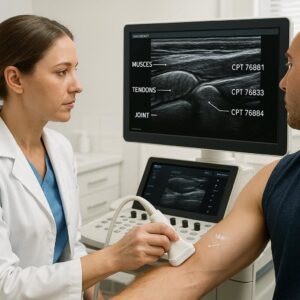
CPT Codes for Musculoskeletal Ultrasound
Understanding the Basics of MSK Ultrasound Coding
Before we dive into the specific numbers, it is crucial to understand how the Current Procedural Terminology (CPT) framework views musculoskeletal ultrasound. The American Medical Association (AMA) organizes these codes into two distinct categories.
The first category is diagnostic ultrasound. This is when you are using the ultrasound machine to look at a structure—like a rotator cuff or a meniscus—to determine what is wrong. The second category is ultrasound guidance. This is when you use the ultrasound to guide a needle for an injection, aspiration, or biopsy.
Mixing these two up is the most common mistake we see in billing departments. You cannot bill for a diagnostic exam just because you looked at the screen while doing an injection. The rules are strict, but they are logical once you understand the intent behind the code.
Diagnostic vs. Guided: Why the Distinction Matters
Imagine you are treating a patient with chronic knee pain. You perform a diagnostic ultrasound to check for a Baker’s cyst and fluid in the suprapatellar pouch. You identify the fluid, and then you decide to drain it. In this scenario, you have two separate services: the diagnostic look and the therapeutic procedure.
However, if you walk into the room intending to drain the knee, and you simply use the ultrasound to see where the fluid is to guide your needle, that is a different story. You are not performing a comprehensive diagnostic examination; you are performing a procedure with guidance.
Payers, including Medicare and commercial insurance, view these as distinct events. The cpt code for musculoskeletal ultrasound used in the first scenario (diagnostic) is reported with one set of codes, while the guidance for the injection uses a completely different set of add-on or primary codes.
The Core Diagnostic Codes: Complete and Limited Exams
When we talk about diagnostic MSK ultrasound, we are usually looking at codes 76881 through 76882. These are the workhorses of the imaging world. They describe ultrasound examinations of the extremities and joints.
The distinction here is largely based on the comprehensiveness of the exam.
Code 76881: The Complete Exam
CPT 76881 is defined as a complete ultrasound examination of the extremity or joint. This code is used when you perform a thorough evaluation of all the relevant anatomy in a specific area.
To bill for 76881, you typically need to evaluate:
-
The joint or soft tissue structure.
-
The surrounding musculature.
-
The tendons and ligaments.
-
The neurovascular structures (if applicable).
-
The bony surfaces.
A complete exam requires documentation that you looked at the area comprehensively. For example, if a patient comes in with generalized shoulder pain and you scan the biceps tendon, rotator cuff (supraspinatus, infraspinatus, subscapularis), subacromial-subdeltoid bursa, and the glenohumeral joint, you are performing a complete exam. It is a time-intensive process that requires a detailed report.
Code 76882: The Limited Exam
CPT 76882 is the code for a limited ultrasound examination of the extremity or joint. This is used when your focus is on a specific, localized structure.
You would use this code when:
-
You are following up on a known finding (e.g., checking a known Baker’s cyst).
-
The clinical question is focused on a single structure (e.g., “Is the Achilles tendon torn?”).
-
You are performing a focused assessment to guide a decision.
The key here is documentation. If you only scan the Achilles tendon and the retrocalcaneal bursa, and you do not look at the rest of the ankle or foot, 76882 is the appropriate choice. It requires less time and less comprehensive reporting, but it still requires a formal interpretation and report.
Comparison Table: 76881 vs. 76882
| Feature | 76881 (Complete) | 76882 (Limited) |
|---|---|---|
| Scope | Comprehensive evaluation of joint/extremity | Focused evaluation of specific structure(s) |
| Documentation | Detailed report covering all anatomical components | Report focused on the targeted anatomy |
| Clinical Use | New patient, unknown etiology, generalized pain | Known pathology, focal pain, follow-up |
| Reimbursement | Higher relative value units (RVUs) | Lower relative value units (RVUs) |
| Typical Time | 20-30 minutes | 10-15 minutes |
Important Note: You cannot bill both 76881 and 76882 for the same extremity on the same day unless the limited exam is for a separate, distinct structure that is not part of the complete exam’s anatomical area. If you do a complete knee and then look at the ankle, you might bill a complete knee and a limited ankle. But if you do a complete knee, you cannot also bill a limited knee.
Ultrasound Guidance for Procedures
This is where things get a little more complex, but also where many practices generate significant revenue. When you use ultrasound to guide a needle, you are ensuring precision, safety, and efficacy.
The primary codes here are 76942 and the newer codes 76881 to 76882? No, sorry, that is a common confusion. Actually, for guidance, we look at 76942 and the more recent codes introduced for image guidance.
Wait, let’s clarify this properly. For many years, 76942 was the standard for ultrasonic guidance for needle placement. However, the AMA has introduced more specific codes to differentiate between soft tissue and joint aspirations/injections.
The Standard: 76942
CPT 76942 is the code for “Ultrasonic guidance for needle placement (e.g., biopsy, aspiration, injection, localization device), imaging supervision and interpretation.”
This is an add-on code. It is always reported in addition to the primary procedure code (the injection or aspiration itself). You cannot bill 76942 alone.
When you use 76942, you are billing for the use of the ultrasound to see the needle enter the target. The key requirement here is documentation of real-time visualization. You must document that you visualized the needle passing through the tissues and reaching the target (e.g., the joint space, the cyst, the tendon sheath) in real-time.
The Nuance: 76881/76882 for Guidance?
There is a persistent myth in the coding world that you can use 76881 or 76882 for guidance if you “look first.” This is generally incorrect.
If the primary purpose of the encounter is the injection, and you use ultrasound only to guide the needle, you use 76942. You do not use a diagnostic code.
However, if the patient presents for a diagnostic evaluation, and based on that diagnostic evaluation you decide to perform an injection, you can bill the diagnostic code (76881 or 76882) plus the injection code plus 76942, provided the documentation clearly separates the diagnostic portion from the procedural guidance portion.
“The distinction lies in the intent and documentation. If the ultrasound is performed to diagnose a pathology, it is diagnostic. If it is performed to place a needle, it is guidance. They are separate services when performed together with separate documentation.” – American College of Radiology (ACR) Coding Source
Common Procedure Codes Paired with MSK Ultrasound
The cpt code for musculoskeletal ultrasound guidance (76942) is rarely alone. It is a supporting actor to a main procedure code. Here are the most common primary procedure codes you will see paired with 76942.
Joint Injections and Aspirations
These codes are typically based on the location of the joint. They are often bundled with 76942.
-
20610: Arthrocentesis, aspiration and/or injection; major joint or bursa (e.g., shoulder, hip, knee, subacromial bursa).
-
20605: Arthrocentesis, aspiration and/or injection; intermediate joint or bursa (e.g., wrist, elbow, ankle, olecranon bursa).
-
20600: Arthrocentesis, aspiration and/or injection; small joint or bursa (e.g., fingers, toes).
When you perform an ultrasound-guided shoulder injection (a major joint), you would bill 20610 for the injection and 76942 for the guidance.
Tendon Sheath and Ligament Injections
Not every injection goes into a joint. Sometimes we need to inject a tendon sheath, a ganglion cyst, or a ligament.
-
20550: Injection(s); single tendon sheath, or ligament, aponeurosis (e.g., plantar fasciia).
-
20551: Injection(s); single tendon origin/insertion.
If you use ultrasound to guide a needle into the sheath of the long head of the biceps tendon, you would report 20551 (if it is the origin/insertion) or 20550 (if it is the sheath) along with 76942.
Biopsies and Aspirations of Fluid Collections
Sometimes the goal is to take tissue or fluid out, rather than put medicine in.
-
20206: Biopsy, muscle, percutaneous needle.
-
10160: Puncture aspiration of abscess, hematoma, bulla, or cyst.
If you drain a large baker’s cyst using ultrasound guidance, you might use 10160 with 76942, assuming the cyst is not within a joint capsule.
Bilateral Procedures and Multiple Injections
One of the trickiest areas involves billing for bilateral procedures or multiple injections during the same visit.
Bilateral Services
If you perform an ultrasound-guided injection on both shoulders on the same day, you cannot simply bill 20610 twice. Medicare and most insurers have specific rules for bilateral procedures.
Typically, you will use modifier 50 (Bilateral Procedure) on the primary procedure code. For the guidance, you will need to decide if the guidance was separate. You usually bill 76942 with a modifier 59 (Distinct Procedural Service) or XS (Separate Structure) to indicate that the guidance for the left side was distinct from the guidance for the right side.
Multiple Injections in the Same Region
What if you inject the subacromial bursa and the glenohumeral joint in the same shoulder during one visit? This is a common practice for conditions like frozen shoulder.
In this case, you cannot bill two units of 20610 for the same shoulder. The Correct Coding Initiative (CCI) edits prevent this. You typically bill one unit of 20610, as it is considered a single surgical field. For the guidance, you also bill only one unit of 76942, as the ultrasound guidance covered the entire procedure.
Anatomy-Specific Coding Considerations
The human body is not uniform, and neither are the coding rules. Certain anatomical areas have unique coding considerations that every provider should know.
The Elbow and Wrist
Coding for the elbow and wrist can be ambiguous. Is the elbow a major joint? According to CPT, the elbow is considered an intermediate joint (20605). The wrist is also intermediate.
However, if you are injecting the biceps tendon at the elbow, you are moving from a joint code to a tendon code (20551). Always double-check the primary target of your injection.
The Foot and Ankle
The ankle is an intermediate joint. The foot, however, is a collection of small joints (tarsals, metatarsals, phalanges). If you are injecting the ankle joint itself, use 20605. If you are injecting the first metatarsophalangeal joint (big toe), use 20600.
When using ultrasound for plantar fasciitis, you are usually billing 20550 for the plantar fascia (ligament) along with 76942. It is rarely a joint injection.
The Spine
Ultrasound is less common for deep spinal structures due to bony interference, but it is used for facet joints, sacroiliac joints, and epidural spaces in some practices.
Spinal injections (e.g., epidural, facet) have their own set of CPT codes (62320-62327, 64490-64495). Ultrasound guidance for these is not typically billed with 76942. Instead, you use 77002 (Fluoroscopic guidance) or 76942 depending on the payer and the specific procedure. Many payers consider ultrasound guidance for epidurals unproven and may deny it. Always check your local coverage determinations (LCDs).
Documentation Requirements for Compliance
You can pick the perfect cpt code for musculoskeletal ultrasound, but if your documentation is weak, your claim will fail. Auditors love ultrasound coding because it is often poorly documented.
To support your codes, your medical record must contain specific elements.
Required Elements for Diagnostic Codes (76881/76882)
-
Indication: A clear medical necessity statement (e.g., “Rule out rotator cuff tear”).
-
Technique: A description of the ultrasound machine used and the technique (e.g., “Linear array transducer, 12 MHz”).
-
Description of Findings: A detailed description of the structures evaluated. For 76881, this must be comprehensive.
-
Images: At least two representative images from each structure evaluated. These must be stored in the patient’s record.
-
Interpretation: A clear impression or diagnosis based on the findings.
-
Signature: The interpreting provider’s signature.
Required Elements for Guidance Codes (76942)
-
Medical Necessity: Why was guidance needed? (e.g., “Patient with large body habitus,” “Complex anatomy,” “Prior failed blind injection”).
-
Real-Time Visualization: A statement confirming that the needle was visualized in real-time.
-
Target: What was the target? (e.g., “Subacromial bursa,” “Glenohumeral joint”).
-
Localization: Confirmation that the needle tip reached the target before injection or aspiration.
-
Images: Images documenting the needle path and final needle placement.
Pro Tip: Use a template. Having a structured report template for both diagnostic and guided procedures ensures that your clinicians don’t forget to document these critical elements. An audit without proper imaging or documentation is a guaranteed payback situation.
Modifiers: The Key to Clean Claims
Modifiers are two-digit codes appended to CPT codes to tell the payer that something about the service was altered but not changed in its definition. In MSK ultrasound, modifiers are essential.
Modifier 59 and X{EPSU}
Modifier 59 (Distinct Procedural Service) is the most used—and most abused—modifier in coding. Because ultrasound guidance (76942) is an add-on code, it doesn’t usually need a modifier. However, when you perform multiple guided procedures in different anatomical areas, you need to show the guidance is distinct.
To avoid audits, use the more specific X modifiers:
-
XE: Separate encounter.
-
XS: Separate structure. (Most common for MSK: left vs. right, or tendon vs. joint in different regions).
-
XP: Separate practitioner.
-
XU: Unusual non-overlapping service.
If you do a guided injection on the left shoulder (20610, 76942) and a guided injection on the right knee (20610, 76942), you would append modifier XS (or 59) to the second set of codes to indicate they are separate structures.
Modifier 26 (Professional Component) and TC (Technical Component)
In facility settings (hospitals, ambulatory surgery centers), the technical component (use of equipment, tech time) and professional component (physician interpretation) are often split.
-
Modifier TC: Technical Component. Billed by the facility.
-
Modifier 26: Professional Component. Billed by the physician.
If you are a physician performing a diagnostic ultrasound in your office, you bill the global code (no modifier). If you perform it in a hospital, you typically bill the professional component only (76881-26).
Payer-Specific Variations
While CPT codes are universal, coverage is not. Just because a code exists does not mean every insurance company will pay for it.
Medicare
Medicare has strict Local Coverage Determinations (LCDs) for musculoskeletal ultrasound. They generally require specific documentation regarding the medical necessity of the procedure. For ultrasound guidance, Medicare often requires that the procedure is not typically performed blindly (e.g., hip injections are often covered, while knee injections may be scrutinized unless there is a specific reason).
Always check your local MAC’s LCD before performing a high volume of ultrasound-guided procedures. Some MACs require specific diagnosis codes to be linked to 76942.
Commercial Payers
Blue Cross Blue Shield, Aetna, Cigna, and UnitedHealthcare often follow Medicare guidelines but may have their own nuances.
-
Pre-authorization: Some payers require prior authorization for diagnostic musculoskeletal ultrasound, especially if it is performed in a hospital outpatient department.
-
Bundling: Some commercial payers bundle 76942 into the primary procedure code, meaning they will not pay extra for the guidance. You must know your contracts.
Reimbursement Rates and RVUs
While we cannot provide specific dollar amounts as they vary wildly by region and payer, understanding Relative Value Units (RVUs) helps you understand the work involved.
-
76881 (Complete): Approximately 0.80–1.20 wRVUs (work RVUs). This reflects the higher skill and time required.
-
76882 (Limited): Approximately 0.50–0.70 wRVUs.
-
76942 (Guidance): Approximately 0.40–0.50 wRVUs. It is an add-on, so it is generally 50-70% of the value of the primary procedure.
When combined, a guided injection (20610 + 76942) yields significantly higher reimbursement than a blind injection (20610 alone), justifying the investment in the equipment and the time required to perform the guidance.
Common Coding Errors and How to Avoid Them
Even experienced coders make mistakes. Here are the most frequent errors we see in MSK ultrasound billing.
1. Billing Diagnostic and Guidance Together Without Proper Separation
This is the number one error. You cannot perform a diagnostic ultrasound and then use that same ultrasound session to guide an injection and bill for both without distinct separation.
How to avoid: If you perform both, you must document a break in the service. Document the diagnostic exam. Save those images. Document the findings. Then, document the decision to inject. Then, document a new consent if necessary. Then, document the guided injection with separate images. If it is a continuous stream of activity, auditors will consider the diagnostic portion as part of the guidance.
2. Using 76942 for a Diagnostic Scan
You cannot use 76942 just because you looked at the screen. 76942 requires needle placement. If you are simply scanning to diagnose a tear, use 76881 or 76882.
3. Incomplete Documentation
If your report does not list the structures evaluated, you cannot bill 76881. If you bill 76881 and only listed the supraspinatus tendon, you will fail an audit. Always ensure the documentation matches the code.
4. Unbundling with CCI Edits
The Correct Coding Initiative (CCI) lists pairs of codes that cannot be billed together unless a modifier is used. Some codes are mutually exclusive. For example, you generally cannot bill a diagnostic ultrasound of the same area on the same day as a guided injection without a modifier, as the diagnostic is considered part of the pre-procedure workup.
The Future of MSK Ultrasound Coding
The world of ultrasound is evolving rapidly. With the rise of point-of-care ultrasound (POCUS) and the expansion of musculoskeletal ultrasound into physical therapy and primary care, coding is under constant review.
We are likely to see more specific codes for soft tissue versus joint guidance in the future. There is also a push for more accurate coding for ultrasound-guided tenotomy, fasciotomy, and other minimally invasive procedures.
Staying educated is the only way to keep your practice compliant. The cpt code for musculoskeletal ultrasound you use today may be updated in the next AMA CPT edition, so subscribing to coding updates is highly recommended.
Additional Resources for Coders and Clinicians
Navigating coding complexities is easier with the right tools. Here are some resources to keep on your desk.
-
American Medical Association (AMA) CPT® Professional Edition: The primary source. Do not rely on online summaries; verify the code language in the official book.
-
American College of Radiology (ACR) Coding Source: Offers excellent specialty-specific guidance and quarterly updates.
-
American Institute of Ultrasound in Medicine (AIUM): Provides practice guidelines and documentation templates.
-
Local Coverage Determinations (LCDs): Search for your Medicare Administrative Contractor’s (MAC) website. Type in “Ultrasound, Musculoskeletal” to see exactly what they require for coverage.
Conclusion
Mastering the cpt code for musculoskeletal ultrasound is about more than just picking a number from a list. It is about understanding the story behind the procedure. Was the exam complete or limited? Was the ultrasound used to diagnose or to guide a needle? The answers to these questions dictate your coding path.
By distinguishing between diagnostic codes like 76881 and 76882, and guidance codes like 76942, and by pairing them correctly with primary procedure codes and modifiers, you can ensure your practice is paid accurately and remains compliant. Remember that solid documentation is your best defense in an audit. When the clinical picture and the coding align, everyone wins—the provider, the payer, and most importantly, the patient.
Frequently Asked Questions (FAQ)
1. Can I bill a diagnostic ultrasound (76881) and an ultrasound-guided injection (76942) on the same day?
Yes, but only if the diagnostic ultrasound was performed for a distinct reason and documented separately from the guidance. You must have a clear break in the service and separate documentation for the diagnostic interpretation. If the ultrasound is solely for needle placement, you should only bill the guidance code.
2. What is the difference between 76882 and 76942?
CPT 76882 is a diagnostic code for a limited examination of a structure. CPT 76942 is a guidance code for needle placement. You use 76882 when you are looking at anatomy to find a problem. You use 76942 when you are looking at anatomy to place a needle.
3. Do I need a separate consent form for ultrasound guidance?
While not always a billing requirement, it is a best practice to obtain separate informed consent for the use of ultrasound guidance, especially for invasive procedures. Documentation of the discussion regarding the risks and benefits of image guidance strengthens your medical record.
4. How do I bill for ultrasound-guided injections in both knees?
You would bill the primary injection code (20610) twice. On one line, use modifier 50 (bilateral) or use two lines with modifier LT (Left) and RT (Right) depending on payer preference. For the guidance (76942), you would bill two units, typically appending modifier XS (Separate Structure) to one of the lines to indicate the services were performed on distinct, separate anatomical sites.
5. Does Medicare pay for ultrasound guidance for trigger finger injections?
Medicare often considers trigger finger (stenosing tenosynovitis) injections to be easily performed without imaging. Unless there is a complicating factor documented (e.g., prior surgery, aberrant anatomy, failed blind injection), Medicare may deny 76942 for this indication. You should check your specific MAC’s LCD for trigger finger and ultrasound guidance.
Additional Resource
For the most up-to-date official coding guidelines, always refer to the American Medical Association (AMA) CPT® Code Set. You can find the official CPT® manual and coding resources directly on their website.