If you work in pediatric immunization, you have likely encountered the challenge of correctly coding for combination vaccines.
Vaxelis is a relatively new player in the childhood immunization space. It is a hexavalent vaccine. That means it protects against six different diseases in a single shot.
But with great convenience comes a common question for billers and coders.
What is the correct Vaxelis CPT code?
You might look for a unique, dedicated code. However, the world of vaccine administration does not always work that way. In this guide, we will walk you through exactly which code to use, how to avoid claim denials, and why documentation matters.
We will keep everything simple, clear, and friendly.
What Exactly Is Vaxelis?
Before we jump into the numbers, let us quickly recap what Vaxelis is.
Vaxelis is a combination vaccine approved for children from 6 weeks through 4 years of age. It helps protect against:
- Diphtheria
- Tetanus
- Pertussis (whooping cough)
- Poliomyelitis (polio)
- Hepatitis B
- Invasive disease caused by Haemophilus influenzae type b (Hib)
That is six vaccines in one injection.
This combination reduces the number of shots a child receives. That means less discomfort and fewer office visits.
From a billing perspective, however, combination vaccines create a unique challenge. Do you bill for each component separately? Or do you use one master code?
The Correct CPT Code for Vaxelis
Here is the direct answer you came for.
There is no single, standalone CPT code named “Vaxelis” in the CPT manual.
Instead, Vaxelis uses an existing combination vaccine code.
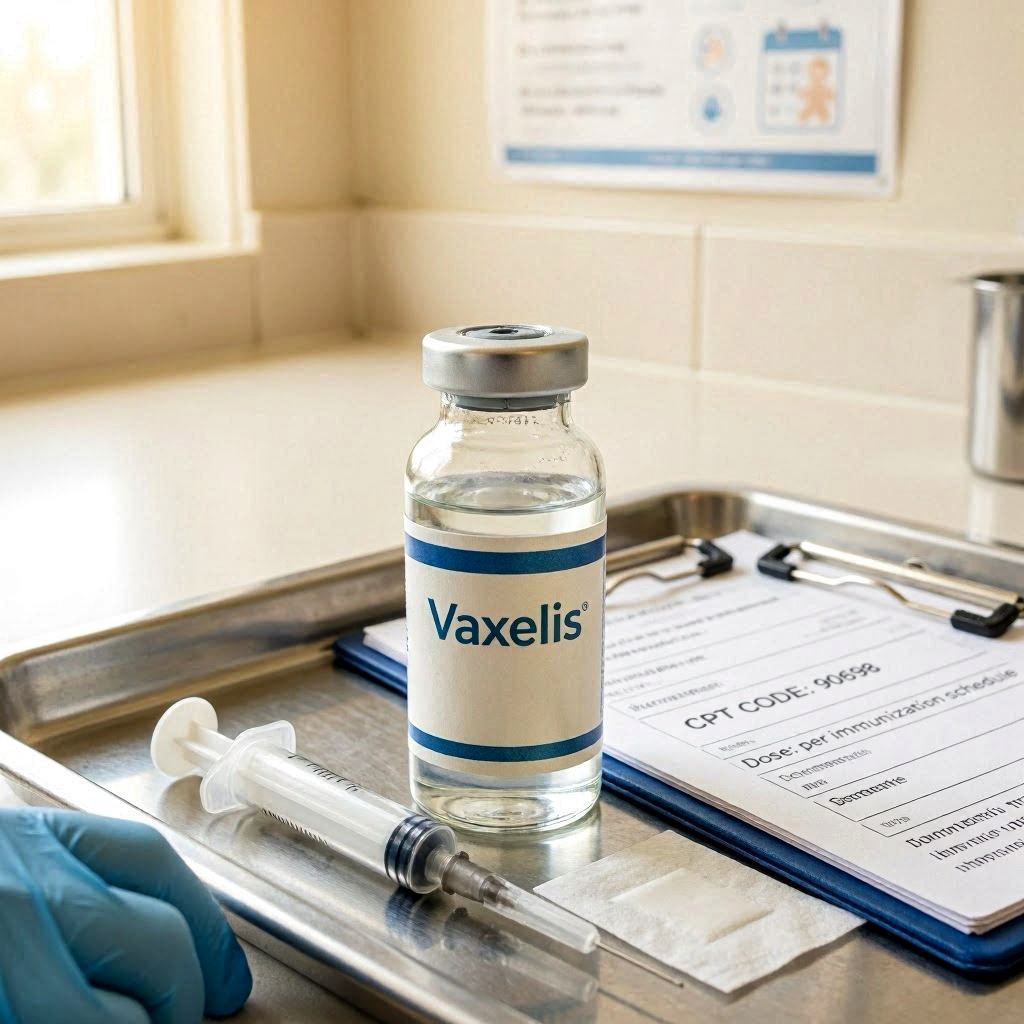
The correct CPT code for Vaxelis is 90698.
Let us break that down.
- 90698 – Diphtheria, tetanus toxoids, acellular pertussis vaccine, inactivated poliovirus vaccine, Haemophilus influenzae type b vaccine (PRP-OMP conjugate), and hepatitis B vaccine (DTaP-IPV-Hib-HepB), for intramuscular use.
This code precisely describes the six components found in Vaxelis.
Important note: Do not use separate individual codes for each disease component. That would be incorrect and likely result in a denial. The combination code 90698 covers the entire product.
What About Administration?
The vaccine product code (90698) covers the drug itself.
You must also bill for the administration of the vaccine. For most pediatric patients, you will use the standard immunization administration codes.
For Vaxelis, the appropriate administration code depends on the patient’s age and counseling provided.
- 90460 – Immunization administration through 18 years of age via any route of administration, with counseling by physician or other qualified health care professional. This is for the first or only component of each vaccine.
- 90461 – Each additional vaccine component (add-on code).
Since Vaxelis contains six antigens, you would generally bill:
- One unit of 90460 for the first component.
- Five units of 90461 for the additional five components.
Alternatively, some payers still accept the older administration codes (90471, 90472). However, for children under 18 with face-to-face counseling, 90460 and 90461 are typically preferred.
Always verify with each insurance plan.
Why No Dedicated Vaxelis Code?
You might wonder: Why doesn’t Vaxelis have its own CPT code?
The American Medical Association (AMA) maintains the CPT code set. New codes are added regularly. However, the AMA generally does not create new codes for every single brand-name vaccine when an existing code already describes the exact combination of antigens.
Vaxelis uses the same six components as another vaccine called Pediarix? Actually, no. There is a subtle difference.
Let us look at a comparison.
Comparison: Vaxelis vs. Other Hexavalent Codes
Currently, 90698 is the only CPT code that matches the six specific components of Vaxelis. Here is a simple table to clarify.
| CPT Code | Vaccine Components | Brand Example |
|---|---|---|
| 90698 | DTaP-IPV-Hib-HepB (6 components) | Vaxelis |
| 90700 | DTaP (only diphtheria, tetanus, pertussis) | Daptacel, Infanrix |
| 90696 | DTaP-IPV (4 components) | Kinrix, Quadracel |
| 90723 | DTaP-HepB-IPV (5 components, no Hib) | Pediarix |
As you can see, Pediarix (90723) is missing the Hib component. Vaxelis includes Hib. Therefore, 90698 is the correct and only match.
Reader Tip: Always double-check the CPT code description against the vaccine vial. The description must match exactly.
Step-by-Step: How to Bill Vaxelis Correctly
Let us walk through a typical scenario.
A 2-month-old patient receives the first dose of Vaxelis during a well-child visit.
Step 1: Bill the vaccine product.
- CPT: 90698
- Units: 1
- NDC (National Drug Code): You will need to report the 11-digit NDC for Vaxelis. The NDC for Vaxelis is typically 49281-0623-xx (check your vial for the exact package size).
- Charge: The cost of the vaccine (varies by provider contract).
Step 2: Bill the administration.
- CPT: 90460 (first component)
- Units: 1
- CPT: 90461 (each additional component)
- Units: 5
- Total administration units for this vaccine: 1 x 90460 + 5 x 90461.
Step 3: Bill the E/M service (if applicable).
- If this is a separate sick visit, append modifier -25 to the E/M code (e.g., 99213-25).
- For a routine well-child check, use preventive medicine codes (e.g., 99381-99382 for new patients or 99391-99392 for established patients).
Step 4: Add diagnosis codes.
- Z23 (Encounter for immunization) is required.
- Also include the well-child diagnosis (Z00.121, Z00.129, etc.) if applicable.
Common Billing Mistakes to Avoid
Even experienced billers can stumble on combination vaccines. Here are the most frequent errors with Vaxelis.
1. Using Multiple Individual Component Codes
Never bill 90700 (DTaP) + 90670 (Hib) + 90744 (HepB) + 90680 (IPV) separately for one shot of Vaxelis.
This is incorrect. It looks like fraud because you are billing for four separate injections when only one was given. Payers will deny this as unbundling.
2. Using the Wrong Combination Code
Some billers mistakenly use 90723 (Pediarix) for Vaxelis.
Remember: Pediarix does not contain Hib. Vaxelis does. If you bill 90723, you are failing to bill for the Hib component. That means you will not be reimbursed for the full value of the vaccine.
3. Incorrect Administration Units
Do not bill 90460 with 5 units of 90461? Wait. That is correct. But some billers bill 90460 only once and stop.
You must bill the add-on code 90461 for each additional component beyond the first. For a hexavalent vaccine, that is five additional components.
Correct:
- 90460 (1 unit)
- 90461 (5 units)
Incorrect:
- 90460 (1 unit) – missing the five add-ons.
4. Missing the NDC
Medicare and many commercial payers now require NDC numbers on vaccine claims. Without the NDC for Vaxelis, your claim may be rejected or paid at a lower rate.
Always include the 11-digit NDC. If your vial shows a 10-digit number, add a leading zero to make it 11 digits.
Reimbursement Realities: What to Expect
Let us be honest about money.
Combination vaccines like Vaxelis are convenient for patients and providers. However, reimbursement can sometimes be lower than billing individual vaccines separately. That is a trade-off.
Payers typically reimburse the combination code 90698 at a rate that reflects the bundled components. Some payers may reimburse at a rate similar to buying the components separately. Others may offer a slight discount.
Medicare does not cover Vaxelis. Medicare is for patients 65 and older. Vaxelis is only approved for children under 5. So, you will bill commercial insurance, Medicaid, or other state programs.
Sample Reimbursement Table (Illustrative – Not Real Rates)
| Payer Type | Typical Reimbursement for 90698 | Administration (90460 + 90461 x5) |
|---|---|---|
| Medicaid (varies by state) | 80–110 | 35–50 |
| Commercial PPO | 120–160 | 40–60 |
| High-Deductible Plan | Negotiated rate | Negotiated rate |
These are not actual rates. Always check your specific fee schedules.
Documentation Best Practices
Insurance auditors love vaccine claims. Why? Because they are high-volume and frequently coded incorrectly.
To protect yourself, follow these documentation rules.
On the patient’s chart, you must clearly note:
- The brand name: Vaxelis.
- The lot number and expiration date.
- The administration site (e.g., left anterolateral thigh).
- The route (intramuscular).
- The dose (0.5 mL).
- That you provided counseling to the parent or guardian about the risks and benefits.
- The Vaccine Information Statement (VIS) date and edition provided to the parent.
Why does this matter?
If an auditor sees CPT 90698, they will look for proof that the Hib component was actually given. If your documentation says “Vaxelis,” that is proof. If your documentation says “DTaP-IPV-HepB” (missing Hib), the auditor may deny the claim.
Be specific. Write “Vaxelis” or “DTaP-IPV-Hib-HepB.”
Vaxelis and the Vaccines for Children (VFC) Program
Many pediatric offices participate in the VFC program. This program provides free vaccines to eligible children.
If you administer Vaxelis through VFC, your billing changes.
- You cannot bill for the vaccine product code (90698) because VFC provided the vaccine for free.
- You can still bill for the administration using 90460 and 90461.
- You must follow VFC-specific coding and modifier rules. Often, you will append modifier SL (Vaccine provided by state) to the administration code.
Check with your state’s VFC program for exact guidance.
Frequently Asked Questions (FAQ)
Q1: Is Vaxelis the same as Pediarix?
No. Pediarix protects against 5 diseases (DTaP, HepB, IPV). Vaxelis protects against 6 diseases (DTaP, HepB, IPV, and Hib). The CPT code for Pediarix is 90723. For Vaxelis, it is 90698.
Q2: Can I use 90698 for any other brand?
Currently, 90698 is also used for a vaccine called DTaP-IPV-Hib-HepB (generic description). However, Vaxelis is the primary brand using this exact combination in the U.S. market as of this writing.
Q3: What if my software does not accept 90461 with 5 units?
Some older systems limit units. You may need to bill 90461 on five separate line items. Check with your billing software vendor or clearinghouse.
Q4: Does Vaxelis require a separate administration code for each antigen?
No. You use one administration code for the first component (90460) and one add-on code (90461) for the remaining components. You do not use five separate administration codes for each antigen.
Q5: What diagnosis code do I need?
Always use Z23 (Encounter for immunization). If the patient is also having a well-child check, add the appropriate preventive medicine diagnosis code (Z00.121, Z00.129).
Q6: Is there a HCPCS code for Vaxelis?
No. HCPCS Level II codes are primarily for drugs, biologics, and devices not covered by CPT. Vaxelis is covered by CPT code 90698, so a separate HCPCS code is generally not needed.
Q7: What is the correct NDC format for Vaxelis?
The NDC for Vaxelis (single-dose vial) is typically 49281-0623-05 (10-digit). For billing, convert to 11 digits by adding a leading zero to one segment. Example: 49281-0623-05 becomes 49281062305 or 49281-0623-05 depending on payer specifications. Check your vial and payer guide.
Additional Resources
For the most current information on vaccine coding, visit the American Academy of Pediatrics (AAP) Vaccines & Immunizations page.
🔗 Resource Link: https://www.aap.org/en/patient-care/vaccines/ (AAP Vaccines Page – always verify coding updates)
You can also check the CDC Vaccine Price List for private sector and VFC pricing.
Conclusion
In three lines: The correct CPT code for Vaxelis is 90698, which covers all six vaccine components. Always pair it with administration codes 90460 (first component) and 90461 (five units) for children under 18. Avoid using separate component codes or the Pediarix code 90723, and always document the brand name and NDC to ensure clean claims and proper reimbursement.