The sensation is often described as a piercing, throbbing, or electric shock-like pain that originates at the base of the skull, frequently radiating over the scalp towards the forehead and behind the eyes. For millions of patients suffering from chronic headache disorders, this is not merely a symptom but a life-altering condition that diminishes their quality of life, impairs daily function, and often proves resistant to conventional oral medications. In the relentless search for relief, interventional pain management has emerged as a beacon of hope, offering targeted strategies that move beyond systemic treatments to address the very source of the pain. Standing at the forefront of these interventions is the occipital nerve block (ONB), a minimally invasive procedure that exemplifies the elegant synergy between anatomical knowledge and clinical application.
However, the successful implementation of this procedure extends far beyond the sterile field of the procedure room. In the modern healthcare ecosystem, the clinical act is inextricably linked to its administrative counterpart: accurate medical coding and billing. At the heart of this process for the ONB is a five-digit code from the Current Procedural Terminology (CPT®) system: 64405. This code, seemingly simple, is a gateway to a complex landscape of rules, regulations, and requirements. Its correct application is not merely an administrative formality; it is a critical component of ethical practice, ensuring that providers are appropriately reimbursed for their expertise and that patients continue to have access to these vital treatments.
This article is designed to be the definitive guide for clinicians, pain management specialists, neurologists, certified medical coders, and practice administrators. We will embark on a detailed journey, beginning with the intricate anatomy of the occipital nerves, progressing through the precise steps of the procedure, and then plunging into the nuanced world of CPT code 64405. We will decode its modifiers, unravel the complexities of payer policies, and emphasize the non-negotiable importance of documentation. Our goal is to equip you with a comprehensive understanding that transforms the occipital nerve block from a clinical and coding challenge into a mastered skill, ensuring both optimal patient outcomes and a sustainable practice.
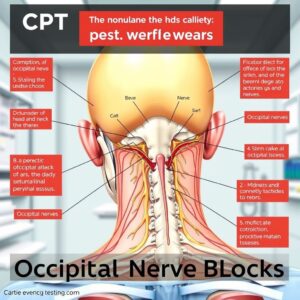
CPT codes for Occipital Nerve Blocks
2. Anatomy of Pain: Understanding the Occipital Nerves
To truly appreciate the mechanism and efficacy of an occipital nerve block, one must first understand the anatomy it targets. The posterior scalp and posterior region of the skull are primarily innervated by the greater and lesser occipital nerves, with a minor contribution from the third occipital nerve.
-
Greater Occipital Nerve (GON): This is the major player, both in terms of size and clinical significance. Contrary to common belief, the GON is not a cranial nerve but is actually the dorsal ramus of the second cervical spinal nerve (C2). It arises between the first and second vertebrae (the atlas and axis) and pierces the semispinalis capitis muscle before traversing the trapezius muscle near its attachment to the superior nuchal line. Its path makes it susceptible to entrapment and irritation from muscle tension or trauma. The GON provides sensory innervation to a large area of the posterior scalp, extending from the external occipital protuberance to the vertex of the skull and laterally to the ears.
-
Lesser Occipital Nerve (LON): This nerve typically arises from the ventral ramus of the second cervical nerve (C2) and sometimes receives contributions from C3. It ascends along the posterior border of the sternocleidomastoid muscle, dividing into branches that innervate the skin on the upper, lateral part of the posterior neck and the scalp posterior to the ear. It is more superficial than the GON.
-
Third Occipital Nerve (TON): This is the superficial medial branch of the dorsal ramus of the third cervical nerve (C3). It innervates a small area of the lower occipital region and the skin overlying the C2-C3 facet joint. While less commonly the primary target, it can be involved in certain pain syndromes.
The concept of peripheral sensitization is key. In chronic headache conditions like occipital neuralgia or migraine, these nerves can become inflamed and sensitized. This means their threshold for firing is lowered, and they may respond to normally non-painful stimuli (allodynia, e.g., brushing hair) or become hyper-responsive to painful stimuli (hyperalgesia). The occipital nerve block works by directly delivering anti-inflammatory and anesthetic agents to this site of sensitization, effectively “resetting” the nerve and interrupting the pain cycle.
3. The Clinical Procedure: How is an Occipital Nerve Block Performed?
The performance of an ONB is a blend of art and science, requiring anatomical knowledge, palpatory skill, and meticulous technique.
Indications: When is an ONB Appropriate?
-
Occipital Neuralgia: The primary indication, characterized by paroxysmal shooting or stabbing pain in the distribution of the GON, LON, or TON, often accompanied by tenderness over the affected nerve and sometimes dysesthesia (e.g., numbness or tingling).
-
Migraine Headache: Used both as an acute treatment for a refractory migraine attack and as a preventive therapy to reduce the frequency and severity of episodes.
-
Cervicogenic Headache: Headache originating from disorders of the cervical spine and its component bony, disc, and/or soft tissue elements, often referring pain to the occipital region.
-
Cluster Headache: Can be used as a transitional therapy to break a cycle of cluster headaches.
-
Post-herpetic Neuralgia: Particularly after shingles outbreaks in the C2-C3 dermatome.
-
Diagnostic Tool: To help confirm an occipital nerve-mediated pain syndrome. A positive response (significant pain reduction) helps pinpoint the pain generator.
Contraindications: When to Avoid the Procedure
-
Absolute: Patient refusal, active infection at the injection site, systemic infection, known allergy to the injectate medications, and coagulopathy (or patients on anticoagulants where the risk of hematoma outweighs the benefit).
-
Relative: Uncontrolled anxiety or psychosis, pregnancy (especially first trimester, though the risks are primarily theoretical for a peripheral block), and poorly controlled diabetes (if using corticosteroids due to risk of hyperglycemia).
The Step-by-Step Technical Process
-
Informed Consent: The process begins with a thorough discussion of the risks, benefits, and alternatives to the procedure, ensuring the patient provides informed consent.
-
Positioning: The patient is typically positioned sitting upright, leaning forward on a table with a pillow, or in the prone position. This allows for relaxation of the neck muscles and optimal access.
-
Landmark Identification and Palpation: The provider palpates the occipital region to identify the point of maximal tenderness, which often corresponds to the location of the greater occipital nerve as it crosses the superior nuchal line, approximately 2-3 cm lateral to the external occipital protuberance.
-
Sterile Preparation: The skin over the injection site(s) is widely cleansed with an antiseptic solution (e.g., chlorhexidine or povidone-iodine) using a sterile technique.
-
Anesthesia: A small wheel of local anesthetic (e.g., lidocaine) may be raised at the injection site for patient comfort, though some providers proceed without it due to the very brief pain of the needle prick.
-
Injection: Using a 25- to 30-gauge needle, the provider advances the needle towards the pre-identified tender point. Palpating the occipital artery, which often runs just medial to the nerve, can help avoid intravascular injection. After negative aspiration to ensure the needle is not in a blood vessel, the therapeutic injectate is slowly deposited. A fan-like technique may be used to ensure dispersion around the nerve trunk.
-
Post-Procedure: Pressure is applied to minimize bleeding or bruising. The patient is monitored for a short period for any immediate adverse reactions.
Materials, Sterilization, and Patient Positioning
The procedure is typically performed with a standard syringe (3-5 mL) and a small-gauge needle. Sterility is paramount to prevent deep tissue infection. Ultrasound guidance is increasingly used to visualize the nerves, surrounding muscles, and occipital artery, potentially improving accuracy and efficacy, especially in cases where anatomical landmarks are difficult to palpate.
![Image description: A clinical photograph showing a provider performing an occipital nerve block on a patient. The patient is seated and leaning forward. The provider is wearing gloves and is palpating the back of the patient’s head to locate the injection site. The injection site is marked and the skin has been prepped with an antiseptic solution.]
4. The Pharmacological Arsenal: Corticosteroids, Anesthetics, and Their Mechanisms
The injectate for an ONB is a carefully chosen combination of medications, each serving a distinct purpose:
-
Local Anesthetics (e.g., Lidocaine, Bupivacaine/Ropivacaine):
-
Mechanism: They work by blocking sodium channels in the nerve membrane, preventing the propagation of action potentials and the transmission of pain signals. This provides immediate, but temporary, pain relief.
-
Purpose: The rapid onset confirms the diagnostic aspect of the block. If the patient’s characteristic pain is relieved, it strongly suggests the nerve is involved in the pain pathway.
-
-
Corticosteroids (e.g., Methylprednisolone, Triamcinolone, Dexamethasone):
-
Mechanism: They are potent anti-inflammatory agents. They suppress the synthesis of inflammatory mediators, reduce nerve edema, and stabilize nerve membranes. They may also inhibit the ectopic discharge from sensitized nerves.
-
Purpose: To provide long-term therapeutic effect by reducing the inflammation and sensitization that is causing the chronic pain. The effects take longer to onset (days) but can last for weeks or months.
-
The choice of specific agents and their volumes (typically 2-4 mL total per side) is based on provider preference and the clinical scenario. Some providers may use only local anesthetic for a purely diagnostic block.
5. Demystifying the CPT Code: 64405 – A Deep Dive
The American Medical Association’s CPT code set is the universal language for describing medical, surgical, and diagnostic services. For the occipital nerve block, the correct code is:
CPT 64405: Injection, anesthetic agent; greater occipital nerve
This deceptively simple description contains a wealth of meaning and implication.
Unbundling the Code’s Description
-
“Injection”: This defines the service as a procedure involving the percutaneous introduction of a substance.
-
“Anesthetic agent”: This is a historical descriptor. While it specifies an anesthetic, the inclusion of a corticosteroid is an accepted and standard practice. The code encompasses the injection of any combination of medications for this purpose.
-
“Greater occipital nerve”: This is the most critical part. Code 64405 is explicitly defined for the greater occipital nerve. This is a unilateral code, meaning it describes the service performed on one side of the body.
Bilateral Procedures: The -50 Modifier
Since many patients have bilateral pain, the procedure is often performed on both the left and right occipital nerves during the same session. CPT guidelines state that if a procedure is performed bilaterally, the provider should:
-
Report the code (64405) twice.
-
Append the Modifier -50 (Bilateral Procedure) to the second unit of the code.
Correct Billing Example:
-
64405 (Left side)
-
64405-50 (Right side)
Alternatively, some payers may prefer the use of a two-line item with modifiers -LT (Left side) and -RT (Right side):
-
64405-LT
-
64405-RT
It is crucial to check individual payer policies, but the -50 modifier is generally the most widely accepted method.
Multiple Levels and the Unilateral Rule
A common point of confusion arises when a provider blocks multiple nerves on the same side (e.g., both the greater and lesser occipital nerves). CPT code 64405 is reported only once per side, regardless of how many occipital nerve branches are injected. The code describes the service of injecting the occipital nerve region(s) unilaterally. It is not an “injection-per-nerve” code. Therefore, injecting both the GON and LON on the left side is still reported as one unit of 64405-LT. Injecting the GON and LON on both sides is reported as 64405 and 64405-50.
6. Documentation is King: The Medical Record Requirements for Success
If coding is the language, documentation is the story. Without robust documentation, even the most technically perfect procedure will face denial. The medical record must tell a clear, consistent, and justified story. Key elements include:
-
History & Physical: A detailed history describing the character, location, duration, and severity of the pain. The physical exam must document tenderness to palpation over the occipital nerve region.
-
Medical Decision Making: Documentation of previous conservative treatments tried and failed (e.g., physical therapy, medications like NSAIDs, neuropathic agents, or triptans). The rationale for choosing the ONB must be clear.
-
Informed Consent: A note stating that the risks, benefits, and alternatives were discussed and that the patient consented.
-
Procedure Note: This is critical. It must include:
-
Indication: The reason for the procedure (e.g., “for treatment of occipital neuralgia”).
-
Procedure: The specific procedure performed (e.g., “greater occipital nerve block”).
-
Site/Side: Explicitly state “left,” “right,” or “bilateral.”
-
Technique: Description of patient position, landmark palpation, sterile prep, and needle insertion.
-
Medications: The exact drugs, concentrations, and volumes injected (e.g., “2 mL of 0.5% bupivacaine and 20 mg of methylprednisolone”).
-
Findings: Note any aspirate (e.g., “negative for blood”) and the patient’s immediate response.
-
-
Post-Procedure Plan: Instructions given to the patient and a plan for follow-up.
7. Navigating the Payer Landscape: Medicare, Medicaid, and Private Insurers
Each insurance payer has its own set of policies, or Local Coverage Determinations (LCDs), that detail the specific requirements for a service to be considered reasonable and necessary.
Medical Necessity: The Cornerstone of Reimbursement
The single most important concept is medical necessity. The documentation must prove that the service was:
-
Appropriate: Meets the standard of care for the patient’s diagnosis.
-
Reasonable: The level of complexity and service provided was warranted.
-
Necessary: Required for the diagnosis or treatment of the patient’s condition.
Payer policies will list the specific diagnoses they cover and the required conservative management steps that must be attempted first.
ICD-10-CM Codes: Telling the Story of Medical Necessity
The diagnosis codes attached to the claim are what justify the procedure. Using vague or incorrect codes is a primary cause of denial.
Table: Common ICD-10-CM Codes for Occipital Nerve Blocks
| ICD-10-CM Code | Code Description | Clinical Context & Notes |
|---|---|---|
| G44.209 | Drug-resistant occipital headache, not intractable | Use for occipital headaches that are not responding to medication but are not “intractable” (i.e., not resistant to all treatment). |
| G44.219 | Drug-resistant occipital headache, intractable | Use for severe, treatment-resistant occipital headaches. “Intractable” must be supported by documentation. |
| G44.309 | Post-traumatic headache, unspecified, not intractable | For headaches following trauma (e.g., whiplash, concussion). |
| G44.319 | Post-traumatic headache, unspecified, intractable | |
| M54.81 | Occipital neuralgia | The most direct and specific diagnosis for ONB. |
| G43.909 | Migraine, unspecified, not intractable | Must be used carefully. Some payers may prefer more specific migraine codes or have policies limiting ONB for migraine. |
| G43.919 | Migraine, unspecified, intractable | |
| G44.011 | Episodic cluster headache, intractable | |
| R51 | Headache | A less specific code; should only be used if a more precise diagnosis is not yet established. |
Understanding NCCI Edits and Modifiers
The National Correct Coding Initiative (NCCI) edits are pairs of CPT codes that should not typically be billed together by the same provider for the same patient on the same day. If they are billed, a modifier must be used to indicate that the services were separate and distinct.
A common NCCI edit exists between 64405 and an Evaluation and Management (E/M) service (e.g., 99213). NCCI considers the E/M service to be bundled into the procedure if it was performed to determine the need for the injection. To bill both, the E/M service must be significant, separately identifiable, and appended with Modifier -25 (“Significant, Separately Identifiable Evaluation and Management Service by the Same Physician or Other Qualified Health Care Professional on the Same Day of the Procedure or Other Service”). The documentation must support that the E/M service was above and beyond the usual pre- and post-procedure work.
8. Beyond 64405: Ancillary Codes and Global Periods
Ultrasound Guidance (76942)
When ultrasound guidance is used to perform the nerve block, it may be separately reportable with code 76942 (Ultrasonic guidance for needle placement, imaging supervision and interpretation). However, strict rules apply:
-
Medical Necessity: The documentation must justify why ultrasound was needed (e.g., failed previous blind injection, abnormal anatomy, patient body habitus).
-
Documentation: The procedure note must document the use of ultrasound, including the structures identified (e.g., “ultrasound was used to identify the trapezius muscle, semispinalis capitis, and the pulsating occipital artery; the needle was advanced under direct visualization lateral to the artery”).
-
Payer Policy: Many private payers cover 76942 with 64405, but Medicare’s policy is restrictive. Medicare typically considers the guidance to be an integral part of the procedure and does not separately reimburse it for occipital nerve blocks. Always verify with the specific payer.
The Office Visit Conundrum: E/M Codes on the Same Day
As mentioned, billing an E/M code with 64405 requires Modifier -25 and robust documentation. The note should clearly separate the history, exam, and medical decision-making for the patient’s underlying chronic condition from the workup and consent for the procedure.
9. Clinical Efficacy: What Does the Evidence Say?
The body of evidence supporting the use of ONBs is growing. Numerous studies and systematic reviews have shown:
-
Occipital Neuralgia: ONBs are a well-established, first-line interventional treatment, providing significant short-term pain relief for a majority of patients.
-
Migraine: Systematic reviews have concluded that ONBs are an effective preventive treatment for migraine, leading to a reduction in headache days, severity, and acute medication use. They are particularly valuable in refractory cases.
-
Cervicogenic Headache: Evidence supports its use, though it is often part of a multimodal approach including physical therapy.
The effect is typically temporary, lasting from weeks to several months, and the procedure can be repeated as needed. The variability in response underscores its use as both a diagnostic and therapeutic tool, helping to identify which patients might benefit from more permanent solutions like occipital nerve stimulation.
10. Risks and Complications: Ensuring Patient Safety
ONBs are very safe, but no procedure is without risk. Potential complications include:
-
Common & Minor: Pain at the injection site, localized bruising (ecchymosis), and temporary numbness or dizziness (vasovagal response).
-
Less Common: Bleeding, infection, and alopecia or skin atrophy at the injection site (due to corticosteroid effect).
-
Rare but Serious: Intravascular injection leading to local anesthetic toxicity, nerve injury, and, extremely rarely, air embolism or puncture of the dura mater if the needle is advanced too deeply and medially.
Aseptic technique, careful anatomical knowledge, and aspiration before injection are paramount to minimizing these risks.
11. The Future of Occipital Nerve Blocks: Innovations and Trends
The field continues to evolve. Key trends include:
-
Prolotherapy & Platelet-Rich Plasma (PRP): Investigational use of regenerative injections to strengthen ligaments and potentially provide longer-lasting relief by addressing structural instability.
-
Neuromodulation: For patients with successful but temporary response to blocks, occipital nerve stimulators implant a device that provides electrical impulses to the nerve, masking pain signals.
-
Standardization: Efforts are ongoing to create more standardized protocols for injectate volumes, concentrations, and techniques to improve consistency of outcomes.
-
Precision with Ultrasound: As ultrasound technology becomes more accessible, its routine use may become standard to improve accuracy and potentially efficacy.
12. Conclusion: Synthesizing Clinical Art with Coding Science
The occipital nerve block is a powerful tool in the arsenal against chronic headache disorders, offering targeted relief where systemic medications often fail. Its success, however, is a product of two equally important disciplines: the clinical expertise to perform it safely and effectively, and the administrative precision to code and document it correctly. Mastering CPT code 64405, its modifiers, and the accompanying narrative of medical necessity is not just about reimbursement—it is about ensuring the longevity and integrity of a practice so it can continue to provide this vital care to the patients who need it most. By harmonizing the art of medicine with the science of coding, providers can achieve the ultimate goal: optimal outcomes for both their patients and their practice.
13. Frequently Asked Questions (FAQs)
Q1: Can I bill 64405 if I only inject the lesser occipital nerve?
A: Yes. While the code descriptor says “greater occipital nerve,” CPT coding conventions and payer policies generally accept 64405 for the injection of any occipital nerve branch (greater, lesser, or third) unilaterally. The code represents the service of an occipital nerve block, not the injection of a specific named nerve.
Q2: If a patient has bilateral pain but I only inject one side for diagnostic purposes, how do I code it?
A: You would report a single unit of 64405, appended with either the -LT or -RT modifier to specify which side was injected. You would not use the -50 modifier.
Q3: Why was my claim for 64405 and 99213-25 denied?
A: The most common reasons are: 1) The documentation did not support that the E/M service was significant and separately identifiable from the procedure work. The note likely focused only on the decision for the injection. 2) The modifier -25 was missing from the E/M code on the claim. 3) The diagnosis codes linked to the E/M service were not distinct enough from those linked to the procedure.
Q4: How often can an occipital nerve block be performed?
A: There is no definitive CPT frequency limit. Frequency is determined by medical necessity. Most providers wait at least 4-8 weeks between injections, especially if corticosteroids are used, to minimize the risk of local tissue effects and systemic side effects like HPA axis suppression. Payer policies may have specific frequency limitations.
Q5: Is prior authorization required for 64405?
A: This is entirely dependent on the patient’s insurance plan. Many private insurers and some Medicare Advantage plans require prior authorization for interventional pain procedures. It is essential to verify benefits and authorization requirements before performing the procedure to avoid certain denial.
14. Additional Resources
-
American Medical Association (AMA): For the definitive CPT® code descriptions and guidelines. https://www.ama-assn.org/
-
Centers for Medicare & Medicaid Services (CMS): For National Coverage Determinations (NCDs), Medicare manuals, and NCCI edits. https://www.cms.gov/
-
American Society of Anesthesiologists (ASA): Often provides excellent resources on coding for pain procedures. https://www.asahq.org/
-
American Academy of Neurology (AAN): For clinical guidelines on headache treatment. https://www.aan.com/
-
American Association of Neuromuscular & Electrodiagnostic Medicine (AANEM): Offers coding resources relevant to neurologists performing procedures. https://www.aanem.org/
-
Your Local Medicare Administrative Contractor (MAC): For your region’s specific Local Coverage Determinations (LCDs) and articles for CPT 64405. (Find yours on the CMS website).
Disclaimer
The information contained in this article is for educational and informational purposes only and is not intended as medical coding, billing, or legal advice. While every effort has been made to ensure the accuracy of the information regarding CPT codes, billing guidelines, and medical procedures, these are subject to change. The ultimate responsibility for correct coding, billing, and documentation lies with the provider and their coding staff. Always consult the most current editions of the CPT® Manual, ICD-10-CM guidelines, and payer-specific policies. You should never base coding or billing decisions solely on the information provided in this article. Always seek the advice of a qualified healthcare provider, certified professional coder, or legal professional with any questions you may have regarding medical coding, billing, or a medical condition.