In the annals of modern medicine, few advancements have been as transformative as Transcatheter Aortic Valve Replacement (TAVR). What began as a groundbreaking life-saving procedure for inoperable patients has rapidly evolved into a standard of care for a broad spectrum of individuals suffering from severe aortic stenosis. TAVR has redefined cardiac intervention, offering a less invasive alternative to open-heart surgery, significantly reducing recovery times, and improving quality of life for millions. However, behind this clinical miracle lies a complex and intricate framework of medical coding and billing that is as critical to the procedure’s accessibility as the surgical technique itself. The Current Procedural Terminology (CPT) codes for TAVR are not mere numbers on a form; they are the essential language that communicates the complexity, resources, and expertise required to deliver this care. They are the bridge between clinical innovation and financial sustainability, ensuring that hospitals and providers can continue to offer this life-changing technology. This comprehensive guide aims to demystify the CPT coding for TAVR, providing a detailed, expert-level exploration that will benefit cardiologists, coding professionals, healthcare administrators, and anyone interested in the intersection of cutting-edge medicine and healthcare economics.
CPT Codes for Transcatheter Aortic Valve Replacement
2. Understanding the Fundamentals: What is TAVR?
Transcatheter Aortic Valve Replacement (TAVR), also known as Transcatheter Aortic Valve Implantation (TAVI), is a minimally invasive procedure to treat severe aortic stenosis. Aortic stenosis is a condition where the heart’s aortic valve narrows, restricting blood flow from the heart to the aorta and the rest of the body.
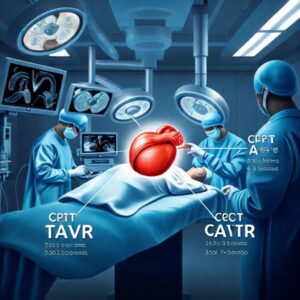
The Procedure: Unlike traditional open-heart surgery, which requires a large chest incision and a heart-lung machine, TAVR is typically performed through a small incision in the groin (femoral artery) or another access point. A catheter is threaded through the blood vessels to the heart. A collapsible artificial valve, mounted on the catheter, is precisely positioned within the diseased native aortic valve. Once in place, the new valve is expanded, pushing the old valve leaflets aside and immediately taking over the function of regulating blood flow.
The Evolution: Since its first-in-human procedure in 2002, TAVR has been validated through landmark clinical trials (e.g., PARTNER, CoreValve) across all surgical risk categories—from inoperable and high-risk to intermediate and low-risk patients. This expansion of indications has made TAVR one of the most common structural heart procedures performed worldwide.
3. The CPT Code Ecosystem: A Primer on Medical Billing Language
Before delving into the specific codes for TAVR, it is crucial to understand the ecosystem in which they exist. The Current Procedural Terminology (CPT) code set, maintained by the American Medical Association (AMA), is the uniform language for describing medical, surgical, and diagnostic services. It is used by physicians, coders, insurers, and accreditation organizations for communication, billing, and data analysis.
CPT codes are categorized into three types:
-
Category I: Codes for procedures and services that are widely performed, approved by the FDA (if applicable), and have proven clinical efficacy. TAVR codes fall into this category.
-
Category II: Supplemental tracking codes used for performance management.
-
Category III: Temporary codes for emerging technologies, services, and procedures.
The codes for TAVR are “surgical” codes, meaning they are typically associated with a “global period.” This period (0, 10, or 90 days) defines the number of post-operative days during which all related routine care is bundled into the payment for the primary procedure.
4. The Core of TAVR Coding: A Deep Dive into CPT Codes 33361, 33362, and 33363
The AMA introduced three dedicated CPT codes for TAVR to accurately reflect the different technical scenarios of the procedure. These codes are inclusive and represent the complete work of valve implantation.
CPT Code 33361: Transcatheter Aortic Valve Implantation (TAVI/TAVR)
This is the primary code for a standalone TAVR procedure. It includes the entire process of implanting the valve via a transcatheter approach.
-
Description: “Transcatheter aortic valve replacement (TAVR/TAVI) with prosthetic valve; percutaneous femoral artery approach”
-
What it includes: The code encompasses all the work of accessing the vessel, advancing the catheter system, deploying the valve, repositioning if necessary, and all associated closure of the arteriotomy. It also includes all balloon valvuloplasty (BAV) performed during the procedure, whether pre-dilation or post-dilation. The code is specific to the percutaneous femoral artery approach, which is the most common access site.
-
Important Note: While the descriptor specifies “femoral artery,” this code is also appropriately used for other percutaneous access sites, such as the axillary/subclavian or carotid arteries, if a percutaneous approach is utilized. The key differentiator is the method of access (percutaneous).
CPT Code 33362: TAVR with Percutaneous Coronary Intervention (PCI)
This code is used when a TAVR procedure is performed and a significant, separately identifiable percutaneous coronary intervention (PCI) is done during the same operative session.
-
Description: “Transcatheter aortic valve replacement (TAVR/TAVI) with prosthetic valve; percutaneous femoral artery approach, with percutaneous coronary artery stent(s) placement”
-
When to use it: This code is a “combination” code. It is only reported when both TAVR and PCI (e.g., stenting of a coronary artery) are performed. It is not reported if a diagnostic coronary angiogram is performed; that is included in the work of 33361 if done through the same access. The PCI must be medically necessary and distinct from the TAVR procedure itself (e.g., treating a significant lesion in the left anterior descending artery).
-
Coding Logic: You report 33362 only. You do not report 33361 and a separate PCI code (e.g., 92928, 92929). Code 33362 encapsulates both procedures.
CPT Code 33363: TAVR with Balloon Valvuloplasty
This code is a misnomer and is a common source of confusion. As established, balloon valvuloplasty is already included in 33361. Code 33363 is reserved for a very specific scenario.
-
Description: “Transcatheter aortic valve replacement (TAVR/TAVI) with prosthetic valve; open femoral artery approach”
-
Clarification: Despite its confusing descriptor, which mentions “balloon valvuloplasty,” the code’s intent, as defined by AMA guidelines and coding experts, is for TAVR performed via an open surgical exposure of the femoral artery. If the surgeon must cut down through the skin and tissue to directly visualize and access the femoral artery (e.g., due to vessel disease, calcification, or small size), this is the correct code. The “balloon valvuloplasty” language is a historical artifact; the code’s defining feature is the open access.
Core TAVR CPT Codes
| CPT Code | Description | Key Usage & Inclusions |
|---|---|---|
| 33361 | TAVR; percutaneous femoral artery approach | Standard code for most TAVR procedures. Includes all balloon valvuloplasty (pre/post-dilation) and diagnostic angiography from the same access. |
| 33362 | TAVR; percutaneous approach, with coronary stent placement | Combination code used only when TAVR and a medically necessary PCI (stent placement) are performed in the same session. |
| 33363 | TAVR; open femoral artery approach | Used when vascular access is achieved via open surgical cut-down to the femoral artery. |
5. The Critical Concept of Medical Necessity and Patient Selection
CPT codes describe what was done, but reimbursement is contingent on why it was done. Medical necessity is the overarching principle that justifies any procedure. For TAVR, this is rigorously documented through a multi-disciplinary “Heart Team” approach.
The patient’s medical record must contain unequivocal evidence of:
-
Severe Symptomatic Aortic Stenosis: Documented by echocardiography (e.g., aortic valve area <1.0 cm², mean gradient >40 mmHg, jet velocity >4.0 m/s).
-
Symptoms: Clearly linked to the stenosis (e.g., syncope, angina, dyspnea on exertion, heart failure).
-
Heart Team Evaluation: Formal consultation and agreement between a cardiothoracic surgeon and an interventional cardiologist that TAVR is the appropriate treatment path. The patient’s surgical risk (STS Score) should be calculated and documented.
-
Informed Consent: Detailed discussion with the patient about the risks, benefits, and alternatives (including medical management and surgical AVR).
Without robust documentation of medical necessity, a claim for TAVR, regardless of correct CPT application, will be denied.
6. Navigating the Global Period: What’s Included in the TAVR Codes?
CPT code 33361, 33362, and 33363 are all assigned a 90-day global surgical period. This means that the payment for the TAVR procedure is intended to cover not only the procedure itself but also all related postoperative care for the next 90 days.
Services Included in the Global Package (Bundled):
-
Subsequent visits to the operating room for control of bleeding
-
Postoperative follow-up visits in the office
-
Management of related complications (e.g., pacemaker interrogation for heart block, though the pacemaker implant itself is separately billable if required)
-
Dressing changes, suture removal
-
Supplies
Services Typically NOT Included (Separately Billable):
-
Unrelated Evaluation and Management (E/M) Services: A visit for an unrelated problem (e.g., a rash, diabetes management) may be billed with modifier -24 (Unrelated E/M Service by the Same Physician During a Postoperative Period).
-
Treatment of Complications Requiring a Return to the OR: If a patient requires a return to the operating room for a procedure unrelated to the TAVR (e.g., appendectomy), it is billed separately. A return for a TAVR-related issue (e.g., vascular repair) is generally not separately billable.
-
Diagnostic Tests: Echocardiograms, EKGs, chest X-rays, and lab work performed for diagnostic purposes (not routine monitoring) are typically billable.
-
Pacemaker Implantation: The need for a permanent pacemaker due to post-TAVR heart block is a known risk, but it is a distinct procedure and is billed with its own CPT code (e.g., 33206-33208, 33212-33214).
7. The Crucial Role of Imaging: Coding for the Diagnostic Journey
TAVR is an imaging-dependent procedure. The coding for these imaging services is complex and occurs in three phases.
1. Pre-Procedure Planning:
This involves high-resolution imaging to determine patient eligibility, valve size, and access route.
-
CT Aorta with 3D Reconstruction (CPT 71275, 74175): The gold standard for measuring the aortic annulus, assessing calcification, and evaluating iliofemoral anatomy for access. This is a separately billable diagnostic test.
-
Transthoracic Echocardiogram (TTE – CPT 93306) and Transesophageal Echocardiogram (TEE – CPT 93355): Critical for assessing stenosis severity and cardiac function.
2. Intra-Procedure Guidance:
Imaging is used in real-time to guide valve placement.
-
Fluoroscopic Guidance (Bundled): The use of fluoroscopy is an integral part of the TAVR procedure and is not separately reportable. It is included in codes 33361-33363.
-
Echocardiographic Guidance (CPT 93355): A TEE performed solely for guidance during the TAVR procedure may be separately reportable. However, the operator must document its necessity beyond the standard fluoroscopy. It is often bundled by payers unless clear, distinct medical necessity is shown.
3. Post-Procedure Assessment:
-
Echocardiogram (CPT 93306, 93355): Performed after valve deployment to assess function, check for paravalvular leak, and measure gradients. This is typically separately billable as a diagnostic test.
8. Concomitant Procedures: When to Code Separately and When to Bundle
A patient undergoing TAVR may have other cardiac issues addressed during the same hospitalization. Understanding bundling rules is critical.
-
Coronary Angiogram: A diagnostic coronary angiogram performed during the TAVR procedure through the same access is included in 33361. If performed as a separate procedure on a different day or through a different access site, it may be billable (e.g., 93454, 93455).
-
Percutaneous Coronary Intervention (PCI): As discussed, if performed, you use the combination code 33362. Do not bill a separate PCI code.
-
Pacemaker Implantation (CPT 33206-33208, 33212-33214): This is a separately billable procedure if performed for new, post-TAVR heart block. Use the appropriate modifier (e.g., -78 if during the global period).
-
Vascular Repair: Surgical repair of a vascular access complication (e.g., 35226 Repair blood vessel, direct; lower extremity) is generally not separately billable as it is considered a complication of the primary procedure.
9. Mastering Modifiers: The Nuance of Billing for TAVR Services
Modifiers provide additional information to payers about the circumstances of a service.
-
Modifier -26 (Professional Component): Used by the physician when billing only for their interpretation/reporting of a diagnostic test (e.g., 71275-26 for interpreting the CT scan).
-
Modifier -59 (Distinct Procedural Service): Used to indicate that a procedure was distinct from other services performed on the same day. Use with extreme caution and only if a procedure is truly separate (e.g., a cath from a different access site on a different day).
-
Modifier -78 (Unplanned Return to the OR): Used by the same physician for a related procedure during the postoperative period (e.g., returning to implant a pacemaker for complete heart block after TAVR).
-
Modifier -TC (Technical Component): Used by the facility for the technical portion of a diagnostic test.
10. The Anatomical Landscape: ICD-10-CM Diagnosis Codes for TAVR
The diagnosis code justifies the procedure. The primary code will come from category I35.0 – Nonrheumatic aortic (valve) stenosis.
-
I35.0 – Nonrheumatic aortic (valve) stenosis
-
I35.2 – Nonrheumatic aortic (valve) stenosis with insufficiency (if mixed disease is present)
-
I50.- – Heart failure codes (to document symptomatic status)
-
R55 – Syncope (if present)
11. Beyond the Procedure: HCPCS Codes for Device and Supply Tracking
The HCPCS Level II code set is used to report the prosthetic valve itself and other supplies.
-
Valve Devices: Specific codes identify the make and model of the valve (e.g., XU092 – Edwards Lifesciences transcatheter heart valve). These codes are used for pass-through payment and tracking.
-
Accessory Supplies: Codes for introducer sheaths, balloons, and other catheter-based equipment may also be reported by the facility.
12. The Financial and Reimbursement Landscape of TAVR
TAVR is a high-cost procedure. Reimbursement is a mix of the DRG (Diagnosis-Related Group) payment for the hospital (e.g., MS-DRG 266, 267) and the Professional Fee for the physicians. The DRG payment is a bundled payment covering the entire hospitalization, incentivizing efficient care. Accurate coding directly impacts the assigned DRG and, consequently, the hospital’s financial viability in offering TAVR programs.
13. Auditing and Compliance: Avoiding Pitfalls in TAVR Coding
Given the high stakes, TAVR coding is a frequent target for audits. Common pitfalls include:
-
Incorrect Access Reporting: Using 33361 for an open access approach or 33363 for a percutaneous approach.
-
Unbundling: Separately billing for balloon valvuloplasty or a coronary angiogram that is included in 33361.
-
Lack of Medical Necessity: Incomplete Heart Team documentation or insufficient evidence of severe symptomatic stenosis.
-
Misuse of Modifier -62: This modifier for two surgeons is rarely appropriate in TAVR unless two surgeons are truly both acting as primary surgeons, each performing distinct parts of the procedure.
14. The Future of TAVR and Its Coding Evolution
The field of structural heart intervention is rapidly advancing. The future will likely see:
-
New CPT Codes: For procedures like transcatheter mitral valve replacement (TMVR) and tricuspid valve repair, which will have their own unique coding structures.
-
Expansion of Indications: TAVR for new patient populations (e.g., bicuspid aortic valves, younger patients) will require ongoing clinical and coding updates.
-
Refined Bundling: Payment models may continue to evolve towards fully episodic or capitated models, further bunding pre-procedure workup and post-procedure care.
15. Conclusion: Mastering the Art and Science of TAVR Coding
Navigating the CPT codes for TAVR requires a meticulous understanding of both clinical medicine and coding guidelines. The codes 33361, 33362, and 33363 are powerful tools that capture the immense technical skill and resource utilization inherent in this life-saving procedure. Accurate application, rooted in robust documentation of medical necessity and a clear understanding of global periods and bundling rules, is paramount. As TAVR technology continues to evolve, so too will its coding landscape, demanding continuous education and vigilance from all stakeholders in the healthcare delivery system. Mastery of this complex language ensures that the financial infrastructure supporting TAVR remains sound, allowing this medical miracle to remain accessible to the patients who need it most.
16. Frequently Asked Questions (FAQs)
Q1: Can we bill separately for a balloon valvuloplasty done during a TAVR?
A: No. All balloon valvuloplasty (whether pre-dilation, post-dilation, or both) is an integral part of the TAVR procedure and is included in the work described by CPT codes 33361, 33362, and 33363. Separate reporting is not permitted.
Q2: What if the TAVR is performed via a non-femoral access site, like the aorta (transaortic) or apex of the heart (transapical)?
A: For these alternative access routes, which require a surgical incision, you must use an unlisted procedure code. The appropriate code is CPT 31785 (Unlisted procedure, cardiac surgery). You will need to submit a detailed operative report and a cover letter comparing the work to the existing TAVR codes (33361) to justify reimbursement.
Q3: How do we code for a valve-in-valve TAVR procedure (e.g., TAVR inside a failed surgical bioprosthesis)?
A: Valve-in-valve TAVR is reported with the same primary CPT codes (33361, 33362, or 33363). The only difference is the medical necessity and the diagnosis code, which would be for a failed prosthetic valve (e.g., T82.857- – Breakdown (mechanical) of other cardiac prosthetic devices, implants and grafts).
Q4: Is the diagnostic coronary angiogram included in the TAVR code?
A: Yes, if it is performed during the same procedure through the same access site. It is considered a necessary step to define anatomy before valve implantation and is bundled. If a diagnostic cath is performed on a separate day or through a different access site, it may be separately billable.
17. Additional Resources
For the most accurate and up-to-date information, always consult the primary sources:
-
American Medical Association (AMA): CPT® Professional Edition (current year). This is the definitive source for CPT code descriptors and official guidelines.
-
Centers for Medicare & Medicaid Services (CMS):
-
Medicare Coverage Center for TAVR NCD (National Coverage Determination)
-
Medicare Claims Processing Manual
-
Annual Physician Fee Schedule and Hospital Outpatient Prospective Payment System (OPPS) Final Rules
-
-
American College of Cardiology (ACC) / Society for Cardiovascular Angiography & Interventions (SCAI): These professional societies often publish expert consensus documents and coding guides for cardiovascular procedures.
-
American Hospital Association (AHA): Coding Clinic for HCPCS provides official advice on coding for hospitals.
-
Your Hospital’s Compliance Department and Professional Coders: Always engage with your internal experts for facility-specific guidance and payer policies.
Date: September 1, 2025
Author: The Medi-Code Content Team
Disclaimer: The information contained in this article is for educational and informational purposes only and does not constitute medical, coding, or legal advice. Medical coding is complex and constantly evolving. Always consult the latest official CPT®, ICD-10-CM, and HCPCS Level II code sets, AMA guidelines, and payer-specific policies for accurate coding and billing. The authors and publishers are not responsible for any errors, omissions, or any consequences resulting from the use of this information.