In the intricate world of healthcare, where clinical care meets administrative precision, few tasks are as deceptively complex as medical coding. It is the language that translates a patient’s journey—their symptoms, diagnoses, and treatments—into standardized data. This data drives everything from reimbursement and revenue cycle management to population health analytics and quality improvement initiatives. At the heart of this system lies the International Classification of Diseases, Tenth Revision, Clinical Modification (ICD-10-CM), a vast and detailed nomenclature that demands both clinical understanding and analytical rigor.
Among the most common conditions encountered by coders is hypertension, or high blood pressure. It is a silent epidemic, affecting nearly half of all adults in the United States. While assigning a code for essential hypertension (I10) may seem straightforward, the real challenge emerges when a provider documents that this condition is “uncontrolled,” “poorly controlled,” or “not responding to current therapy.” This single adjective triggers a cascade of coding rules, clinical interpretations, and documentation requirements that, if misunderstood, can lead to significant financial, legal, and clinical consequences.
This article is designed to be the definitive guide for medical coders, billers, healthcare administrators, and even clinicians on the nuanced and critical process of correctly coding uncontrolled hypertension. We will move beyond a simple code lookup and embark on a deep dive into the official guidelines, explore the symbiotic relationship between documentation and coding, analyze real-world scenarios, and illuminate the profound impact of accuracy on the entire healthcare ecosystem. Our goal is to transform this common coding challenge from a point of confusion into a mastered skill.
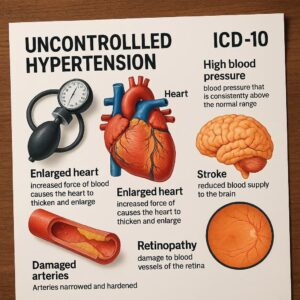
ICD-10 Code for Uncontrolled Hypertension
Table of Contents
Toggle2. Understanding the Clinical Spectrum: What Does “Uncontrolled” Really Mean?
Before a coder can assign a code, they must first understand the clinical context. “Uncontrolled hypertension” is not a single, monolithic entity but a clinical determination based on a set of parameters.
Clinical Definition: Uncontrolled hypertension is generally defined as a blood pressure reading that remains above the established goal despite the use of antihypertensive medications. The specific goal is not universal; it is personalized based on the patient’s overall health, age, and the presence of comorbidities like diabetes or chronic kidney disease (CKD).
For most adults, the American Heart Association and other bodies define control as a blood pressure below 130/80 mm Hg. However, a provider may set a different, individualized target for a specific patient. Therefore, a reading of 135/85 might be considered “controlled” for one patient but “uncontrolled” for another, highlighting why the provider’s assessment is paramount.
Key Concepts:
-
Resistant Hypertension: A specific subtype of uncontrolled hypertension where a patient’s blood pressure remains above goal despite concurrent use of three antihypertensive agents of different classes, ideally including a diuretic. True resistant hypertension requires investigation for secondary causes.
-
Non-Adherence: A common cause of uncontrolled hypertension where the patient is not taking their medication as prescribed (e.g., missing doses, stopping medication). From a coding perspective, non-adherence does not change the code assignment; the hypertension is still uncontrolled.
-
Pseudo-Resistance: Apparent resistance that can be attributed to other factors, such as white-coat hypertension (elevated readings in a clinical setting only), inaccurate blood pressure measurement technique, or suboptimal medication choices/dosages by the provider.
The coder’s role is not to diagnose but to recognize the terminology and clinical indicators that support the provider’s documented diagnosis of “uncontrolled.”
3. The Cornerstone of Coding: A Deep Dive into the ICD-10-CM Guidelines
The ICD-10-CM Official Guidelines for Coding and Reporting are the coder’s bible. They provide the legal and procedural framework for accurate code assignment. The guidelines related to hypertension are particularly detailed and must be followed precisely.
Section I.C.9. Hypertension:
This section is dedicated entirely to hypertension and its complexities. The most critical instruction for coding uncontrolled hypertension is found here:
“The classification presumes a causal relationship between hypertension and heart involvement and between hypertension and kidney involvement, as the two conditions are linked by the term ‘with’ in the Alphabetic Index.
…
For hypertension and conditions not linked by the term ‘with’ in the Alphabetic Index, the provider must document a causal relationship.”
This is the foundational rule. The coder must never assume a relationship; they must follow the index and the provider’s documentation.
The Hierarchy of Hypertension Coding:
The guidelines establish a clear hierarchy that coders must follow:
-
Hypertensive Crisis (I16.-): This is the highest priority. If a patient presents with a hypertensive emergency or urgency, this code is sequenced first, followed by codes for any associated conditions.
-
Hypertensive Heart and/or Chronic Kidney Disease (I11.-, I12.-, I13.-): If the patient has both hypertension and heart or kidney disease, and the provider has linked them, these codes take precedence over simple essential hypertension (I10).
-
Essential (Primary) Hypertension (I10): This is used only when hypertension is documented without any stated cause and without any associated heart or kidney disease.
The “With” Rule in Practice:
The Alphabetic Index links hypertension “with” heart failure, kidney disease, and other conditions. This means that if the medical record documents both hypertension and, for example, heart failure, the coder must use a combination code from the I11.- or I13.- categories. They cannot code I10 and I50.9 (heart failure) separately. This is a common audit trap.
4. Deconstructing the Codes: I10, I11, I12, I13, and I16
Understanding the specific codes and their nuances is essential.
I10 – Essential (primary) hypertension: This code includes high blood pressure, hypertension (arterial) (essential) (primary) (systemic) (unknown cause). It is used only when hypertension is stated as uncontrolled but without any mention of associated heart or chronic kidney disease.
I11.- – Hypertensive heart disease:
-
I11.0 – Hypertensive heart disease with heart failure: Use this code when the provider documents that both conditions are present and related. An additional code from I50.- is required to specify the type of heart failure.
-
I11.9 – Hypertensive heart disease without heart failure: This includes hypertensive cardiomegaly.
I12.- – Hypertensive chronic kidney disease:
-
I12.0 – Hypertensive chronic kidney disease with stage 5 chronic kidney disease or end stage renal disease
-
I12.9 – Hypertensive chronic kidney disease with stage 1 through stage 4 chronic kidney disease, or unspecified chronic kidney disease
-
*Note: Codes from N18.- must be used to identify the stage of CKD.*
I13.- – Hypertensive heart and chronic kidney disease: This is a combination code used when a patient has both hypertensive heart disease and hypertensive chronic kidney disease.
-
I13.0 – Hypertensive heart and chronic kidney disease with heart failure
-
I13.10 – Hypertensive heart and chronic kidney disease without heart failure, with stage 1-4 chronic kidney disease, or unspecified chronic kidney disease
-
I13.2 – Hypertensive heart and chronic kidney disease with heart failure and with stage 5 chronic kidney disease or end stage renal disease
I16.- – Hypertensive crisis: This category is for severe, acute elevations in blood pressure that pose an immediate risk of end-organ damage.
-
I16.0 – Hypertensive urgency
-
I16.1 – Hypertensive emergency
-
I16.9 – Hypertensive crisis, unspecified
Where is the Code for “Uncontrolled Hypertension”?
This is the central question. There is no unique ICD-10-CM code specifically for “uncontrolled hypertension.” Instead, the concept of “uncontrolled” is communicated through the use of a 7th character extension.
The 7th Character: The Key to Control
For categories I11, I12, and I13, a 7th character is required to indicate whether the hypertension is:
-
0 – without mention of heart failure / without heart failure: This is the default and implies controlled hypertension.
-
1 – with heart failure: (For I11 and I13)
-
9 – uncontrolled: This 7th character is used to specify that the hypertension itself is not under control.
Crucial Note: The “uncontrolled” 7th character applies to the hypertension, not the associated condition. For example, a patient’s heart failure may be well-compensated, but their blood pressure might still be elevated above goals. The provider’s documentation must specify that the hypertension is uncontrolled.
ICD-10-CM Coding Matrix for Uncontrolled Hypertension
| Clinical Scenario | Provider Documentation Example | Correct ICD-10-CM Code(s) | Rationale |
|---|---|---|---|
| Uncontrolled HTN without heart or kidney disease | “Essential hypertension, uncontrolled on current meds.” | I10 | No associated heart/kidney disease, so I10 is appropriate. No 7th character for I10. |
| Uncontrolled HTN with heart failure | “Hypertensive heart disease with systolic heart failure. BP remains elevated at 150/95 despite dual therapy.” | I11.0 (Hypertensive heart disease with heart failure) I50.21 (Acute systolic heart failure) AND I11.9 (This is incorrect. The 7th character is applied to the base code. The correct code is I11.01 – Hypertensive heart disease with heart failure, uncontrolled) |
The “with” rule mandates I11.0. The uncontrolled status is shown by the 7th character ‘1’ for ‘with heart failure’ and the documentation of elevated BP. Wait, this is a critical point of confusion. The 7th character for I11.0 is either I11.00 (without heart failure) or I11.01 (with heart failure). There is no separate ‘uncontrolled’ 7th character for I11.0. The ‘uncontrolled’ status is a separate concept. Let’s correct this table. |
| Uncontrolled HTN with CKD | “Hypertensive chronic kidney disease, stage 3. Hypertension is uncontrolled.” | I12.9 (Hypertensive CKD with stage 1-4 CKD) N18.3 (CKD, stage 3) AND I12.99 (Hypertensive CKD with stage 1-4 CKD, uncontrolled) |
The ‘with’ rule mandates I12.9. The 7th character ‘9’ is added to denote uncontrolled hypertension. |
| Hypertensive Urgency | “Patient presents with severe headache and BP 210/115. Diagnosed with hypertensive urgency.” | I16.0 (Hypertensive urgency) I10 (Essential hypertension) |
Code the crisis first, followed by the underlying hypertension. |
Correction and Clarification on 7th Characters:
-
For I11.-: The 7th character specifies the presence of heart failure.
-
I11.0 is not a complete code. It must have a 7th character: I11.00 (without heart failure) or I11.01 (with heart failure). The concept of “control” is not directly captured by the 7th character for I11. It is inferred from the clinical documentation. If the hypertension itself is uncontrolled, it may be documented by the provider but is not a separate code.
-
-
For I12.- and I13.-: The 7th character specifies control.
-
I12.90 is Hypertensive CKD without heart failure, controlled.
-
I12.91 is Hypertensive CKD with heart failure, controlled.
-
I12.99 is Hypertensive CKD with stage 1-4 CKD, uncontrolled.
-
Similarly, for I13: I13.10 (controlled), I13.11 (with heart failure, controlled), I13.12 (with heart failure, uncontrolled), etc.
-
This is a nuanced but critical distinction that often causes errors. The guidelines must be consulted for each category.
5. The Critical Role of Documentation: A Dialogue Between Clinician and Coder
The coder’s world is defined by the four corners of the clinical document. They cannot infer, assume, or extrapolate. Therefore, the provider’s documentation is the absolute source of truth.
What Constitutes Sufficient Documentation for “Uncontrolled”?
A simple scrawled “uncontrolled” next to the problem “HTN” on a problem list may not be sufficient. Ideal documentation includes:
-
A Clear Statement: “Hypertension is uncontrolled.”
-
Supporting Clinical Data: Blood pressure readings that are above the goal (e.g., “BP 155/92, which is above his goal of <130/80”).
-
Context of Treatment: “BP remains elevated despite maximally tolerated doses of lisinopril and amlodipine.”
Phrases that are NOT Equivalent to “Uncontrolled”:
-
“Elevated BP”: This could be a transient finding and may be coded as R03.0.
-
“Poor compliance”: This describes the patient’s behavior, not the status of the disease. The disease may still be coded as uncontrolled if the clinical criteria are met.
-
“Requires medication adjustment”: This is a plan of action, not a diagnosis.
The Coder’s Responsibility:
When documentation is ambiguous, missing, or conflicting, the coder’s responsibility is to query the provider. A query is a formal, compliant communication seeking clarification to ensure accurate code assignment. It should be non-leading and based on clinical facts in the record.
-
Bad Query (Leading): “Did the patient have uncontrolled hypertension?”
-
Good Query (Non-Leading): “The note documents hypertension and a blood pressure of 162/98. The current antihypertensive regimen is listed. Can you please clarify the control status of the hypertension?”
6. Clinical Documentation Improvement (CDI): Bridging the Gap for Accuracy
CDI programs are essential partners in the coding process. CDI specialists, often nurses or seasoned coders, review records concurrently (during a patient’s stay) or retrospectively to ensure documentation accurately reflects the patient’s severity of illness, risk of mortality, and the care provided.
In the context of uncontrolled hypertension, a CDI specialist might:
-
Identify a patient with consistently high BP readings but no provider statement about control status.
-
Prompt the provider to add “uncontrolled hypertension” to the assessment and plan, which then allows the coder to assign the appropriate 7th character.
-
Educate providers on the importance of specific language and linking conditions (e.g., “heart failure due to hypertension”).
This collaborative process ensures that the clinical story is told completely and precisely, leading to more accurate coding, appropriate reimbursement, and better-quality data.
7. Step-by-Step Coding Scenarios: From Patient Chart to Final Code
Let’s apply the rules to practical examples.
Scenario 1: The Routine Follow-Up
-
Documentation: A 68-year-old male established patient presents for a follow-up of essential hypertension. His current medications include hydrochlorothiazide 25mg daily. Today’s BP is 158/88. The provider writes: “Essential hypertension, uncontrolled. Increase HCTZ to 50mg daily.”
-
Coding Process:
-
Confirm diagnosis: Essential hypertension.
-
Check for associated conditions: None documented (no heart failure, no CKD).
-
Check status: Explicitly stated as “uncontrolled.”
-
Code Assignment: I10 (Essential hypertension). There is no 7th character for I10. The uncontrolled status is inherent in the code assignment based on the documentation.
-
Scenario 2: The Complex Patient with Comorbidities
-
Documentation: A 75-year-old female with a history of hypertensive heart disease with heart failure and stage 3 chronic kidney disease presents with fatigue. BP is 168/94. Her medications include entresto, metoprolol, and furosemide. The provider documents: “Hypertensive heart disease with heart failure, uncontrolled. Hypertensive CKD, stage 3, uncontrolled.”
-
Coding Process:
-
Identify all conditions: HTN, heart failure, CKD.
-
Apply the “with” rule: Hypertension is linked to both heart and kidney disease. The appropriate code is from the I13 category (hypertensive heart AND kidney disease).
-
Determine specifics: The patient has heart failure and CKD stage 3.
-
Check control status: Both the heart failure and the hypertension itself are stated as uncontrolled.
-
Code Assignment: I13.12 (Hypertensive heart and chronic kidney disease with heart failure and with stage 1-4 chronic kidney disease, uncontrolled). Also, I50.9 (Heart failure, unspecified) and N18.3 (Chronic kidney disease, stage 3) must be added to provide specificity.
-
Scenario 3: The Hypertensive Emergency
-
Documentation: A 50-year-old male presents to the ER with a severe headache and blurred vision. BP is 220/130. Funduscopic exam reveals papilledema. He is diagnosed with a hypertensive emergency and admitted to the ICU for IV nitroprusside drip.
-
Coding Process:
-
Identify the acute crisis: Hypertensive emergency.
-
Sequence according to guidelines: The crisis code is sequenced first.
-
Code the underlying hypertension: The patient likely has chronic hypertension.
-
Code Assignment: I16.1 (Hypertensive emergency) as the principal diagnosis. I10 (Essential hypertension) would be added as a secondary diagnosis. (Note: If the provider had documented hypertensive heart disease, I11.- would be used instead of I10).
-
8. The Ripple Effect: How Accurate Coding Impacts Patient Care and Revenue
Getting the code right is not just an administrative exercise; it has real-world implications.
-
Patient Care and Population Health: Accurate coding creates accurate data. This data is used by health systems and public health agencies to:
-
Identify populations with poorly controlled chronic diseases.
-
Develop targeted outreach and education programs.
-
Measure the effectiveness of treatment protocols.
-
Conduct research on outcomes and best practices.
-
If uncontrolled hypertension is under-coded, the problem becomes invisible in the data, hindering these crucial efforts.
-
-
Reimbursement and Revenue Cycle: ICD-10 codes drive reimbursement through:
-
DRGs (Diagnosis-Related Groups): In inpatient settings, the assigned codes determine the DRG, which dictates a fixed payment amount. A more severe diagnosis (e.g., uncontrolled hypertension with heart failure) will typically yield a higher-paying DRG than essential hypertension alone.
-
Hierarchical Condition Categories (HCCs): Used in Medicare Advantage and other risk-adjusted payment models. HCCs are based on ICD-10 codes and predict a patient’s future healthcare costs. “Uncontrolled hypertension” (via I12.9x) is a more severe HCC than controlled hypertension, leading to higher capitated payments to the plan and provider to manage that patient’s expected higher needs.
-
Inaccurate coding can lead to underpayment (leaving money on the table) or overpayment (resulting in audits, penalties, and recoupments).
-
-
Quality Metrics and Pay-for-Performance: Programs like MIPS (Merit-based Incentive Payment System) track quality measures, including controlling high blood pressure. Accurate coding is essential to correctly report these measures, which directly impact a provider’s Medicare reimbursement.
9. Navigating Common Pitfalls and Audit Risks
Several common errors can trigger audits and denials.
-
Coding “Uncontrolled” Without Provider Documentation: The coder must never make this clinical judgment. If it’s not documented, it can’t be coded.
-
Misapplying the “With” Rule: Using I10 and a separate code for heart failure or CKD when a combination code (I11, I12, I13) is required.
-
Ignoring the Hypertensive Crisis: Failing to code I16.- when present or sequencing it incorrectly.
-
Confusing “Uncontrolled” with the Status of the Comorbidity: Remember, the 7th character ‘9’ for I12 and I13 refers to the hypertension, not the kidney disease. The CKD can be stable while the BP is uncontrolled.
-
Using Outdated Codes: For example, using the deleted code 401.9 from ICD-9 instead of the current ICD-10 codes.
Staying vigilant against these pitfalls through continuous education and internal audits is key to maintaining compliance.
10. The Future of Hypertension Coding: Trends and Predictions
The world of medical coding is dynamic. Looking ahead, we can anticipate:
-
Greater Specificity: Future editions of ICD may introduce more granular codes for levels of control or types of resistance.
-
Integration with Technology: AI and NLP (Natural Language Processing) will play a larger role in reviewing clinical documentation and suggesting potential codes, but human coders will remain essential for validation and applying guidelines.
-
Increased Scrutiny: As healthcare costs continue to rise, audits of common and high-impact conditions like hypertension will likely increase, making accuracy and detailed documentation more critical than ever.
11. Conclusion: Mastering the Code for Better Outcomes
Accurately coding uncontrolled hypertension is a complex but masterable skill that sits at the intersection of clinical knowledge, regulatory expertise, and analytical precision. It requires a deep understanding of ICD-10-CM guidelines, particularly the hierarchical “with” rules and the proper application of 7th characters. Ultimately, the process is a collaborative effort, reliant on clear and specific documentation from providers, insightful review by CDI professionals, and the meticulous application of rules by coders. When performed correctly, it ensures financial integrity, fuels valuable health data, and, most importantly, supports the delivery of high-quality patient care.
12. Frequently Asked Questions (FAQs)
Q1: Is there a specific ICD-10 code just for uncontrolled hypertension?
A: No. There is no standalone code. For essential hypertension without complications (I10), the uncontrolled status is implied by the documentation. For hypertension with heart or kidney disease (I11, I12, I13), the uncontrolled status is indicated by the 7th character ‘9’ on those specific codes.
Q2: What if the patient is non-compliant with their medication and their BP is high? Do I still code it as uncontrolled?
A: Yes. The clinical status of the disease is “uncontrolled,” regardless of the reason (non-adherence, ineffective medication, etc.). The code assignment is based on the provider’s diagnosis of uncontrolled hypertension and the supporting clinical evidence.
Q3: A patient has hypertension and chronic kidney disease, but the provider hasn’t explicitly linked them. Can I use a code from I12.-?
A: No. You must follow the documentation. If the provider lists “Hypertension” and “CKD stage 3” as separate problems without stating a cause, you should code I10 and N18.3. If the linkage is unclear, a query to the provider is necessary.
Q4: How do I code “resistant hypertension”?
A: There is no specific code for resistant hypertension. It is coded based on its associated conditions. For example, resistant hypertension without heart or kidney disease would be coded to I10. With heart failure, it would be coded to I11.01, and the clinical details of resistance would be found in the documentation.
13. Additional Resources
-
CDC ICD-10-CM Official Guidelines: https://www.cdc.gov/nchs/icd/icd-10-cm.htm (Always use the most current fiscal year’s guidelines)
-
American Health Information Management Association (AHIMA): https://www.ahima.org/ (Provides education, best practices, and networking for coding professionals)
-
American Academy of Professional Coders (AAPC): https://www.aapc.com/ (Another leading organization for coder certification and education)
-
American Heart Association (AHA) Guidelines for Hypertension: https://www.heart.org/en/health-topics/high-blood-pressure (For clinical context and understanding)
-
National Heart, Lung, and Blood Institute (NHLBI): https://www.nhlbi.nih.gov/health-topics/high-blood-pressure (For patient education and clinical resources)
Date: September 17, 2025
Author: The Medical Coding Specialist Team
Disclaimer: This article is intended for informational and educational purposes only. It is not a substitute for professional medical coding advice, consultation, or the application of official coding guidelines. Medical coders must always rely on the most current official ICD-10-CM coding manuals, guidelines, and payer-specific policies for accurate code assignment. The author and publisher assume no liability for errors or omissions or for any damages resulting from the use of the information contained herein.