Finding the right medical code can sometimes feel like searching for a needle in a haystack. If you are dealing with a patient who has a rare, progressive autoimmune disorder, you want to be precise. You want to avoid denials. And you certainly want to reflect the true complexity of the condition.
Chronic Inflammatory Demyelinating Polyradiculoneuropathy (CIDP) is exactly that kind of condition. It is a neurological disorder that causes weakness, numbness, and fatigue. For medical coders, billers, and neurologists, getting the ICD 10 code right is the first step toward proper reimbursement and patient care tracking.
In this guide, we will walk you through everything you need to know about the ICD 10 code for chronic inflammatory demyelinating polyradiculoneuropathy. We will keep things simple, clear, and practical.
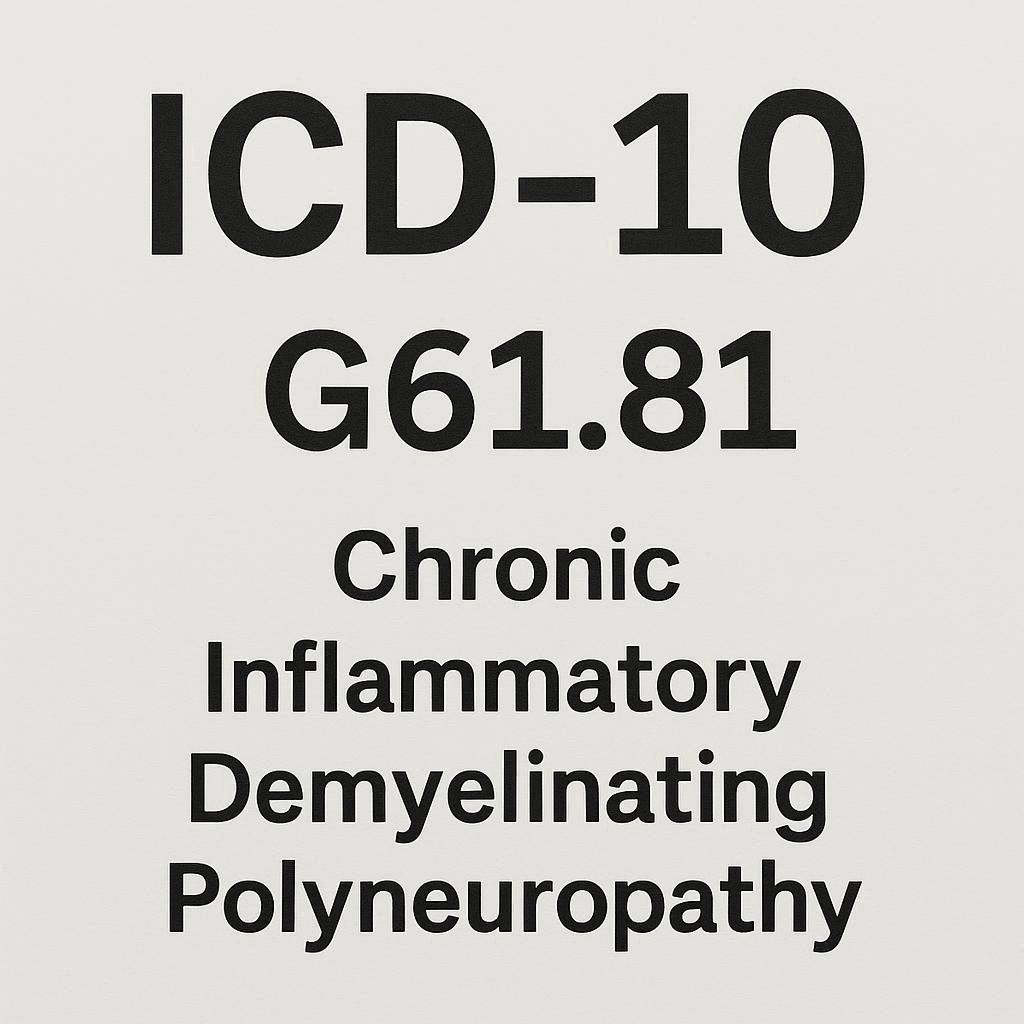
The Short Answer: The Primary ICD 10 Code for CIDP
If you need the code right now, here it is:
- G61.81 – Chronic inflammatory demyelinating polyradiculoneuropathy
This is the dedicated, specific code for CIDP. It was introduced to replace older, less specific codes like G61.8 (Other inflammatory polyneuropathies) or G61.9 (Inflammatory polyneuropathy, unspecified).
Important Note for Readers: Always verify code changes at the beginning of each fiscal year. While G61.81 is current as of this writing (2026), ICD-10 updates happen annually. Check your official coding manual or software.
Why a Specific Code for CIDP Matters
Before G61.81 existed, coders had to squeeze CIDP into vague categories. That caused problems. Insurers would question the diagnosis. Researchers could not easily track how many people had CIDP. And doctors struggled to justify expensive treatments like intravenous immunoglobulin (IVIg) or plasmapheresis.
Now, with a unique code, the medical system acknowledges CIDP as a distinct condition. This helps in three major ways:
- Faster prior authorizations for treatments.
- Better data collection for epidemiological studies.
- Fewer claim denials due to unspecified diagnosis codes.
Understanding CIDP in Simple Terms
To code well, you need to understand what you are coding. You do not need a medical degree. But a basic grasp of the disease helps you spot documentation errors.
What Actually Happens in CIDP?
Your body’s immune system attacks the myelin sheath. Think of myelin as the plastic coating around an electrical wire. When that coating gets damaged, the nerve signals slow down or stop. Unlike Guillain-Barré syndrome (which comes on fast and often resolves), CIDP is chronic. It lasts for months or years. Symptoms come and go or slowly get worse.
Common Symptoms You Will See in Medical Records
When you read a patient’s chart, look for these documented findings:
- Progressive weakness in the legs and arms (often symmetrical)
- Tingling or numbness starting in the toes and fingers
- Loss of reflexes (areflexia)
- Fatigue that is out of proportion to activity
- Difficulty walking or climbing stairs
- Impaired balance
If the physician documents these symptoms alongside an electrodiagnostic study showing demyelination, you are likely looking at a CIDP case.
Official Classification of G61.81
Let us break down the code structure. Understanding the hierarchy makes you a stronger coder.
| Code Component | Value | Meaning |
|---|---|---|
| Category | G61 | Inflammatory polyneuropathy |
| Subcategory | G61.8 | Other inflammatory polyneuropathies |
| Specific code | G61.81 | Chronic inflammatory demyelinating polyradiculoneuropathy |
| Billable? | Yes | Specific and valid for reimbursement |
G61.81 falls under the larger chapter of Diseases of the nervous system (G00-G99). Specifically, it belongs to the block Polyneuropathies and other disorders of the peripheral nervous system (G60-G65).
When to Use G61.81 (And When Not To)
This is where many coders get confused. Just because a patient has neuropathy and inflammation does not automatically mean you use G61.81.
✅ Correct Scenarios for G61.81
- A neurologist writes: “The patient meets EFNS/PNS criteria for definite CIDP. Electrophysiology shows multifocal demyelination.”
- The discharge summary lists: “Chronic inflammatory demyelinating polyradiculoneuropathy, relapsing-remitting type.”
- A follow-up note states: “CIDP, currently on maintenance IVIg every 4 weeks.”
❌ Incorrect Scenarios for G61.81
- The documentation only says “Chronic neuropathy, inflammatory type” – that is too vague.
- The patient has acute symptoms lasting less than 8 weeks – that may be Guillain-Barré (G61.0).
- The physician writes “Possible CIDP, rule out other causes” without a definitive diagnosis.
Golden rule of coding: Never assume a diagnosis. Code only what the physician explicitly documents as confirmed or probable (if your facility allows probable diagnosis coding).
Clinical Variants of CIDP and Related Codes
CIDP is not one single, uniform disease. It has several variants. Each variant may require a different code or an additional code. Let us look at the most common ones.
Typical CIDP (G61.81)
This is the classic form. Symmetric weakness in proximal and distal muscles. Sensory loss. The patient may need a cane or walker.
Multifocal Acquired Demyelinating Sensory and Motor Neuropathy (MADSAM)
Also called Lewis-Sumner syndrome. This variant is asymmetric. It affects individual nerves. Many experts still classify it under CIDP. In practice, most coders use G61.81 for MADSAM as well, because there is no separate specific code. However, check your payer guidelines.
Distal Acquired Demyelinating Symmetric (DADS) Neuropathy
This variant mainly affects the lower legs and hands. It is often associated with IgM monoclonal gammopathy. Here you may need two codes:
- G61.81 for the CIDP
- C88.0 (Waldenström macroglobulinemia) or a code for monoclonal gammopathy if documented
Pure Motor CIDP
Only weakness, no sensory symptoms. Still coded as G61.81. But the physician should document the pure motor presentation in the notes.
Pure Sensory CIDP
Only numbness and sensory ataxia. Again, use G61.81. Be careful: sensory variants are often misdiagnosed. Make sure the neurologist explicitly confirms the demyelinating nature.
Comparison Table: CIDP vs. Similar Conditions
This table helps you quickly distinguish CIDP from other neuropathies. It reduces coding errors.
| Condition | ICD 10 Code | Key Difference from CIDP |
|---|---|---|
| Chronic inflammatory demyelinating polyradiculoneuropathy | G61.81 | Chronic (>8 weeks), relapsing or progressive |
| Guillain-Barré syndrome | G61.0 | Acute (peaks within 4 weeks), often precedes recovery |
| Other inflammatory polyneuropathy | G61.8 | Non-specific, use only if CIDP is ruled out |
| Inflammatory polyneuropathy, unspecified | G61.9 | Avoid if possible. Last resort only. |
| Diabetic polyneuropathy | E11.42 (type 2 with neuropathy) | Caused by diabetes, not autoimmune demyelination |
| Charcot-Marie-Tooth disease | G60.0 | Hereditary, not inflammatory |
| Chronic relapsing polyneuropathy | G61.81 (effectively the same as CIDP) | This is an older term; G61.81 still applies |
Documentation Requirements for G61.81
You can have the right code. But if the medical record does not support it, the insurance company will deny your claim. Here is what every chart must contain to justify G61.81.
Essential Elements
- Chronicity: Symptoms for at least 8 weeks. Ideally documented as “symptoms began 6 months ago” or “persistent weakness since 2024.”
- Demyelinating features: Nerve conduction studies showing slowed conduction velocities, prolonged distal latencies, or conduction block.
- Inflammatory nature: CSF analysis with elevated protein (though not mandatory for all cases).
- Exclusion of other causes: Documentation that diabetes, uremia, toxins, and heredity were ruled out.
Optional But Helpful Elements
- Response to immunotherapy (e.g., “Patient improved after 5 days of IVIg”)
- CIDP Disease Activity Score (CDAS)
- Functional status (ability to walk, need for assistive device)
A quote from a practicing neurologist: “The number one reason I see claims denied is not the wrong code, but missing nerve conduction study results in the chart. Always make sure the electrodiagnostic report is scanned in.” – Dr. S. Patel, MD, Neuromuscular Medicine.
How to Sequence ICD 10 Codes for CIDP
Medical coding is rarely a single code. Most patients with CIDP have other conditions. Or they develop complications. Proper sequencing (listing the primary diagnosis first) affects payment.
Scenario 1: CIDP as the Primary Reason for Encounter
The patient comes for an IVIg infusion. CIDP is the main problem.
- Primary (first-listed): G61.81
- Secondary: Z51.81 (Encounter for therapeutic drug level monitoring) or the appropriate infusion code in CPT, not ICD-10.
Scenario 2: CIDP with a Related Complication
CIDP leads to a fall. The patient fractures a hip.
- Primary: S72.001A (Fracture of unspecified part of neck of right femur, initial encounter)
- Secondary: G61.81
- Reason: The fracture is the reason for admission. CIDP is the underlying cause.
Scenario 3: CIDP with a Chronic Comorbidity
The patient has CIDP and type 2 diabetes.
- Primary: G61.81 (if CIDP is the focus of today’s visit)
- Secondary: E11.42 (Type 2 diabetes with diabetic polyneuropathy)
- Note: You can code both neuropathies because they have different etiologies. Do not use E11.42 alone if CIDP is confirmed.
Scenario 4: CIDP in Remission
The patient has no active symptoms but continues follow-up care.
- Primary: G61.81
- Secondary: Z92.81 (History of CIDP? Actually, there is no specific history code for CIDP. Use Z09 – follow-up examination after treatment of other conditions).
- Better approach: Some coders use G61.81 with a “personal history” note. Ask your compliance officer.
Common Billing Mistakes and How to Avoid Them
Even experienced coders slip up. Here are the top five mistakes for CIDP coding.
1. Using G61.9 (Unspecified Inflammatory Polyneuropathy)
This is a lazy code. It pays less. And it triggers audits. Always push for G61.81 if the physician has done the basic workup.
2. Mixing Up CIDP with CIDP Variants That Have Different Codes
There is no specific code for “multifocal motor neuropathy” (MMN) – that is G61.81 as well. But “chronic motor neuropathy with conduction block” sometimes confuses coders. Stick to G61.81 unless the physician writes a different diagnosis.
3. Forgetting to Code the Associated Conditions
CIDP often comes with:
- Monoclonal gammopathy – add D47. (Essential thrombocythemia) or related code.
- HIV – add B20
- Hepatitis C – add B17.10 or B18.2
Do not ignore these. They affect medical necessity for certain treatments.
4. Coding CIDP as “Chronic Relapsing Polyneuropathy”
This is an older synonym. But some coders look for a different code. There is none. G61.81 remains correct. However, avoid confusing this with “Chronic relapsing inflammatory optic neuropathy” (which is H46.1).
5. Using G61.81 for Acute Presentations
If the onset was two weeks ago, and the physician says “possible early CIDP,” wait. Most guidelines require 8 weeks of progression. Use G61.0 (Guillain-Barré) or G62.9 (Polyneuropathy, unspecified) until the diagnosis is confirmed.
ICD 10 Code for CIDP in Children vs. Adults
CIDP is rare in children, but it happens. The code does not change based on age. You still use G61.81 for pediatric patients.
However, pay attention to:
- Pediatric CIDP may have a different prognosis. But code remains the same.
- Age-specific guidelines for IVIg dosing do not affect diagnosis coding.
- Genetic neuropathies (like CMT) are more common in children. Rule them out before using G61.81.
Treatment Codes Often Paired with G61.81
While ICD-10 codes describe the diagnosis, CPT codes describe the service. Here are common procedures you will see alongside G61.81.
| Treatment | CPT Code (example) | Typical Frequency |
|---|---|---|
| Intravenous immunoglobulin (IVIg) infusion | 96365 (first hour) + 96366 (each additional hour) | Every 3–4 weeks |
| Subcutaneous immunoglobulin (SCIg) | 96372 (therapeutic injection) | Weekly or biweekly |
| Plasmapheresis | 36514 (apheresis) | 5 sessions over 10 days |
| Corticosteroids (prednisone) | No CPT code for oral meds; J-code for IV: J7512 | Daily taper or pulse |
| Rituximab infusion | J9312 (10 mg) | Every 6 months |
| Nerve conduction study / EMG | 95913 (NCS) + 95886 (EMG) | One time for diagnosis |
Real-World Example: A Complete Coding Scenario
Let us walk through a sample patient chart. This will show you how theory becomes practice.
Patient Presentation:
A 54-year-old woman comes to the neurology clinic. She has a known diagnosis of CIDP for three years. She reports increased difficulty walking and numbness spreading to her thighs. Her last IVIg infusion was five weeks ago. She also has well-controlled hypothyroidism.
Physician Note:
“Patient with CIDP, currently in mild relapse based on decreased knee reflexes and increased Neuropathy Impairment Score. Will resume IVIg every three weeks. Check TSH to rule out hypothyroidism exacerbation.”
Step-by-Step Coding:
- Primary code: G61.81 – The physician documents active CIDP relapse.
- Secondary code: E03.9 (Hypothyroidism, unspecified) – It is controlled but still present.
- Do NOT code: Z51.81 (Encounter for IVIg) because this is a clinic visit, not the infusion session.
- Final ICD-10-CM codes: G61.81, E03.9.
Pro tip: If the same patient went to the infusion center next week, then you would add a “Z” code for long-term drug use (Z79.89 – Other long-term drug therapy).
Frequently Asked Questions (FAQ)
Q1: Is G61.81 a billable code?
Yes. G61.81 is a valid, specific, and billable ICD-10-CM code. It is not a placeholder or a parent code.
Q2: Can I use G61.81 for the acute onset variant of CIDP?
CIDP, by definition, is chronic. Acute onset cases (symptoms for less than 4 weeks) are usually Guillain-Barré. Use G61.0. If the condition evolves into CIDP after 8 weeks, you can change the code back to G61.81.
Q3: What is the difference between G61.81 and G61.8?
G61.8 is the parent category “Other inflammatory polyneuropathies.” G61.81 is the specific child code for CIDP. Always use G61.81 when CIDP is confirmed. Use G61.8 only for rare inflammatory polyneuropathies that are not CIDP, not GBS, and not otherwise classified.
Q4: Does CIDP have a separate code if it is paraneoplastic?
No. If CIDP is secondary to cancer, you code both:
- The cancer (C00-D49)
- G61.81 for CIDP
Use the “manifestation” sequencing rules. Usually, the cancer is primary if it is the underlying cause.
Q5: How do I code CIDP if the documentation says “Chronic inflammatory demyelinating polyneuropathy” (without the full “radiculoneuropathy”)?
Code it as G61.81. The term “polyneuropathy” is clinically equivalent to “polyradiculoneuropathy” in most contexts. But to be safe, ask the physician to add the full term.
Q6: What about CIDP with a monoclonal gammopathy of undetermined significance (MGUS)?
You need two codes:
- G61.81 for CIDP
- D47. (Essential thrombocythemia? No) – Actually MGUS is D47.2 (Monoclonal gammopathy of undetermined significance).
This combination is common and well-supported by clinical literature.
Q7: Can I code G61.81 as a secondary diagnosis for inpatient stays?
Yes. For example, a patient admitted for pneumonia but with history of CIDP. If the CIDP is stable and does not affect treatment, you can list it as a secondary diagnosis. However, if CIDP complicates management (e.g., respiratory weakness), it should be primary or secondary as appropriate.
Additional Resources for Medical Coders
You do not have to memorize everything. Use trusted references.
🔗 Recommended external link:
The GBS/CIDP Foundation International – Medical Professionals Page
This non-profit organization offers free coding webinars, clinical criteria summaries, and billing tip sheets. It is a reliable, peer-reviewed source.
Other useful resources:
- ICD-10-CM Official Guidelines for Coding and Reporting – Updated annually by CMS and NCHS.
- AAN (American Academy of Neurology) – CIDP practice guidelines – These help you understand what documentation payers expect.
- Your local MAC (Medicare Administrative Contractor) – They publish local coverage determinations for IVIg in CIDP.
Final Coding Checklist for CIDP
Before you submit a claim with G61.81, run through this checklist.
- The physician explicitly wrote “Chronic inflammatory demyelinating polyradiculoneuropathy” or “CIDP.”
- The chart contains nerve conduction study results showing demyelination.
- Symptoms have been present for at least 8 weeks (unless it is a previously diagnosed case).
- You have checked for associated conditions (MGUS, hepatitis, HIV, diabetes).
- The sequencing follows the reason for the encounter (primary = main reason).
- You are not using G61.81 for acute neuropathy or unspecified inflammatory neuropathy.
- For Medicare patients, you have verified the medical necessity for any high-cost treatment.
What the Future Holds for CIDP Coding
ICD-11 is already out in some countries. The United States continues to use ICD-10 for now. But change will come. In ICD-11, CIDP has its own stem code: 8C43.0 (Chronic inflammatory demyelinating polyradiculoneuropathy). The classification is more detailed.
When the US transitions, expect better specificity. But for today, G61.81 remains your best and most accurate choice.
Stay updated. Follow the CDC’s website for ICD-10 updates. And always, always read the physician’s note – do not code from a face sheet.
Conclusion: Your Takeaway in Three Lines
The correct ICD 10 code for chronic inflammatory demyelinating polyradiculoneuropathy is G61.81, a specific, billable code that replaced vague alternatives. To use it properly, ensure the documentation clearly shows chronicity (over 8 weeks), demyelination on nerve studies, and a definitive diagnosis from a neurologist. Always pair G61.81 with any related conditions like MGUS or diabetes, and avoid using unspecified codes like G61.9 unless absolutely necessary.
Disclaimer: This article is for educational purposes only. Medical coding regulations vary by location, payer, and date. Always consult your official ICD-10-CM manual and your compliance officer. The author and publisher assume no responsibility for claim denials, audit penalties, or adverse outcomes resulting from the use of this information.
Date of last review: APRIL 27, 2026