Chest pain is one of the most common, yet most alarming, symptoms that brings a patient to a healthcare provider. It is a sensation that can range from a dull, persistent ache to a sharp, stabbing torment, and its origins are as varied as its character. It can be the harbinger of a life-threatening myocardial infarction, the burning discomfort of gastroesophageal reflux, the sharp catch of a musculoskeletal strain, or the tightness of an anxiety attack. For the clinician, the immediate goal is diagnosis and treatment—a medical puzzle of the highest stakes. But for the medical coder, the puzzle is one of language and precision: how to accurately translate the clinician’s findings into the universal, standardized code that tells the patient’s story to insurance companies, researchers, and public health officials.
This translation is not a mere administrative task. The International Classification of Diseases, 10th Revision, Clinical Modification (ICD-10-CM) code assigned for a case of chest pain is a critical piece of data. It impacts healthcare reimbursement, drives quality metrics, influences public health tracking, and contributes to medical research. Using an incorrect or nonspecific code can lead to claim denials, compliance issues, audits, and a distorted understanding of population health. Therefore, mastering the ICD-10 coding for chest pain is an essential skill for any medical coder, biller, or healthcare administrator.
This comprehensive guide is designed to be your definitive resource. We will move beyond a simple listing of codes and delve into the philosophy, rules, and practical application of ICD-10-CM as it pertains to chest pain. We will explore the hierarchy of codes, from the general “unspecified” code to highly specific descriptors of pain location and type. Most importantly, we will emphasize the cardinal rule of coding: code first the underlying cause. By the end of this article, you will not only know which code to use but, more crucially, why you are using it, enabling you to navigate even the most complex clinical documentation with confidence and accuracy.
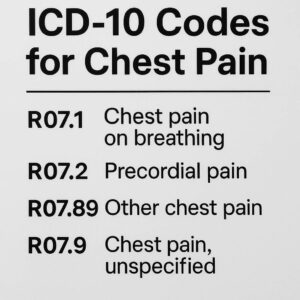
ICD-10 Codes for Chest Pain
2. Chapter 1: Understanding the ICD-10-CM Framework for Symptoms and Signs
Before we address chest pain specifically, it is vital to understand where its codes reside within the vast ICD-10-CM system. Codes for chest pain are found in Chapter 18: Symptoms, Signs, and Abnormal Clinical and Laboratory Findings, Not Elsewhere Classified (R00-R99).
The Role of Codes for Symptoms and Signs (Chapter 18)
This chapter serves a specific and important purpose. It provides codes for situations where a patient presents with a symptom, but a definitive diagnosis has not yet been established. For example, when a patient arrives at the Emergency Department with chest pain, the initial presenting symptom is the chest pain itself. After a thorough workup—which may include an EKG, blood tests, and imaging—a diagnosis like “musculoskeletal strain” or “gastroesophageal reflux disease” may be reached. However, if the workup is inconclusive and no specific cause is identified, the symptom (chest pain) remains the billable diagnosis.
The codes in Chapter 18 are governed by a fundamental rule, stated in the official ICD-10-CM Guidelines:
“Codes from Chapter 18 should not be used if a definitive diagnosis has been established.”
This is the cornerstone of accurate coding for symptoms like chest pain.
Specificity is King: The Philosophy Behind ICD-10
A primary driver of the transition from ICD-9 to ICD-10 was the immense increase in specificity. ICD-9 had a single, broad code for chest pain (786.50). ICD-10-CM, by contrast, offers a family of codes that allow for a much more nuanced description. This specificity provides a clearer clinical picture for data analysis. For instance, tracking the number of patients with “chest pain on breathing” (R07.1) can offer different public health insights than tracking “precordial pain” (R07.2).
3. Chapter 2: The Primary Code – A Deep Dive into R07.9 (Chest Pain, Unspecified)
The code most associated with chest pain is R07.9 – Chest pain, unspecified.
When and Why to Use R07.9
This code should be used sparingly and only when justified by the medical documentation. Its appropriate use is limited to scenarios where the documentation is genuinely lacking in detail. For example:
-
The clinician’s note simply states “chest pain” with no further description of its nature, location, or cause.
-
The patient’s workup is incomplete, and the provider has not indicated a more specific type of pain or a underlying cause.
R07.9 is a necessary tool for coding encounters where information is incomplete. However, it is often overused as a default, which leads to significant drawbacks.
The Legal and Reimbursement Risks of Overusing Unspecified Codes
Relying heavily on R07.9 poses several risks:
-
Claim Denials: Insurance payers may view the use of an unspecified code as indicative of a lack of medical necessity for the services provided. They expect that a competent clinical evaluation will yield a more specific diagnosis.
-
Audit Triggers: A high frequency of unspecified codes in a practice’s billing can be a red flag for auditors, suggesting poor documentation or a lack of clinical rigor.
-
Poor Data Quality: It undermines the very purpose of ICD-10’s specificity, contributing to vague and less useful healthcare data for research and public health initiatives.
The coder’s responsibility is to always look for a more specific code within the documentation before resorting to R07.9.
4. Chapter 3: The Specificity Spectrum – A Guide to R07.1 – R07.89
When the documentation provides more detail, you must use a more specific code. The following codes offer a hierarchy of specificity for chest pain not yet linked to a definitive underlying disease.
| ICD-10-CM Code | Code Description | Clinical Example & When to Use |
|---|---|---|
| R07.0 | Pain in throat and chest | Patient complains of a pain that seems to originate in the throat and radiate to the chest. |
| R07.1 | Chest pain on breathing | Pain that is explicitly tied to respiration (e.g., “pain when I take a deep breath”). Often associated with pleural irritation. |
| R07.2 | Precordial pain | Pain localized to the precordium (the area over the heart). This is a more specific location than general chest pain. |
| R07.81 | Pleurodynia | Sharp, intermittent pain due to inflammation of the pleural muscles (often viral in origin). |
| R07.82 | Intercostal pain | Pain localized to the intercostal spaces (between the ribs), often musculoskeletal. |
| R07.89 | Other chest pain | A critical code. Used for other well-described chest pain not represented by the other codes (e.g., “left-sided chest pain,” “burning chest pain” if not GERD). |
Table 1: Spectrum of Specificity for ICD-10-CM Chest Pain Codes
R07.89: Other Chest Pain – A Critical Category
R07.89 is arguably one of the most important codes in this family. It is used when the documentation provides a specific description of the pain that doesn’t fit the other subcategories but where a definitive underlying cause (like angina or GERD) has not been diagnosed. Examples include:
-
“Left-sided chest pain”
-
“Burning chest pain” (if the provider has not diagnosed GERD)
-
“Non-radiating chest tightness”
The key is that R07.89 is more specific than R07.9 but is still a symptom code, meaning it is subject to the “code first” rule if a cause is found.
5. Chapter 4: The Golden Rule – Code First the Underlying Cause
This is the most critical concept in chest pain coding. As per the ICD-10-CM guidelines, if the provider establishes a causal diagnosis, you must code that condition first. The chest pain code (from the R07 series) should generally not be used as the primary code in this situation. It may be listed as a secondary code if the pain is a significant part of the clinical picture.
Let’s examine the most common underlying causes.
Cardiac Chest Pain: The I20-I25 Series
If the provider diagnoses a cardiac condition as the cause, this becomes the primary code.
-
Angina Pectoris (I20.-): Codes like I20.0 (Unstable angina) or I20.9 (Angina, unspecified) would be primary. The chest pain is a symptom of the angina.
-
Acute Myocardial Infarction (I21.-): The MI code is primary. Chest pain is the defining symptom.
-
Other forms of Ischemic Heart Disease (I24-I25): These would also be coded first.
Coding Example:
-
Diagnosis: “Acute anterolateral myocardial infarction.”
-
Correct Coding: I21.09 (ST elevation myocardial infarction involving other coronary artery of anterior wall) is the primary code. A code from R07.8 or R07.9 is typically not added, as the pain is inherent to the diagnosis.
Respiratory Causes: J00-J99
Chest pain is a common symptom of many respiratory conditions.
-
Pneumonia (J18.9): Pleuritic chest pain (pain on breathing) is common.
-
Pleurisy (J90): Inflammation of the pleura directly causes chest pain on breathing.
-
Pulmonary Embolism (I26.-): Often presents with pleuritic chest pain.
Coding Example:
-
Diagnosis: “Community-acquired pneumonia with pleuritic chest pain.”
-
Correct Coding: J18.9 (Pneumonia, unspecified organism) is primary. You may add R07.1 (Chest pain on breathing) as a secondary code to emphasize the symptom.
Gastrointestinal Causes: K20-K31
GI issues are a frequent non-cardiac cause of chest pain.
-
Gastroesophageal Reflux Disease (GERD) (K21.0 or K21.9): The classic “heartburn” is a form of chest pain.
-
Esophageal Spasm (K22.4): Can cause severe, squeezing chest pain mimicking a heart attack.
Coding Example:
-
Diagnosis: “Chest pain due to GERD.”
-
Correct Coding: K21.9 (Gastro-esophageal reflux disease without esophagitis) is primary. A chest pain code is not necessary as the GERD is the cause.
Musculoskeletal Causes
-
Costochondritis (M94.0): Inflammation of the costochondral junctions. This is a very common cause of localized chest wall pain.
-
Pain in Thoracic Spine (M54.6): Can refer pain to the chest.
Coding Example:
-
Diagnosis: “Anterior chest wall pain, consistent with costochondritis.”
-
Correct Coding: M94.0 (Costochondritis) is primary.
Anxiety and Panic Disorders: F41.0, F41.1
Chest pain, often described as tightness or palpitations, is a common somatic symptom of anxiety and panic attacks.
Coding Example:
-
Diagnosis: “Panic attack presenting with acute chest tightness.”
-
Correct Coding: F41.0 (Panic disorder) is primary.
6. Chapter 5: The Coding Workflow – From Patient Encounter to Final Code
A structured approach ensures accuracy and compliance. Follow these steps:
-
Thoroughly Review the Medical Documentation: Read the entire encounter note—the History of Present Illness (HPI), Review of Systems (ROS), Physical Exam, and Assessment/Plan. Look for descriptive words about the pain (sharp, dull, burning, pleuritic, precordial) and any definitive diagnoses.
-
Identify the Provider’s Final Diagnosis: The “Assessment” or “Diagnosis” section is paramount. This is the provider’s conclusion. Do not code based solely on the patient’s complaints in the HPI.
-
Apply the ICD-10-CM Official Guidelines: Consult the guidelines for Chapter 18 and any specific guidelines for the diagnosed condition. Look for “Code first” and “Use additional code” notes in the Tabular List.
-
Sequence Codes Correctly: If a definitive cause is diagnosed, sequence that code first. If the encounter is purely for a symptom with no cause found, the symptom code (from R07) is primary.
-
Verify Medical Necessity: Ensure that the chosen code(s) justify the procedures (CPT codes) performed during the visit. The diagnosis must support the medical necessity of the service.
7. Chapter 6: Real-World Clinical Scenarios and Coding Examples
Let’s apply the workflow to realistic cases.
Scenario 1: The Emergency Department Visit for Atypical Chest Pain
-
Documentation: A 45-year-old male presents with 2 hours of sharp, left-sided chest pain that worsens with deep inspiration. EKG and troponin levels are normal. The physician’s final assessment is “Atypical chest pain, rule out pleurisy. Etiology unclear at this time.”
-
Analysis: No definitive cause is diagnosed. The pain is described as “sharp, left-sided” and “worsens with inspiration,” which points to pleuritic qualities.
-
Correct Codes: R07.1 (Chest pain on breathing) is the most specific primary code. R07.89 (Other chest pain) could be considered as an additional code to capture “left-sided,” but R07.1 is sufficient. R07.9 would be incorrect due to the specific description.
Scenario 2: The Primary Care Follow-up for Diagnosed Costochondritis
-
Documentation: A patient follows up for chest pain. The note states: “Patient here for follow-up of chest wall pain. Diagnosed with costochondritis at last visit. Pain is improving with NSAIDs.”
-
Analysis: A definitive, underlying cause has been established: costochondritis.
-
Correct Codes: M94.0 (Costochondritis) is the primary code. A chest pain code from the R07 series is not used.
Scenario 3: The Inpatient Admission for Acute Myocardial Infarction
-
Documentation: Patient admitted with severe substernal chest pressure radiating to the left arm. Diagnosed with NSTEMI (Non-ST elevation MI).
-
Analysis: The chest pain is the symptom of the definitive, underlying cause: an acute MI.
-
Correct Codes: I21.4 (Non-ST elevation myocardial infarction) is the primary code. A code for chest pain is redundant and should not be assigned.
Scenario 4: The Specialist Visit for GERD-Related Chest Pain
-
Documentation: Gastroenterologist note: “Patient presents for evaluation of chronic burning chest pain. Endoscopy confirms GERD. Chest pain is consistent with reflux.”
-
Analysis: The chest pain is a symptom of the definitive diagnosis of GERD.
-
Correct Codes: K21.9 (Gastro-esophageal reflux disease without esophagitis) is the primary code.
8. Chapter 7: Common Pitfalls, Audits, and Compliance
Pitfall 1: Defaulting to R07.9 Without Justification
This is the most common error. Always query the provider if the documentation is vague before defaulting to an unspecified code.
Pitfall 2: Ignoring “Code First” Notes and Sequencing Errors
Sequencing a symptom code (R07.9) when a definitive diagnosis code is available is a direct violation of coding guidelines and will likely lead to a claim denial.
Pitfall 3: Insufficient Documentation to Support the Code
The code must be supported by the provider’s note. If the provider documents “costochondritis,” but the coder uses R07.2 (Precordial pain) instead of M94.0, this is an error that could be flagged in an audit.
Preparing for a Coding Audit
Maintain accuracy by:
-
Continuous Education: Stay updated on annual ICD-10-CM changes.
-
Using Current Resources: Always have the current year’s coding manual and guidelines.
-
Internal Audits: Periodically review your own work or have a colleague perform an audit.
9. Chapter 8: The Future of Coding – ICD-11 and Beyond
The World Health Organization (WHO) has already released ICD-11, which will eventually be adopted in a clinical modification (ICD-11-CM) by the United States. ICD-11 introduces a more logical, digital-friendly structure.
In ICD-11, chest pain is found in the chapter on Symptoms and Signs, under “Symptoms of the cardiovascular system.” The code structure is alphanumeric. For example, a core code for chest pain exists, but it can be combined with other codes (called “clustering”) to add extreme specificity, such as the timing, severity, and associated symptoms, all in a more structured way than ICD-10. This promises even greater precision for data analytics and clinical decision support.
10. Conclusion: Mastering the Nuance
Accurate ICD-10 coding for chest pain hinges on a deep understanding of clinical documentation.
The journey from a patient’s symptom to a final code requires careful analysis, not just simple code lookup.
Always prioritize the provider’s definitive diagnosis over the symptomatic description.
Embrace the specificity offered by ICD-10 to ensure proper reimbursement, compliance, and data integrity.
11. Frequently Asked Questions (FAQs)
Q1: Can I use both a chest pain code (R07.9) and a diagnosis code (like K21.9 for GERD) together?
A: Generally, no. If the provider has documented a definitive cause for the chest pain (like GERD), you should code only the cause (K21.9). Adding the symptom code (R07.9) is redundant and violates the ICD-10-CM guideline to avoid using symptom codes when a definitive diagnosis is known.
Q2: What is the difference between R07.1 (Chest pain on breathing) and a diagnosis of pleurisy (J90)?
A: R07.1 is a symptom code. It describes the type of pain (worsened by breathing). J90 (Pleurisy) is a disease code describing the underlying cause of that pain (inflammation of the pleura). If the provider diagnoses pleurisy, you code J90 first. If the provider only notes “chest pain on breathing” without specifying a cause, you code R07.1.
Q3: When a patient is admitted for observation to rule out a myocardial infarction (MI), what is the correct principal diagnosis?
A: This is a complex scenario. According to the ICD-10-CM Official Guidelines for Coding and Reporting, if a patient is admitted for observation following outpatient surgery or a procedure, a different set of rules applies. However, for a patient admitted for observation to rule out MI where no MI is confirmed, the principal diagnosis would be the symptom or reason for the encounter, which is typically a code from the R07 series (e.g., R07.89 for other chest pain). Always check the admission record and the discharge summary for the physician’s stated reason for the observation stay.
Q4: How should I code chest pain that is described as “atypical”?
A: The term “atypical” is a clinical descriptor. Your coding should be based on the specific information available. If “atypical chest pain” is the final diagnosis with no further specification, R07.9 (Chest pain, unspecified) may be necessary. However, if the note describes it as “atypical, pleuritic chest pain,” then the more specific R07.1 would be appropriate. When in doubt, query the provider for clarification.
12. Additional Resources
-
Centers for Medicare & Medicaid Services (CMS) ICD-10-CM Official Guidelines: The essential rulebook for all coders. Updated annually.
-
American Health Information Management Association (AHIMA): Offers a wealth of resources, including practice briefs, webinars, and forums for coding professionals.
-
American Academy of Professional Coders (AAPC): Provides certification, training, newsletters, and local chapter meetings for ongoing education.
-
CDC ICD-10-CM Browser Tool: A free online tool to search and browse the current year’s ICD-10-CM codes.
Date: September 23, 2025
Author: The Medical Coding Team
Disclaimer: This article is intended for informational and educational purposes only. It is not a substitute for professional medical coding advice, consultation, or training. Medical coding is a complex field that requires formal education, certification, and continuous learning. The codes and guidelines referenced are based on the International Classification of Diseases, 10th Revision, and are subject to change. Always consult the most current, official ICD-10-CM coding manuals, guidelines, and payer-specific policies for accurate coding. The author and publisher are not responsible for any errors, omissions, or consequences resulting from the use of this information.