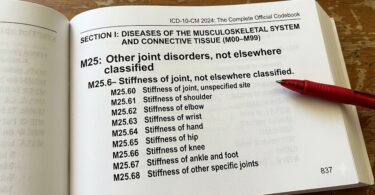
We have all experienced it at some point—a sudden, involuntary, and often painful tightening of a muscle. It might strike in the middle of the night, seizing your calf in a paralyzing charley horse. It might grip your lower back as you lift a heavy box, freezing you in a posture of agony. Or it might manifest as a persistent twitch in your eyelid, a minor but maddening reminder of your body’s autonomous functions. The muscle spasm is a universal human experience, a common thread in the tapestry of physical discomfort. Yet, for healthcare providers, physical therapists, and medical coders, a muscle spasm is far more than a simple cramp. It is a clinical sign, a symptom pointing to a vast array of potential underlying conditions, from benign dehydration to serious neurological disorders. In the intricate language of modern medicine, accurately translating this physical symptom into a precise alphanumeric code is critical. This code, from the International Classification of Diseases, Tenth Revision, Clinical Modification (ICD-10-CM), forms the bedrock of patient records, medical billing, epidemiological research, and healthcare analytics. This comprehensive guide will delve deep into the world of ICD-10 code for muscle spasms, moving beyond the basic code to explore the nuanced, detailed, and essential practice of capturing the full clinical picture.

ICD-10 Code for Muscle Spasms
Understanding the Enemy: What is a Muscle Spasm?
Before we can code it, we must understand it. A muscle spasm, also known as a muscle cramp, is a sudden, involuntary contraction of one or more muscles. This contraction can last from a few seconds to several minutes and can range in intensity from a slight, annoying twitch to excruciating pain. The muscle often feels hard to the touch during the event.
It is crucial to distinguish a spasm from related phenomena:
-
Spasticity: A velocity-dependent increase in muscle tone due to damage to the nerve pathways controlling movement, often seen in conditions like cerebral palsy or after a stroke. It is a chronic state of hypertonicity.
-
Dystonia: A sustained or repetitive muscle twisting disorder that leads to abnormal postures, often due to neurological dysfunction.
-
Myoclonus: A quick, involuntary jerk of a muscle or group of muscles, like the “hypnic jerk” experienced when falling asleep.
-
Fasciculation: A small, local, involuntary muscle contraction visible under the skin, commonly known as a muscle twitch, which is not typically painful.
A true spasm is a distinct event of sustained contraction.
The Pathophysiology of a Spasm: A Cellular Misfire
At its core, a muscle spasm is a failure of the normal relaxation mechanism at the cellular level. Muscle contraction is initiated by signals from motor neurons. These signals trigger the release of calcium from the sarcoplasmic reticulum within muscle cells. The calcium binds to proteins, leading to the interaction of actin and myosin filaments, which causes the muscle to contract. For the muscle to relax, the calcium must be pumped back into the sarcoplasmic reticulum. Spasms are thought to occur when there is hyperexcitability of the motor nerves or when the complex process of calcium reuptake is disrupted, leading to sustained contraction. This can be influenced by fatigue, electrolyte imbalances, and dehydration.
Common Triggers and Etiologies: From Dehydration to Disease
Muscle spasms are rarely a diagnosis in and of themselves; they are a symptom of an underlying issue. The causes are protean, including:
-
Electrolyte Depletion: Low levels of potassium, calcium, magnesium, or sodium.
-
Dehydration: Inadequate fluid intake, especially during strenuous activity.
-
Muscle Fatigue and Overuse: Common in athletes or after unaccustomed physical activity.
-
Poor Circulation: Reduced blood flow to the muscles, such as in peripheral artery disease.
-
Nerve Compression: As seen in lumbar spinal stenosis or a herniated disc, where compressed nerves can cause radicular pain and muscle spasms.
-
Metabolic Disorders: Such as thyroid issues or kidney disease.
-
Neurological Disorders: Multiple sclerosis, amyotrophic lateral sclerosis (ALS), and others.
-
Medication Side Effects: Diuretics, statins, and some asthma medications.
-
Pregnancy: Often causing leg cramps, particularly in the second and third trimesters.
This wide range of potential causes is precisely why accurate ICD-10 coding is so vital. The code must reflect not just the spasm, but its context.
The World of ICD-10-CM: A Primer for Precision
The International Classification of Diseases, 10th Revision, Clinical Modification (ICD-10-CM) is the system used in the United States to classify and code all diagnoses, symptoms, and procedures recorded in conjunction with hospital care. It replaced the older ICD-9-CM system in 2015, bringing with it a dramatic increase in specificity. Where ICD-9 had approximately 14,000 codes, ICD-10 boasts over 70,000. This expansion allows for a much more detailed description of a patient’s condition.
Why Specificity is King in Modern Medical Coding
The shift to ICD-10 was not merely an administrative update; it was a paradigm shift in healthcare data. The enhanced specificity serves several critical functions:
-
Improved Patient Care: Detailed codes create a richer patient history, allowing new providers to understand past conditions with greater clarity.
-
Enhanced Public Health Surveillance: Tracking the prevalence of specific conditions (e.g., “muscle spasm of the right calf due to dehydration”) becomes far more precise, aiding in resource allocation and research.
-
Accurate Reimbursement: Insurance companies use diagnosis codes to determine medical necessity. A vague code can lead to claim denials, while a precise code that matches the documented clinical picture supports appropriate reimbursement.
-
Reduced Fraud and Abuse: The specificity makes it harder to use vague codes to bill for unnecessary services.
For muscle spasms, this means that simply coding a “spasm” is almost never sufficient. The coder must ask: Where is it? What is the likely cause? Is it acute or chronic?
The Alphabetic Index: Your Starting Point
The ICD-10-CM manual is divided into two main parts: the Alphabetic Index and the Tabular List. The proper coding process always starts with the Alphabetic Index. You look up the main term of the diagnosis—in this case, Spasm.
A lookup for “Spasm” in the Alphabetic Index would guide you to various subterms. You would likely find a pathway like this:
Spasm -> muscle -> M62.83-
This indicates that the general code for muscle spasm falls under the M62.83- category. The hyphen indicates that additional characters are required. Crucially, the Alphabetic Index is only a starting point. You must never assign a code directly from it. The final code must always be verified and selected from the Tabular List.
Navigating the Tabular List: The Final Authority
The Tabular List is where the full code, its description, and any instructional notes are located. Following our Alphabetic Index lead, we turn to the category M62.83-.
A Deep Dive into M62.83-: The Muscle Spasm Code Family
Let’s examine the Tabular List entry for M62.83, which is found in Chapter 13 of ICD-10-CM, “Diseases of the Musculoskeletal System and Connective Tissue.”
M62 Other disorders of muscle
M62.8 Other specified disorders of muscle
M62.83 Muscle spasm
The official code description for M62.83 is “Muscle spasm.” However, this is a category code that requires a 6th character to specify the anatomical site. This is a perfect example of ICD-10’s demand for specificity.
Anatomical Specificity with M62.83-
The 6th character defines the location of the spasm. The complete codes include:
-
M62.831 Muscle spasm of back
-
M62.832 Muscle spasm of calf
-
M62.838 Muscle spasm of other site (Used for sites not represented by a specific code, e.g., neck, thigh, arm)
-
M62.839 Muscle spasm of unspecified site (Should be used only if the documentation does not specify the location)
It is vital to note that there is no specific code for spasms of the neck under M62.83. A neck spasm would be coded as M62.838. Similarly, a spasm in the thigh or hamstring would also fall under this “other site” code.
Laterality: A Crucial Component
For codes in Chapter 13, ICD-10 requires laterality (left, right, or bilateral). The code M62.83- requires a 7th character to indicate this. The 7th character extension for this code family is:
-
1: Right side
-
2: Left side
-
9: Unspecified side
Therefore, a complete, billable code for a muscle spasm would look like this:
-
M62.8321: Muscle spasm of right calf
-
M62.8312: Muscle spasm of left back
-
M62.8389: Muscle spasm of other site, unspecified side (e.g., an unspecified neck spasm)
M62.83- Code Family for Muscle Spasms
| ICD-10-CM Code | Code Description | Clinical Example |
|---|---|---|
| M62.8311 | Muscle spasm of back, right side | Spasm in the right erector spinae muscles after lifting. |
| M62.8312 | Muscle spasm of back, left side | Spasm in the left lumbar region due to a herniated disc. |
| M62.8319 | Muscle spasm of back, unspecified side | Documentation states “low back spasm” without specifying left or right. |
| M62.8321 | Muscle spasm of calf, right side | Nocturnal charley horse in the right calf. |
| M62.8322 | Muscle spasm of calf, left side | Exercise-associated cramp in the left gastrocnemius. |
| M62.8329 | Muscle spasm of calf, unspecified side | “Calf cramps” documented without specifying which calf. |
| M62.8381 | Muscle spasm of other site, right side | Spasm in the right trapezius (neck) muscle. |
| M62.8382 | Muscle spasm of other site, left side | Spasm in the left quadriceps (thigh). |
| M62.8389 | Muscle spasm of other site, unspecified side | “Neck spasm” documented without side specified. |
| M62.8391 | Muscle spasm of unspecified site, right side | Rarely used; the site is unspecified, but the side is known. |
| M62.8392 | Muscle spasm of unspecified site, left side | Rarely used; the site is unspecified, but the side is known. |
| M62.8399 | Muscle spasm of unspecified site, unspecified side | Should be avoided. Used only if documentation is severely lacking. |
Beyond the Generic Spasm: Coding the Underlying Cause
While M62.83- is the direct code for the symptom of a muscle spasm, ICD-10 coding guidelines emphasize that you should code the underlying etiology (cause) whenever it is known. The spasm itself may be listed as an additional code if it is a significant part of the clinical presentation and is not inherent to the underlying disease.
This is the most critical concept in coding spasms. The M62.83- code is often a symptom code; the real diagnostic weight lies in the condition causing it. Let’s explore how to code spasms in the context of various underlying conditions.
Spasms in Musculoskeletal Disorders (Chapter 13)
Many spasms are secondary to musculoskeletal injuries or conditions.
-
Low Back Pain (M54.5-): A patient presents with acute low back pain and associated muscle spasms after a lifting injury. The provider diagnoses “acute lumbago with muscle spasm.”
-
Primary Code: M54.51 (Low back pain, with sciatica, right side) or M54.59 (Other low back pain). The code M54.5- includes “lumbago.”
-
Secondary Code: M62.831- (Muscle spasm of back) to provide additional detail about the presence of spasm.
-
-
Cervical Radiculopathy (M54.12): A patient has a herniated cervical disc causing nerve compression, resulting in neck pain, arm pain, and neck muscle spasms.
-
Primary Code: M54.12 (Cervical radiculopathy)
-
Secondary Code: M62.838- (Muscle spasm of other site [neck])
-
Spasms in Neurological Disorders (Chapter 6)
Here, the spasm is often a direct symptom of the neurological disease.
-
Multiple Sclerosis (G35): MS can cause severe muscle spasms and spasticity.
-
Primary Code: G35 (Multiple sclerosis)
-
Secondary Code: R25.2 (Cramp and spasm) is often used, but M62.83- could be considered if the documentation specifies it as a muscle spasm distinct from general spasticity. However, for true spasticity, codes like R25.2 or the specific type of spasticity may be more accurate. This highlights the need for precise clinical documentation.
-
-
Torticollis (M43.6): This is a condition characterized by an abnormal, asymmetrical head or neck position, often due to spasms of the sternocleidomastoid muscle.
-
Primary Code: M43.6 (Torticollis). This code inherently includes the muscle spasm causing the postural abnormality. You would not additionally code M62.838-.
-
Spasms Related to Electrolyte Imbalances (Chapter 4)
-
Hypocalcemia (E83.51): Low calcium can cause tetany, which includes muscle spasms, cramps, and paresthesia.
-
Primary Code: E83.51 (Hypocalcemia)
-
Secondary Code: R25.2 (Cramp and spasm) is typically used here. The code R25.2 is a symptom code from Chapter 18 and is often paired with metabolic causes.
-
-
Hypokalemia (E87.6): Low potassium is a common cause of muscle cramps.
-
Primary Code: E87.6 (Hypokalemia)
-
Secondary Code: R25.2 (Cramp and spasm)
-
Spasms in Mental and Behavioral Disorders (Chapter 5)
-
Conversion Disorder (F44.4- F44.7): A patient may present with muscle weakness or spasms that have no apparent physiological cause and are linked to psychological stress.
-
Primary Code: The specific conversion disorder code (e.g., F44.4 for movement disorders).
-
Secondary Code: The symptom code (e.g., M62.83- or R25.2) would be assigned as well.
-
Spasms in Pregnancy, Childbirth, and the Puerperium (Chapter 15)
-
Leg Cramps in Pregnancy (O26.85-): ICD-10 provides a specific code for leg cramps associated with pregnancy.
-
Primary Code: O26.85- (Leg cramps in pregnancy). This is a pregnancy-related code and requires a final character for trimester.
-
Note: You would not use M62.832- (Muscle spasm of calf) in this scenario because a more specific obstetric code is available.
-
Spasms in Injury, Poisoning, and External Causes (Chapter 19)
-
Acute Strain (S-codes): A patient sustains a hamstring strain (S76.311-) during a soccer game, with significant muscle spasm noted.
-
Primary Code: S76.311- (Strain of muscle, fascia and tendon of hamstring, right thigh).
-
Secondary Code: M62.838- (Muscle spasm of other site, right side) can be added to specify the associated spasm.
-
Clinical Documentation: The Bedrock of Accurate Coding
The coder can only code what the provider has documented. Poor documentation leads to inaccurate coding, which can impact patient care and reimbursement.
The Provider’s Responsibility
The healthcare provider’s documentation must be specific and detailed. Instead of writing “muscle spasms,” the note should read:
-
“Patient presents with acute, painful muscle spasms in the right lumbar paraspinal muscles.”
-
“Complains of nocturnal calf cramps in the left leg.”
-
“Observed spasms of the left trapezius muscle upon palpation.”
The documentation should also clearly link the spasm to its underlying cause: “Muscle spasms are secondary to the acute lumbar strain” or “Calf cramps are likely due to the patient’s diuretic use.”
The Coder’s Responsibility
The coder must be a detective and a linguist, carefully reading the entire medical record to identify the most specific code. They must:
-
Identify the location of the spasm.
-
Determine the laterality.
-
Identify the underlying cause.
-
Apply ICD-10 coding guidelines to sequence the codes correctly (etiology first, followed by manifestation).
5 Query the provider if the documentation is unclear, conflicting, or incomplete.
Case Studies: From Patient Encounter to Final Code
Let’s apply our knowledge to realistic patient scenarios.
Case Study 1: The Weekend Warrior
Scenario: A 45-year-old male presents to his primary care physician after spending the weekend moving furniture. He complains of severe pain and tightness in his lower back. The physician’s note states: “Patient exhibits significant pain with range of motion. Palpation reveals tightness and spasms in the right-sided paraspinal muscles. Diagnosis: Acute lumbar muscle strain with associated muscle spasms.”
Coding Process:
-
Underlying Cause: Acute lumbar muscle strain. In the Alphabetic Index: Strain -> lumbar -> S39.012-. In the Tabular List, this leads to S39.012A (Strain of muscle, fascia and tendon of lower back, initial encounter).
-
Symptom: Muscle spasm of the back, right side. From the Tabular List: M62.8311.
-
Sequencing: The strain is the cause, so it is the primary diagnosis. The spasm is a secondary code providing additional detail.
Final Codes: S39.012A, M62.8311
Case Study 2: The Chronic Back Pain Patient
Scenario: A 60-year-old female with a known history of lumbar spinal stenosis (LSS) presents for a follow-up. She reports an exacerbation of her chronic low back pain and new-onset cramping in both calves after walking short distances (neurogenic claudication). The physician documents: “Exacerbation of lumbar spinal stenosis with neurogenic claudication and associated bilateral calf cramping.”
Coding Process:
-
Underlying Cause: Lumbar spinal stenosis. In the Tabular List: M48.06 (Spinal stenosis, lumbar region).
-
Symptom: The calf cramping is a direct symptom of the neurogenic claudication caused by LSS. While M62.832- could be considered, the code R25.2 (Cramp and spasm) is often more appropriate for this type of neurological cramping. Since it is bilateral, no laterality is needed for R25.2.
-
Sequencing: The stenosis is the underlying disease.
Final Codes: M48.06, R25.2
Case Study 3: The Neurological Mystery
Scenario: A patient is admitted to the hospital with severe, generalized muscle cramps and tingling in their hands and feet. Lab work reveals significantly low calcium levels. The final diagnosis is hypocalcemia causing tetany.
Coding Process:
-
Underlying Cause: Hypocalcemia. In the Tabular List: E83.51 (Hypocalcemia).
-
Symptom: The muscle cramps and spasms are the manifestation of the tetany. The appropriate symptom code is R25.2 (Cramp and spasm). The tingling (paresthesia) would be coded as R20.2.
-
Sequencing: The hypocalcemia is the cause.
Final Codes: E83.51, R25.2, R20.2
Common Coding Pitfalls and How to Avoid Them
-
Using M62.83- as a Primary Code Without an Etiology: This is a common error. Always search for and code the underlying cause first.
-
Ignoring Laterality: For codes in Chapter 13, failing to assign the 7th character for laterality will result in an invalid code.
-
Using the Wrong Code for the Context: Using M62.832- for pregnancy-related leg cramps instead of O26.85- is incorrect. Always check for condition-specific codes first.
-
Confusing Spasm with Spasticity: Code R25.2 or more specific spasticity codes may be more appropriate for chronic neurological conditions like cerebral palsy or post-stroke spasticity.
-
Coding from the Alphabetic Index: This is a cardinal sin of medical coding. The Tabular List has the final say and contains essential instructional notes.
The Role of Muscle Spasms in Medical Billing and Reimbursement
Accurate coding is directly tied to reimbursement. A insurance payer will review the diagnosis codes on a claim to determine if the treatment provided (e.g., physical therapy, medication, manipulation) was medically necessary for the diagnosed condition. For example, billing for multiple physical therapy sessions for “M62.8399 (Muscle spasm of unspecified site, unspecified side)” is likely to be questioned or denied due to vagueness. However, a claim for therapy with a primary code of “S39.012A (Lumbar strain)” and a secondary code of “M62.8311 (Muscle spasm of back, right side)” paints a clear, justifiable clinical picture, supporting the medical necessity of the treatment.
The Future: ICD-11 and Beyond
The World Health Organization (WHO) has already released ICD-11, which is gradually being adopted by member countries. ICD-11 offers even greater detail and a more logical, digital-friendly structure. While the US has not yet set a timeline for transitioning to ICD-11, it’s important to be aware of the ongoing evolution. In ICD-11, the approach to coding symptoms and signs is refined, and the code for muscle spasm (ME64.0) will fit into a broader, more interconnected hierarchy. The fundamental principle—that specificity and etiological coding are paramount—will only become more deeply ingrained.
Conclusion
Accurately coding a muscle spasm in ICD-10-CM is a process that extends far beyond a simple lookup. It demands a thorough understanding of the coding system’s structure, a meticulous approach to clinical documentation, and a deep knowledge of disease pathology. The journey from a patient’s complaint to a final, billable code requires the coder to identify the precise location and laterality of the spasm and, most importantly, to determine and sequence the underlying etiological condition. By mastering the nuances of codes like M62.83- and understanding when to use them in conjunction with—or in deference to—other diagnostic codes, healthcare professionals can ensure the integrity of medical data, support optimal patient care, and facilitate appropriate reimbursement. In the world of modern medicine, the humble muscle spasm is a small but significant piece of a much larger diagnostic puzzle.
Frequently Asked Questions (FAQs)
Q1: What is the default ICD-10 code for a muscle spasm if the location isn’t specified?
A: The code is M62.8399 (Muscle spasm of unspecified site, unspecified side). However, this code is non-specific and should be used as a last resort. It is always best practice to query the provider for a more precise location.
Q2: When should I use R25.2 (Cramp and spasm) instead of M62.83-?
A: This is a nuanced decision. Generally, use R25.2 when the spasm is generalized, or when it is a symptom of a systemic or metabolic condition (e.g., electrolyte imbalance, dehydration). Use M62.83- when the spasm is localized to a specific muscle group and is associated with a musculoskeletal condition (e.g., back strain). Always follow the provider’s documentation.
Q3: How do I code a muscle spasm that is a side effect of a medication?
A: You would use two codes. First, code the poisoning or adverse effect of the drug using a code from the T36-T50 series with a 5th or 6th character to specify the drug. Second, code the manifestation, which is the muscle spasm (using M62.83- or R25.2). For example, an adverse effect of a diuretic causing calf cramps would be coded as T50.1X5A (Adverse effect of loop diuretics, initial encounter) and M62.832-.
Q4: Is there a specific code for a neck muscle spasm?
A: No, there is not a unique code for the neck under the M62.83- family. A neck muscle spasm is coded as M62.838- (Muscle spasm of other site), with the appropriate 7th character for laterality.
Q5: Can I code both a muscle strain and a muscle spasm for the same site?
A: Yes, and in many cases, you should. The strain (e.g., S39.012A) is the injury or underlying cause, and the spasm (e.g., M62.8311) is a symptom or manifestation of that injury. This provides a more complete clinical picture.
Additional Resources
-
The Official ICD-10-CM Guidelines for Coding and Reporting: Published by the CDC and CMS, this is the essential rulebook for all coders.
-
American Health Information Management Association (AHIMA): Offers a wealth of resources, including coding clinics, webinars, and certification programs.
-
American Academy of Professional Coders (AAPC): A leading organization for medical coders, providing education, certification, and local chapter support.
-
CDC’s ICD-10-CM Browser Tool: An online tool to search and browse the official ICD-10-CM codes.
-
National Center for Health Statistics (NCHS) ICD-10-CM Page: The home for all official ICD-10-CM updates and information.
Date: October 13, 2025
Disclaimer: The information contained in this article is for educational and informational purposes only and is not intended as a substitute for professional medical advice, diagnosis, or treatment. Always seek the advice of your physician or other qualified health provider with any questions you may have regarding a medical condition or medical coding. The author and publisher are not responsible for any errors or omissions or for any consequences from the application of the information presented.