Nasal congestion. It is one of the most universal human experiences, a simple phrase that describes the frustrating sensation of a blocked nose, the struggle for a full breath, the muffled sound of one’s own voice. For patients, it is a nuisance that ranges from a mild inconvenience to a debilitating condition that ruins sleep, impairs concentration, and diminishes quality of life. For the healthcare provider, it is a common chief complaint, a symptom that points down a diagnostic labyrinth of potential causes—from the mundane common cold to complex systemic disorders. But for the medical coder, the billing specialist, and the healthcare administrator, nasal congestion is something else entirely: it is a precise alphanumeric code, a critical data point in a vast digital ecosystem that drives reimbursement, informs public health, and fuels clinical research.
The International Classification of Diseases, Tenth Revision, Clinical Modification (ICD-10-CM) transforms the subjective experience of a “stuffy nose” into a structured, standardized language. However, this language is far from simple. There is no single, monolithic code for “nasal congestion.” Instead, coders are faced with a nuanced and often confusing array of choices: J34.89, R09.81, J00, J30.9, J31.0, and many others. The selection depends on a intricate web of factors including the underlying etiology, the presence of other symptoms, the chronicity of the condition, and the specific clinical documentation provided by the physician.
This article serves as a definitive guide to navigating this complex terrain. We will move beyond basic code lookups and delve deep into the clinical reasoning and coding guidelines that govern the accurate representation of nasal congestion. We will explore the subtle but critical distinctions between congestion and rhinorrhea, unravel the coding for infectious, allergic, and structural causes, and tackle complex scenarios like pregnancy-related rhinitis and drug-induced congestion. Our goal is not only to provide the correct codes but to foster a profound understanding of why they are correct, empowering clinicians, coders, and healthcare students alike to achieve a level of precision that ensures optimal patient care, accurate reimbursement, and the integrity of our health data.
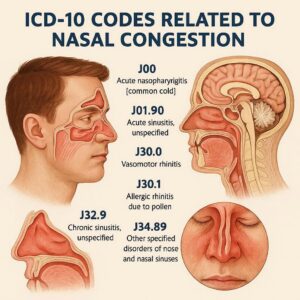
ICD-10 Codes for Nasal Congestion
Chapter 1: The Foundation – Understanding ICD-10 and Its Importance
What is the ICD-10-CM?
The ICD-10-CM is the official system for assigning codes to diagnoses and procedures in the United States. It is a morbidity classification published by the World Health Organization (WHO) and modified for clinical use by the Centers for Disease Control and Prevention (CDC) and the National Center for Health Statistics (NCHS). This system replaces its predecessor, ICD-9-CM, offering a dramatic expansion in specificity and detail.
Imagine ICD-9 as a small-town library and ICD-10 as the Library of Congress. Where ICD-9 had roughly 13,000 diagnosis codes, ICD-10 boasts over 68,000. This granularity allows for a much richer and more precise description of a patient’s condition. A code can now specify not just the disease, but its etiology, anatomical location, severity, and laterality (right, left, or bilateral).
For example, instead of a generic code for a sinus infection, ICD-10 allows coders to specify:
-
J01.00: Acute maxillary sinusitis, unspecified
-
J01.01: Acute recurrent maxillary sinusitis
-
J01.10: Acute frontal sinusitis, unspecified
-
J01.11: Acute recurrent frontal sinusitis
This level of detail is the cornerstone of modern healthcare data analytics.
Why Accurate Coding is Non-Negotiable
The implications of accurate ICD-10 coding extend far beyond mere medical record-keeping. They are woven into the very fabric of the healthcare system’s financial, clinical, and public health operations.
-
Reimbursement and Revenue Cycle: ICD-10 codes are the primary drivers of medical billing. They justify the medical necessity of the services rendered—the evaluation, the tests ordered, the treatments provided. An incorrect or insufficiently specific code can lead to claim denials, delays in payment, and audits, directly impacting a practice’s or hospital’s financial health. Using an unspecified code when a more specific one is available can sometimes result in a lower reimbursement rate.
-
Clinical Decision Support and Patient Care: Aggregated coded data is used to track patient outcomes, identify best practices, and support clinical decision-making tools. If the data is inaccurate due to poor coding, the insights derived from it are flawed. Precise coding helps create a accurate patient history, which is crucial for future care.
-
Public Health and Research: On a macro level, ICD-10 data is essential for public health surveillance. It helps track disease outbreaks (e.g., influenza, COVID-19), monitor the prevalence of chronic conditions like asthma and allergic rhinitis, and allocate resources effectively. Researchers rely on this data to study disease patterns, treatment efficacy, and health disparities.
-
Quality Metrics and Performance Reporting: Healthcare organizations are increasingly evaluated based on quality metrics, many of which are defined by diagnosis codes. Accurate coding ensures that an organization’s performance is represented fairly and can impact its reputation and funding.
In the context of a symptom as common as nasal congestion, applying the correct ICD-10 code is the critical act of translating a patient’s complaint into actionable, valuable data.
Chapter 2: The Primary Code – J34.89 Other specified disorders of nose and nasal sinuses
When a clinician documents “nasal congestion” without specifying an underlying cause, the ICD-10 system provides a home for this symptom under code J34.89.
Deconstructing the Code: J34.89
Let’s break down this code to understand its meaning and placement within the ICD-10 hierarchy:
-
J: The chapter. “J” represents “Diseases of the Respiratory System.”
-
J30-J39: The block. This block covers “Other diseases of the upper respiratory tract.”
-
J34: The category. This category is for “Other disorders of nose and nasal sinuses.” It includes a variety of conditions like deformities, polyps, and other specified disorders.
-
J34.8: The subcategory. “Other specified disorders of nose and nasal sinuses.”
-
J34.89: The full code. “Other specified disorders of nose and nasal sinuses.”
Nasal congestion is listed in the ICD-10 index under “Congestion, nasal,” which directs the coder to J34.89. It is crucial to understand that J34.89 is a “wastebasket” code for nasal conditions that don’t have their own specific code elsewhere. It can include disorders like nasal mucocyst, rhinolith, and, importantly, nasal congestion when it is the diagnosed disorder itself.
When is it Appropriate to Use J34.89?
J34.89 is appropriate in specific, limited circumstances:
-
A Self-Limited Viral URI: A patient presents with two days of nasal congestion and mild malaise. The physician diagnoses “viral upper respiratory infection” but the congestion is the predominant symptom being addressed. While
J06.9(Acute upper respiratory infection, unspecified) might be the primary code, J34.89 can be used as an additional code to specify the symptom if it is separately treated or documented as a significant issue. -
Non-Specific Diagnosis: The physician’s final assessment is simply “nasal congestion” after ruling out sinusitis, allergic rhinitis, and other specific causes. The congestion is treated as the primary disorder.
-
Following a Procedure: A patient experiences congestion after nasal surgery, and it is documented as a persistent issue not directly linked to active infection or allergic reaction.
The Pitfalls of Overusing “Unspecified” Codes
While J34.89 is a valid code, its overuse is a sign of poor clinical documentation. Relying on it too heavily can raise red flags for payers, suggesting that the provider did not perform a thorough enough examination to determine a more precise cause. The goal of modern healthcare coding is specificity. If the documentation supports a more definitive diagnosis like “acute bacterial sinusitis” or “allergic rhinitis due to pollen,” those codes (J01.90, J30.1) must be used instead.
Best Practice: Use J34.89 as a temporary or default code only when the clinical picture is genuinely unclear and a more specific diagnosis cannot be established.
Chapter 3: The Rhinorrhea Distinction – J34.89 vs. R09.81
One of the most common points of confusion in coding nasal symptoms is the distinction between congestion and rhinorrhea. Clinicians often use these terms interchangeably or together, but for coding purposes, they are distinct.
-
Nasal Congestion: The feeling of obstruction or “stuffiness” in the nasal passages. It is caused by swelling and inflammation of the nasal tissues and blood vessels (vasodilation). This is coded to J34.89.
-
Rhinorrhea: The objective, observable discharge of fluid from the nose—what is commonly called a “runny nose.” The fluid can be thin and clear (serous), thick and colored (mucopurulent), or watery. This is coded to R09.81.
R09.81 belongs to a different chapter of ICD-10:
-
R00-R99: Chapter 18, “Symptoms, signs, and abnormal clinical and laboratory findings, not elsewhere classified.”
-
R09: This category is for “Other symptoms and signs involving the circulatory and respiratory systems.”
-
R09.81: “Nasal congestion” is not listed here. This code is specifically for “Rhinorrhea.”
The index entry for “Rhinorrhea” correctly leads to R09.81.
Clinical Scenarios and Coding Decisions
-
Scenario A: A patient presents and states, “My nose is completely blocked, I can’t breathe.” The physician documents “nasal congestion.”
-
Coding: J34.89
-
-
Scenario B: A patient presents with a constant “runny nose.” The physician documents “rhinorrhea.”
-
Coding: R09.81
-
-
Scenario C (Most Common): A patient presents with “a stuffy and runny nose.” The physician documents “nasal congestion and rhinorrhea.”
-
Coding: BOTH J34.89 AND R09.81 should be assigned, sequenced according to the reason for the encounter.
-
This distinction, while seemingly minor, is a perfect example of the precision required by ICD-10. It allows for the separate tracking of these two related but pathophysiologically different symptoms.
Chapter 4: The Infectious Pathways – Coding Congestion in Viral and Bacterial Rhinitis & Sinusitis
Often, nasal congestion is not a diagnosis in itself but a symptom of a broader infectious process. In these cases, the code for the underlying infection takes precedence.
Acute Rhinitis (J00 & J31.0)
-
J00 – Acute nasopharyngitis [Common Cold]: This is the code for the classic common cold, typically caused by viruses. The presentation almost always includes nasal congestion. When the diagnosis is explicitly “common cold” or “acute viral rhinitis,” J00 is the primary code. You would not typically also code J34.89, as congestion is an integral part of the diagnosis. However, if the congestion is unusually severe and requires specific, separate treatment (e.g., prolonged use of nasal sprays), an additional code could be considered.
-
J31.0 – Chronic rhinitis: This code is for long-standing inflammation of the nasal mucous membrane. It includes conditions like chronic catarrhal rhinitis. If a patient has persistent congestion without an allergic trigger, and it is diagnosed as chronic rhinitis, this code is used.
The Sinusitis Spectrum (J01.x & J32.x)
Sinusitis, the inflammation of the paranasal sinuses, is a major cause of nasal congestion. ICD-10 provides extensive detail for sinusitis.
-
Acute Sinusitis (J01.-): This category requires a fourth digit to specify the sinus involved.
-
J01.00: Acute maxillary sinusitis, unspecified
-
J01.01: Acute recurrent maxillary sinusitis
-
J01.10: Acute frontal sinusitis, unspecified
-
J01.20: Acute ethmoidal sinusitis, unspecified
-
J01.30: Acute sphenoidal sinusitis, unspecified
-
J01.40: Acute pansinusitis (all sinuses involved)
-
J01.90: Acute sinusitis, unspecified
-
-
Chronic Sinusitis (J32.-): Similarly, this category has codes for persistent sinusitis.
-
J32.0: Chronic maxillary sinusitis
-
J32.1: Chronic frontal sinusitis
-
J32.2: Chronic ethmoidal sinusitis
-
J32.3: Chronic sphenoidal sinusitis
-
J32.4: Chronic pansinusitis
-
J32.9: Chronic sinusitis, unspecified
-
Coding Logic: When a patient is diagnosed with acute sinusitis, the sinusitis code (e.g., J01.00) is the principal diagnosis. Nasal congestion is a defining symptom of sinusitis. Therefore, you would not additionally code J34.89 for the congestion. The sinusitis code encompasses that symptom.
Chapter 5: The Allergic Connection – Coding for Allergic Rhinitis (J30.x)
Allergic rhinitis (hay fever) is one of the most common chronic conditions worldwide, and nasal congestion is a hallmark symptom. ICD-10 offers a highly specific set of codes for this condition.
The category J30 is for “Vasomotor and allergic rhinitis.” The codes require a fourth digit to specify the type of allergen, if known.
-
J30.0: Vasomotor rhinitis (discussed in Chapter 7)
-
J30.1: Allergic rhinitis due to pollen (Hay fever)
-
J30.2: Other seasonal allergic rhinitis
-
J30.5: Allergic rhinitis due to animal (cat, dog) hair and dander
-
J30.81: Allergic rhinitis due to dust mite
-
J30.89: Other allergic rhinitis (e.g., to mold, cockroach)
-
J30.9: Allergic rhinitis, unspecified (use this only when the provider documents allergic rhinitis but does not specify the type)
Seasonal vs. Perennial Allergic Rhinitis
Clinically, allergic rhinitis is often described as seasonal (occurring at specific times of the year, typically due to pollen) or perennial (year-round, typically due to indoor allergens like dust mites or pet dander). ICD-10 does not directly use these clinical terms in the code titles but maps them as follows:
-
Seasonal: Usually coded to J30.1 (pollen) or J30.2 (other seasonal).
-
Perennial: Usually coded to J30.5 (animals), J30.81 (dust mite), or J30.89 (other, like mold).
The Importance of Specificity in Allergen Identification
The shift from ICD-9 to ICD-10 emphasized specificity in allergic rhinitis. In ICD-9, there was one code for “allergic rhinitis.” Now, being able to code for the specific allergen is powerful. It allows for better patient education, targeted environmental control advice, and more precise public health data on allergen prevalence.
Coding Logic: If a provider documents “patient presents with nasal congestion and itchy eyes; history and exam consistent with seasonal allergies, likely pollen,” the correct code is J30.1. The nasal congestion is a symptom of the allergic rhinitis and is not coded separately.
Chapter 6: The Structural and Anatomical Culprits
Sometimes, the cause of nasal congestion is not inflammation or infection, but a physical obstruction within the nasal cavity.
Nasal Polyps (J33.x)
Nasal polyps are soft, painless, noncancerous growths on the lining of the nasal passages or sinuses. They can block nasal airflow, causing a persistent sensation of congestion.
-
J33.0: Polyp of nasal cavity
-
J33.1: Polypoid sinus degeneration
-
J33.8: Other polyp of sinus
-
J33.9: Nasal polyp, unspecified
If a patient’s congestion is directly attributed to the presence of a nasal polyp, J33.9 (or a more specific code if available) is the primary diagnosis. The congestion is not coded separately.
Deviated Nasal Septum (J34.2)
The nasal septum is the wall of cartilage and bone that divides the two nostrils. A deviation, often from injury or natural development, can cause one-sided or bilateral congestion.
-
J34.2: Deviated nasal septum
This code is used when the deviated septum is the cause of the patient’s symptoms (congestion, obstruction, difficulty breathing). It is a common finding, but it should only be coded if it is clinically significant and addressed during the encounter.
Hypertrophy of Nasal Turbinates (J34.3)
The turbinates are bony structures inside the nose covered by soft tissue that help humidify and filter air. When this tissue becomes enlarged (hypertrophied), often due to chronic inflammation or allergy, it can cause significant nasal obstruction.
-
J34.3: Hypertrophy of nasal turbinates
This is a specific anatomical diagnosis that directly causes congestion. Like a polyp or deviated septum, if this is the diagnosed cause, it is coded instead of J34.89.
Chapter 7: The Vasomotor and Drug-Induced Landscape
Vasomotor Rhinitis (J30.0)
Vasomotor rhinitis is a chronic condition that resembles allergic rhinitis but is not caused by an allergen. It is characterized by nasal congestion, rhinorrhea, and post-nasal drip triggered by environmental irritants like smoke, strong odors, changes in temperature or humidity, and even emotional stress. The blood vessels in the nose dilate (vasodilation) in response to these non-allergic triggers, leading to swelling and congestion.
-
J30.0: Vasomotor rhinitis
This is the correct code when the provider makes this specific diagnosis. It is distinct from allergic rhinitis and requires its own code.
Rhinitis Medicamentosa (J34.89 or R09.81?)
This is a particularly important and tricky condition to code. Rhinitis medicamentosa is drug-induced nasal congestion, most commonly caused by the overuse (typically beyond 5-7 days) of topical nasal decongestant sprays (e.g., oxymetazoline, phenylephrine). The body develops a rebound effect, where the nasal tissues become more congested once the spray wears off, leading to a vicious cycle of use.
There is no specific ICD-10 code for rhinitis medicamentosa. The coding path is as follows:
-
Code first the drug: Use a code from T36-T50 to identify the specific drug if known, with a 5th or 6th character to indicate “adverse effect.”
-
Example: T48.5X5A (Adverse effect of other anti-common cold drugs, initial encounter). This would cover a nasal decongestant spray.
-
-
Code the manifestation: The rhinitis medicamentosa itself, which presents primarily as congestion, is coded to J34.89 (Other specified disorders of nose).
Some coding experts debate whether R09.81 (Rhinorrhea) could be used if runny nose is the predominant feature, but congestion is the hallmark. J34.89 is the most widely accepted and logical choice.
Chapter 8: Complex Cases – Congestion in Systemic Conditions and Pregnancy
Nasal congestion can sometimes be a manifestation of a broader systemic issue.
Rhinitis of Pregnancy
Hormonal changes during pregnancy, particularly increased estrogen and progesterone, can cause swelling of the nasal mucous membranes, leading to congestion and stuffiness without any other signs of infection or allergy. This is very common.
-
Coding: There is no single code for “rhinitis of pregnancy.” The correct coding sequence is:
-
Primary Code: A code from Chapter 15 (Pregnancy, Childbirth, and the Puerperium). Since this is a maternal condition affecting the pregnancy, you would use O99.89 (Other specified diseases and conditions complicating pregnancy, childbirth and the puerperium).
-
Secondary Code: The code for the rhinitis itself. Since it is non-allergic and non-infectious, the most accurate code is J30.0 (Vasomotor rhinitis) or, if not specified, J30.9 (Allergic rhinitis, unspecified) is often used as a default, though J30.0 is more physiologically correct.
-
Other Systemic Conditions
-
Hypothyroidism (E03.9): Can cause generalized mucosal edema, including in the nose, leading to congestion.
-
Granulomatous Diseases (e.g., Sarcoidosis, Granulomatosis with Polyangiitis): These can directly involve the nasal tissues, causing obstruction and crusting.
-
Cerebrospinal Fluid (CSF) Rhinorrhea (G96.0): A rare cause of a persistent “runny nose” where the fluid is actually CSF, usually following trauma or surgery. This is coded to G96.0 and is a medical emergency.
In these cases, the systemic condition is coded first, and the nasal congestion is typically not coded separately unless it is the primary reason for the encounter and is being actively managed.
Chapter 9: The Art of Sequencing – Primary, Secondary, and Co-morbidities
The order in which you list diagnosis codes—known as sequencing—is critically important. The general rule is:
The primary diagnosis is the condition chiefly responsible for the patient’s encounter.
Let’s look at a complex scenario:
-
Patient Presentation: A 45-year-old female with a known history of perennial allergic rhinitis due to dust mites presents to her PCP with 5 days of severe facial pressure, green nasal discharge, and profound nasal congestion. She states her allergy medications are not helping this time.
-
Physician’s Final Diagnosis: “Acute bacterial maxillary sinusitis, superimposed on underlying perennial allergic rhinitis.”
Coding and Sequencing:
-
Primary Diagnosis: J01.00 (Acute maxillary sinusitis, unspecified). This is the new, acute condition that is the reason for this specific visit.
-
Secondary Diagnosis: J30.89 (Other allergic rhinitis, or more specifically J30.81 if dust mite is confirmed). This is a co-morbid condition that is relevant to the patient’s overall health and may influence treatment, but it is not the reason for today’s encounter.
The nasal congestion and rhinorrhea are symptoms of the acute sinusitis and are therefore not coded separately. Sequencing J01.00 first accurately reflects that the sinusitis is the billable reason for the visit.
Chapter 10: A Practical Guide – Clinical Documentation Improvement (CDI)
The coder can only code what the provider documents. Clear, specific, and unambiguous documentation is the foundation of accurate coding.
What Coders Need from Providers
Instead of documenting “nasal congestion,” providers should document the diagnosis.
-
Poor Documentation: “Patient has a stuffy nose. Assess: Nasal congestion.”
-
Excellent Documentation: “Patient presents with 10-day history of bilateral nasal congestion and frontal headache. Purulent discharge noted on exam. Tender over frontal sinuses. Assessment: Acute recurrent frontal sinusitis.“
The excellent documentation immediately leads to the specific code J01.11.
Common Documentation Pitfalls and How to Avoid Them
-
Using “Rule Out”: You cannot code a diagnosis that is “ruled out.” Document the presenting symptoms and the final confirmed diagnosis. (e.g., Instead of “Rule out sinusitis,” write “Nasal congestion and facial pain. Sinusitis was considered but not confirmed. Final Dx: Viral URI.”)
-
Linking Symptoms to Diagnoses: Clearly state the cause. “Nasal congestion due to allergic rhinitis.” “Rhinorrhea secondary to common cold.”
-
Specifying Laterality and Chronicity: “Left-sided nasal obstruction” is better than just “nasal obstruction.” “Chronic nasal congestion” is more informative than “nasal congestion.”
Chapter 11: Looking Ahead – ICD-11 and the Future of Respiratory Coding
The World Health Organization has already released ICD-11, which will eventually be adopted in the US (as ICD-11-CM). While the transition is years away, it’s useful to see the evolving approach.
In ICD-11, nasal congestion is found under:
-
CA08.0: Allergic rhinitis
-
CA08.1: Non-allergic rhinitis (which includes vasomotor rhinitis)
-
CA08.2: Chronic rhinosinusitis
-
ME84.0: Acute upper respiratory infection
The structure remains detailed but is organized differently, often with more emphasis on etiology and combination codes that reduce the need for multiple codes. The fundamental principle of specificity will only become more entrenched.
Chapter 12: Quick Reference Table for Nasal Congestion Coding
The table below summarizes the primary codes discussed in this article.
| Clinical Scenario / Diagnosis | Primary ICD-10 Code | Notes |
|---|---|---|
| Non-Specific Nasal Congestion | J34.89 | Use only when no more specific cause is diagnosed. |
| Rhinorrhea (Runny Nose) | R09.81 | Distinct from congestion; code for discharge. |
| Common Cold (Acute Nasopharyngitis) | J00 | Congestion is a inherent symptom; do not add J34.89. |
| Acute Sinusitis | J01.xx | Use fourth digit to specify sinus. Congestion is inherent. |
| Chronic Sinusitis | J32.x | Use fourth digit to specify sinus. Congestion is inherent. |
| Allergic Rhinitis (Hay Fever) | J30.x | Use fourth digit to specify allergen (e.g., J30.1 for pollen). |
| Vasomotor Rhinitis | J30.0 | Non-allergic triggers. |
| Nasal Polyp | J33.x | Code the polyp, not the congestion. |
| Deviated Nasal Septum | J34.2 | Code if it is the cause of symptomatic obstruction. |
| Rhinitis Medicamentosa | J34.89 | Code first the drug (T-code) for the adverse effect. |
| Rhinitis of Pregnancy | O99.89 & J30.0 | Sequence O99.89 first, then the rhinitis code. |
Conclusion
Navigating the ICD-10 coding for nasal congestion requires a meticulous approach that bridges clinical understanding and administrative precision. The journey from a patient’s complaint to a final code hinges on identifying the underlying etiology—be it infectious, allergic, structural, or pharmacological—and applying the most specific code supported by detailed clinical documentation. By moving beyond the generic J34.89 whenever possible, healthcare professionals ensure accurate reimbursement, contribute to robust public health data, and ultimately, support a higher standard of patient care.
Frequently Asked Questions (FAQs)
Q1: What is the default ICD-10 code for nasal congestion?
A: The default code is J34.89 (Other specified disorders of nose and nasal sinuses). However, this should only be used when a more definitive diagnosis (like sinusitis or allergic rhinitis) cannot be made.
Q2: When should I use R09.81 instead of J34.89?
A: Use R09.81 when the primary symptom is a “runny nose” or nasal discharge (rhinorrhea). Use J34.89 for the sensation of blockage or “stuffiness.” If both are present, you may code both.
Q3: My patient has a cold with congestion. Do I code both J00 and J34.89?
A: Typically, no. Nasal congestion is a cardinal symptom of the common cold. Coding J00 alone is sufficient, as it inherently includes the congestion. Adding J34.89 is usually redundant unless the congestion is being treated as a separate, significant problem.
Q4: How do I code for chronic allergies that cause daily congestion?
A: You would use a code from the J30.x category. The specific code depends on the identified allergen. For example, use J30.1 for pollen-related (hay fever) or J30.5 for animal dander-related allergies. The congestion itself is not coded separately.
Q5: What is the most common coding mistake for nasal congestion?
A: The most common mistake is overusing the unspecified code J34.89 when the clinical documentation supports a more specific code, such as for allergic rhinitis (J30.9) or acute sinusitis (J01.90). Always review the provider’s final assessment for the diagnosed cause.
Additional Resources
-
CDC ICD-10-CM Official Guidelines for Coding and Reporting: The definitive source for coding rules and conventions. https://www.cdc.gov/nchs/icd/icd-10-cm.htm
-
American Health Information Management Association (AHIMA): A leading professional organization for medical coders, offering resources, education, and updates. https://www.ahima.org/
-
American Academy of Allergy, Asthma & Immunology (AAAAI): Provides clinical practice guidelines for conditions like allergic rhinitis, which can inform documentation. https://www.aaaai.org/
-
American Academy of Otolaryngology–Head and Neck Surgery (AAO-HNS): Clinical guidelines on the diagnosis and management of rhinitis and sinusitis. https://www.entnet.org/
Date: October 15, 2025
Author: The Health Content Team
Disclaimer: The information contained in this article is intended for educational and informational purposes only. It is not a substitute for professional medical advice, diagnosis, or treatment. Always seek the advice of your physician or other qualified health provider with any questions you may have regarding a medical condition or medical coding. The author and publisher are not responsible for any errors or omissions or for any outcomes related to the use of this information.