If you are a medical biller, coder, or healthcare provider, you already know that precision is everything. Using the wrong code for a medication like Nucala (mepolizumab) can lead to denied claims, delayed payments, and frustrated patients.
So, what is the correct Nucala ICD 10 code? Let’s be honest right from the start: There is no single code that says “Nucala use.” Instead, you need to capture two critical pieces of information.
First, you need a code for the condition Nucala treats (like severe asthma or eosinophilic granulomatosis with polyangiitis). Second, you need a code to show the patient is actively on the medication.
This guide walks you through every scenario. We will cover the primary diagnosis codes, the long-term drug therapy code, and how to pair them correctly. By the end, you will feel confident submitting clean claims for Nucala.
Understanding Nucala and Its FDA Approvals
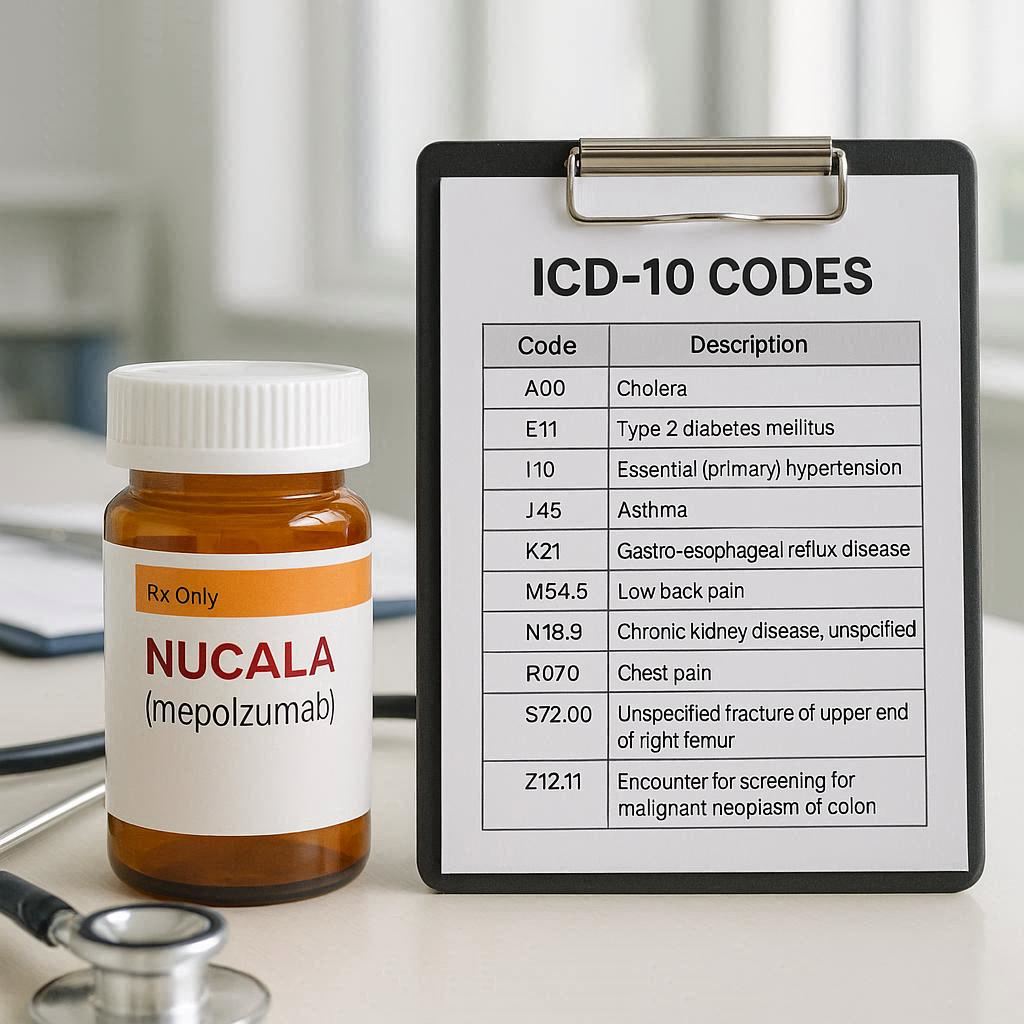
Before we jump into the alphanumeric codes, let’s quickly review what Nucala is. Nucala (mepolizumab) is a monoclonal antibody that targets interleukin-5 (IL-5). By blocking IL-5, it reduces eosinophils—a type of white blood cell that causes inflammation in certain diseases.
The FDA has approved Nucala for four main conditions. Knowing these is crucial because each condition points to a different ICD-10 code family.
- Severe eosinophilic asthma (patients aged 6 years and older)
- Eosinophilic granulomatosis with polyangiitis (EGPA) – formerly called Churg-Strauss syndrome
- Hypereosinophilic syndrome (HES) – for patients lasting at least six months without another identifiable cause
- Chronic rhinosinusitis with nasal polyps (CRSwNP) – as an add-on maintenance treatment
Each of these conditions has its own specific diagnostic code. You cannot use a general “asthma” code for a patient receiving Nucala for EGPA. That would be incorrect and likely get your claim rejected.
The Primary ICD-10 Code for Nucala Administration
Let’s answer the main question directly. When a patient receives Nucala, the primary diagnosis code depends entirely on why they are taking the drug.
For Severe Eosinophilic Asthma
The most common use of Nucala is for severe eosinophilic asthma. In this case, you will use a combination of codes. The primary diagnosis is typically J45.998 – Other asthma. But wait, that sounds vague. Why not J45.50 (Severe persistent asthma)?
Here is the nuance. Nucala is specifically for eosinophilic asthma. The ICD-10 system allows you to add an additional code to capture the eosinophilic component. That code is J82.83 – Eosinophilic asthma.
So, for severe eosinophilic asthma treated with Nucala, your coding might look like this:
- J45.998 (Other asthma)
- J82.83 (Eosinophilic asthma)
- Z79.83 (Long term (current) use of monoclonal antibody – we will explain this below)
Important note: Some payers prefer J45.50 (Severe persistent asthma) as the primary. However, J45.998 paired with J82.83 provides more specificity. Always verify local payer guidelines.
For Eosinophilic Granulomatosis with Polyangiitis (EGPA)
If your patient has EGPA, you will use a code from the M30 series. The specific code is M30.1 – Polyarteritis nodosa and related conditions. Under this category, EGPA is included.
There is no separate code for “EGPA” alone. It falls under M30.1. So, for Nucala used to treat EGPA, the primary diagnosis is M30.1.
For Hypereosinophilic Syndrome (HES)
HES is a rare group of disorders marked by persistently high eosinophil counts that damage organs. The ICD-10 code for hypereosinophilic syndrome is D72.11 – Hypereosinophilic syndrome [HES].
Remember, HES is a hematologic disorder. Do not confuse it with eosinophilic asthma. The two conditions are coded very differently.
For Chronic Rhinosinusitis with Nasal Polyps (CRSwNP)
In 2019, the FDA expanded Nucala’s approval to include CRSwNP. For these patients, the primary diagnosis is J33.8 – Other polyp of sinus. You can also use J33.9 (Nasal polyp, unspecified) in some cases, but J33.8 is preferred when the specific sinus is documented.
Additionally, you should code the chronic rhinosinusitis itself. That code is J32.9 – Chronic sinusitis, unspecified. Yes, you may need two diagnosis codes for the condition itself, plus the drug administration code.
The Secret Code: Z79.83 (Long term use of monoclonal antibody)
Here is something many coders overlook. When a patient receives a biologic like Nucala, you absolutely need an additional ICD-10 code that indicates long-term drug therapy.
The correct code is Z79.83 – Long term (current) use of monoclonal antibody.
This code is not a primary diagnosis. You will list it as a secondary diagnosis. It tells the payer: “This patient is actively on this medication, and it is medically necessary.”
Why is Z79.83 so important? Without it, your claim might look incomplete. The payer sees a diagnosis of asthma and a billing code for an injection. They might wonder if this is a one-time treatment or an ongoing therapy. Z79.83 clarifies that Nucala is a maintenance medication.
Think of Z79.83 as the glue that connects the condition to the treatment. It is a small code that carries a lot of weight.
Complete Coding Scenarios (With Examples)
Let’s put everything together with real-world examples. This will help you visualize how to list these codes on a CMS-1500 form or in your EHR.
Scenario 1: 45-Year-Old with Severe Eosinophilic Asthma
A patient comes in for their monthly Nucala injection. The physician has documented severe eosinophilic asthma poorly controlled on high-dose inhaled corticosteroids.
Your ICD-10 coding would be:
- J45.998 – Other asthma
- J82.83 – Eosinophilic asthma
- Z79.83 – Long term (current) use of monoclonal antibody
| Code Type | ICD-10 Code | Description |
|---|---|---|
| Primary Diagnosis | J45.998 | Other asthma |
| Secondary Dx 1 | J82.83 | Eosinophilic asthma |
| Secondary Dx 2 | Z79.83 | Long term use of monoclonal antibody |
Scenario 2: 60-Year-Old with EGPA
A patient with confirmed EGPA receives their Nucala injection. No asthma symptoms are present today.
Your ICD-10 coding would be:
- M30.1 – Polyarteritis nodosa and related conditions (This includes EGPA)
- Z79.83 – Long term (current) use of monoclonal antibody
| Code Type | ICD-10 Code | Description |
|---|---|---|
| Primary Diagnosis | M30.1 | Polyarteritis nodosa and related conditions |
| Secondary Dx | Z79.83 | Long term use of monoclonal antibody |
Scenario 3: 35-Year-Old with HES
A patient with hypereosinophilic syndrome affecting the skin and gastrointestinal tract receives Nucala.
Your ICD-10 coding would be:
- D72.11 – Hypereosinophilic syndrome [HES]
- Z79.83 – Long term (current) use of monoclonal antibody
| Code Type | ICD-10 Code | Description |
|---|---|---|
| Primary Diagnosis | D72.11 | Hypereosinophilic syndrome [HES] |
| Secondary Dx | Z79.83 | Long term use of monoclonal antibody |
Scenario 4: 50-Year-Old with CRSwNP
A patient with chronic rhinosinusitis and nasal polyps receives Nucala as add-on therapy.
Your ICD-10 coding would be:
- J33.8 – Other polyp of sinus
- J32.9 – Chronic sinusitis, unspecified
- Z79.83 – Long term (current) use of monoclonal antibody
| Code Type | ICD-10 Code | Description |
|---|---|---|
| Primary Diagnosis | J33.8 | Other polyp of sinus |
| Secondary Dx 1 | J32.9 | Chronic sinusitis, unspecified |
| Secondary Dx 2 | Z79.83 | Long term use of monoclonal antibody |
Common Mistakes Coders Make with Nucala ICD 10 Codes
Even experienced coders slip up sometimes. Here are the most frequent errors and how to avoid them.
Using a Non-Specific Asthma Code
Many coders grab J45.40 (Moderate persistent asthma) or J45.20 (Mild persistent asthma). Nucala is approved only for severe asthma. If you use a mild or moderate asthma code, the payer will likely deny the claim.
Always confirm the documentation says “severe” or “severe persistent” asthma.
Forgetting the Eosinophilic Specifier
Asthma is a broad category. Nucala is specifically for eosinophilic asthma. If your documentation supports it, always add J82.83. This tells the payer why this patient needs an IL-5 inhibitor instead of a cheaper medication.
Listing Z79.83 as the Primary Diagnosis
This is a major error. Z codes (factors influencing health status) are never primary diagnoses for an injection administration. You must list the medical condition first. Z79.83 is a supporting actor, not the star.
Using Expired or Unapproved Diagnosis Codes
ICD-10 codes change every year. For example, some older codes for EGPA have been revised. Always use the most current version of the ICD-10-CM (updated October 1 each year). As of 2026, the codes listed above are current, but always double-check.
The Relationship Between Nucala Administration CPT Codes and ICD-10
You cannot talk about ICD-10 codes without mentioning CPT (Current Procedural Terminology) codes. The CPT code tells the payer what procedure you performed. The ICD-10 code tells them why.
Nucala is given as a subcutaneous injection. The typical CPT code for this administration is:
- 96372 – Therapeutic, prophylactic, or diagnostic injection (specify substance or drug); subcutaneous or intramuscular
Some payers may also require the J-code for the drug itself. The J-code for Nucala is:
- J2182 – Injection, mepolizumab, 1 mg
Your claim will generally include:
- CPT 96372 (administration)
- J2182 x 100 (for a 100 mg dose – the standard Nucala dose)
- ICD-10 codes (primary condition + Z79.83)
Without the correct ICD-10 codes, the CPT and J-codes are meaningless. The payer won’t know if the injection was medically necessary.
A Quick Reference Table: Nucala Indications and Corresponding Codes
Here is a handy reference table for your desk or digital files.
| FDA Indication | Primary ICD-10 Code | Additional Specifier Code | Long-term Drug Code |
|---|---|---|---|
| Severe Eosinophilic Asthma | J45.998 (Other asthma) | J82.83 (Eosinophilic asthma) | Z79.83 |
| EGPA | M30.1 (Polyarteritis nodosa) | None needed | Z79.83 |
| HES | D72.11 (Hypereosinophilic syndrome) | None needed | Z79.83 |
| CRSwNP | J33.8 (Other polyp of sinus) | J32.9 (Chronic sinusitis) | Z79.83 |
Pro tip: Save this table as a PDF. It will save you hours of searching through coding manuals.
Documenting Medical Necessity for Nucala
ICD-10 codes are only half the battle. You also need solid documentation in the medical record. The physician’s notes must support the codes you submit.
What should the documentation include?
- Confirmation of the specific diagnosis (e.g., “severe eosinophilic asthma” not just “asthma”)
- Eosinophil level (usually ≥150 cells/µL at initiation or ≥300 cells/µL in the past 12 months)
- Failure or intolerance to standard treatments (high-dose inhaled corticosteroids plus another controller)
- Ongoing monitoring (response to therapy, any adverse effects)
Without these elements, an auditor might question medical necessity. Even with the correct Nucala ICD 10 code, you could face a clawback.
How Payers Review Nucala Claims
Insurance companies use automated systems to check claims. These systems look for specific code pairs.
For example, a typical payer’s logic might be:
*If CPT 96372 AND J2182 are billed, then the primary ICD-10 code must be one of the following: J45.998, M30.1, D72.11, or J33.8.*
If the primary code is J45.998, then a secondary code J82.83 must be present.
If all of the above are true, then Z79.83 must be present.
If your claim fails any of these steps, it will be automatically denied. You will then need to appeal, which takes weeks or months.
Knowing these internal rules helps you build cleaner claims from the start.
Nucala ICD 10 Coding for Different Healthcare Settings
The right code doesn’t change, but how you use it might vary by setting.
In the Outpatient Clinic (Physician Office)
This is the most common setting. The patient comes in, sees the doctor or nurse, and receives their injection. You will submit a professional claim (CMS-1500). List the primary diagnosis as the condition (e.g., J45.998) and add Z79.83 as secondary.
In the Hospital Outpatient Department (HOPD)
The hospital bills for the facility resources. The coding is similar, but you may need to list additional diagnosis codes related to comorbidities. The primary diagnosis remains the condition Nucala treats.
For a Home Health Administration
Some patients receive Nucala at home from a visiting nurse. The coding guidelines are identical. However, you also need a home health-specific G-code for the visit itself. The ICD-10 codes do not change.
In a Specialty Pharmacy
Specialty pharmacies often bill medical claims for Nucala. They must be extremely careful with the Z79.83 code. Without it, many payers will reject the drug cost entirely.
Frequently Asked Questions (FAQ)
Let’s answer the most common questions we hear from readers.
1. What is the exact Nucala ICD 10 code for asthma?
There is no single code. For severe eosinophilic asthma, use J45.998 (Other asthma) plus J82.83 (Eosinophilic asthma) plus Z79.83.
2. Can I use J45.50 (Severe persistent asthma) instead?
Some payers accept J45.50. However, J45.998 paired with J82.83 is more precise. Precision reduces your risk of audit denials. Check with your specific payer’s medical policy.
3. Is Z79.83 required for every Nucala claim?
In nearly every case, yes. Z79.83 indicates long-term use of a monoclonal antibody. Without it, the payer may assume this is an acute, one-time treatment. Nucala is a maintenance drug, so Z79.83 is expected.
4. What if the patient also has another condition, like diabetes?
You can list additional diagnosis codes. For example, the patient has asthma (J45.998) and diabetes (E11.9). However, do not let the additional codes overshadow the primary reason for Nucala. The primary diagnosis must be the condition the drug treats.
5. Do I need a different code for pediatric patients (under 18)?
No. The ICD-10 codes are the same for children and adults. Nucala is approved for asthma in patients aged 6 and older. The coding remains J45.998, J82.83, and Z79.83.
6. What code shows Nucala is working?
You don’t use a code for “treatment response.” Instead, you continue using the same condition codes. If the asthma is now well-controlled, you might add a code for “long-term (current) drug therapy” (which is Z79.83) but the primary diagnosis stays the same. The condition doesn’t disappear; it’s just managed.
7. My claim was denied for “lack of medical necessity.” What went wrong?
Most likely, you forgot J82.83 (eosinophilic asthma) or the provider did not document “severe.” Another possibility: you used a non-approved diagnosis like J45.30 (Mild persistent asthma). Review the documentation and resubmit with the correct codes.
Helpful Tips for Clean Nucala Claims
We have gathered advice from certified professional coders (CPCs) who handle biologic claims daily.
- Always double-check the lab results. The medical record should show an elevated eosinophil count. If it doesn’t, ask the provider to add a note before you submit the claim.
- Use a coding checklist. Before you hit “submit,” verify you have: (1) the correct condition code, (2) the eosinophilic specifier if asthma, and (3) Z79.83.
- Watch for payer-specific edits. Medicare may have different requirements than Blue Cross or Aetna. Some commercial payers want a different primary asthma code. Do not assume one size fits all.
- Keep an eye on the calendar. ICD-10 codes change every October 1. Sign up for updates from the CDC or your coding software provider.
- Train your providers. Physicians and nurse practitioners are busy. They might write “asthma” when they mean “severe eosinophilic asthma.” Offer a short tip sheet to help them document correctly. It will save you hours of query time.
A Note on Audits and Compliance
Biologics like Nucala are expensive. A single dose can cost over $3,000. Because of the high cost, payers audit these claims more frequently than they audit claims for cheap generic drugs.
That means your coding needs to be bulletproof.
The Office of Inspector General (OIG) has identified monoclonal antibody therapies as a high-risk area for improper payments. If you are audited, the reviewer will look for:
- Correct primary diagnosis
- Supporting documentation for eosinophilia
- Evidence of failure on standard therapies
- Proper use of Z79.83
Do not cut corners. If the documentation does not support the code, do not submit the claim. Work with the provider to correct the record first.
Additional Resources for Medical Coders
You don’t have to memorize everything. Use these reliable resources to double-check your work.
- CMS ICD-10-CM Official Guidelines for Coding and Reporting – Free PDF updated annually.
- AHA Coding Clinic – The authoritative source for coding advice. Search for “mepolizumab” or “monoclonal antibodies.”
- The manufacturer’s prescribing information for Nucala – Found on the FDA website or GlaxoSmithKline’s site. This tells you exactly which conditions are approved.
- Local Coverage Determinations (LCDs) – Check your Medicare Administrative Contractor’s (MAC) website for specific Nucala policies.
Link to additional resource: CMS 2026 ICD-10-CM Official Guidelines (This is an external link to a trusted government source. Always verify you are using the current year’s guidelines.)
Conclusion
Coding for Nucala does not have to be stressful. Remember the core formula: one code for the condition (severe eosinophilic asthma, EGPA, HES, or CRSwNP), one code for eosinophilic asthma if applicable, and always the long-term drug code Z79.83. Use this guide as your daily reference. Master these codes, and you will reduce denials, speed up payments, and help patients get the therapy they need.