Navigating the world of medical codes can feel like learning a foreign language. You see a string of letters and numbers—like F33.0—and you might feel lost. But these codes are essential. They help doctors communicate, ensure proper treatment, and make sure health insurance works correctly.
If you or a loved one has received this specific code, you likely have questions. What does the “F” stand for? What does “recurrent” mean? And why is “mild” included in the title?
Let’s break it down together. In this guide, we will explore everything you need to know about ICD-10 code F33.0 in a clear, friendly, and honest way. No complicated jargon. Just useful facts.
What Exactly is ICD-10 Code F33.0?
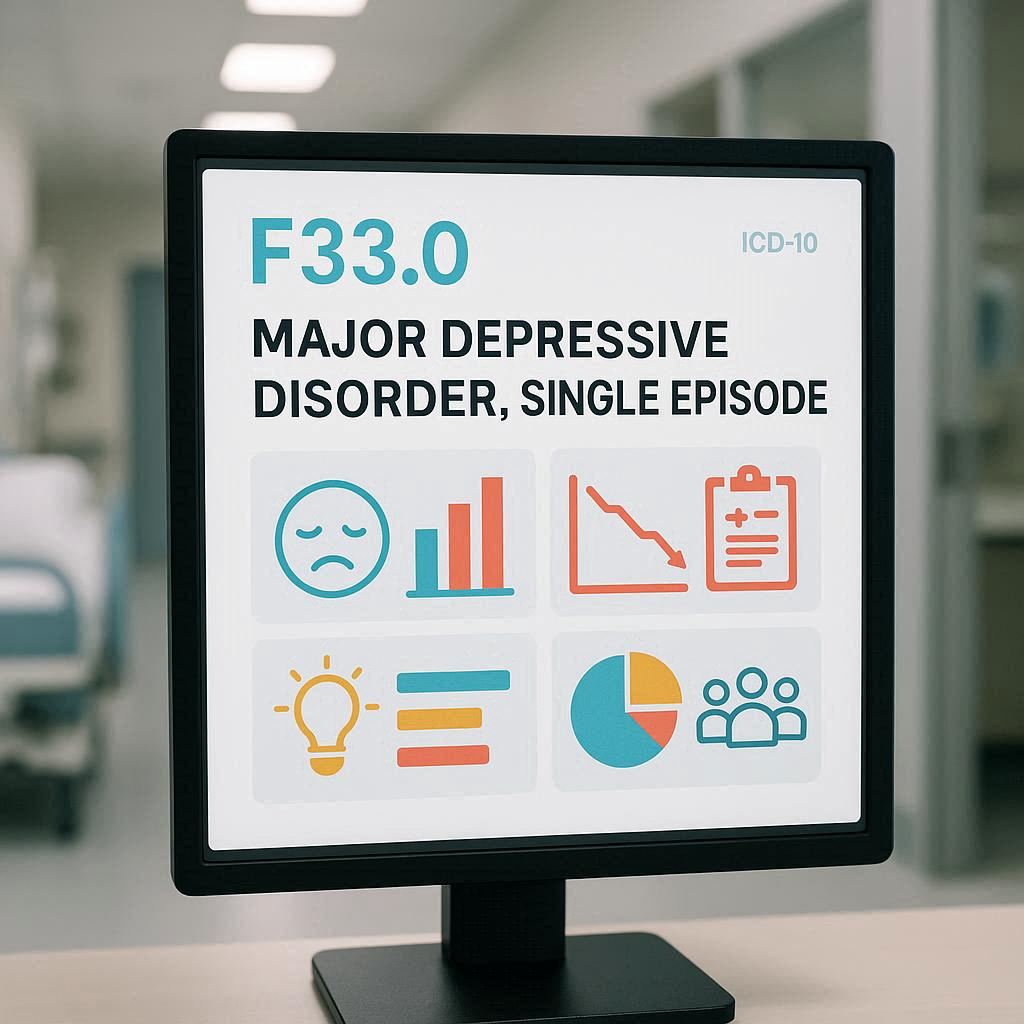
In the simplest terms, ICD-10 code F33.0 is the diagnostic label used by healthcare providers for Major Depressive Disorder, Recurrent, Mild.
Let’s unpack those words one by one.
- Major Depressive Disorder (MDD): This is the clinical name for what most people call “depression.” It is more than just feeling sad for a day. It is a persistent state of low mood, loss of interest, and other symptoms that interfere with daily life.
- Recurrent: This means the person has had at least two separate episodes of depression. The first episode may have happened months or even years ago. After the first episode ended (with or without treatment), a second episode began. F33.0 is not used for a first-time depression.
- Mild: This does not mean the depression is “not real” or “easy to handle.” It means the number and severity of symptoms are lower than in moderate or severe depression. A person with mild depression can usually continue most daily activities, but it still feels like a heavy weight on their shoulders.
Think of it this way: If severe depression is a storm that grounds all flights, mild depression is a steady, heavy rain that makes every walk outside miserable. You can still function, but the joy is gone.
Where Does This Code Fit in the ICD-10 Manual?
The ICD-10 (International Classification of Diseases, 10th Revision) is organized like a family tree. Code F33.0 belongs to a specific branch:
- Chapter V: Mental and behavioural disorders (Codes F00-F99)
- Block F30-F39: Mood [affective] disorders
- Category F33: Recurrent depressive disorder
- Subcategory F33.0: Recurrent depressive disorder, current episode mild
Specifically, F33.0 falls under F33.0x with a fifth character often used for specifiers (like F33.1 for moderate, F33.2 for severe). For mild recurrent depression, we usually look at F33.0 without additional specifiers, or F33.0 with the specifier for “without somatic syndrome.”
Important Note for Readers: A “somatic syndrome” refers to physical symptoms of depression, such as changes in sleep, appetite, or energy levels. When a doctor adds this specifier, it helps them understand the physical impact of the depression.
The Difference Between F33.0 and Other Depression Codes
One of the biggest sources of confusion is telling F33.0 apart from similar codes. Let’s clarify this with a simple comparison.
| ICD-10 Code | Full Description | Key Difference from F33.0 |
|---|---|---|
| F32.0 | Major Depressive Disorder, Single Episode, Mild | This is the first episode. F33.0 requires at least two episodes. |
| F33.1 | Recurrent Depressive Disorder, Current Episode Moderate | The current episode has more symptoms and greater functional impairment than F33.0. |
| F33.2 | Recurrent Depressive Disorder, Current Episode Severe | The current episode causes major impairment (e.g., cannot work or care for self). |
| F34.1 | Dysthymia (Persistent depressive disorder) | A chronic, low-grade depression lasting at least two years, but symptoms are often less intense than F33.0. |
| F43.21 | Adjustment disorder with depressed mood | Depression triggered by a specific stressor (like a divorce or job loss) and usually resolves when the stressor goes away. |
Why “Recurrent” Matters for Treatment
If a doctor uses F33.0, they are signaling that this is a long-term pattern. It is not a one-time reaction to a bad event. For patients, this is actually useful information.
Knowing you have recurrent depression helps you plan for the future. You and your doctor can focus on relapse prevention. You might talk about maintenance therapy—treatments that continue even when you feel better, just to stop the next episode from happening.
As one therapist put it, “Treating recurrent depression is like maintaining a garden, not just putting out a fire. You need to keep watering and weeding even when the sun is shining.”
Diagnostic Criteria: How Does a Doctor Identify F33.0?
Doctors do not guess. They follow strict guidelines. To diagnose F33.0, a professional will confirm the following three requirements:
Requirement 1: At Least Two Depressive Episodes
The person must have had at least two episodes of depression separated by at least two consecutive months without any significant mood disturbance. During those two months, they felt back to their normal self.
Requirement 2: The Current Episode is Mild (F33.0)
For the current episode to be “mild,” the person must meet the general criteria for a depressive episode but only have a few symptoms.
According to standard diagnostic manuals (like the DSM-5, which aligns with ICD-10), a mild depressive episode involves:
- At least 2 of the core symptoms (depressed mood, loss of interest, or fatigue).
- At least 2 of the other common symptoms (changes in appetite, sleep issues, agitation, low self-worth, poor concentration, or thoughts of death).
- Total of 4 to 5 symptoms present most days for at least two weeks.
- The person can typically continue daily routines (work, home, social life) but with noticeable effort.
Requirement 3: Exclusion of Other Causes
The symptoms cannot be caused by:
- Substance abuse (alcohol, drugs, medication side effects).
- A general medical condition (thyroid problems, vitamin deficiency, brain tumor).
- Grief or bereavement (adjustment disorder).
A Practical Checklist for Patients
If you think you or someone you know might fit F33.0, here is a quick list of common signs for a mild recurrent episode:
- You feel sad, empty, or hopeless most of the day.
- You don’t enjoy hobbies that used to make you happy.
- You feel tired or have low energy almost every day.
- Your sleep is off (difficulty sleeping or sleeping too much) on a few nights per week.
- Your appetite has changed (eating more or less) but without major weight change.
- You feel guilty or worthless about small things.
- You struggle to focus on TV, books, or conversations.
- You feel restless or slowed down.
If you checked 4 or 5 of these boxes, and this has happened before, talk to a doctor. Do not diagnose yourself. These are just conversation starters.
Symptoms and Real-Life Impact of F33.0 (Mild Recurrent Depression)
One of the biggest myths about “mild” depression is that it is harmless. This is false. Mild depression is still depression. It still hurts. It just hurts in a quieter, more creeping way.
Let’s look at what a typical day might look like for someone with F33.0.
The Emotional Experience
- Persistent low mood: It feels like wearing gray-tinted glasses. You see the world, but the colors are faded. You can laugh at a joke, but the laughter fades quickly.
- Irritability: Small annoyances feel huge. A messy counter or a slow internet connection can trigger disproportionate frustration.
- Anhedonia (loss of pleasure): This is the hallmark of depression. You used to love gardening? Now it feels like chores. You looked forward to Friday nights? Now Friday feels like Monday.
The Physical Experience
Because we are talking about “mild” without somatic syndrome (or with very mild somatic symptoms), the physical changes are subtle but real.
- You might wake up once or twice at night, but you fall back asleep.
- You might feel moderately tired by 2 PM, even after 8 hours of sleep.
- Your back or head might ache for no medical reason.
The Behavioral Experience
- Withdrawal: You still go to work or school, but you skip the after-work drinks. You answer texts slowly.
- Procrastination: Tasks that take 10 minutes feel like they require an hour of mental preparation.
- Neglect: You maintain basic hygiene (showering, brushing teeth), but you stop doing the “extra” things (shaving, makeup, styling hair).
A Realistic Note: Unlike severe depression, a person with F33.0 usually does not have suicidal ideation with a plan, psychotic features (hallucinations), or complete inability to get out of bed. However, they might have fleeting thoughts like, “I wish I could just sleep forever” or “Life feels pointless.” These thoughts should always be taken seriously.
Treatment Approaches for F33.0: What Actually Works?
The good news is that mild recurrent depression is highly treatable. Because the episode is mild, doctors often start with less intensive interventions before moving to medication.
Here is the typical step-by-step approach for F33.0.
First-Line: Psychotherapy (Talking Therapies)
For mild depression, therapy is often preferred over drugs. It has no side effects (except emotional discomfort during sessions) and teaches lifelong skills.
- Cognitive Behavioral Therapy (CBT): This is the gold standard. CBT helps you identify automatic negative thoughts (“I always screw up”) and replace them with realistic thoughts (“I made a mistake, but I learn from it”). Studies show CBT reduces the risk of another recurrence by up to 50%.
- Interpersonal Therapy (IPT): This focuses on relationships. It helps you manage grief, role disputes (e.g., at work or home), and social isolation.
- Behavioral Activation (BA): A very practical approach. You schedule positive activities (a walk, a coffee with a friend) even if you don’t feel like it. By doing, the feeling often follows.
Second-Line: Antidepressant Medication
For F33.0, medication is not always necessary. But it is an option if:
- Therapy alone has not worked after 8-12 weeks.
- The patient prefers medication (everyone is different).
- There is a strong family history of recurrent depression.
Common medications used for mild depression include:
| Medication Class | Examples | Typical use in F33.0 |
|---|---|---|
| SSRIs (Selective Serotonin Reuptake Inhibitors) | Sertraline (Zoloft), Fluoxetine (Prozac), Escitalopram (Lexapro) | Most common first choice. Low dose often sufficient. |
| SNRIs (Serotonin-Norepinephrine Reuptake Inhibitors) | Venlafaxine (Effexor), Duloxetine (Cymbalta) | Used if SSRIs don’t work or if there is chronic pain. |
| Atypical Antidepressants | Bupropion (Wellbutrin) | Good for low energy and lack of motivation. Not good for anxiety. |
Important Safety Note: Antidepressants take 4-6 weeks to work. Side effects (nausea, headache, sleep changes) often appear before benefits. Do not stop suddenly without a doctor’s guidance, as this can trigger a worse recurrence.
Lifestyle and Self-Help (Essential for Recurrence Prevention)
Because this is a recurrent disorder, lifestyle changes are not just “nice to have.” They are medicine.
- Sleep hygiene: Go to bed and wake up at the same time every day, even on weekends.
- Regular exercise: 30 minutes of moderate activity (brisk walking, cycling) 3-5 times per week. Exercise releases endorphins, natural antidepressants.
- Omega-3 fatty acids: Found in fish oil. Some studies suggest they help with mild depression.
- Social connection: Isolation is the fuel for depression. Schedule one low-pressure social activity per week (e.g., a 15-minute phone call).
- Reduce alcohol: Alcohol is a central nervous system depressant. It feels good for an hour, but worsens mood for days.
Special Considerations for Coding and Documentation
For healthcare professionals and medical coders, accuracy with F33.0 is critical for reimbursement and patient records. Here are practical tips.
When to Use F33.0 (Do’s)
- Do use F33.0 when the patient has a clear history of at least two prior depressive episodes (the current being the second or later).
- Do use F33.0 when the current episode meets criteria for mild severity (4-5 symptoms, mild functional impairment).
- Do use additional codes if needed (e.g., Z91.49 for psychological abuse history, or F33.2 for a prior severe episode that is currently in remission).
When NOT to Use F33.0 (Don’ts)
- Don’t use F33.0 for a first episode. Use F32.0.
- Don’t use F33.0 if the current episode is moderate or severe. Use F33.1 or F33.2.
- Don’t use F33.0 if the depression is clearly due to a medical condition (e.g., hypothyroidism). Use a code from F02.8 or G00-G99.
- Don’t use F33.0 for bipolar disorder. Recurrent depression in bipolar disorder is coded as F31.3 (mild) or F31.4 (moderate).
Common Documentation Mistakes
| Mistake | Correction |
|---|---|
| Writing “Depression NOS” (Not Otherwise Specified) | Specify: “Recurrent major depressive disorder, current episode mild.” |
| Forgetting to document the history of prior episodes | Explicitly state: “Patient had a prior depressive episode in 2020 that resolved.” |
| Coding F33.0 for a patient with dysthymia | Dysthymia is F34.1. It is chronic but less episodic. |
Answering Your Frequently Asked Questions (FAQ)
Here are the most common questions people ask about F33.0.
Q1: Is F33.0 a serious diagnosis?
Yes, it is serious because it is a recurrent mental health condition. However, “serious” does not mean “hopeless.” It means you need a long-term management plan. Many people with F33.0 live full, happy, productive lives with proper care.
Q2: Can F33.0 turn into severe depression?
Yes, a mild episode can worsen if untreated. That’s why early intervention is key. If you notice your symptoms increasing (e.g., sleeping all day, having suicidal thoughts), contact your doctor immediately. However, with treatment, many mild episodes resolve without ever becoming severe.
Q3: How long does a mild recurrent depressive episode last?
Without treatment, a mild episode can last 4 to 6 months on average. With treatment (therapy or medication), many people feel significant improvement within 4-8 weeks. However, recurrent depression means you might have multiple episodes across your lifetime.
Q4: Does F33.0 qualify for disability benefits?
It depends on your location and the specific insurance or government program. Generally, mild depression (F33.0) does not automatically qualify for disability because the criteria require that you cannot perform any substantial gainful activity. Since F33.0 allows for most daily functioning, approval is rare. Moderate or severe recurrent depression (F33.1, F33.2) has a higher chance of qualifying.
Q5: Can children or adolescents be diagnosed with F33.0?
Yes, but it is less common. Depression in children often presents as irritability rather than sadness. A diagnosis of recurrent mild depression in a child requires very careful documentation by a child psychiatrist. Always rule out ADHD, anxiety, or home stressors first.
Q6: What is the difference between F33.0 and “situational depression”?
Situational depression (Adjustment Disorder, F43.21) is directly tied to a specific life event (job loss, breakup, illness). F33.0 is endogenous—it can happen without any clear trigger. If a second depressive episode occurs long after a stressor is gone, it is likely F33.0, not an adjustment disorder.
A Realistic Look at Living with Recurrent Mild Depression
Let’s be honest for a moment. Living with F33.0 can feel exhausting in a quiet way. You are not in crisis, so you might think, “Others have it worse. I should just push through.” That internal voice is the depression talking.
Here is the truth: You deserve care even if your pain is not a 10/10.
Think of F33.0 like a sprained ankle versus a broken leg. A broken leg gets a cast and immediate emergency surgery. A sprained ankle gets rest, ice, and physical therapy. Both are valid injuries. Both need treatment. If you ignore a sprained ankle, you can develop a chronic limp.
Similarly, ignoring mild recurrent depression can lead to:
- Increased frequency of episodes (from once every 2 years to twice a year).
- Longer episodes (from 3 months to 9 months).
- A higher risk of developing moderate or severe episodes.
The Role of Support Systems
If you love someone with F33.0, here is how to help effectively:
- Don’t minimize it: Avoid phrases like “Just think positive” or “Everyone feels sad sometimes.”
- Offer specific help: Instead of “Let me know if you need anything,” say “I’m going for a 10-minute walk at 3 PM. Want to come?”
- Encourage treatment gently: “I’ve noticed you seem tired lately. Would you like me to help you find a therapist?”
- Watch for changes: If their mild depression shifts to not eating for days or talking about death, seek urgent care.
Additional Resources and Where to Find Help
You do not have to navigate F33.0 alone. Here are trusted resources.
- National Alliance on Mental Illness (NAMI): Helpline 800-950-6264 (Monday-Friday, 10 AM-10 PM ET). Excellent for family support.
- Substance Abuse and Mental Health Services Administration (SAMHSA): National Helpline 1-800-662-4357 (24/7, confidential, free).
- International Bipolar Foundation: Useful if you are unsure between recurrent depression and bipolar disorder.
- Psychology Today Therapist Directory: You can search for therapists who specialize in CBT or IPT for recurrent depression.
Resource Link: For a free, evidence-based self-assessment tool and a guide to finding low-cost therapy in your area, visit the Anxiety & Depression Association of America (ADAA) and search for “mild depression resources.”
Conclusion
ICD-10 code F33.0 represents recurrent major depressive disorder, current episode mild. It is a diagnosis of two or more depressive episodes where the current symptoms are manageable but still disruptive to quality of life. Unlike severe depression, it allows for daily functioning, but it still requires active treatment—primarily therapy and lifestyle changes—to prevent future episodes from worsening or becoming more frequent. Recognizing and respecting the “mild” label is crucial: it is not a lesser diagnosis, but an earlier opportunity for effective intervention.
Author: Technical Health Writer
Date: APRIL 26, 2026
Disclaimer: This article is for informational and educational purposes only. It does not constitute medical advice. Diagnosis and coding should always be performed by a qualified healthcare professional.