Imagine your day, meticulously planned, suddenly hijacked by an unpredictable, relentless, and overwhelming sensation. It’s not a call of nature you can politely postpone; it’s a sudden, imperative command from your own body—a desperate, non-negotiable urge to urinate, right now. This is the daily reality for millions of individuals living with Overactive Bladder (OAB). It is a condition shrouded in silence and stigma, often dismissed as a normal part of aging or a simple lack of self-control. Yet, its impact is profound, eroding quality of life, disrupting sleep, diminishing professional productivity, and leading to social isolation, anxiety, and depression.
For healthcare providers, accurately diagnosing and treating OAB is a clinical imperative. But in the modern healthcare ecosystem, clinical care is inextricably linked to administrative precision. At the heart of this administrative-clinical interface lies the International Classification of Diseases, Tenth Revision (ICD-10). The correct application of the ICD-10 code for Overactive Bladder is not a mundane clerical task; it is a critical act of translation. It transforms a patient’s subjective suffering into an objective, standardized language that facilitates appropriate reimbursement, enables robust population health research, and ensures an accurate medical record that travels with the patient through their care continuum. This article aims to be the definitive guide to that translation, offering a deep, exhaustive exploration of ICD-10 for Overactive Bladder that will benefit clinicians, medical coders, healthcare administrators, and informed patients alike.
ICD-10 for Overactive Bladder
2. Understanding the Enemy: What is Overactive Bladder (OAB)?
The Clinical Definition: Beyond the Layman’s Term
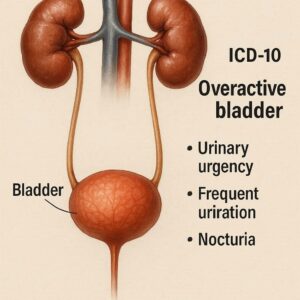
Overactive Bladder is not a disease in itself but a clinical syndrome characterized by a specific set of symptoms. The International Continence Society (ICS) defines it as “urinary urgency, usually accompanied by frequency and nocturia, with or without urgency urinary incontinence, in the absence of urinary tract infection or other obvious pathology.” This definition is crucial because it establishes OAB as a diagnosis of symptoms, not signs. It is what the patient experiences, and it exists on a spectrum of severity.
The Symptom Complex: Urgency, Frequency, Nocturia, and Urge Incontinence
-
Urgency: The cornerstone symptom of OAB. It is defined as a sudden, compelling desire to pass urine that is difficult to defer. This is distinct from the normal sensation of a gradually filling bladder. It is an abrupt, “got-to-go-now” feeling that can cause significant anxiety.
-
Frequency: The complaint of voiding too often by day. While there is no universal number, most clinicians consider urinating more than 8 times in a 24-hour period as increased frequency. This is often a compensatory behavior—patients void frequently to avoid being caught off-guard by an urgency episode.
-
Nocturia: Waking at night one or more times to void. Each episode must be preceded and followed by sleep. While common in older adults, when it occurs due to OAB, it is because the bladder’s involuntary contractions wake the patient up.
-
Urge Urinary Incontinence (UUI): The involuntary leakage of urine, accompanied by or immediately preceded by urgency. This is the most distressing symptom for many, as it can lead to accidental leakage, sometimes before reaching the toilet.
The Physiology of a Misfire: How a Healthy Bladder Becomes Overactive
A healthy bladder functions as a coordinated, low-pressure storage system. As it fills with urine from the kidneys, the detrusor muscle (the bladder wall) remains relaxed, and the urethral sphincters remain tightly closed. When it’s time to void, a conscious signal from the brain causes the detrusor to contract and the sphincters to relax.
In OAB, this system malfunctions. The prevailing theory is that OAB is often due to “detrusor overactivity”—involuntary contractions of the detrusor muscle during the filling phase. These contractions can be:
-
Neurogenic: Caused by neurological conditions (e.g., stroke, Multiple Sclerosis, spinal cord injury) where the nerve signals between the brain and bladder are disrupted, leading to a loss of inhibitory control.
-
Myogenic: Caused by changes in the bladder muscle itself, where the muscle cells become oversensitive and start communicating with each other, leading to widespread, spontaneous contractions.
Often, the exact cause is unknown, leading to a diagnosis of Idiopathic Overactive Bladder.
3. The Critical Role of Medical Coding: Why Getting the Code Right Matters
More Than Just Billing: The Ecosystem of ICD-10
The ICD-10 code is the fundamental currency of modern healthcare data. Its uses extend far beyond generating a bill.
-
Reimbursement: It justifies the medical necessity of the services provided, from the office visit to the urodynamic study and the prescribed medication. Incorrect coding leads to claim denials and financial loss for the practice.
-
Epidemiology and Research: Aggregated ICD-10 data allows public health officials and researchers to track the prevalence of OAB, identify risk factors, study treatment outcomes, and allocate resources effectively.
-
Quality Metrics and Patient Care: Codes are used to measure the quality of care provided. Accurate coding ensures that a patient’s problem list is correct, which is vital for coordinating care, avoiding harmful drug interactions, and creating an effective treatment plan.
-
Clinical Decision Support: Electronic Health Records (EHRs) use diagnosis codes to trigger alerts, suggest order sets, and provide relevant clinical guidelines to the provider at the point of care.
Consequences of Inaccurate Coding: Denials, Audits, and Compromised Care
Using an incorrect or nonspecific code for OAB has tangible negative consequences:
-
Claim Denials: If a coder uses a symptom code like R35.8 (Other polyuria) when the definitive diagnosis of OAB (N32.81) has been established, the insurer may deny the claim, stating the service was not medically necessary.
-
Audit Risks: Upcoding (using a more severe code) or downcoding (using a less specific code) can trigger audits from payers like Medicare, potentially resulting in hefty fines and penalties.
-
Inaccurate Patient Record: If a patient with OAB with incontinence is only coded as N32.81, their record does not fully reflect the severity of their condition, which could impact future care decisions.
4. The Core Code: A Deep Dive into N32.81 – Overactive Bladder
The principal ICD-10-CM code for this condition is N32.81.
-
Category N32: This category encompasses “Other disorders of bladder.”
-
Code N32.81: Specifically denotes “Overactive bladder.”
This code is used when a provider has diagnosed the patient with the OAB syndrome, regardless of the presence of incontinence. It is the code for the idiopathic form—when no specific underlying neurological or other cause is identified.
Official Coding Guidelines and Instructional Notes:
The ICD-10 manual includes critical instructions for using N32.81.
-
Code also: There is an instructional note to “Code also any associated urgency incontinence (N39.41).” This is not an “and” statement; it means that if the patient has urge incontinence, you must code it in addition to N32.81.
-
Excludes1: This note is crucial. It states “Excludes1: detrusor sphincter dyssynergia (N32.81)” This is a paradox in the coding system. While N32.81 is the code for OAB, it explicitly excludes itself. This is often interpreted to mean that for pure coding purposes, the specific diagnosis of OAB is represented by N32.81, but coders must be aware of this oddity.
Clinical Documentation Requirements for N32.81:
For a coder to legitimately assign N32.81, the medical record must contain clear and consistent documentation from the provider. Phrases that support this code include:
-
“Diagnosis: Overactive Bladder”
-
“Patient presents with symptoms consistent with OAB syndrome.”
-
“Idiopathic detrusor overactivity confirmed on urodynamics.”
Vague terms like “irritable bladder” or “bladder spasms” are insufficient and may require the provider to be queried for clarification.
5. Navigating the Nuances: Coding for OAB with and without Incontinence
This is the most common point of confusion and the most critical distinction in OAB coding.
The Primary Distinction: N32.81 vs. N39.41
-
N32.81 – Overactive bladder: This code represents the syndrome itself. It includes the symptoms of urgency, frequency, and nocturia.
-
N39.41 – Urge incontinence: This code represents the specific symptom of involuntary leakage associated with urgency.
The relationship is hierarchical. All patients with OAB have urgency; some of those patients also have urge incontinence.
Case Study 1: The Patient with “Just” Urgency and Frequency
A 52-year-old female presents with a 6-month history of sudden urges to urinate every 1-2 hours during the day and waking up 3 times nightly to void. She denies any leakage of urine.
-
Provider’s Diagnosis: Overactive Bladder without incontinence.
-
Correct Coding: N32.81 (Overactive bladder).
Case Study 2: The Patient with Urgency Incontinence
A 68-year-old male presents with a strong, sudden urge to urinate that sometimes causes him to leak urine before he can get to the bathroom. This happens 2-3 times per week. He also voids 10-12 times per day.
-
Provider’s Diagnosis: Overactive Bladder with urge incontinence.
-
Correct Coding: N32.81 (Overactive bladder) and N39.41 (Urge incontinence). The sequencing (which code is listed first) depends on the reason for the encounter. If the focus is the overall OAB management, N32.81 is primary. If the encounter is specifically to address the incontinence, N39.41 could be listed first.
6. The Comorbidities and Etiologies: When OAB is a Symptom of Something Else
A proficient coder must understand when OAB is the primary problem and when it is a secondary manifestation of another condition. The coding rule is: code the underlying etiology first.
The Rule-Out Process: Distinguishing Idiopathic OAB from Secondary OAB
A provider will typically perform a history, physical, and basic tests (like a urinalysis) to rule out conditions like UTIs before settling on a diagnosis of idiopathic OAB (N32.81).
Coding for Neurological Causes:
If a neurological condition is causing the OAB, that condition is coded first.
-
Multiple Sclerosis (MS): G35 (Multiple sclerosis) would be the primary diagnosis. The OAB is a symptom. You may also assign N32.81 to further specify the nature of the bladder dysfunction, but G35 must be sequenced first.
-
Parkinson’s Disease: G20 (Parkinson’s disease) is primary. There is also a specific code for G25.81 (Restless legs syndrome) but for OAB related to Parkinson’s, G20 is correct.
-
Spinal Cord Injury: A code from the G82 series (Paraplegia, Quadriplegia) would be primary, often with the addition of N31.2 (Flaccid neuropathic bladder) or N31.1 (Hyperreflexic neuropathic bladder), which is the neurological equivalent of OAB.
Coding for Anatomical and Post-Surgical Causes:
-
Post-Prostatectomy: After a radical prostatectomy for cancer, men often develop OAB symptoms. The primary code might be N99.81 (Other complications of genitourinary procedures). N32.81 could be added as a secondary code to specify the complication.
-
Bladder Outlet Obstruction (BOO) from BPH: In men with an enlarged prostate (BPH), the obstruction can cause secondary OAB. The primary code would be N40.1 (Enlarged prostate with lower urinary tract symptoms). The OAB symptoms are considered part of the clinical picture of BPH.
The Diabetes Connection:
Diabetes can cause OAB through two mechanisms: neuropathy (damaging the nerves controlling the bladder) or polyuria (producing excessive urine). If the OAB is directly linked to diabetic neuropathy, code the diabetes first (e.g., E11.41 – Type 2 diabetes mellitus with diabetic polyneuropathy). If it’s due to the sheer volume of urine, the diabetes code (e.g., E11.9) is primary.
Urinary Tract Infections (UTIs):
A UTI can mimic OAB symptoms. The rule is: if the symptoms are acute and clearly caused by the UTI, code only the UTI (N39.0 – Urinary tract infection, site not specified). If the patient has a chronic, underlying OAB and develops a UTI, both codes may be used, with the UTI often listed as the primary reason for that acute encounter.
7. The Patient Journey: From Presentation to Diagnosis and Treatment Coding
A patient’s encounter with the healthcare system for OAB involves multiple steps, each with its own coding implications.
-
Initial Encounter (Office Visit): The provider establishes medical decision-making. The codes used (N32.81, N39.41) support the Evaluation and Management (E/M) code for the office visit.
-
Diagnostic Tests:
-
Urodynamics/CMG (Cystometrogram): This test confirms detrusor overactivity. The CPT code for the procedure (e.g., 51725) is linked to the diagnosis code N32.81 to prove medical necessity.
-
Cystoscopy: If performed to rule out other pathology like stones or tumors, the diagnosis code supporting this procedure could be R35.8 (Frequency) or N32.81.
-
-
Treatment Pathways:
-
Behavioral Therapies: Coded with the appropriate E/M or physical therapy codes, linked to N32.81/N39.41.
-
Pharmacological Management: Prescribing an anticholinergic like oxybutynin or a beta-3 agonist like mirabegron. The drug is prescribed for the diagnosis of N32.81.
-
Advanced Therapies:
-
Botox Injections (J0585 + 52287): The injection procedure is coded for the diagnosis of N32.81, often with the addition of a code like G25.81 if due to a neurological condition.
-
Sacral Neuromodulation (InterStim): The implantation procedure is supported by the diagnosis codes for refractory OAB (N32.81, N39.41).
-
-
8. A Practical Tool: ICD-10 Code Table for Overactive Bladder and Related Conditions
The following table provides a quick-reference guide to the most commonly used ICD-10-CM codes in the management of OAB.
9. The Future of Coding: A Glimpse at ICD-11 and Beyond
The World Health Organization’s ICD-11 has already been released and offers a more refined structure. In ICD-11, the code for Overactive Bladder is GC50.0. The key advancements include:
-
A Dedicated Chapter for Diseases of the Genitourinary System: It allows for more granularity.
-
Postcoordination: ICD-11 encourages linking multiple codes to paint a complete picture. For example, GC50.0 (OAB) could be linked to a code for the underlying cause (e.g., Multiple Sclerosis) and a code for the severity of incontinence, all in a structured, computer-friendly format.
This shift promises even greater precision in defining patient populations for research and tailoring reimbursement models to complexity.
10. Conclusion: Precision in Coding, Clarity in Care
Accurate ICD-10 coding for Overactive Bladder is a critical bridge between clinical practice and healthcare administration. The correct application of N32.81 and N39.41 ensures financial integrity and fuels valuable research. Most importantly, it creates a precise and reliable medical record, forming the foundation for the high-quality, patient-centered care that individuals living with this challenging condition deserve.
11. Frequently Asked Questions (FAQs)
Q1: What is the difference between N32.81 and R35.0 (Frequency of micturition)?
A: R35.0 is a symptom code. It is used when a patient complains of frequent urination, but the provider has not yet established a definitive diagnosis. N32.81 is a diagnosis code for a specific clinical syndrome. Once the provider diagnoses Overactive Bladder, you must transition from the symptom code (R35.0) to the diagnosis code (N32.81).
Q2: If a patient has OAB due to a stroke, which code do I use first?
A: You must code the underlying etiology first. In this case, you would use the appropriate code for the sequelae of the stroke (e.g., I69.3XX – Sequelae of cerebral infarction) as the primary diagnosis. You can then add N32.81 as a secondary code to specify the resulting bladder condition.
Q3: Can I use both N32.81 and N39.41 on the same claim?
A: Yes, and in many cases, you should. The ICD-10 guidelines instruct to “code also” urge incontinence with OAB. This means if both conditions are documented, both codes must be reported. This provides a complete picture of the patient’s severity.
Q4: My provider documented “OAB with incontinence.” Is that sufficient for coding N39.41?
A: While it strongly implies urge incontinence, best practice is to query the provider for clarification. The ideal documentation is “Overactive Bladder with urge incontinence.” This distinguishes it from stress or mixed incontinence, which have different codes (N39.3).
Q5: Are there any specific codes for refractory OAB?
A: No, ICD-10-CM does not have a unique code for medication-resistant or refractory OAB. You would continue to use N32.81 (and N39.41 if applicable). The “refractory” nature of the condition is communicated through the treatment plan (e.g., moving to third-line therapies like Botox or neuromodulation).
12. Additional Resources
-
Centers for Medicare & Medicaid Services (CMS) ICD-10-CM Official Guidelines for Coding and Reporting: https://www.cms.gov/medicare/coding/icd10 (The definitive source for coding rules).
-
World Health Organization (WHO) ICD-10 Online Browser: https://icd.who.int/browse10/2019/en (A useful tool for looking up codes and their hierarchies).
-
American Urological Association (AUA): https://www.auanet.org (Provides clinical guidelines on the diagnosis and treatment of OAB which inform documentation).
-
International Continence Society (ICS): https://www.ics.org (The leading international scientific organization for continence and lower urinary tract function, providing standardized definitions).
-
The National Association for Continence (NAFC): https://www.nafc.org (A valuable patient-oriented resource that helps explain conditions and treatments in layman’s terms).