In the intricate world of medical coding, few conditions seem as deceptively simple as otitis externa. Often colloquially dubbed “swimmer’s ear,” it is frequently perceived as a straightforward, minor ailment. For the medical coder, however, this perception is a trap. Beneath this common diagnosis lies a complex tapestry of anatomical precision, pathological variation, and coding nuance that, if misunderstood, can lead to significant clinical, financial, and administrative repercussions. Accurate ICD-10 coding for otitis externa is not a mere clerical task; it is a critical skill that bridges clinical practice and healthcare infrastructure.
This comprehensive guide is designed to be your definitive resource. We will move beyond a simple list of codes to explore the “why” behind the “what.” We will delve into the anatomy and pathophysiology of the external ear, providing the clinical foundation necessary to make informed coding decisions. We will deconstruct the H60 code block with meticulous detail, exploring every subcategory and the vital importance of the 5th and 6th characters that specify laterality. Through real-world clinical vignettes, we will illustrate the practical application of these codes, demonstrating how to handle complex cases involving comorbidities and external causes. Furthermore, we will examine the profound impact of accurate coding on patient care, reimbursement, and public health data. Whether you are a seasoned medical coder, a healthcare administrator, a clinical practitioner, or a student entering the field, this article will equip you with the knowledge and confidence to master the coding of otitis externa in all its forms.
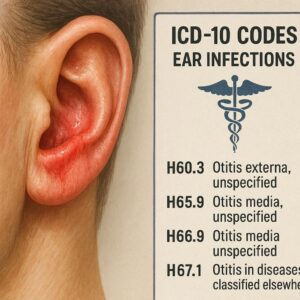
ICD-10 Codes for Otitis Externa
2. Understanding the Clinical Landscape: What is Otitis Externa?
Before a single code can be accurately assigned, a firm grasp of the clinical entity is paramount. Otitis externa is an inflammatory condition of the external auditory canal (EAC), which may also involve the pinna (auricle) and/or the tympanic membrane. This inflammation can be infectious (bacterial or fungal) or non-infectious (dermatological, allergic, or traumatic).
The Anatomy of the External Ear
The external ear is a sophisticated structure designed to funnel sound and protect the delicate middle and inner ear.
-
Pinna (Auricle): The visible, cartilaginous portion of the ear.
-
External Auditory Canal (EAC): A tube approximately 2.5 cm long extending from the concha of the pinna to the tympanic membrane. Its outer third is cartilaginous, lined with skin containing hair follicles, ceruminous (wax-producing) glands, and sebaceous glands. The inner two-thirds are bony and covered by a thin, sensitive layer of skin.
-
Tympanic Membrane (Eardrum): The thin, cone-shaped membrane that separates the external ear from the middle ear.
This anatomical knowledge is crucial. For instance, coding for an abscess on the pinna (H60.0) is distinct from coding for a furuncle within the cartilaginous part of the EAC, though both fall under the broader otitis externa umbrella.
Pathophysiology: How Does Infection Take Hold?
The healthy EAC has several defense mechanisms, including the migration of skin cells out of the canal (epithelial migration), the presence of cerumen (earwax) which is acidic and contains lysozymes, and its relative dryness. Otitis externa typically occurs when these defenses are breached. The common sequence of events is:
-
Loss of Protective Cerumen: Often due to aggressive cleaning with cotton swabs, which can also cause micro-abrasions.
-
Trauma to the Epithelial Lining: Creating a portal of entry for pathogens.
-
Retention of Moisture: “Swimmer’s ear” is a classic example where water remaining in the EAC macerates the skin, washing away protective cerumen and elevating the pH, creating an ideal environment for bacterial growth.
-
Inflammation and Infection: Bacteria (most commonly Pseudomonas aeruginosa and Staphylococcus aureus) or fungi colonize and invade the compromised skin, leading to the classic symptoms of pain, itching, erythema, and discharge.
Etiology: Bacterial, Fungal, and Non-Infectious Causes
Understanding the etiology guides both treatment and coding.
-
Acute Diffuse Bacterial OE: The most common form, accounting for over 80% of cases.
-
Fungal OE (Otomycosis): Often caused by Aspergillus or Candida species, characterized by itching, a feeling of fullness, and fungal debris that looks like “wet newspaper” in the canal.
-
Acute Localized OE (Furunculosis): This is a staphylococcal infection of a hair follicle in the lateral EAC, essentially a small, painful abscess.
-
Chronic OE: Persisting for more than 3 months, often associated with underlying skin conditions like eczema or psoriasis, or repeated instrumentation of the ear.
-
Necrotizing (Malignant) Otitis Externa: A life-threatening, progressive infection of the EAC and surrounding temporal bone, almost exclusively seen in immunocompromised patients, especially the elderly with diabetes.
Risk Factors and Prevention
Key risk factors include water exposure (swimming), humid climates, trauma from hearing aids, earplugs, or cotton swabs, and dermatological conditions (eczema, seborrheic dermatitis). Prevention focuses on keeping ears dry, avoiding trauma, and managing underlying skin conditions.
3. The ICD-10 Coding System: A Primer for Precision
The International Classification of Diseases, 10th Revision, Clinical Modification (ICD-10-CM) is the system used in the United States to classify and code all diagnoses, symptoms, and procedures. The transition from ICD-9 to ICD-10 in 2015 was a monumental shift, primarily characterized by a massive increase in specificity.
From ICD-9 to ICD-10: The Shift to Specificity
ICD-9 had a single, non-specific code for otitis externa (380.10 – Unspecified otitis externa). ICD-10, by contrast, features an entire category (H60) with numerous subcodes that specify the type of otitis externa and, critically, its laterality (left, right, or bilateral). This granularity allows for a more accurate reflection of the patient’s condition.
Understanding the Code Structure: Chapters, Blocks, and Categories
ICD-10-CM is organized hierarchically:
-
Chapter: Diseases of the Ear and Mastoid Process (Chapter VIII, Codes H60-H95).
-
Block: Diseases of External Ear (H60-H62).
-
Category: H60 – Otitis externa.
Within the H60 category, the codes are further broken down using 4th, 5th, and sometimes 6th characters to provide the required detail.
4. Deconstructing the ICD-10 Codes for Otitis Externa (H60)
Here, we will dissect the entire H60 category. This is the core reference section for coders.
H60.0-: Abscess of the External Ear
This code is used for a localized collection of pus involving the external ear. The 5th character specifies the site.
-
H60.00- Abscess of external ear, unspecified ear
-
H60.01- Abscess of right external ear
-
H60.02- Abscess of left external ear
-
H60.03- Abscess of external ear, bilateral
-
Note: A furuncle (boil) of the EAC is a type of abscess and is included here. The documentation must specify “abscess” or “furuncle.”
H60.1-: Cellulitis of the External Ear
This refers to a diffuse, spreading infection of the skin and subcutaneous tissues of the external ear, without a localized collection of pus (abscess).
-
H60.10- Cellulitis of external ear, unspecified ear
-
H60.11- Cellulitis of right external ear
-
H60.12- Cellulitis of left external ear
-
H60.13- Cellulitis of external ear, bilateral
-
Clinical Pearl: It is possible for a patient to have both an abscess and cellulitis. In such cases, both codes (H60.0- and H60.1-) would be assigned.
H60.2-: Malignant Otitis Externa
This is a critical code for a severe, life-threatening condition. It is not a malignancy (cancer), but rather an aggressive, invasive infection, typically caused by Pseudomonas aeruginosa, that spreads to the soft tissues and bone of the skull base.
-
H60.20- Malignant otitis externa, unspecified ear
-
H60.21- Malignant otitis externa, right ear
-
H60.22- Malignant otitis externa, left ear
-
H60.23- Malignant otitis externa, bilateral
-
Coding Tip: This condition often requires prolonged IV antibiotics and surgical debridement. Accurate coding is essential for justifying the high level of resource utilization.
H60.3-: Other Infective Otitis Externa
This is a broad subcategory for other types of infectious otitis externa not specified elsewhere.
-
H60.31- Diffuse otitis externa: The classic “swimmer’s ear,” involving a generalized inflammation of the EAC.
-
H60.32- Hemorrhagic otitis externa: A rare, painful condition characterized by blood-filled blisters on the tympanic membrane and EAC skin, often associated with viral infections.
-
H60.33- Swimmer’s ear: This is an explicit synonym for diffuse otitis externa. Coders can use H60.31- or H60.33- based on the physician’s documentation.
-
H60.39- Other infective otitis externa: For other specified infections not covered above (e.g., E. coli otitis externa, if specifically documented).
H60.4-: Cholesteatoma of the External Ear
A cholesteatoma is a benign but destructive growth of keratinizing squamous epithelium that can erode bone. While more common in the middle ear, it can occur in the external ear, often as a result of canal stenosis or trauma.
-
H60.40- Cholesteatoma of external ear, unspecified ear
-
H60.41- Cholesteatoma of right external ear
-
H60.42- Cholesteatoma of left external ear
-
H60.43- Cholesteatoma of external ear, bilateral
H60.5-: Acute Otitis Externa, Unspecified
This code is used when the provider documents “acute otitis externa” but does not specify the type (e.g., diffuse, hemorrhagic). It is a less specific code and should be used only when the documentation lacks detail.
-
H60.50- Acute otitis externa, unspecified ear
-
H60.51- Acute otitis externa, right ear
-
H60.52- Acute otitis externa, left ear
-
H60.53- Acute otitis externa, bilateral
H60.6-: Other Otitis Externa (Chronic and Unspecified)
This subcategory captures non-infectious and chronic forms.
-
H60.61- Chronic otitis externa, right ear
-
H60.62- Chronic otitis externa, left ear
-
H60.63- Chronic otitis externa, bilateral
-
H60.8- Other otitis externa: This includes conditions like eczematoid otitis externa or reactive inflammation due to contact dermatitis.
-
H60.9- Otitis externa, unspecified: This is the least specific code and should be a last resort, used only when the provider gives no further detail beyond “otitis externa.”
The Crucial 5th and 6th Characters: Laterality
As demonstrated above, the 5th character (and sometimes a 6th) is dedicated to specifying laterality. This is a non-negotiable aspect of ICD-10 coding. Using an “unspecified” code (e.g., H60.509) when the laterality is known can lead to claim denials or down-coding.
-
1 – Right
-
2 – Left
-
3 – Bilateral
-
9 – Unspecified
Quick Reference Guide to Common Otitis Externa Codes
| Clinical Presentation | ICD-10-CM Code | Code Description | Notes |
|---|---|---|---|
| Swimmer’s Ear (Right) | H60.331 | Other infective otitis externa, right ear | Use when documented as “diffuse otitis externa” or “swimmer’s ear.” |
| Furuncle (Left EAC) | H60.012 | Abscess of left external ear | A furuncle is a type of abscess. |
| Cellulitis of Pinna (Bilateral) | H60.13 | Cellulitis of external ear, bilateral | Affects the auricle and/or EAC. |
| Malignant OE (Diabetic Patient) | H60.21 | Malignant otitis externa, right ear | Code also the diabetes (E11.9). |
| Chronic OE from Eczema | H60.62 & L20.9 | Chronic otitis externa, left ear & Atopic dermatitis, unspecified | Code both the chronic OE and the underlying skin condition. |
| Acute OE, type unspecified | H60.521 | Acute otitis externa, left ear | Use only when no further specification is available. |
*(Diagram: A flow chart for coding otitis externa. Start: “Provider Documents Otitis Externa.” Then, questions: “Is it Malignant (Necrotizing)?” If Yes -> H60.2-. If No -> “Is it an Abscess/Furuncle?” If Yes -> H60.0-. If No -> “Is it Cellulitis?” If Yes -> H60.1-. If No -> “Is it specified as Diffuse/Swimmer’s Ear?” If Yes -> H60.31-/H60.33-. If No -> “Is it specified as Acute?” If Yes -> H60.5-. If No -> “Is it specified as Chronic?” If Yes -> H60.6-. If No -> “Is it another specified type?” If Yes -> H60.8-. If No -> H60.9-. At every branch, a final step: “Assign 5th/6th character for Laterality (Right-1, Left-2, Bilateral-3, Unspecified-9).”)*
5. Navigating Complexity: Associated Conditions and Combination Coding
Otitis externa rarely exists in a vacuum. Accurate coding often requires the use of additional codes to paint a complete picture of the patient’s health status.
Coding for Underlying Dermatological Conditions (L20-L30, L40-L45)
If the otitis externa is a manifestation of a systemic skin condition, that condition must be coded first, followed by the otitis externa code.
-
Example: A patient with severe seborrheic dermatitis (L21.9) presents with inflamed, flaky skin in both ear canals. The primary code would be L21.9, followed by H60.8X3 (Other otitis externa, bilateral).
The Role of External Cause Codes (Chapter 20)
External cause codes are secondary codes that describe the circumstance causing an injury or condition. They are never used as a principal diagnosis but provide valuable context.
-
Example: A patient develops otitis externa after swimming in a lake. The codes would be H60.331 (for right swimmer’s ear) and W16.211A (Fall into swimming pool striking water surface causing drowning and submersion, initial encounter – *Note: A more specific code for water exposure causing OE may not exist, but this illustrates the concept; often an activity code like Y93.2- Activity, swimming might be used for status, not cause*). For a more direct example, if the OE was caused by trauma from a cotton swab, you would use an external cause code from the W45-series (Foreign body entering into or through skin).
When Otitis Externa Leads to Other Conditions
In severe cases, otitis externa can lead to complications like stenosis (narrowing) of the ear canal. In such cases, both the otitis externa and the stenosis (H61.1-) would be coded.
6. Clinical Vignettes: Applying Codes in Real-World Scenarios
Let’s apply our knowledge to realistic patient encounters.
Vignette 1: The Weekend Swimmer
-
Presentation: A 25-year-old presents with a 2-day history of right ear pain, itching, and a feeling of fullness after returning from a beach vacation. On otoscopy, the EAC is edematous, erythematous, and contains white debris.
-
Provider Documentation: “Acute diffuse otitis externa, right ear.”
-
Correct Coding: H60.331 (Other infective otitis externa, right ear). The term “diffuse” directs the coder away from the unspecified acute code (H60.51-) to the more specific H60.31-.
Vignette 2: The Diabetic Patient with Severe Pain
-
Presentation: A 70-year-old male with uncontrolled Type 2 diabetes presents with severe, deep right ear pain, purulent discharge, and facial nerve weakness. A CT scan shows erosion of the temporal bone.
-
Provider Documentation: “Necrotizing (malignant) otitis externa, right ear, in the context of uncontrolled diabetes mellitus.”
-
Correct Coding: H60.211 (Malignant otitis externa, right ear) followed by E11.9 (Type 2 diabetes mellitus without complications). The diabetes is a critical co-morbidity that must be coded.
Vignette 3: The Patient with Chronic Eczema and Ear Pain
-
Presentation: A 40-year-old female with a known history of atopic eczema presents with bilateral ear canal itching and scaling that has been present for months.
-
Provider Documentation: “Chronic eczematous otitis externa, bilateral, secondary to atopic dermatitis.”
-
Correct Coding: L20.9 (Atopic dermatitis, unspecified) followed by H60.63 (Chronic otitis externa, bilateral). The underlying dermatitis is coded first as it is the causative factor.
Vignette 4: Post-Operative Otitis Externa
-
Presentation: A patient develops a painful, localized swelling in the left EAC one week after undergoing a procedure that required the use of an ear speculum.
-
Provider Documentation: “Post-instrumentation furunculosis of the left external auditory canal.”
-
Correct Coding: H60.012 (Abscess of left external ear) and an external cause code, Y65.0 (Foreign object inadvertently left in body during procedure – Note: This may not be a perfect fit; a code for “misadventure” during a procedure might be more appropriate, but specific codes for instrumentation trauma are limited. This highlights the importance of thorough documentation.).
7. The Importance of Accurate Coding: Clinical, Financial, and Epidemiological Impact
Precision in coding is not an abstract goal; it has tangible consequences across the healthcare system.
Driving Patient Care and Treatment Decisions
Accurate codes travel with the patient’s record. If a patient with malignant otitis externa (H60.21-) is transferred to a specialist, that code immediately signals the severity of the condition, prompting a different treatment pathway (e.g., IV antibiotics, surgical consult) than for simple swimmer’s ear (H60.331).
Ensuring Proper Reimbursement and Avoiding Denials
Payers use ICD-10 codes to determine medical necessity and reimbursement rates. Coding a simple, unspecified otitis externa (H60.92) when the documentation supports a more complex code like malignant otitis externa (H60.21) will result in underpayment. Conversely, “upcoding” without clinical justification is fraudulent. Specificity and accuracy are key to clean claims and full, appropriate reimbursement.
Supporting Public Health and Research
Aggregated ICD-10 data is used by public health officials and researchers to track disease prevalence, identify outbreaks (e.g., a spike in swimmer’s ear in a community pool), and allocate resources. Inaccurate coding corrupts this data, leading to flawed conclusions and poor public health decisions.
8. Common Pitfalls and How to Avoid Them
-
Confusing Otitis Externa with Otitis Media: This is a fundamental error. Otitis media (H65-H67) is an infection of the middle ear, behind the eardrum. The key is in the documentation: “TM bulging/erythematous” suggests otitis media; “EAC edematous/erythematous” suggests otitis externa.
-
Overlooking Laterality: Always check for documentation of left, right, or bilateral. Using an unspecified laterality code as a default is a common cause of claim flags.
-
Misidentifying the Specific Type: Do not assume “otitis externa” is always “acute, unspecified.” Look for keywords: abscess, furuncle, cellulitis, diffuse, malignant, chronic, eczematous.
-
Failing to Code Co-existing Conditions: Always review the entire record for underlying conditions (diabetes, eczema) or external causes that should be coded.
9. The Future of Coding: A Glimpse Beyond ICD-10
The world of medical classification is ever-evolving. The World Health Organization has already released ICD-11, which features a further reorganized and digital-friendly structure. While the US has not yet set a timeline for transitioning to ICD-11, it represents the future. In ICD-11, otitis externa is found under code AA00.0. The principles of specificity and anatomical precision will only become more critical. The skills honed by mastering ICD-10 will be directly transferable, ensuring a smooth transition when it occurs.
10. Conclusion
Accurately coding otitis externa in the ICD-10 system requires a synthesis of clinical knowledge and coding expertise. Moving beyond the outdated perception of a simple “swimmer’s ear” code is essential for capturing the true complexity of this condition, from a localized furuncle to a life-threatening necrotizing infection. By understanding the anatomy, pathophysiology, and the detailed structure of the H60 code block—particularly the imperative of specifying laterality—coders can ensure precision that supports optimal patient care, justifies appropriate reimbursement, and contributes to robust public health data. In the nuanced landscape of medical coding, such mastery is not just about assigning numbers; it is about telling the accurate and complete story of the patient’s health.
11. Frequently Asked Questions (FAQs)
Q1: What is the difference between H60.31- (Diffuse otitis externa) and H60.51- (Acute otitis externa, unspecified)?
A: H60.31- is used when the provider specifically documents “diffuse otitis externa” or “swimmer’s ear,” indicating a widespread inflammation of the ear canal. H60.51- is a less specific code used when the provider only documents “acute otitis externa” without specifying the type (diffuse, hemorrhagic, etc.). Always use the most specific code supported by the documentation.
Q2: How do I code for a fungal ear infection (otomycosis)?
A: Otomycosis is classified under “Other infective otitis externa.” You would use code **H60.39-* (Other infective otitis externa) with the appropriate laterality character. If the specific fungus is identified, you may also code that infectious agent (e.g., B48.2 for Allergic bronchopulmonary aspergillosis, if Aspergillus is the cause), though this is often not required for the primary encounter.
Q3: A patient has both otitis externa and otitis media. How should this be coded?
A: Code both conditions. The sequencing (which code is listed first) depends on the reason for the encounter. If the patient is being seen primarily for the otitis externa, list that code first (e.g., H60.321 for left diffuse OE) followed by the otitis media code (e.g., H66.92 for left otitis media, unspecified). If the focus is on the otitis media, reverse the order. The documentation should guide your decision.
Q4: Is “malignant otitis externa” a form of cancer?
A: No, this is a common point of confusion. Malignant otitis externa is not a neoplasm (cancer). The term “malignant” here refers to its aggressive, destructive, and potentially life-threatening nature. It is a severe bacterial infection, most often caused by Pseudomonas aeruginosa.
Q5: What should I do if the provider’s documentation is incomplete, for example, just “otitis externa” with no laterality or type?
A: The golden rule of coding is “do not assume.” If the documentation is incomplete, you must query the provider for clarification. Assigning an unspecified code (H60.92) should be a last resort when, after a query, the information remains unavailable. Consistent queries improve documentation quality over time.
Date: October 20, 2025
Author: Dr. Anya Sharma, MD, MPH, CIC
Disclaimer: The information contained in this article is for educational and informational purposes only and is not intended as a substitute for professional medical advice, diagnosis, or treatment. Always seek the advice of your physician or other qualified health provider with any questions you may have regarding a medical condition or coding practice. The author and publisher are not responsible for any errors or omissions or for any consequences from the application of the information presented.