Peripheral Vascular Disease (PVD) represents a monumental challenge in modern healthcare, affecting millions of individuals worldwide and imposing a significant burden on healthcare systems. It is an umbrella term for disorders of the blood vessels outside of the heart and brain, primarily affecting the arteries, veins, and lymphatic vessels of the extremities. While often used interchangeably with Peripheral Artery Disease (PAD), which specifically denotes arterial disease, PVD encompasses a broader spectrum of vascular pathologies. The clinical implications are profound, ranging from debilitating pain and functional impairment to catastrophic outcomes like non-traumatic amputation and death. However, behind every clinical diagnosis lies a critical, yet often underappreciated, process: medical coding.
In the intricate ecosystem of healthcare delivery, accurate ICD-10-CM coding for PVD is not merely an administrative formality; it is a fundamental pillar supporting clinical care, reimbursement, public health surveillance, and medical research. A correctly assigned code tells a precise story about the patient’s condition. It communicates the disease’s etiology (e.g., atherosclerotic vs. vasospastic), its anatomic location (aorta, femoral artery, popliteal artery), its severity (with rest pain, with ulceration), and its laterality (right, left, bilateral). This granularity enables healthcare providers to track disease progression, allows payers to understand the complexity of care required, and empowers researchers to identify trends and evaluate treatments on a population level.
Conversely, inaccurate or nonspecific coding can trigger a cascade of negative consequences. It can lead to claim denials or underpayments, hamper quality improvement initiatives, skew epidemiological data, and ultimately, impede the delivery of optimal patient care. This comprehensive guide is designed to be an authoritative resource for medical coders, healthcare providers, students, and administrators seeking to master the complexities of ICD-10-CM coding for Peripheral Vascular Disease. We will journey from the fundamentals of the disease process to the advanced nuances of code assignment, empowering you to translate clinical documentation into accurate, specific, and compliant data.
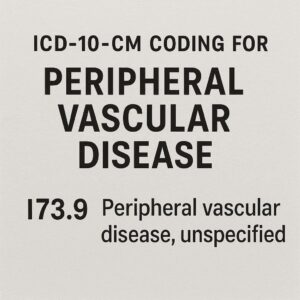
ICD-10-CM Coding for Peripheral Vascular Disease
2. Demystifying Peripheral Vascular Disease: A Primer on Pathophysiology and Clinical Spectrum
To code PVD effectively, one must first understand its clinical nature. PVD is characterized by the obstruction or dysfunction of blood vessels, leading to reduced perfusion to the affected limbs. This pathology is broadly divided into two categories: arterial and venous, with arterial disease generally being the more acute and limb-threatening.
Atherosclerotic PVD (PAD): The Most Common Culprit
Accounting for the vast majority of clinical cases, Atherosclerotic PVD, or PAD, is a manifestation of systemic atherosclerosis. It involves the buildup of fatty plaques (atheromas) within the intimal layer of the arterial wall. This process, known as atherosclerosis, leads to:
-
Stenosis: Narrowing of the arterial lumen, restricting blood flow.
-
Occlusion: Complete blockage of the artery.
-
Loss of Elasticity: Hardening of the arteries, impairing their ability to dilate and constrict as needed.
The primary symptom of PAD is claudication—derived from the Latin word for “limping”—which is defined as reproducible muscle pain, cramping, or fatigue induced by physical activity and relieved by rest. The location of the pain often corresponds to the level of the arterial obstruction. For example, calf pain typically indicates disease in the superficial femoral or popliteal arteries, while buttock and hip pain may suggest aortoiliac disease.
As PAD progresses, it can escalate to Critical Limb Ischemia (CLI), a severe stage characterized by:
-
Rest Pain: Persistent, often excruciating pain in the foot or toes, particularly at night, that may be relieved by dangling the leg over the side of the bed.
-
Tissue Loss: The development of non-healing ulcers or gangrene (tissue death).
[Image: A diagram showing the progression of atherosclerosis in a leg artery, from a healthy artery to a narrowed one with plaque buildup, and finally to a completely blocked artery.]
Caption: The progression of atherosclerosis from a healthy artery to a stenotic and then occluded vessel, leading to significantly reduced blood flow to the lower leg and foot.
Non-Atherosclerotic PVD: A Diverse Array of Causes
While atherosclerosis is the dominant cause, a proficient coder must be aware of other etiologies, as they are classified differently in ICD-10-CM.
-
Vasospastic Disorders: Conditions like Raynaud’s phenomenon (I73.0) involve episodic, exaggerated vasoconstriction of the small digital arteries in response to cold or stress, leading to characteristic color changes (white, blue, red) and numbness in the fingers or toes.
-
Inflammatory Arteritides: Thromboangiitis Obliterans (Buerger’s Disease) (I73.1) is an inflammatory disease strongly linked to tobacco use, causing segmental thrombotic occlusions of small and medium-sized arteries, veins, and nerves in the extremities.
-
Venous Disorders: This includes Deep Vein Thrombosis (DVT) (I82.4x), a blood clot in a deep vein, and Chronic Venous Insufficiency (CVI) (I87.2), which results from damaged venous valves leading to blood pooling, edema, skin changes, and venous stasis ulcers.
-
Varicose Veins (I83.x): Dilated, tortuous, and elongated superficial veins caused by venous hypertension and valvular incompetence.
3. Navigating the ICD-10-CM Framework: Structure and Conventions
The ICD-10-CM code set is organized logically, with codes for PVD scattered across several chapters, primarily within Chapter 9: Diseases of the Circulatory System (I00-I99). Understanding the structure of these code blocks is the first step to accurate coding.
The I70 Series: The Atherosclerosis Core
This is the most critical category for coding PAD. The codes are hierarchical and require a high degree of specificity.
-
I70.0: Atherosclerosis of aorta
-
I70.1: Atherosclerosis of renal artery
-
I70.2: Atherosclerosis of native arteries of the extremities
-
I70.3- I70.8: Atherosclerosis of other specific arteries (e.g., bypass grafts, other grafts).
-
I70.9: Generalized and unspecified atherosclerosis
The I73 Series: Other Peripheral Vascular Diseases
This category is a catch-all for non-atherosclerotic arterial diseases.
-
I73.0: Raynaud’s syndrome
-
I73.1: Thromboangiitis obliterans [Buerger’s disease]
-
I73.8: Other specified peripheral vascular diseases
-
I73.9: Peripheral vascular disease, unspecified (Use with extreme caution)
The I77 Series: Other Disorders of Arteries and Arterioles
This includes a variety of arterial conditions like arteriovenous fistula (I77.0), arterial fibromuscular dysplasia (I77.3), and other specified disorders.
The I80 Series: Phlebitis and Thrombophlebitis
This block covers inflammation of veins and thrombosis in various locations, including superficial and deep veins of the lower extremities.
The I83 Series: Varicose Veins of Lower Extremities
This category is for varicose veins, with codes specifying the presence of ulcers, inflammation, or both.
4. A Deep Dive into Atherosclerotic PVD (PAD) Coding (Category I70)
This section is the cornerstone of PVD coding. The codes in category I70 are combination codes, meaning they identify both the diagnosis (atherosclerosis) and the affected site.
I70.2: Atherosclerosis of the Arteries of the Extremities
This is the most frequently used code for PAD. It requires a minimum of 5 characters to be valid. The 5th character specifies the type of vessel and the presence of symptoms.
I70.21- Atherosclerosis of the extremities with intermittent claudication
-
I70.211: Right leg
-
I70.212: Left leg
-
I70.213: Bilateral legs
-
I70.218: Other extremity (e.g., arms)
-
I70.219: Unspecified extremity
I70.22- Atherosclerosis of the extremities with rest pain
-
(Same laterality options as above: .221, .222, .223, etc.)
I70.23- Atherosclerosis of the extremities with ulceration
-
This code is used when an ulcer is present due to PAD. It requires two additional 6th characters to specify the severity of the ulcer.
-
I70.231: … with ulceration limited to breakdown of skin
-
I70.232: … with ulceration with involvement of muscle
-
I70.233: … with ulceration with involvement of bone
-
I70.234: … with ulceration with necrosis of muscle
-
I70.235: … with ulceration with necrosis of bone
-
I70.24- Atherosclerosis of the extremities with gangrene
-
This code is used when gangrene is present. It is a combination code that includes both the atherosclerosis and the gangrene, so an additional code from category I96 (Gangrene, not elsewhere classified) is generally not required unless the documentation is unclear. Like I70.23, it requires a 6th character for laterality.
I70.25- Other atherosclerosis of the extremities
-
Used for cases that don’t fit the above categories (e.g., asymptomatic PAD diagnosed via an abnormal ABI).
Coding with Comorbidities: Gangrene (I96) and Ulcerations
The coding guidelines provide specific instructions for coding ulcerations and gangrene. If a patient has atherosclerosis with gangrene, code I70.24- is assigned. However, if the gangrene is documented as being caused by another condition (e.g., diabetes), the coding sequence changes. You would code the underlying disease (e.g., E11.52, Type 2 diabetes mellitus with peripheral angiopathy with gangrene) and then a code from I96 for the gangrene.
Similarly, for ulcers, if the ulcer is exclusively due to atherosclerosis, I70.23- is sufficient. If the patient has both arterial and venous ulcers, both codes may be required.
The “Use Additional Code” Mandate: Managing Comorbidities
Category I70 has a crucial instructional note: “Use additional code to identify:” This is non-negotiable for complete coding.
-
Exposure to tobacco: (Z77.22, F17.-)
-
Chronic kidney disease: (N18.-)
-
Hypertension: (I10)
-
Hyperlipidemia / Hypercholesterolemia: (E78.0, E78.1, E78.2, etc.)
Example: A patient with bilateral leg claudication due to atherosclerosis, who is a current smoker with hypertension and high cholesterol, would be coded as:
-
I70.213 – Atherosclerosis of native arteries of the extremities with intermittent claudication, bilateral legs
-
F17.210 – Nicotine dependence, cigarettes, uncomplicated
-
I10 – Essential (primary) hypertension
-
E78.5 – Hyperlipidemia, unspecified
5. Coding Non-Atherosclerotic Peripheral Vascular Diseases
Not all limb ischemia is due to plaque buildup. Accurate differentiation is key.
I73.0: Raynaud’s Syndrome
This code requires careful attention to documentation.
-
Primary Raynaud’s (Raynaud’s Disease): Is idiopathic and typically symmetric. Code I73.00 (Raynaud’s syndrome without gangrene) or I73.01 (Raynaud’s syndrome with gangrene).
-
Secondary Raynaud’s (Raynaud’s Phenomenon): Is caused by an underlying condition like scleroderma, lupus, or rheumatoid arthritis. In this case, you must code the underlying condition first, followed by I73.0-.
I73.1: Thromboangiitis Obliterans (Buerger’s Disease)
This code stands alone for this specific inflammatory condition. Documentation of a strong smoking history is a key clinical indicator.
I73.9: Peripheral Vascular Disease, Unspecified – A Code of Last Resort
This code should be used sparingly and only when the medical record documentation is insufficient to specify the type of PVD. It is a nonspecific code that may trigger audits or claim denials. The coder should always query the provider for more specific documentation before defaulting to I73.9.
I82.4_: Acute Venous Embolism and Thrombosis of Deep Vessels of Lower Extremity
This code requires a 5th character for laterality and specificity.
-
I82.401: Acute embolism and thrombosis of unspecified deep vessels of right lower extremity
-
I82.402: … left lower extremity
-
I82.4_2: Acute embolism and thrombosis of femoral vein
-
I82.4_3: Acute embolism and thrombosis of iliac vein
-
I82.4_9: Acute embolism and thrombosis of unspecified deep vessels
I83._: Varicose Veins with and without Complications
This category uses a 4th character to specify the presence of complications.
-
I83.0: Varicose veins of lower extremities with ulcer
-
I83.1: Varicose veins of lower extremities with inflammation
-
I83.2: Varicose veins of lower extremities with both ulcer and inflammation
-
I83.8: Varicose veins of lower extremities without ulcer or inflammation
6. Documentation is Everything: What Clinicians Need to Provide for Accurate Coding
The coder is entirely dependent on the quality of the clinical documentation. Ambiguous documentation leads to inaccurate coding. Providers should be encouraged to document the following with precision:
-
Etiology: Is it “atherosclerotic,” “vasospastic,” “thrombotic,” or “venous”?
-
Anatomic Site: “Superficial femoral artery,” “popliteal artery,” “aortoiliac segment,” “great saphenous vein.”
-
Laterality: Always specify “right,” “left,” or “bilateral.”
-
Severity/Symptoms: “Asymptomatic,” “intermittent claudication,” “rest pain,” “critical limb ischemia.”
-
Complications: “Non-healing ulcer, right great toe,” “dry gangrene, left forefoot.”
-
Cause-and-Effect Relationship: “The gangrene is due to peripheral arterial disease,” or “The ulcer is a venous stasis ulcer.”
7. Case Studies: Applying ICD-10-CM Codes to Real-World Scenarios
Let’s apply our knowledge to practical examples.
Case Study 1: Diabetic Patient with Claudication and Non-Healing Ulcer
-
Scenario: A 65-year-old patient with Type 2 diabetes presents with a non-healing ulcer on the plantar surface of the left foot and reports classic claudication in the left calf after walking one block. An angiogram shows significant atherosclerosis of the left superficial femoral artery. The patient has a history of hypertension and hyperlipidemia.
-
Codes:
-
I70.232 – Atherosclerosis of native arteries of left leg with rest pain? Wait, no. The patient has an ulcer, not rest pain. The claudication is a separate symptom. The primary reason for this encounter is the ulcer. Therefore: I70.232 – Atherosclerosis of native arteries of left leg with ulceration with involvement of muscle (assuming documentation supports muscle involvement).
-
E11.51 – Type 2 diabetes mellitus with diabetic peripheral angiopathy with gangrene? No gangrene is documented. We use E11.52 only if there is gangrene. Since the ulcer is attributed to PAD, the diabetes code should reflect the complication: E11.621 – Type 2 diabetes mellitus with foot ulcer.
-
L97.429 – Non-pressure chronic ulcer of left heel and midfoot with unspecified severity. (This code is used to provide additional specificity about the ulcer location, as per coding guidelines for coding ulcers).
-
I10 – Essential hypertension
-
E78.5 – Hyperlipidemia
-
Case Study 2: Patient with Acute Leg Swelling and DVT
-
Scenario: A 45-year-old female presents to the ER with acute, painful swelling of her right leg. A Doppler ultrasound confirms an acute deep vein thrombosis (DVT) in the right popliteal vein. She has no significant past medical history.
-
Codes:
-
I82.421 – Acute embolism and thrombosis of popliteal vein, right lower extremity.
-
Case Study 3: Patient with Raynaud’s and Connective Tissue Disease
-
Scenario: A patient with a established diagnosis of systemic sclerosis (scleroderma) presents for a follow-up, reporting increased frequency and severity of finger color changes and pain upon cold exposure.
-
Codes:
-
M34.0 – Progressive systemic sclerosis (This is the underlying cause, coded first).
-
I73.00 – Raynaud’s syndrome without gangrene.
-
8. Common Coding Pitfalls and How to Avoid Them
-
Pitfall 1: Using I73.9 (PVD, unspecified) when the documentation clearly states “atherosclerosis.” Solution: Always use the more specific I70.- code series for atherosclerotic disease.
-
Pitfall 2: Confusing claudication (I70.21-) with rest pain (I70.22-). Solution: Claudication is exercise-induced and relieved by rest. Rest pain occurs at rest and is a sign of critical ischemia.
-
Pitfall 3: Forgetting the “use additional code” instructions for tobacco use, hypertension, and hyperlipidemia. Solution: Always check the official guidelines and tabular list for instructional notes beneath the code.
-
Pitfall 4: Incorrect laterality. Solution: If the documentation doesn’t specify, query the provider. Do not assume.
9. The Future of PVD Coding: A Glimpse Beyond ICD-10-CM
The healthcare world is steadily preparing for the transition to ICD-11. The structure of ICD-11 is fundamentally different, relying on a digital “foundation” of entities and using clustering rather than combination codes. For example, in ICD-11, a case of atherosclerotic PAD with a ulcer might be represented by two codes: one for “Atherosclerosis of artery of lower extremity” (BD52.2) and another for “Ulcer of lower limb” (EF40.1), linked together to show the causal relationship. This system allows for greater flexibility and clinical detail. While the US has not yet set a implementation date for ICD-11, understanding its direction emphasizes the growing need for extremely precise clinical documentation.
Summary of Key ICD-10-CM Codes for Peripheral Vascular Disease
| Code Range | Code Description | Clinical Context | Key Instructional Notes |
|---|---|---|---|
| I70.21- | Atherosclerosis of extremities with intermittent claudication | Patient experiences reproducible leg pain with exercise, relieved by rest. | Requires 5th character for laterality. Use additional code for tobacco use (Z77.22, F17.-), hypertension (I10), hyperlipidemia (E78.5). |
| I70.22- | … with rest pain | Patient has ischemic pain at rest, a sign of Critical Limb Ischemia (CLI). | Represents a higher severity than claudication. Code this, not I70.21-, if both are present. |
| I70.23- | … with ulceration | Patient has a trophic skin ulcer due to arterial insufficiency. | Requires 6th character to specify depth of ulcer (skin, muscle, bone). Also code the ulcer from L97.-. |
| I70.24- | … with gangrene | Patient has tissue death (dry or wet gangrene) due to PAD. | This is a combination code. An additional code from I96 is generally not needed. |
| I73.00/.01 | Raynaud’s syndrome | Episodic vasospasm of digital arteries. | Use I73.00 (without gangrene) or I73.01 (with gangrene). If secondary, code the underlying condition FIRST. |
| I73.1 | Thromboangiitis Obliterans (Buerger’s Disease) | Inflammatory thrombosis linked to smoking. | This code stands alone for this specific diagnosis. |
| I73.9 | Peripheral vascular disease, unspecified | NONSPECIFIC. Use only if the etiology cannot be determined from documentation. | Avoid this code. Always query the provider for a more specific diagnosis. |
| I82.4_ | Acute DVT of lower extremities | Blood clot in a deep vein (e.g., |
10. Conclusion
Mastering ICD-10-CM coding for Peripheral Vascular Disease is a complex but essential skill that bridges clinical practice and healthcare administration. It requires a solid understanding of vascular pathophysiology, meticulous attention to the hierarchical structure and instructional notes within the code set, and an unwavering commitment to specificity. By leveraging detailed clinical documentation, adhering to official guidelines, and avoiding common pitfalls, healthcare professionals can ensure the accurate translation of a patient’s vascular story into data that drives quality care, appropriate reimbursement, and meaningful health outcomes. The journey from a patient’s symptoms to a finalized code is one of precision and professional diligence, and it is a journey worth taking with expertise.
Frequently Asked Questions (FAQs)
Q1: What is the difference between ICD-10 code I70.2 and I73.9?
A: I70.2 is used specifically for Peripheral Artery Disease (PAD) caused by atherosclerosis. I73.9, “Peripheral vascular disease, unspecified,” is a nonspecific code that should only be used when the medical documentation does not specify the etiology of the disease (e.g., it just says “PVD” without clarifying if it’s atherosclerotic, vasospastic, etc.). I70.2 is always preferred over I73.9 when atherosclerosis is documented.
Q2: How do I code a patient with both diabetes and PAD who has a gangrenous foot ulcer?
A: This is a complex scenario that depends entirely on provider documentation. If the provider states the gangrene is due to the PAD, you would code I70.24-(Atherosclerosis with gangrene) and E11.51 (Type 2 diabetes with diabetic peripheral angiopathy without gangrene). If the provider states it is primarily due to diabetes, you would code E11.52 (Type 2 diabetes with diabetic peripheral angiopathy with gangrene) and I96 (Gangrene, not elsewhere classified). If the causality is unclear, a query to the provider is mandatory.
Q3: When coding atherosclerosis of the legs, is the 5th character for “with rest pain” (I70.22-) used if the patient has both claudication and rest pain?
A: No. The codes for rest pain (I70.22-) and ulceration (I70.23-) represent a higher level of severity than claudication. According to coding conventions, you code to the highest level of specificity and severity known. Therefore, if a patient has rest pain, you would code I70.22-, not I70.21-, even if they also have claudication. The rest pain supersedes the claudication in the code hierarchy.
Q4: Is a code from I70.2- sufficient for a diabetic foot ulcer, or do I need an additional code?
A: You will almost always need additional codes. If the ulcer is due to PAD, I70.23- describes the cause (atherosclerosis with ulceration). However, you must also use a code from category L97- to describe the ulcer itself (e.g., location, severity). Furthermore, if diabetes is present, you must also assign the appropriate diabetes code with complications, such as E11.621 for a diabetic foot ulcer. The codes work together to paint a complete picture.
Additional Resources
-
The Official ICD-10-CM Guidelines for Coding and Reporting: Published annually by the CDC and CMS. This is the ultimate authority for coding rules.
-
American Health Information Management Association (AHIMA): Provides a wealth of resources, articles, and educational materials on coding best practices.
-
American Academy of Professional Coders (AAPC): Offers certification, training, and ongoing education for medical coders, including specialty-specific information for cardiovascular coding.
-
American Heart Association (AHA) / American College of Cardiology (ACC): Provide clinical guidelines on the management of Peripheral Artery Disease, which can offer context for the conditions being coded.
Disclaimer: This article is intended for informational and educational purposes only. It is not a substitute for professional medical coding, billing, or clinical advice. Medical coders must consult the most current, official ICD-10-CM coding guidelines, payer-specific policies, and the patient’s complete medical record to ensure accurate code assignment. The author and publisher disclaim any liability arising directly or indirectly from the use of this information.
Date: October 20, 2025
Author: The Coding & Clinical Intelligence Team