Tobacco use remains one of the most significant public health challenges globally, a silent epidemic responsible for millions of preventable deaths each year from cancer, cardiovascular disease, and respiratory failure. In the intricate world of modern healthcare, where patient care intersects with complex administrative systems, the act of documenting and coding a patient’s relationship with tobacco has evolved from a clerical task to a critical clinical intervention. It is a process that speaks volumes, telling a story not just of a habit, but of a diagnosable disorder, a risk factor, a complicating condition, and, most importantly, a potential for recovery. At the heart of this narrative lies a seemingly simple set of alphanumeric characters: the ICD-10 codes for tobacco use and dependence.
For many healthcare providers, the choice between Z72.0 (Tobacco use) and F17.210 (Nicotine dependence, cigarettes, uncomplicated) can appear ambiguous, a minor decision in a busy day. However, this choice carries profound implications. It influences the perceived medical necessity of cessation counseling, impacts hospital quality metrics, shapes population health data, and ultimately, determines whether a healthcare system can effectively identify, treat, and support the millions of patients struggling with nicotine addiction. This article aims to be the definitive guide on this topic—a deep, exhaustive exploration that moves beyond the basic code lookup. We will dissect the nuances of the ICD-10 classification system as it pertains to tobacco, explore the critical link between precise documentation and accurate coding, unravel complex clinical scenarios, and demystify the billing processes that make smoking cessation services viable. Our goal is to empower clinicians, coders, and healthcare administrators to use these codes not merely as billing tools, but as powerful instruments in the ongoing fight against tobacco addiction.
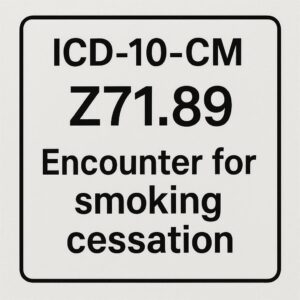
ICD-10 Code for Smoking Cessation and Tobacco Use Disorder
Table of Contents
Toggle2. Understanding the Landscape: Why Accurate Coding for Tobacco Use Matters
The accurate application of ICD-10 codes for tobacco is not an academic exercise; it is a multifaceted necessity with direct consequences for patient care, healthcare finance, and public health strategy.
The Clinical Imperative
From a clinical standpoint, a correctly documented and coded tobacco status is a vital sign for a patient’s long-term health. It alerts all members of the care team to a significant modifiable risk factor. When a provider correctly assigns a code from the F17.- series, it formally recognizes Nicotine Dependence as a medical diagnosis, a chronic, relapsing brain disorder. This legitimizes the patient’s struggle, moving it from a “bad habit” to a treatable medical condition. This diagnosis then opens the door for structured interventions: pharmacotherapy (varenicline, bupropion, nicotine replacement therapy), behavioral counseling, and dedicated follow-up. It ensures that smoking cessation is integrated into the patient’s overall care plan, especially when managing tobacco-related conditions like hypertension, diabetes, or asthma. In a hospital setting, identifying nicotine dependence allows for the proactive management of withdrawal symptoms, which can improve patient comfort, reduce agitation, and potentially shorten length of stay.
The Financial and Reimbursement Imperative
Financially, accurate coding is the linchpin of reimbursement. Insurance payers, including Medicare and Medicaid, require specific codes to justify the medical necessity of smoking cessation services. Using a vague or incorrect code can lead to claim denials. For instance, a provider cannot bill for intensive cessation counseling (e.g., CPT 99407) using only Z72.0; they typically need a dependence code like F17.210 to demonstrate that a diagnosable disorder is being treated. Furthermore, in risk-adjusted payment models like Medicare Advantage and ACA plans, conditions like Nicotine Dependence can impact the patient’s risk score, leading to higher per-member per-month payments to the provider organization to account for the increased cost of caring for that patient. Accurate coding ensures that healthcare systems are adequately compensated for the complexity of caring for populations with substance use disorders.
The Public Health and Data Analytics Imperative
On a macro level, the data generated by ICD-10 codes is the bedrock of public health surveillance. When millions of patient encounters are coded consistently, health agencies and researchers can track the prevalence of tobacco use and dependence across geographic, demographic, and socioeconomic lines. This data informs where to target prevention campaigns, how to allocate resources for quitlines, and allows for the measurement of the effectiveness of large-scale tobacco control policies, such as tax increases or flavor bans. Inaccurate coding creates “noise” in this data, obscuring the true picture of the epidemic and hampering the ability to mount an effective public health response.
3. Deconstructing the ICD-10 Codes: A Deep Dive
To navigate this landscape effectively, one must have a mastery of the specific codes available. The ICD-10-CM manual provides a structured hierarchy for classifying tobacco use.
Z72.0 – Tobacco Use: The “Status” Code
Z72.0 is found in Chapter 21 of ICD-10-CM, which covers factors influencing health status and contact with health services. It is a “Z code,” often used to describe a circumstance or problem that is itself not a disease or injury but may be a reason for encounter.
-
Appropriate Use Cases: This code is best used for a patient who uses tobacco but for whom a definitive diagnosis of Nicotine Dependence has not been made or is not applicable. This is common in:
-
Annual wellness visits: “Patient is here for a routine physical and reports he smokes 5-10 cigarettes per socially.”
-
Documenting a risk factor: A patient with a new diagnosis of hypertension who is a current smoker. The smoking is a risk factor for the hypertension, but the clinician has not assessed for the criteria of dependence.
-
Light or non-dependent smokers: A patient who smokes infrequently (e.g., a few cigarettes per week) and does not exhibit loss of control, withdrawal, or other dependence criteria.
-
-
Common Misconceptions and Pitfalls: The most significant error is using
Z72.0when the patient clearly has Nicotine Dependence. If the patient reports cravings, withdrawal symptoms, multiple quit attempts, and tolerance, they meet the criteria for anF17.-code. UsingZ72.0in such a case undersells the severity of the condition and may hinder reimbursement for treatment.
The F17.- Series: Tobacco Use Disorder – The “Diagnosis” Code
This series is located in Chapter 5 of ICD-10-CM, which deals with Mental, Behavioral, and Neurodevelopmental disorders. The code F17 is the parent code for “Nicotine dependence.” Its structure requires additional digits to specify the substance and the presence of complications.
-
Understanding the Structure:
-
F17.2 – Nicotine Dependence: This is the base code. The fifth and sixth digits provide specificity.
-
F17.20 – Nicotine dependence, unspecified: Used when the type of tobacco is not specified (e.g., the record just says “chewing tobacco” or “smokes tobacco”) and no complications are documented.
-
F17.21 – Nicotine dependence, cigarettes: The most commonly used code. For dependence on cigarette smoking.
-
F17.22 – Nicotine dependence, chewing tobacco: For dependence on smokeless tobacco.
-
F17.29 – Nicotine dependence, other tobacco product: For products like cigars, pipes, or hookah.
A seventh digit is often required to specify remission status, with the most common being:
-
F17.210 – Nicotine dependence, cigarettes, uncomplicated: The default code for active dependence.
-
F17.211 – Nicotine dependence, cigarettes, in remission: Used for a patient who has previously been diagnosed but is currently not using and not experiencing cravings/withdrawal.
-
-
Clinical Criteria for Diagnosis: According to the DSM-5, which informs ICD-10’s clinical perspective, Tobacco Use Disorder is diagnosed by a problematic pattern of tobacco use leading to clinically significant impairment or distress, as manifested by at least two of the following within a 12-month period:
-
Tobacco is often taken in larger amounts or over a longer period than was intended.
-
There is a persistent desire or unsuccessful efforts to cut down or control tobacco use.
-
A great deal of time is spent in activities necessary to obtain or use tobacco.
-
Craving, or a strong desire or urge to use tobacco.
-
Recurrent tobacco use resulting in a failure to fulfill major role obligations at work, school, or home.
-
Continued tobacco use despite having persistent or recurrent social or interpersonal problems caused or exacerbated by the effects of tobacco.
-
Important social, occupational, or recreational activities are given up or reduced because of tobacco use.
-
Recurrent tobacco use in situations in which it is physically hazardous.
-
Tobacco use is continued despite knowledge of having a persistent or recurrent physical or psychological problem that is likely to have been caused or exacerbated by tobacco.
-
Tolerance.
-
Withdrawal.
-
-
Severity Specifiers:
-
Mild: 2-3 symptoms
-
Moderate: 4-5 symptoms
-
Severe: 6 or more symptoms
*While the ICD-10 code itself does not directly encode mild/moderate/severe (it’s part of the clinical documentation), this assessment is crucial for determining the intensity of treatment.*
-
F17.21 – The Crucial Code for Active Cessation Management
F17.21- is the workhorse code for managing a patient actively engaged in quitting. When a patient presents for cessation counseling, is prescribed varenicline (Chantix), or is using NRT patches, this is the primary diagnosis code that substantiates the medical necessity of those interventions. It tells the payer, “We are treating a diagnosed substance use disorder.”
Other Relevant Codes: A Supporting Cast
-
T65.22-: Toxic effect of tobacco. This code is used for acute poisoning from tobacco, such as a child who ingests cigarettes or nicotine gum. It is not for chronic use or dependence. A 7th character is required for encounter status (e.g., A-initial, D-subsequent).
-
O99.33-: Tobacco use complicating pregnancy, childbirth, and the puerperium. This is a critical code for obstetric care. It should be sequenced alongside the pregnancy codes and can be used in conjunction with
Z72.0orF17.21-to provide a more complete picture. -
Z87.891: Personal history of nicotine dependence. This is the appropriate code for a patient who has successfully quit and is no longer dependent. It indicates a past condition that may still have relevance for their current health risk profile (e.g., a former smoker at risk for lung cancer).
ICD-10 Code Quick Reference Guide
| ICD-10 Code | Code Description | Primary Use Case | When to Avoid |
|---|---|---|---|
| Z72.0 | Tobacco use | Documenting a risk factor during a wellness visit; patient uses tobacco but does not meet dependence criteria. | When the patient exhibits signs of addiction (cravings, withdrawal, loss of control). |
| F17.210 | Nicotine dependence, cigarettes, uncomplicated | Primary diagnosis for active treatment of cigarette addiction (counseling, pharmacotherapy). | For non-dependent users or for a history of past dependence. |
| F17.211 | Nicotine dependence, cigarettes, in remission | Patient has a past diagnosis of dependence but has been abstinent and without symptoms for an extended period. | For a patient who is currently using or struggling with cravings. |
| F17.220 | Nicotine dependence, chewing tobacco, uncomplicated | Primary diagnosis for active treatment of smokeless tobacco addiction. | For cigarette or other tobacco product dependence. |
| O99.333 | Tobacco use complicating the puerperium | For a patient who uses tobacco during the postpartum period. | For non-pregnant patients. |
| Z87.891 | Personal history of nicotine dependence | Patient is a former smoker/dipper, no longer dependent. Relevant for long-term risk assessment. | For current users or those in remission (use F17.211 instead). |
4. The Art of Documentation: Bridging the Gap Between Clinician and Coder
The accuracy of the final coded data is entirely dependent on the quality of the clinician’s documentation. Vague terms lead to inaccurate codes. The coder can only code what they can read.
-
Key Phrases and Specificity:
-
Avoid: “Smoker,” “Uses tobacco.”
-
Use: “Patient reports smoking 1 pack of cigarettes per day for 15 years.” “Patient uses 1 can of smokeless tobacco every 2 days.” This specificity allows the coder to confidently assign
F17.21-for cigarettes orF17.22-for chewing tobacco.
-
-
Documenting Severity and Motivation:
-
Document behaviors that support the diagnosis: “Reports strong cravings when unable to smoke for more than 2 hours.” “Has made 3 serious quit attempts in the past year.” “Continues to smoke despite diagnosis of COPD.”
-
Document the patient’s stage of change: “Patient is in the contemplation stage, interested in quitting in the next 6 months.” This informs treatment strategy.
-
-
The Smoking History: A Template for Clarity
A structured note can ensure all necessary elements are captured:Tobacco Use History:
-
Product: Cigarettes
-
Frequency: 1 pack per day (ppd)
-
Duration: 20 years
-
Pack-Year History: 20 pack-years
-
Previous Quit Attempts: 2 attempts with cold turkey, longest abstinence 3 weeks.
-
Craving/Witdhrawal Symptoms: Yes, reports irritability, anxiety, and intense cravings when attempting to quit.
-
Assessment: Nicotine Dependence, Cigarettes, Moderate Severity.
-
Plan: Discussed cessation options; patient agreed to start nicotine patch and behavioral counseling.
-
This level of detail leaves no room for coder ambiguity.
5. Clinical Applications and Coding Scenarios: Putting Theory into Practice
Let’s apply our knowledge to realistic patient encounters.
-
Scenario 1: The Routine Physical and a Patient Who Smokes
-
Encounter: A 45-year-old male presents for his annual physical. He feels well. He reports smoking “about half a pack a day” but has no interest in quitting. He denies cravings or withdrawal if he goes without.
-
Documentation: “Patient is here for routine physical. He is a current smoker, ~10 cigarettes/day for 20 years. He is not interested in cessation at this time. No signs of dependence noted.”
-
Correct Coding: Z72.0. This is a status or risk factor. Dependence has not been established.
-
-
Scenario 2: The Patient with COPD Actively Trying to Quit
-
Encounter: A 60-year-old female with established COPD presents for follow-up and wants to quit smoking. She smokes 2 ppd, has morning cough, and gets “very shaky and irritable” if she doesn’t smoke every hour. She has tried to quit 5 times before.
-
Documentation: “Patient with COPD here for smoking cessation management. She meets criteria for severe Nicotine Dependence (tolerance, withdrawal, repeated unsuccessful quit attempts). We discussed pharmacotherapy; she will start varenicline today and follow up in 2 weeks.”
-
Correct Coding: J44.9 (COPD, unspecified) and F17.210 (Nicotine dependence, cigarettes, uncomplicated). The F17.21- code justifies the prescription and counseling.
-
-
Scenario 3: The Hospitalized Patient and Withdrawal
-
Encounter: A patient is admitted for community-acquired pneumonia. He is a heavy smoker and on day 2, becomes agitated and requests a cigarette.
-
Documentation: “Patient exhibiting signs of nicotine withdrawal: agitation, anxiety, and intense cravings. He has a 40-pack-year history and smokes within 30 minutes of waking. Diagnosis of Nicotine Dependence is confirmed.”
-
Correct Coding: J18.9 (Pneumonia, unspecified organism) and F17.210. The dependence code supports the medical necessity for administering NRT during the hospitalization to manage withdrawal and prevent AMA discharge.
-
-
Scenario 4: Pediatric Exposure and Secondhand Smoke
-
Encounter: A 4-year-old is brought in for recurrent ear infections. The mother smokes indoors.
-
Documentation: “Recurrent otitis media likely exacerbated by environmental tobacco smoke exposure. Counseled mother on risks of secondhand smoke.”
-
Correct Coding: H66.93 (Otitis media, unspecified, bilateral) and Z77.22 (Contact with and (suspected) exposure of environmental tobacco smoke). Note: This is not a code for the mother’s smoking status, but for the child’s exposure.
-
-
Scenario 5: Long-Term Follow-Up After Successful Cessation
-
Encounter: A 70-year-old former smoker presents for a Medicare Annual Wellness Visit. He quit smoking 10 years ago after a 30-pack-year history.
-
Documentation: “Patient is a former smoker, quit in 2015. No current use or cravings. Personal history of nicotine dependence is relevant for cancer screening.”
-
Correct Coding: Z00.00 (Encounter for general adult medical examination without abnormal findings) and Z87.891 (Personal history of nicotine dependence).
-
6. Billing and Reimbursement: Translating Codes into Actionable Care
The correct ICD-10 diagnosis codes must be paired with the appropriate procedure codes to bill for cessation services.
-
CPT and HCPCS Codes for Smoking Cessation Services:
-
99406: Smoking and tobacco use cessation counseling visit; intermediate, lasting 3 to 10 minutes.
-
99407: Smoking and tobacco use cessation counseling visit; intensive, lasting greater than 10 minutes.
-
G0436: Smoking and tobacco cessation counseling visit for the asymptomatic patient; intermediate, 3-10 minutes.
-
G0437: Smoking and tobacco cessation counseling visit for the asymptomatic patient; intensive, >10 minutes.
-
CPT Codes 99202-99215: Office/Outpatient Visit codes. These are used when cessation counseling is provided as part of a larger, medically necessary evaluation and management (E/M) service (e.g., the patient with COPD in Scenario 2).
-
-
Medicare and Medicaid Coverage Policies:
-
Medicare: Covers two cessation attempts per year. Each attempt may include a maximum of four intermediate or intensive counseling sessions. The total annual benefit covers up to 8 sessions in a 12-month period. The patient must be using a tobacco product and the service must be provided by a qualified physician or other Medicare-recognized practitioner.
-
Medicaid: Coverage varies significantly by state. Most states cover some form of tobacco cessation services for their beneficiaries, but the specifics (copays, number of sessions, covered medications) differ. It is essential to verify state-specific guidelines.
-
-
The Role of ICD-10 Codes in Substantiating Medical Necessity:
The diagnosis codeF17.21-is the primary justification for billing 99407 or G0437. It proves that the service was not just a casual conversation, but the treatment of a diagnosed disorder. The medical record must clearly link the diagnosis to the service provided.
7. The Future of Tobacco Coding: ICD-11 and Beyond
The World Health Organization’s ICD-11, which has been adopted for reporting by some countries, offers a more refined structure for substance use disorders. While the U.S. has not yet set a timeline for transitioning from ICD-10 to ICD-11, it is instructive to look ahead. In ICD-11, the code for Disorders due to use of nicotine, Nicotine dependence is 6C4A.2. The coding system allows for more granularity regarding the substance (e.g., cigarettes, smokeless tobacco, multiple specified nicotine-containing substances) and the current state (e.g., current use, early remission, sustained remission). This continued evolution promises even more precise data capture, which will further enhance treatment personalization and public health tracking.
8. Conclusion: Coding as a Catalyst for Change
The accurate application of ICD-10 codes for tobacco use and dependence is a critical, yet often underestimated, component of comprehensive patient care. Moving beyond the basic Z72.0 to the specific F17.21- transforms a status note into a powerful diagnostic statement that unlocks access to treatment, ensures appropriate reimbursement, and enriches public health data. By mastering the nuances of these codes, fostering precise documentation, and understanding their role in the healthcare ecosystem, clinicians, coders, and administrators can collectively ensure that every patient struggling with tobacco addiction is seen, diagnosed, and supported on their journey to a smoke-free life. In the fight against tobacco, the pen—and the code it writes—is indeed mightier than the sword.
9. Frequently Asked Questions (FAQs)
Q1: Can I use both Z72.0 and F17.210 together?
A1: It is generally not recommended and is considered redundant. The F17.210 code encompasses the dependence, which includes the “use.” Using both does not provide additional information for reimbursement or data tracking and may be flagged by payers. Choose the most specific code that reflects the patient’s clinical picture.
Q2: What is the difference between “in remission” (F17.211) and “personal history” (Z87.891)?
A2: This is a nuance of timing and clinical context. Use F17.211 for a patient who has recently achieved abstinence and is still in a monitored phase of recovery, where the focus of the encounter may still be on sustaining remission and preventing relapse. Use Z87.891 for a patient who has maintained long-term abstinence (often years) and the dependence is considered a resolved past medical condition, now primarily relevant for historical risk stratification.
Q3: How do I code for a patient who uses e-cigarettes or vaping products?
A3: This is an area of ongoing evolution. Currently, there is no specific ICD-10 code for nicotine dependence on e-cigarettes. The official Coding Clinic guidance advises to code it as F17.299 – Nicotine dependence, other tobacco product. Documentation should be very specific, stating “nicotine dependence due to e-cigarette use” or “vaping.” It is crucial to avoid codes for cannabis or other substances unless the vaping product is confirmed to contain them.
Q4: My patient is admitted for a heart attack and is a smoker. What is the principal diagnosis?
A4: The acute condition that occasioned the admission is the principal diagnosis. In this case, the acute myocardial infarction (e.g., I21.9) would be principal. The nicotine dependence (F17.210) would be listed as a secondary/comorbid condition that influences the patient’s care and prognosis.
Q5: Are there any specific documentation requirements for billing Medicare smoking cessation counseling?
A5: Yes. The medical record must document:
-
That the patient is a current user of a tobacco product.
-
The specific type and frequency of counseling provided (e.g., “10-minute intensive counseling on triggers and relapse prevention”).
-
The total duration of the face-to-face counseling.
-
The diagnosis of nicotine dependence (
F17.21-). -
The use of appropriate CPT (99406, 99407) or HCPCS (G0436, G0437) codes.
10. Additional Resources
-
Centers for Disease Control and Prevention (CDC) – Office on Smoking and Health: Provides extensive clinical resources, patient handouts, and data on tobacco use. https://www.cdc.gov/tobacco
-
American Lung Association – Freedom From Smoking: A renowned smoking cessation program and resource hub. https://www.lung.org/quit-smoking
-
Substance Abuse and Mental Health Services Administration (SAMHSA) – National Helpline: 1-800-662-HELP (4357) – A free, confidential, 24/7 treatment referral and information service. https://www.samhsa.gov/find-help/national-helpline
-
CMS.gov – Medicare Learning Network: Preventive Services: The official guide to Medicare coverage for tobacco cessation counseling. https://www.cms.gov/Outreach-and-Education/Medicare-Learning-Network-MLN/MLNProducts/PreventiveServices
-
Official ICD-10-CM Guidelines and Code Sets: The definitive source for coding rules and updates from the Centers for Medicare & Medicaid Services (CMS) and the National Center for Health Statistics (NCHS).
Date: October 24, 2025
Author: The Health Policy & Coding Institute
Disclaimer: This article is for informational purposes only and is not a substitute for professional medical, coding, or legal advice. Medical coders should consult the most current, official ICD-10-CM coding guidelines and payer-specific policies for accurate billing and reimbursement.