Upper gastrointestinal bleeding (UGIB) is a formidable medical emergency, a dramatic event where every minute counts in the clinical realm. It presents with hematemesis, melena, or hematochezia, sending patients to the emergency room in a potentially life-threatening state. But once the immediate clinical storm has passed, a parallel process begins—one of meticulous documentation and precise classification. This is the world of medical coding, where the narrative of a patient’s illness is translated into the universal language of alphanumeric codes. For the medical coder, an upper GI bleed is not just a bleed; it is a complex puzzle defined by its source, its cause, its acuity, and its associated complications.
The International Classification of Diseases, Tenth Revision, Clinical Modification (ICD-10-CM) has transformed this task from a simple annotation into a detailed forensic exercise. With over 70,000 codes, ICD-10 demands a level of specificity that mirrors the complexity of modern medicine. A code for UGIB is no longer a single, generic entity. It is a precise descriptor that can tell the story of a bleeding duodenal ulcer, a ruptured esophageal varix in a cirrhotic patient, or a Mallory-Weiss tear from violent retching. This granularity is not merely bureaucratic; it drives reimbursement, impacts quality metrics, fuels epidemiological research, and shapes our understanding of disease patterns on a population level.
This article is designed to be the definitive guide for medical coders, healthcare professionals, students, and practice managers who seek to master the intricate landscape of ICD-10 coding for upper GI bleeding. We will move beyond the code book and into the clinical context, exploring the anatomy, the pathologies, and the documentation requirements that form the bedrock of accurate coding. By the end of this deep dive, you will not only know which code to assign but, more importantly, you will understand why.
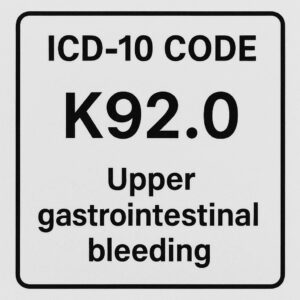
ICD-10 Code for Upper Gastrointestinal Bleeding
Table of Contents
Toggle2. Anatomy and Physiology of the Upper GI Tract: A Foundation for Understanding
Accurate coding begins with anatomical knowledge. The upper gastrointestinal tract is formally defined as the segment of the digestive system from the mouth to the ligament of Treitz, which suspends the duodenojejunal junction. The key sites for bleeding within this region are:
-
Esophagus: A muscular tube connecting the pharynx to the stomach. A common site for esophageal varices and Mallory-Weiss tears.
-
Stomach: A J-shaped organ that secretes acid and pepsin to digest food. It is the primary site for gastric ulcers and gastritis.
-
Duodenum: The first part of the small intestine, immediately following the stomach. It is the most common site for duodenal ulcers.
The mucosa lining these organs is resilient but vulnerable to erosion from acid, pepsin, medications, and portal hypertension. Understanding this anatomy is crucial because the ICD-10 code set is organized, in large part, around the specific anatomical site of the disease.
3. Clinical Presentation and Diagnosis of UGIB: What the Coder Needs to Know
The coder must be fluent in the clinical language used to describe a UGIB.
-
Hematemesis: Vomiting of blood. It can be bright red (“fresh”) or dark, granular “coffee-ground” material, which indicates blood has been partially digested by stomach acid.
-
Melena: Black, tarry, foul-smelling stools resulting from the digestion of blood in the GI tract. It is the most common presentation of UGIB.
-
Hematochezia: The passage of bright red blood per rectum. While typically associated with lower GI bleeding, it can occur with a massive, rapid upper GI bleed.
Diagnosis is confirmed through:
-
Endoscopy (EGD – Esophagogastroduodenoscopy): The gold standard. A scope is used to visualize the esophagus, stomach, and duodenum directly to identify the source of bleeding.
-
Nasogastric Lavage: Insertion of a tube through the nose into the stomach to aspirate contents. The return of blood or coffee-ground material suggests an upper GI source.
-
Laboratory Tests: Checking for anemia (low hemoglobin/hematocrit), elevated BUN (from blood protein digestion), and coagulopathy.
The endoscopy report is the single most important document for the coder, as it will specify the exact location and nature of the lesion.
4. The ICD-10-CM Coding System: A Primer for GI Bleeds
ICD-10-CM is a hierarchical system. Chapters are dedicated to body systems or disease types. For UGIB, the most relevant chapters are:
-
Chapter 11: Diseases of the Digestive System (K00-K95): This is the home for most UGIB codes, including those for ulcers, gastritis, and Mallory-Weiss tears.
-
Chapter 9: Diseases of the Circulatory System (I00-I99): This is where codes for esophageal varices (I85) reside.
-
Chapter 20: External Causes of Morbidity (V00-Y99): Used to indicate the cause of an injury, if applicable.
-
Chapter 21: Factors Influencing Health Status and Contact with Health Services (Z00-Z99): Used for screening or history codes.
The coding convention requires using the maximum number of characters available. A 5th, 6th, or 7th character is often required to indicate detail about the encounter (initial, subsequent, sequela) or a specific clinical detail (e.g., with obstruction).
5. Deconstructing the Codes: A Deep Dive into the K25-K28 Series
Peptic Ulcer Disease: The K25-K28 Labyrinth
Peptic Ulcer Disease (PUD) is a leading cause of UGIB. The ICD-10 codes for PUD are meticulously structured by anatomical site and clinical presentation.
-
K25 – Gastric ulcer
-
K26 – Duodenal ulcer
-
K27 – Peptic ulcer, site unspecified
-
K28 – Gastrojejunal ulcer
The Fifth Digit Imperative: Specificity is King
This is where ICD-10’s power and complexity are fully displayed. The 5th digit following the decimal point defines the ulcer’s behavior. For a bleeding ulcer, the coder must distinguish between acute and chronic.
-
.0 – Acute with hemorrhage: This is the code for an acute ulcer that is actively bleeding or has recently bled. The hemorrhage is a complication of the acute ulcer.
-
.4 – Chronic or unspecified with hemorrhage: This code is for a chronic ulcer that is bleeding. If the documentation does not specify “acute” or “chronic,” the default is “unspecified,” and this code is used.
-
.2 – Acute with both hemorrhage and perforation
-
.6 – Chronic or unspecified with both hemorrhage and perforation
Other important 5th digits include:
-
.1 – Acute with perforation
-
.3 – Acute without hemorrhage or perforation
-
.5 – Chronic or unspecified without hemorrhage or perforation
Case Studies: Applying K25.0 vs. K25.4
-
Case 1: A 45-year-old patient presents to the ER with hematemesis. Endoscopy reveals a new, acute gastric ulcer with a visible vessel that is cauterized. The physician’s final diagnosis is “Acute gastric ulcer with hemorrhage.”
-
Correct Code: K25.0 (Acute gastric ulcer with hemorrhage)
-
-
Case 2: A 70-year-old patient with a known history of PUD presents with melena. Endoscopy shows a chronic, calloused duodenal ulcer that is oozing blood.
-
Correct Code: K26.4 (Chronic duodenal ulcer with hemorrhage)
-
-
Case 3: A patient is admitted for UGIB. The endoscopy report simply states “Bleeding gastric ulcer.” There is no mention of “acute” or “chronic.”
-
Correct Code: K25.4 (Gastric ulcer, unspecified as acute or chronic, with hemorrhage). When specificity is lacking, the coder must use the “unspecified” option.
-
6. Esophageal Varices: Navigating the I85 Chapter
Esophageal varices are dilated, tortuous veins in the esophagus, most commonly caused by portal hypertension due to cirrhosis. Coding for variceal bleeding is distinct as it falls under diseases of the circulatory system.
The Critical Distinction: With vs. Without Bleeding
-
I85.01 – Esophageal varices with bleeding
-
I85.11 – Secondary esophageal varices with bleeding
-
I85.00 – Esophageal varices without bleeding
-
I85.10 – Secondary esophageal varices without bleeding
The distinction is absolute. If the patient was admitted for a variceal bleed, I85.01 or I85.11 must be assigned as the principal diagnosis, even if the bleeding was controlled on admission. The code for “without bleeding” is used for a patient who has varices noted incidentally during an endoscopy for another reason.
Coding Alcoholic Liver Disease with Variceal Hemorrhage
This is a classic and complex coding scenario that requires combination coding. The underlying liver disease is the cause of the portal hypertension, which causes the varices, which then bleed.
-
Scenario: A patient with a long history of heavy alcohol use is admitted with massive hematemesis. Endoscopy confirms bleeding esophageal varices. The physician documents “Alcoholic cirrhosis of the liver with portal hypertension and acute variceal hemorrhage.”
The coding would be:
-
I85.01 – Esophageal varices with bleeding (Principal Diagnosis, as this is the reason for admission).
-
K70.30 – Alcoholic cirrhosis of liver without ascites (Or K70.31 if ascites is present). This code captures the underlying etiology.
-
K76.6 – Portal hypertension. While often implied by cirrhosis, if explicitly documented, it should be coded.
This combination paints a complete clinical picture for data tracking and reimbursement.
7. Other Important Causes and Their Codes: Beyond Ulcers and Varices
A proficient coder must be aware of the less common, but equally important, causes of UGIB.
-
Mallory-Weiss Syndrome (K22.6): A tear in the mucosa at the junction of the stomach and esophagus, typically caused by forceful vomiting or retching. Code K22.6 is specific for this condition, which is inherently associated with bleeding.
-
Gastritis and Duodenitis: Inflammation of the stomach or duodenal lining can cause bleeding. The codes require a 5th digit to specify the presence of bleeding.
-
K29.01 – Acute gastritis with bleeding
-
K29.21 – Alcoholic gastritis with bleeding
-
K29.31 – Chronic superficial gastritis with bleeding
-
K29.41 – Chronic atrophic gastritis with bleeding
-
K29.61 – Other gastritis with bleeding
-
K29.81 – Duodenitis with bleeding
-
-
Dieulafoy’s Lesion (K31.82): A rare condition where a large, tortuous artery in the stomach wall erodes through the mucosa, causing sudden, massive bleeding.
-
Angiodysplasia (K55.21): Vascular malformations. While more common in the colon, they can occur in the upper GI tract. The code K55.21 is for angiodysplasia of the small intestine with hemorrhage.
8. The Role of Combination Coding and Associated Conditions
Coding Anticoagulant-Associated Bleeds
If a patient on warfarin, apixaban, or another anticoagulant presents with a UGIB, the coder must capture both the bleed and the drug.
-
First, code the specific type of hemorrhage (e.g., K25.0 for a bleeding gastric ulcer).
-
Second, assign a code from the T45.51- series for the adverse effect of the anticoagulant.
-
T45.515A – Adverse effect of anticoagulants, initial encounter
-
-
Finally, a code from the T45.51- series may require a 7th character to denote the encounter (A, D, S).
According to the ICD-10 guidelines, the nature of the adverse effect (the bleed) is coded first, and the drug code is sequenced second.
Helicobacter Pylori: The Common Accomplice
H. pylori infection is a major cause of PUD. If testing confirms an active H. pylori infection in a patient with a bleeding ulcer, the coder should assign:
-
The appropriate ulcer code with hemorrhage (e.g., K26.4).
-
B96.81 – Helicobacter pylori [H. pylori] as the cause of diseases classified elsewhere.
This provides crucial information for directing antibiotic therapy.
9. Documentation: The Bedrock of Accurate Coding
The coder is entirely dependent on the quality of the physician’s documentation. Vague terms like “GI bleed” or “UGIB” are insufficient. The medical record must specify:
-
The precise anatomical site: Gastric antrum, duodenal bulb, etc.
-
The specific etiology: Ulcer, varices, Mallory-Weiss tear, etc.
-
The acuity: Acute vs. chronic ulcer.
-
The presence of hemorrhage/bleeding.
-
Any associated conditions: Perforation, obstruction, H. pylori.
Querying the Provider for Clarity
When documentation is unclear, the coder’s responsibility is to initiate a physician query. This is a formal process to clarify the clinical picture.
-
Example of a Query: “The endoscopy report describes a ‘gastric ulcer with an adherent clot.’ The final diagnosis is ‘UGIB.’ For accurate coding, can you please specify if this ulcer is acute or chronic?”
10. A Practical Coding Algorithm for Upper GI Bleed: A Step-by-Step Guide
This flowchart provides a visual pathway to the correct ICD-10 code for a diagnosed Upper GI Bleed.
11. The Future of Coding: A Glimpse Beyond ICD-10
The healthcare world is preparing for the eventual transition to ICD-11, which was implemented by the WHO in 2022 and is slowly being adopted by member countries. ICD-11 offers a more flexible, digital-friendly structure. For UGIB, the codes become even more specific. For example, a bleeding gastric ulcer would be found under DA42.0 (Acute gastric ulcer with haemorrhage). The coding logic, however—the emphasis on site, etiology, and complication—remains the same. Mastering ICD-10 provides a solid foundation for whatever system comes next.
12. Conclusion: Mastering the Art and Science of UGIB Coding
Accurately coding an upper GI bleed requires a synthesis of clinical knowledge, anatomical understanding, and meticulous attention to the granular details of the ICD-10-CM system. The journey from a patient’s symptoms to a final code is a critical one, ensuring that the clinical story is accurately told in a language that drives healthcare forward. By moving beyond memorization to a deeper comprehension of the “why,” medical coders elevate their role from technical to indispensable.
13. Frequently Asked Questions (FAQs)
Q1: What is the default code for a bleeding peptic ulcer if the physician does not specify “acute” or “chronic”?
A1: The default is to use the “.4” code series (Chronic or unspecified with hemorrhage). For example, an unspecified bleeding gastric ulcer is K25.4.
Q2: How do I code a patient who has a history of UGIB but is now admitted for an unrelated condition?
A2: You would use a personal history code, Z87.71 – Personal history of gastrointestinal bleeding, as a secondary diagnosis. Do not use an acute bleeding code (like K25.0) as the bleed is not current.
Q3: Can I code both K25.0 and K92.0 (Hematemesis) together?
A3: No. According to the ICD-10 Coding Guidelines, you should not code symptoms that are integral to the diagnosis. Hematemesis is a inherent symptom of a bleeding upper GI source like K25.0. Coding both would be considered duplicative.
Q4: A patient has alcoholic cirrhosis and bleeding esophageal varices. Which code is principal?
A4: The code for the bleeding varices (I85.01) is sequenced as the principal diagnosis because that is the reason for the admission. The alcoholic cirrhosis (K70.30) is coded as a secondary diagnosis.
Q5: What is the code for a GI bleed suspected to be from NSAID use?
A5: First, code the specific source of the bleed if known (e.g., K29.01 for acute gastritis with bleeding). Then, code the adverse effect of the NSAID: T39.315A – Adverse effect of propionic acid derivatives, initial encounter (assuming ibuprofen or naproxen).
14. Additional Resources
-
The Official ICD-10-CM Guidelines for Coding and Reporting: https://www.cms.gov/medicare/coding-billing/icd-10-cm (This is the ultimate authority).
-
CDC ICD-10-CM Browser Tool: https://www.cdc.gov/nchs/icd/icd-10-cm.htm
-
American Health Information Management Association (AHIMA): https://www.ahima.org/ (Provides education and resources for coders).
-
American Academy of Professional Coders (AAPC): https://www.aapc.com/ (Another leading organization for coder certification and education).