Venous insufficiency is not merely a cosmetic concern of unsightly spider veins; it is a pervasive, chronic, and often debilitating medical condition affecting millions worldwide. It represents a significant public health burden, leading to pain, reduced quality of life, loss of productivity, and, in its most severe forms, catastrophic tissue breakdown and limb-threatening ulcers. For healthcare providers, accurately diagnosing and managing this condition is a clinical imperative. For medical coders, billers, and healthcare administrators, accurately representing this condition through the International Classification of Diseases, 10th Revision (ICD-10) is a parallel imperative that drives appropriate reimbursement, supports quality reporting, and ensures a clear and accurate patient record. The journey from a patient’s symptomatic complaints to a precisely selected alphanumeric code is a critical pathway that demands a deep understanding of both clinical medicine and coding logic. This article serves as the definitive guide to navigating that pathway. We will move beyond simple code look-ups and delve into the hemodynamic principles, the structural hierarchy of the ICD-10 system, and the nuanced clinical scenarios that separate a correct claim from a denied one. By mastering the codes for venous insufficiency, you are not just processing data; you are telling the complete and accurate story of the patient’s disease, enabling effective care and sustaining the financial health of the medical practice.
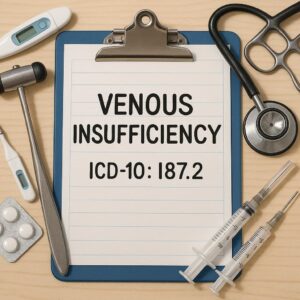
ICD-10 code for venous insufficiency
Chapter 1: The Foundation – Understanding Venous Insufficiency Clinically
Before a single code can be assigned, one must first understand the disease process. Venous insufficiency is, at its core, a failure of the venous system to efficiently return deoxygenated blood from the extremities back to the heart.
The Hemodynamics of a Healthy Venous System
The venous return system in the legs is a remarkable feat of engineering, working against gravity. It relies on three key components:
-
The Calf Muscle Pump: Often called the “peripheral heart,” the contraction of calf muscles during walking compresses the deep veins, propelling blood upward.
-
Venous Valves: Delicate, one-way valves located inside the veins prevent the backflow of blood, ensuring unidirectional flow towards the heart.
-
Venous Tone: The intrinsic pressure within the venous system helps maintain flow.
The Pathophysiology of Failure: Valve Dysfunction and Reflux
Venous insufficiency occurs when this system breaks down, most commonly due to valvular incompetence. When a valve becomes damaged or weakened—due to genetics, aging, prolonged standing, obesity, or a previous deep vein thrombosis (DVT)—it fails to close properly. This allows blood to flow backward, a phenomenon known as reflux. This reflux increases venous pressure distal to the faulty valve, a condition termed chronic venous hypertension. This elevated pressure is the primary culprit behind all the signs and symptoms of venous disease. It causes veins to dilate and become tortuous (varicose), forces fluid into the surrounding tissues (edema), and ultimately compromises the microcirculation of the skin, leading to inflammation, pigmentation changes, and tissue death (ulceration).
Clinical Spectrum: From Telangiectasias to Venous Ulcers
The manifestations of venous insufficiency exist on a wide spectrum, formally classified by the CEAP system (which we will explore in detail in Chapter 4). This spectrum ranges from:
-
C0: No visible or palpable signs.
-
C1: Telangiectasias (spider veins) or reticular veins.
-
C2: Varicose veins.
-
C3: Edema.
-
C4: Skin changes (e.g., pigmentation, eczema, lipodermatosclerosis).
-
C5: Healed venous ulcer.
-
C6: Active venous ulcer.
Understanding this progression is vital for coding, as the specific complication dictates the specific ICD-10 code required.
Chapter 2: The ICD-10 Coding System – A Primer for Precision
The transition from ICD-9 to ICD-10 was a quantum leap in medical coding, moving from a system of approximately 14,000 codes to over 70,000. This expansion was driven by a demand for greater specificity.
Beyond ICD-9: The Evolution to Specificity
Where ICD-9 had a single code for “Venous insufficiency,” ICD-10 requires detailed information about laterality, etiology, and associated complications. This specificity provides a richer data set for clinical research, epidemiology, and, crucially, for justifying the medical necessity of treatments.
Anatomy of an ICD-10 Code: Structure and Meaning
An ICD-10 code is not a random string of characters. Its structure is logical:
-
Category (Characters 1-3): The code begins with a letter followed by two numbers. This defines the general category of the disease. For venous insufficiency, the category is I87, which covers “Other disorders of veins and lymphatic vessels.”
-
Etiology, Site, Severity (Characters 4-6): These characters add detail. A decimal point follows the third character. For I87.2, the “.2” specifies “Venous insufficiency (chronic) (peripheral).”
-
Laterality (Character 5 or 7): This is a critical extension. For codes in the I87.2 family, a 5th digit specifies the affected limb:
-
I87.21: Venous insufficiency (chronic) (peripheral) of right lower extremity
-
I87.22: Venous insufficiency (chronic) (peripheral) of left lower extremity
-
I87.23: Venous insufficiency (chronic) (peripheral) of bilateral lower extremities
-
I87.29: Venous insufficiency (chronic) (peripheral) of unspecified lower extremity (This should be used sparingly, as laterality is almost always known in a clinical setting).
-
Chapter 3: Deconstructing the Core Codes – The I87.2 Family
The code family I87.2 is the home for most cases of primary or non-post-thrombotic chronic venous insufficiency.
I87.2 – Venous insufficiency (chronic) (peripheral): The Default and Its Pitfalls
This code describes the underlying physiological state of chronic venous hypertension. It is the appropriate code when a patient presents with symptoms like aching, heaviness, swelling, or cramps, and diagnostic studies (like a venous duplex ultrasound) confirm valvular reflux, even in the absence of visible varicose veins or skin changes. The term “peripheral” in the descriptor typically refers to the lower extremities, as upper extremity venous insufficiency is far less common and has different codes.
The Essential 5th Digit: Laterality is Not Optional
Perhaps the most common coding error in this category is the use of an unspecified code (I87.29). Venous duplex ultrasound is a standard diagnostic tool that explicitly identifies which veins are incompetent and in which limb. Therefore, the clinical documentation will almost always support the use of I87.21 (right), I87.22 (left), or I87.23 (bilateral). Using an unspecified code can lead to claim denials or down-coding, as it fails to provide the required specificity.
I87.2 vs. I87.1 – The Critical Distinction from Postphlebitic Syndrome
This is a crucial differentiator.
-
I87.2 is used for primary venous insufficiency, where the valve failure is not attributed to a prior DVT. It is often related to genetic predisposition, lifestyle, or hormonal factors.
-
I87.1, “Postphlebitic syndrome,” is used for secondary venous insufficiency that is a direct consequence of a previous deep vein thrombosis. The DVT causes scarring and damage to the venous valves, leading to the same symptomatology. The distinction is critical because the etiology is different, and it impacts code selection for associated conditions like ulcers, as we will see in Chapter 7.
Chapter 4: The Clinical-Etiological-Anatomical-Pathophysiological (CEAP) Classification – A Coder’s Best Friend
The CEAP classification is a standardized system used by vascular specialists to describe the severity of chronic venous disorders. For coders, it is a goldmine of information that directly maps to ICD-10 codes.
Demystifying the CEAP Components
-
C (Clinical): The visible signs (C0-C6), as described in Chapter 1.
-
E (Etiological): Congenital (Ec), Primary (Ep), or Secondary (Es). ‘Primary’ aligns with I87.2, while ‘Secondary’ often aligns with I87.0-.
-
A (Anatomical): Which venous systems are affected (superficial, deep, perforator).
-
P (Pathophysiological): Reflux (Pr), Obstruction (Po), or both (Pr,o).
How CEAP Informs and Justifies ICD-10 Code Selection
If a physician’s note documents “CEAP: C4b, Ep, As, Pr,” the coder can interpret this as:
-
C4b: Lipodermatosclerosis or atrophic blanche (significant skin changes). This points toward the use of I87.2-.
-
Ep: Etiology is Primary. This confirms the use of I87.2- and not I87.0-.
-
As, Pr: Anatomical site is superficial veins with pathophysiology of reflux.
This single, standardized notation provides all the evidence needed to confidently assign a code like I87.22 for left lower extremity venous insufficiency with associated skin changes.
Chapter 5: Coding the Complications – When Insufficiency Manifests
Venous insufficiency is often coded alongside its complications. The coding guidelines provide clear instruction on how to sequence these codes.
Varicose Veins of Lower Extremities (I83.-): A Deep Dive
This category is used when varicose veins are the primary reason for the encounter or a significant documented finding. Like I87.2, it requires a 5th digit for laterality.
-
I83.0 – Varicose veins of lower extremities with ulcer: This code is a combination code. It includes both the varicose veins and the presence of an ulcer. You would not additionally code L97.- for the ulcer. The 5th digit specifies laterality (e.g., I83.01 for right lower extremity).
-
I83.1 – Varicose veins of lower extremities with inflammation: This code is used for superficial thrombophlebitis in a varicose vein. The 5th digit specifies laterality.
-
I83.2 – Varicose veins of lower extremities with both ulcer and inflammation: A combination code for the rare instance where both an ulcer and phlebitis are present.
-
I83.9 – Varicose veins of lower extremities without ulcer or inflammation: The code for uncomplicated varicose veins.
Venous Ulcers (L97.-): Location, Severity, and Laterality
When an ulcer is present but not explicitly linked to varicose veins in the diagnosis, you use codes from the L97.- series. These codes also require high specificity.
-
They require a 5th digit to specify the site (e.g., L97.1- for ulcer of thigh).
-
They also allow for a laterality specification through a 6th character, though this is not always required by payers if the site is inherently unilateral (e.g., ‘L97.119 – Ulcer of right thigh’ implies laterality).
-
Importantly, you would use an L97.- code when the ulcer is due to the underlying venous hypertension (I87.2) but not directly categorized under the I83.0 umbrella.
The Interplay: Coding I87.2 with I83.- and L97.-
The coding hierarchy is key.
-
Scenario A: Patient with primary venous insufficiency and varicose veins that have ulcerated.
-
Code 1: I83.01- (Varicose veins of right lower extremity with ulcer)
-
Code 2: I87.211 (Venous insufficiency of right lower extremity) – This can be sequenced second as the underlying cause.
-
-
Scenario B: Patient with primary venous insufficiency and a venous stasis ulcer, but varicose veins are not the dominant feature or are not mentioned.
-
Code 1: L97.919 (Non-pressure ulcer of unspecified part of right lower limb) [Note: A more specific site code should be used if documented]
-
Code 2: I87.211 (Venous insufficiency of right lower extremity) – This is the underlying cause.
-
Chapter 6: The Post-Thrombotic Syndrome (PTS) Conundrum – I87.0-
When venous insufficiency is a direct result of a past Deep Vein Thrombosis (DVT), it is classified as Post-Thrombotic Syndrome.
Defining PTS: A Sequel to Deep Vein Thrombosis
PTS is characterized by chronic pain, swelling, heaviness, and skin changes in a limb previously affected by DVT. It develops in 20-50% of patients after a proximal DVT. The pathophysiology involves valvular damage and/or persistent venous obstruction from the resolved thrombus.
Differentiating I87.01- (Postthrombotic syndrome with ulcer) from I83.0-
This is a nuanced but critical distinction.
-
Use I87.01- when the ulcer is a direct result of the post-thrombotic syndrome. The history of DVT is key.
-
Use I83.0- when the ulcer is associated with primary varicose veins, without a history of DVT.
-
The physician’s documentation must link the current condition to the past DVT to justify using I87.0-.
The Importance of a Documented DVT History
The coder cannot assume a history of DVT. The patient’s medical record must contain a clear statement from the provider, such as “Patient presents with post-thrombotic syndrome of the left leg, status post DVT in 2022.” Without this link, the default should be the I87.2 family for primary insufficiency.
Chapter 7: Real-World Coding Scenarios – From Clinic Note to Claim
Let’s apply our knowledge to practical examples.
Scenario 1: The New Patient with Aching and Edema
-
Clinical Note: “Patient presents with 2-year history of aching and heaviness in both legs, worse at the end of the day. Physical exam reveals 2+ pitting edema bilaterally. Venous duplex shows great saphenous vein reflux bilaterally. No skin changes or ulceration noted.”
-
ICD-10 Codes:
-
I87.233 – Venous insufficiency (chronic) of bilateral lower extremities.
-
Scenario 2: The Complex Case with Stasis Dermatitis and Ulcer
-
Clinical Note: “Patient with known history of severe chronic venous insufficiency presents for wound care. Examination of the left lower extremity shows brawny edema, stasis dermatitis, and a 3cm x 2cm full-thickness ulceration on the medial malleolus. No history of DVT.”
-
ICD-10 Codes:
-
L97.212 – Non-pressure ulcer of left ankle with fat layer exposed. [Sequenced first as the reason for encounter].
-
I83.922 – Varicose veins of left lower extremity without ulcer or inflammation. [If varicose veins are documented].
-
I87.222 – Venous insufficiency (chronic) of left lower extremity. [The underlying cause].
-
Scenario 3: Post-Thrombotic Syndrome Management
-
Clinical Note: “Follow-up for post-thrombotic syndrome of the right leg, following an extensive iliofemoral DVT in 2024. Patient has persistent edema and hyperpigmentation. No active ulcer.”
-
ICD-10 Codes:
-
I87.021 – Post-thrombotic syndrome without complications of right lower extremity.
-
Scenario 4: Post-Procedural Follow-up
-
Clinical Note: “Patient returns for 6-week follow-up after endovenous laser ablation (EVLA) of the right great saphenous vein for symptomatic venous insufficiency. Patient doing well, with resolution of pain. Duplex shows successful closure of the GSV.”
-
ICD-10 Codes:
-
Z09 – Encounter for follow-up examination after completed treatment. [This is the primary reason for the visit].
-
I87.211 – Venous insufficiency (chronic) of right lower extremity. [This is the condition for which the procedure was performed].
-
Chapter 8: Common Pitfalls and How to Avoid Them
-
Pitfall 1: Using I87.29 (unspecified laterality) as a default.
-
Solution: Scrutinize the documentation and duplex report. Always code to the highest specificity of laterality.
-
-
Pitfall 2: Coding both I83.0- and L97.- for the same ulcer.
-
Solution: Remember that I83.0- is a combination code. Do not add an L97.- code.
-
-
Pitfall 3: Confusing acute thrombophlebitis (I80.-) with chronic venous insufficiency.
-
Solution: I80.- is for the acute inflammatory clot. I87.2 and I87.0- are for the chronic, post-inflammatory or primary failure state.
-
-
Pitfall 4: Relying on the problem list without checking the encounter note.
-
Solution: Code for the conditions addressed and documented during the specific encounter. A patient may have a history of an ulcer that is now healed; you would not code for an active ulcer.
-
Chapter 9: The Future of Coding – ICD-11 and Beyond
The World Health Organization has already released ICD-11, which will eventually be adopted. It offers even greater granularity. For example, ICD-11 has specific codes for conditions like “Post-thrombotic syndrome with ulceration and inflammation” (BD71.21). While the US has not yet set a timeline for transitioning to ICD-11, understanding its direction emphasizes the ongoing trend towards extreme specificity and clinical detail in medical classification.
ICD-10 Code Quick Reference Guide for Venous Insufficiency
| Condition | ICD-10 Code | Code Description | Key Points & Usage |
|---|---|---|---|
| Chronic Venous Insufficiency | I87.21- | Venous insufficiency (chronic), right lower extremity | Use for the underlying condition of valvular reflux and hypertension. Laterality is mandatory. |
| I87.22- | Venous insufficiency (chronic), left lower extremity | ||
| I87.23- | Venous insufficiency (chronic), bilateral lower extremities | ||
| I87.29- | Venous insufficiency (chronic), unspecified lower extremity | Avoid; use only if laterality is truly unknown. | |
| Post-Thrombotic Syndrome | I87.00- | Post-thrombotic syndrome without complications of unsp lower extremity | Use when a documented history of DVT is the cause of the venous insufficiency. |
| I87.01- | Post-thrombotic syndrome with ulcer of unsp lower extremity | A combination code; do not add an L97.- code. | |
| Varicose Veins with Ulcer | I83.00- | Varicose veins with ulcer of unsp lower extremity | A combination code. Includes both the varicosities and the ulcer. |
| I83.01- | Varicose veins with ulcer of right lower extremity | Laterality is mandatory. | |
| I83.02- | Varicose veins with ulcer of left lower extremity | ||
| Varicose Veins without Ulcer | I83.9- | Varicose veins without ulcer or inflammation | Use for uncomplicated varicose veins. |
| Venous Ulcer | L97.- | Non-pressure ulcer of lower limb, not elsewhere classified |
Chapter 10: Conclusion: Mastering the Flow of Venous Coding
Accurate ICD-10 coding for venous insufficiency is a multidisciplinary skill, blending clinical knowledge with coding expertise. It requires moving beyond the basic code look-up to a deeper analysis of the patient’s story—understanding the etiology (primary vs. post-thrombotic), identifying the specific manifestations (varicose veins, edema, ulcer), and meticulously applying the rules of laterality and combination codes. By doing so, coders ensure that the narrative of the patient’s chronic, often challenging condition is fully and accurately told, facilitating optimal patient care and ensuring the integrity of the healthcare data ecosystem.
Frequently Asked Questions (FAQs)
1. What is the difference between I87.2 and I83.9?
I87.2 describes the underlying physiological problem of chronic venous hypertension and valvular reflux. I83.9 describes the anatomical manifestation of that problem—dilated, tortuous veins. They are often used together, with I87.2 providing the etiology for the varicose veins.
2. When should I use a code from the L97.- series instead of I83.0-?
Use I83.0- when the physician’s documentation explicitly links the ulcer to the patient’s varicose veins. Use L97.- when the ulcer is attributed to the general condition of “venous insufficiency” or “venous stasis” without a specific mention of varicose veins as the direct cause.
3. Can I code both I87.2 and I87.0- for the same leg?
No. These codes are mutually exclusive for the same limb at the same encounter. I87.0- (Post-thrombotic syndrome) implies a known cause (prior DVT). I87.2 implies a primary, non-post-thrombotic etiology. The medical record must be reviewed to determine the correct underlying cause.
4. Is a 5th digit for laterality always mandatory for I87.2 codes?
Yes, for complete and accurate coding. While a claim with I87.29 might not always be rejected, it is considered incomplete and does not reflect the standard of care, as laterality is almost always determined through clinical examination and/or ultrasound.
5. How do I code a healed venous ulcer (CEAP C5)?
You would code the underlying venous insufficiency (e.g., I87.23-). There is no active ulcer to code from the L97.- series. The fact that it is healed (C5) is a clinical descriptor but does not have a separate ICD-10 code for the healed state itself. The history of the ulcer may be documented in the patient’s past medical history.
Date: October 31, 2025
Author: Dr. Evelyn Reed, MD, CIRCC (Certified Interventional Radiology Cardiovascular Coder)
Disclaimer: The information contained in this article is for educational and informational purposes only and is not intended as a substitute for professional medical advice, diagnosis, or treatment. Always seek the advice of your physician or other qualified health provider with any questions you may have regarding a medical condition or coding practice. The author and publisher are not responsible for any errors or omissions or for any consequences from the application of the information presented.