The well-child exam is a fundamental pillar of pediatric medicine. It is a proactive, scheduled visit designed to monitor a child’s growth and development, provide immunizations, offer anticipatory guidance, and screen for potential issues—all within the context of building a strong, trusting relationship between the provider, the child, and the family. For clinicians, the focus is squarely on the patient’s health and well-being. However, in the complex ecosystem of modern healthcare, this clinical encounter is inextricably linked to a parallel process: medical coding and billing. The accurate translation of this vital preventive service into standardized alphanumeric codes is not merely an administrative task; it is a critical function that ensures the financial viability of a pediatric practice and guarantees compliance with a web of payer regulations.
At the heart of this process lies the International Classification of Diseases, Tenth Revision, Clinical Modification (ICD-10-CM) code set. For well-child visits, these codes fall under the “Z-code” category, which designates factors influencing health status and contact with health services. While seemingly straightforward, the specific codes for well-child exams—primarily Z00.121, Z00.129, and Z00.110—carry subtle but significant distinctions that can mean the difference between a clean, timely reimbursement and a denied claim that requires costly rework. A misunderstanding or oversight in selecting the correct code can trigger audits, recoupments, and compliance risks.
This article serves as the definitive guide for pediatric providers, coders, billers, and practice administrators. We will embark on a detailed exploration of the ICD-10 codes for well-child examinations, moving beyond basic definitions to uncover the nuanced application of these codes in real-world scenarios. We will dissect the criteria for each code, illustrate their use with clinical examples, and build a robust framework for creating a bulletproof coding workflow. Our goal is to empower you with the knowledge to not only avoid common pitfalls but also to optimize your revenue cycle, strengthen your compliance posture, and, ultimately, ensure that your practice can continue to deliver the high-quality preventive care that every child deserves.
ICD-10 Codes for Well-Child Exams
Chapter 1: Understanding the Landscape of ICD-10-CM and the Z-Code Chapter
To master the coding of well-child exams, one must first understand the environment in which these codes exist. The ICD-10-CM system is a monumental, globally influenced coding taxonomy used in the United States to report diagnoses and reasons for patient encounters. It provides the “why” behind a patient’s visit, which in turn justifies the medical necessity of the procedures (CPT® codes) performed.
The Role of Z-Codes (Chapter 21)
Within the ICD-10-CM manual, codes are grouped into chapters based on etiology or body system. Chapter 21, titled “Factors Influencing Health Status and Contact with Health Services (Z00-Z99),” is the home for codes describing encounters for circumstances other than a disease or injury. This is a crucial conceptual shift: Z-codes are not for sick visits; they are for health services.
These codes are used for a variety of reasons, including:
-
Preventive care encounters: Routine physicals, well-child checks, and annual exams.
-
Screenings: Encounters specifically for tests to detect undiagnosed conditions.
-
Aftercare: Follow-up for a resolved condition, such as a healed fracture.
-
Personal and Family History: Documenting risk factors that may influence care.
-
Donors: Encounters for individuals donating blood or an organ.
For well-child visits, the relevant codes are found in the block Z00-Z13, “Persons encountering health services for examinations.” The specific sub-category is Z00.1-, “Encounter for routine child health examination.”
Key Concept: Medical Necessity and The “First-Listed” Code
In a diagnostic coding context, the primary reason for the encounter is always sequenced first. For a well-child visit, the Z00.1- code is, with rare exception, the first-listed diagnosis. This code establishes the medical necessity for the preventive services rendered during that visit, such as the comprehensive physical examination (CPT® 99381-99395), the developmental screening, and the administration of vaccines.
It is a common misconception that Z-codes are “unbillable” or lead to automatic denials. This is false. When used appropriately for a preventive encounter, they are not only billable but required. The problem arises when they are used incorrectly or when a payer’s specific policy regarding preventive services is not followed.
Chapter 2: A Deep Dive into Code Z00.121 – The Cornerstone of Infant Care
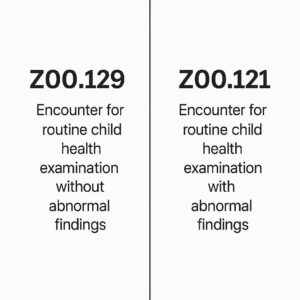
ICD-10-CM Code: Z00.121 – Encounter for routine child health examination with abnormal findings
This code is one of the most frequently used codes in a pediatric practice, yet its application is often misunderstood due to the phrase “abnormal findings.” Let’s demystify it.
Definition and Official Guidelines
According to the ICD-10-CM Official Guidelines for Coding and Reporting, code Z00.121 is used for a routine well-child examination when abnormal findings are encountered. The guidelines further clarify that “abnormal findings” in this context refer to those that are incidental or unrelated to the primary purpose of the encounter.
In other words, the child is presenting for their scheduled, routine checkup. During the examination, the provider discovers a new, often asymptomatic, issue that was not the reason for the visit.
What Constitutes an “Abnormal Finding”?
An abnormal finding is any newly identified sign, symptom, or laboratory result that requires further evaluation or monitoring. It is not a chronic, already-diagnosed condition for which the child is being followed. Examples include:
-
Physical Exam Findings:
-
A newly detected heart murmur.
-
An undescended testicle (cryptorchidism) noted during an infant exam.
-
A previously unnoticed hip click, raising suspicion for developmental dysplasia of the hip (DDH).
-
Poor weight gain or a drop in percentile on the growth chart since the last visit.
-
Signs of a previously undiagnosed plagiocephaly.
-
-
Developmental/Behavioral Findings:
-
A failed milestone on a standardized developmental screening tool (e.g., M-CHAT, ASQ-3).
-
Concerns about speech delay raised during the visit.
-
Behavioral concerns like significant tantrums or social withdrawal that are newly identified.
-
-
Laboratory/Screening Findings:
-
Anemia discovered on a routine hemoglobin/hematocrit check.
-
Lead level elevated above the reference range on a routine screening.
-
An abnormal hearing or vision screening result.
-
Clinical Scenarios and Code Application
Scenario 1: The 6-Month Well-Child Visit
A 6-month-old infant presents for their routine well-child exam. The parents have no specific concerns. During the physical examination, the pediatrician auscultates a new, soft, innocent heart murmur. The child is otherwise healthy, growing well, and meeting all milestones.
-
Coding: Z00.121 is the first-listed code because the encounter was for a routine checkup that resulted in an incidental abnormal finding (the heart murmur). The murmur itself may not have its own code if it is documented as “innocent” or “functional,” as these are not considered diseases. The code Z00.121 accurately captures the situation.
Scenario 2: The 15-Month Well-Child Visit
A 15-month-old is in for a routine checkup. The pediatrician administers a standardized autism screening tool (M-CHAT-R), and the child fails the screen, indicating a need for further evaluation.
-
Coding: Z00.121 is the first-listed code. The failed screening is the abnormal finding discovered during the preventive encounter.
Scenario 3: The 2-Year Well-Child Visit
A 2-year-old is brought in for their well visit. The parents mention the child is a “picky eater,” but upon plotting the growth chart, the pediatrician notes the child’s weight has fallen from the 50th to the 10th percentile since the 18-month visit.
-
Coding: Z00.121 is the first-listed code. The significant drop in weight percentile, even in the absence of a specific diagnosis, constitutes an abnormal finding that requires investigation.
Coding Tip: The key is that the abnormal finding was unexpected and discovered during the routine exam. The family did not schedule the visit to address the murmur or the developmental concern; those issues surfaced as part of the preventive process.
Chapter 3: Demystifying Code Z00.129 – The Standard for Older Children and Adolescents
ICD-10-CM Code: Z00.129 – Encounter for routine child health examination without abnormal findings
This code is the counterpart to Z00.121 and is used when a child undergoes a routine well-child examination and no abnormal findings are identified.
Definition and Application
Code Z00.129 is applied when the encounter is straightforwardly preventive. The child is examined, their growth and development are assessed and found to be normal, all screenings are within normal limits, and no new, incidental problems are discovered. The child is, for all clinical purposes related to this encounter, completely healthy.
This code is often perceived as “easier” to use, but it requires diligent clinical documentation. The provider’s note must support the conclusion that no abnormal findings were present.
Clinical Scenarios and Code Application
Scenario 1: The 5-Year Well-Child Visit (Kindergarten Physical)
A healthy 5-year-old presents for their pre-kindergarten checkup. The physical exam is unremarkable. Vision and hearing screenings are passed. The parents have no behavioral or developmental concerns. The child is up-to-date on immunizations.
-
Coding: Z00.129 is the first-listed code. The encounter was routine, and no abnormal findings were documented.
Scenario 2: The 12-Year-Old Well-Child Visit
A 12-year-old comes in for their annual well visit. They are active, doing well in school, and have no complaints. The physical exam, including Tanner staging for puberty, is within normal limits for their age. A screening for depression (e.g., PHQ-9) is negative.
-
Coding: Z00.129 is the first-listed code.
The Documentation Imperative for Z00.129
Using Z00.129 requires a note that implicitly or explicitly states the absence of abnormalities. Phrases like “no acute issues,” “physical exam within normal limits,” “development appears normal,” and “screenings passed” all support the use of this code. The documentation must paint a picture of a comprehensive examination that yielded normal results.
Chapter 4: The Special Case of Code Z00.110 – When a Healthy Checkup Reveals a Concern
ICD-10-CM Code: Z00.110 – Health examination for newborn under 8 days old
This code occupies a unique space in the well-child coding spectrum. It is specifically reserved for the routine health examination of a newborn who is under 8 days old.
Distinguishing the Newborn Exam
It is critical to distinguish this routine examination from other newborn encounters. Code Z00.110 is for the healthy, routine checkup of a newborn, typically occurring in the outpatient setting after hospital discharge (e.g., the 2-5 day post-discharge visit mandated for breastfeeding infants).
This code is NOT used for:
-
Initial hospital newborn care (CPT® 99460-99463): These services have their own specific diagnosis codes.
-
Encounters for suspected or confirmed conditions: If the newborn is being seen for jaundice (P59.9), feeding problems (P92.5), or a suspected infection, the code for that condition would be the first-listed diagnosis, not Z00.110.
-
Newborns over 8 days old: Once a newborn is 8 days or older, the standard well-child codes (Z00.121 or Z00.129) take effect.
Clinical Scenarios and Code Application
Scenario 1: Routine 3-Day Post-Discharge Visit
A term, healthy newborn is seen in the office at 3 days of age for a routine weight check and physical assessment following an uncomplicated hospital discharge. The baby is breastfeeding well, has no jaundice, and has lost less than 8% of birth weight.
-
Coding: Z00.110 is the first-listed code.
Scenario 2: 5-Day Visit for Jaundice Follow-Up
A 5-day-old newborn is seen for a follow-up specifically for hyperbilirubinemia. The bilirubin level is checked, and the baby is assessed for clinical jaundice.
-
Coding: Z00.110 is NOT appropriate. The first-listed code should be the code for neonatal jaundice (e.g., P59.9, Neonatal jaundice, unspecified). This is a sick or problem-focused encounter, not a routine well exam.
The following table provides a clear, at-a-glance comparison of the three primary well-child ICD-10 codes.
Table 1: ICD-10 Code Comparison for Well-Child Examinations
| ICD-10 Code | Code Description | Patient Age | Clinical Scenario | Key Differentiator |
|---|---|---|---|---|
| Z00.110 | Health exam for newborn under 8 days old | Under 8 days | Routine post-discharge check for a healthy newborn. | Specific to the immediate newborn period. Not for problem-focused visits. |
| Z00.121 | Encounter for routine child health exam with abnormal findings | 8 days through 17 years | A routine checkup where a new, incidental issue is found (e.g., heart murmur, failed developmental screen, anemia). | The discovery of a new, unexpected finding during the preventive visit. |
| Z00.129 | Encounter for routine child health exam without abnormal findings | 8 days through 17 years | A routine checkup where the child is found to be healthy with no new issues. All screenings are normal. | The absence of any incidental abnormal findings. Requires supporting documentation. |
Chapter 5: The Nuances of Age and Frequency – Applying the Right Code at the Right Time
The correct application of well-child codes is not only about findings but also about the patient’s age and the timing of the visit according to the standard “Bright Futures” periodicity schedule.
The Age Parameter
As illustrated in Table 1, the age cut-off for Z00.110 is firm: under 8 days old. For all other well-child visits, from 8 days through 17 years, you will use either Z00.121 or Z00.129. There is no specific ICD-10 code that differentiates an infant exam from an adolescent exam; that granularity is handled by the CPT® evaluation and management (E/M) code (e.g., 99391 for a 5-year-old vs. 99395 for a 16-year-old).
The “Routine” vs. “Early/Extra” Visit Conundrum
A common coding challenge arises when a patient presents for a well-child exam outside the recommended schedule. For example:
-
A parent demands a “6-month checkup” at 7 months because they missed the original appointment.
-
A school or sports league requires a physical 10 months after the last annual exam.
In these cases, the encounter is still considered a “routine child health examination” from a coding perspective. You would still use Z00.121 or Z00.129. The fact that it is off-schedule does not change the fundamental nature of the service. However, it is crucial that the medical record documentation clearly states the reason for the off-schedule visit (e.g., “Patient presents for school physical requirement; last well exam was 10 months ago”). This can help preempt payer questions about the medical necessity of a preventive service being provided “too soon” according to their internal policies, which are often based on the Bright Futures schedule.
Chapter 6: Beyond the Primary Code – The Essential Role of Secondary Diagnoses
While the Z00.1- code is the first-listed diagnosis, a well-child visit note often contains other relevant information that should be captured with additional codes. These secondary diagnoses provide a more complete picture of the patient’s health status and the services provided.
Common and Important Secondary Codes
-
Vaccine Status and Administration: When vaccines are administered during the well visit, you must code for them. The first-listed code remains the well-child code, but you will add codes for the vaccines and toxoids administered (Z23) and, importantly, any related counseling.
-
Z23: “Encounter for immunization.” This is a standalone code used to indicate that an immunization was given.
-
Example: A 2-month-old well visit (Z00.121 or Z00.129) with administration of DTaP, IPV, Hib, PCV13, and Rotavirus vaccines would also include Z23.
-
-
Personal and Family History: Documenting risk factors is a key part of preventive care.
-
Z82.49: “Family history of other cardiovascular diseases.” (e.g., if there is a strong family history of hypercholesterolemia).
-
Z83.3: “Family history of diabetes mellitus.”
-
Z81.0- : “Family history of intellectual disabilities.”
-
Z91.83: “Wandering.” (Important for patients with autism spectrum disorder).
-
-
Chronic Conditions in Stable State: A child with a stable, chronic condition like well-controlled asthma or epilepsy still receives well-child care. The well-child code is first-listed, but the chronic condition should be listed as a secondary diagnosis to reflect the patient’s complete health picture.
-
Example: A child with stable, well-controlled asthma presents for a 7-year well visit. No acute issues.
-
First-listed: Z00.129
-
Secondary: J45.909 (Unspecified asthma, uncomplicated)
-
-
-
Abnormal Findings Requiring a Specific Code: If the “abnormal finding” that prompted the use of Z00.121 is a specific, codable condition, you should add that code as secondary.
-
Example: A 12-month-old well visit where the child is diagnosed with an undescended testicle.
-
First-listed: Z00.121
-
Secondary: Q53.9 (Undescended testicle, unspecified)
-
-
-
Exposure to Communicable Diseases: During the COVID-19 pandemic, a code for exposure became relevant.
-
Z20.822: “Contact with and (suspected) exposure to COVID-19.” This could be used if the family is seeking reassurance after an exposure, even during a well visit.
-
Chapter 7: Linking Medical Necessity – The Crucial Bridge Between ICD-10 and CPT® Codes
Coding is a dual-track system. ICD-10 codes describe the “why” (diagnosis/reason), and Current Procedural Terminology (CPT®) codes describe the “what” (procedure/service). For a claim to be paid, there must be a clear and logical link between the two, demonstrating medical necessity.
The CPT® Codes for Well-Child Visits
The CPT® code set has a specific series for preventive medicine services, stratified by age and whether the patient is new or established.
-
New Patient Preventive Care Codes:
-
99381: Initial comprehensive preventive medicine evaluation… infant (age under 1 year)
-
99382: …early childhood (age 1-4 years)
-
99383: …late childhood (age 5-11 years)
-
99384: …adolescent (age 12-17 years)
-
99385: …18-39 years (rarely used in pediatrics)
-
-
Established Patient Preventive Care Codes:
-
99391: Periodic comprehensive preventive medicine reevaluation… infant (age under 1 year)
-
99392: …early childhood (age 1-4 years)
-
99393: …late childhood (age 5-11 years)
-
99394: …adolescent (age 12-17 years)
-
99395: …18-39 years (rarely used in pediatrics)
-
Creating the Link
The ICD-10 code Z00.121 or Z00.129 provides the medical necessity for the comprehensive preventive E/M service described by CPT® codes 99381-99395. This link tells the payer, “We performed this comprehensive physical exam and preventive counseling because the patient presented for a routine well-child examination.”
Handling Separately Reported Services
A well-child visit is a bundle of services. However, some services are considered separate and distinct and can be billed in addition to the preventive visit code. Their medical necessity is supported by their own specific diagnosis codes.
-
Vaccine Administration (CPT® 90460, 90461, +90471-+90474): The medical necessity for vaccines is supported by the routine vaccination schedule. The ICD-10 code Z23 is typically used for this purpose on the claim form line for the vaccine adminstration.
-
Separate Laboratory Tests: If a lab test is performed and interpreted, it may be billed separately. Its medical necessity is supported by a code for the condition being screened for or found.
-
Example: A routine hemoglobin test during a well visit reveals anemia. The CBC (85025 or 85027) could be billed with a diagnosis code for the anemia (e.g., D64.9) as the primary diagnosis justifying the lab test, while the well-child code remains for the overall encounter.
-
-
Separate Screening Procedures (e.g., 96110): Developmental/behavioral screening is often bundled, but if performed as a distinct, standardized tool, it may be billable. The medical necessity is supported by the well-child code (Z00.121 or Z00.129) or, if a problem is suspected, a code for that specific concern.
Coding Tip: Never use a “sick” diagnosis code (e.g., R05.9 Cough) as the primary diagnosis for a well-child visit just because the parent mentioned a minor, resolved illness. This misrepresents the nature of the encounter. If the visit was truly a well-child exam, the Z00.1- code must be first-listed. Minor, resolved issues can be documented in the note but do not need to be coded unless they were a significant focus of the visit.
Chapter 8: Navigating the Pitfalls – Common Coding Errors and How to Avoid Them
Even experienced coders can stumble in the nuanced world of pediatric preventive coding. Here are the most common errors and strategies to avoid them.
1. Misusing Z00.121 for Chronic or Pre-existing Conditions
-
The Error: Using Z00.121 for a child with a known, stable chronic condition like asthma or ADHD.
-
The Correction: The well-child code (Z00.129 or Z00.121) is first-listed. The chronic condition is listed as a secondary diagnosis. Z00.121 is only for new, incidental findings discovered during the exam. A known condition is not an “abnormal finding” in this context.
2. Using a “Sick” Code as the Primary Diagnosis for a Well Visit
-
The Error: A child comes in for a well visit, and the parent mentions the child had a cold last week that is now resolved. The coder uses R05.9 (Cough) as the primary diagnosis because it’s documented in the note.
-
The Correction: The primary reason for the encounter was the well-child exam. The Z00.1- code must be first-listed. The resolved cold is historical information and does not change the nature of the visit. It does not need to be coded.
3. Confusing a Sick Visit with a Well Visit with Abnormal Findings
-
The Error: A child is brought in because the parent is concerned about a heart murmur they heard. The pediatrician confirms a murmur. The coder uses Z00.121.
-
The Correction: This is incorrect. The encounter was scheduled specifically to address a problem (the murmur). This is a sick or problem-oriented visit (CPT® 99212-99215). The primary diagnosis should be the code for the heart murmur (e.g., R01.1, Cardiac murmur, unspecified). Z00.121 is only for when the finding is discovered incidentally during a routine exam that was not scheduled to address that problem.
4. Failing to Document Support for Z00.129
-
The Error: Using Z00.129 with a note that is sparse and does not explicitly or implicitly confirm that the exam was normal and no abnormalities were found.
-
The Correction: Encourage providers to use phrases that support a “without abnormal findings” conclusion. Templates can be helpful but must be used carefully to avoid cloning errors.
5. Incorrectly Coding the Newborn Visit (Z00.110)
-
The Error: Using Z00.110 for a newborn being seen for a specific problem like jaundice or feeding difficulties.
-
The Correction: If the visit is problem-focused, the problem is the first-listed diagnosis. Z00.110 is reserved for the true, routine, healthy newborn check.
Chapter 9: A Proactive Workflow – Strategies for Streamlining Your Well-Child Visit Coding
Accuracy and efficiency go hand-in-hand. Implementing a systematic workflow can minimize errors and reduce claim denials.
-
Pre-Visit Planning: When scheduling the well-child appointment, confirm the reason for the visit is “annual physical,” “well-baby check,” etc. Verify the patient’s age to ensure the correct CPT® age band is selected.
-
Robust Clinical Documentation: The provider’s note is the foundation of everything. It must clearly state:
-
The reason for the encounter: “Routine 4-year well-child visit.”
-
A comprehensive review of systems and physical exam findings.
-
The results of any screenings (developmental, vision, hearing, etc.).
-
An assessment that summarizes the patient’s status: “Healthy 4-year-old here for routine well care. No abnormal findings.” OR “Healthy 4-year-old here for routine well care; note failed vision screen in left eye, will re-check in 6 months.”
-
-
Coder Education and Communication: Ensure your billing staff understands the nuances of Z00.121 vs. Z00.129. Regular meetings between clinicians and coders can resolve ambiguities and clarify documentation expectations.
-
Claim Scrubbing and Auditing: Use your practice management system’s claim scrubber to flag potential errors (e.g., a Z00.1- code paired with a sick visit E/M code). Conduct periodic internal audits of well-child claims to ensure coding and documentation alignment.
Chapter 10: The Future of Preventive Coding – Trends, Technology, and Telehealth
The landscape of healthcare coding is not static. Several trends are shaping the future of how we code for well-child care.
-
Increased Specificity: The transition to ICD-10 was a leap in specificity, and this trend will continue. Future updates may introduce codes for specific types of abnormal findings or for encounters focused on particular aspects of preventive care.
-
Artificial Intelligence (AI) in Coding: AI-powered computer-assisted coding (CAC) tools are becoming more sophisticated. These systems can read the clinical documentation and suggest appropriate ICD-10 and CPT® codes, reducing manual effort and potentially increasing accuracy. However, human review remains essential.
-
Telehealth and Preventive Care: The rise of telehealth presents new coding challenges. A “virtual check-in” (HCPCS code G2012) is not a preventive visit. However, parts of a well-child visit (e.g., behavioral health counseling, history gathering) could potentially be done via telehealth. Payers are still developing policies for this. The key is that the core component of a well-child exam—the hands-on physical assessment—cannot be performed virtually. Therefore, a full well-child visit with its corresponding Z-code cannot be billed for a purely telehealth encounter.
-
Value-Based Care and Population Health: Accurate Z-coding is vital for value-based care models. These codes help identify a practice’s panel of healthy patients, track preventive service completion rates, and demonstrate quality outcomes. Inaccurate coding skews this data and can negatively impact performance-based reimbursements.
Conclusion
The accurate application of ICD-10 codes for well-child exams is a critical skill that blends clinical understanding with administrative precision. Mastering the distinctions between Z00.110, Z00.121, and Z00.129 ensures that claims reflect the true nature of the preventive service provided. By diligently linking these diagnosis codes to the appropriate CPT® procedures, supporting them with robust documentation, and avoiding common pitfalls, pediatric practices can safeguard their revenue, maintain compliance, and solidify the financial foundation that allows them to focus on their primary mission: nurturing the health and well-being of every child they serve.
Frequently Asked Questions (FAQs)
Q1: What if a child comes in for a well visit but also has a minor acute illness, like an ear infection?
This becomes a combination visit. You will need to bill both the preventive medicine service (CPT® 99381-99395) and an office visit E/M code (99212-99215) with modifier -25 attached to the E/M code to indicate a significant, separately identifiable service was performed on the same day. The first-listed diagnosis would be the well-child code (Z00.121 or Z00.129), and the diagnosis for the acute illness (e.g., H66.90, Otitis media, unspecified) would be listed as a secondary diagnosis linked to the sick visit E/M code.
Q2: Can I use Z00.129 if the child has a stable chronic condition like ADHD?
Yes. The purpose of the encounter is the routine examination. Therefore, Z00.129 (or Z00.121 if a new finding is made) is the first-listed code. The chronic condition (e.g., F90.9, Attention-deficit hyperactivity disorder, unspecified type) should be listed as a secondary diagnosis to reflect the patient’s complete health status.
Q3: Our state requires a specific form for school/sports physicals. Does this change the ICD-10 code?
No. The completion of a form is part of the preventive medicine service. The reason for the encounter is still a “routine child health examination.” You would use Z00.129 (if normal) or Z00.121 (if an abnormal finding is discovered). The CPT® code for the preventive visit encompasses the history, exam, counseling, and the completion of required forms.
Q4: What is the difference between Z00.129 and Z01.419 (Encounter for routine gynecological examination)?
Z00.129 is for a general, comprehensive routine health examination for a child. Z01.419 is for a focused examination of the gynecological system only. An adolescent female could have a well-child exam (Z00.129) that includes a brief gynecological assessment, but if she presents specifically for a Pap smear and pelvic exam, Z01.419 would be more appropriate.
Q5: A payer denied our claim stating that Z00.129 is not a covered benefit. What should we do?
This is a policy issue, not a coding error. First, verify the patient’s insurance plan indeed covers “routine/preventive care.” If it does, this is likely a claims processing error. You should appeal the denial, citing the patient’s evidence of coverage (EOC) document that shows preventive services are covered. You may also need to confirm that the provider is in-network and that the correct CPT® preventive code was used.
Additional Resources
-
Centers for Disease Control and Prevention (CDC) ICD-10-CM Official Guidelines: https://www.cdc.gov/nchs/icd/icd-10-cm.htm – The definitive source for coding rules and updates.
-
American Academy of Pediatrics (AAP) Coding Resources: https://www.aap.org/en/practice-management/coding/ – Offers specialty-specific guidance, newsletters, and workshops.
-
Bright Futures (AAP): https://www.aap.org/en/practice-management/bright-futuses/ – Provides the periodicity schedule and guidelines for the content of well-child visits.
-
American Medical Association (AMA) CPT® Network: https://www.ama-assn.org/practice-management/cpt – The official resource for CPT® code information and updates.
Date: November 04, 2025
Author: Pediatric Healthcare Insights
Disclaimer: This article is for informational and educational purposes only and does not constitute medical, legal, or coding advice. The author and publisher are not responsible for any errors or omissions or for any consequences resulting from the use of this information. Medical coding is a complex and dynamic field. While every effort has been made to ensure accuracy based on current guidelines, codes and policies are subject to change. It is the responsibility of the healthcare provider and billing staff to consult the most current, official ICD-10-CM and CPT® coding manuals, payer-specific policies, and applicable government regulations for definitive guidance. The ultimate responsibility for correct coding lies with the healthcare provider.