
In the intricate ecosystem of modern healthcare, the language of medicine is dual-faceted. One facet is clinical, composed of anatomy, physiology, and patient care. The other is administrative, a complex lexicon of alphanumeric codes that translates clinical events into standardized data. At the intersection of these two worlds lies the practice of medical coding, a discipline where precision is not merely a best practice but an absolute necessity. Nowhere is this precision more critical than in the realm of procedural coding with ICD-10-PCS (International Classification of Diseases, Tenth Revision, Procedure Coding System), particularly for high-volume procedures like the colonoscopy.
A colonoscopy is more than a routine screening tool; it is a life-saving procedure instrumental in the early detection and prevention of colorectal cancer, one of the leading causes of cancer-related deaths worldwide. From a coding perspective, it represents a complex challenge. A single procedure can transition from a simple diagnostic inspection to a therapeutic intervention in moments, based on the findings and actions of the gastroenterologist. Coding this dynamic process accurately is paramount. It ensures appropriate reimbursement for the healthcare provider, maintains compliance with stringent payer policies, and, most importantly, contributes to rich, high-quality data that drives public health initiatives, clinical research, and quality improvement programs.
This article is designed to be the definitive guide for medical coders, coding students, billers, and healthcare administrators seeking to master ICD-10-PCS coding for colonoscopy. We will embark on a detailed journey, dissecting the procedure from a coder’s viewpoint, deconstructing the seven characters of the ICD-10-PCS code, and exploring countless clinical scenarios. Our goal is to move beyond simple code lookup and foster a deep, conceptual understanding that will empower you to code with confidence and accuracy, even in the most complex cases.
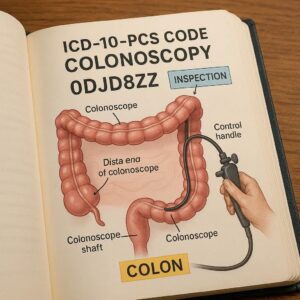
ICD-10-PCS Code for Colonoscopy
2. Understanding the Foundation: The Structure of ICD-10-PCS
Before we delve into the specifics of colonoscopy, it is essential to grasp the fundamental architecture of the ICD-10-PCS system. Unlike its diagnosis counterpart (ICD-10-CM), which is largely derived from the World Health Organization’s system and used globally, ICD-10-PCS was developed by the Centers for Medicare & Medicaid Services (CMS) specifically for reporting procedures in inpatient hospital settings in the United States.
ICD-10-PCS is a multi-axial, seven-character alphanumeric code set. Each character represents a specific aspect of the procedure, and each character’s value is selected from a predefined table. This structure allows for a vast number of unique codes, providing an unparalleled level of specificity.
Let’s break down the meaning of each character position:
-
Character 1: Section – This is the broadest category, identifying the general type of procedure (e.g., Medical and Surgical, Obstetrics, Imaging).
-
Character 2: Body System – This specifies the general body system on which the procedure was performed (e.g., Gastrointestinal System, Hepatobiliary System).
-
Character 3: Root Operation – This is the cornerstone of the code. It defines the objective of the procedure—what the physician did at its most fundamental level (e.g., Cutting, Altering, Taking Out).
-
Character 4: Body Part – This identifies the specific anatomical site where the root operation was performed (e.g., Ascending Colon, Descending Colon, Rectum).
-
Character 5: Approach – This describes the technique used to reach the operative site (e.g., Open, Percutaneous, Via Natural or Artificial Opening).
-
Character 6: Device – This character specifies any device that remains in or on the patient after the procedure is completed (e.g., a stent) or is used during the procedure (e.g., a diagnostic device). It also includes materials like sutures.
-
Character 7: Qualifier – This is a catch-all character that provides additional information about the procedure that is not captured elsewhere. Its meaning is specific to the root operation and body system.
For a colonoscopy, the vast majority of procedures will fall under the Medical and Surgical section (Character 1: 0) and the Gastrointestinal System (Character 2: D). Our primary focus, therefore, will be on Characters 3 through 7 within the 0D table.
3. The Colonoscopy Procedure: A Clinical Primer for Coders
To code a procedure accurately, a coder must understand what the procedure entails. A colonoscopy is an endoscopic examination of the large intestine (colon) and the distal part of the small intestine (terminal ileum) with a camera on a flexible tube called a colonoscope.
The typical sequence of events is as follows:
-
Preparation: The patient undergoes a bowel cleansing regimen (e.g., a liquid diet and laxatives) to ensure the colon is completely clear of stool, providing optimal visibility.
-
Sedation: The procedure is usually performed under sedation or anesthesia to ensure patient comfort.
-
Insertion: The gastroenterologist inserts the colonoscope through the anus and advances it carefully through the rectum, sigmoid colon, descending colon, transverse colon, ascending colon, and potentially into the cecum and terminal ileum.
-
Inspection: As the scope is advanced and then slowly withdrawn, the physician insufflates the colon with air or carbon dioxide to distend it and meticulously inspects the mucosal lining for any abnormalities.
-
Intervention: If an abnormality is found, the physician may perform an intervention. This is the critical juncture where the coding changes dramatically.
-
Biopsy: A small forceps is passed through an instrument channel in the colonoscope to take a tissue sample (a polyp or a piece of suspicious tissue).
-
Polypectomy: If a polyp (a benign or pre-cancerous growth) is identified, it can be removed in several ways: snipped with a wire snare (snare polypectomy), burned with an electrical current (hot biopsy or cauterization), or ablated with argon plasma coagulation.
-
Control of Bleeding: If active bleeding is found, the physician can cauterize the vessel or clip it.
-
Stent Placement: In cases of a malignant obstruction, a metal stent may be placed to keep the colon open.
-
-
Documentation: The physician dictates or writes a procedure report detailing the indications, findings, technique, and any interventions performed. This report is the coder’s primary source document.
Understanding this workflow is crucial because the coder must translate each distinct medical action into a specific ICD-10-PCS code.
4. Deconstructing the ICD-10-PCS Code for Colonoscopy: The Seven Characters
Now, let’s build an ICD-10-PCS code for a colonoscopy from the ground up.
Section and Body System (Characters 1 & 2)
As previously stated, almost all colonoscopies are coded in the Medical and Surgical section (0) and the Gastrointestinal System (D). Therefore, every code we discuss will begin with 0D.
The Root Operation (Character 3): The Heart of the Matter
This is the most important and often the most challenging character to assign correctly. The root operation defines the intent of the procedure. For colonoscopy, several root operations come into play, and the correct one is determined solely by the objective of the procedure as documented by the physician.
The key root operations for colonoscopy are:
-
Inspection: Visually and/or manually exploring a body part.
-
Excision: Cutting out or off, without replacement, a portion of a body part.
-
Destruction: Eradicating a body part without taking any of it out.
-
Extraction: Pulling or stripping out or off a body part by the use of force.
-
Drainage: Taking or letting out fluids and/or gases from a body part.
-
Removal: Taking out a foreign body or device from a body part.
We will explore each of these in exhaustive detail in the next section.
5. A Deep Dive into Root Operations for Colonoscopy
Root Operation: Inspection
-
Definition: Visually and/or manually exploring a body part.
-
Application to Colonoscopy: This is used for a diagnostic or screening colonoscopy where the physician only examines the colon and does not perform any intervention (like a biopsy or polypectomy). The purpose is purely to “inspect” the anatomy.
-
Key Consideration: If any other root operation (e.g., Excision, Destruction) is performed during the same session, the Inspection code is not assigned separately. The therapeutic procedure takes precedence, as the inspection is considered an integral part of the more definitive procedure.
Example: A screening colonoscopy is performed. The scope is advanced to the cecum. The physician visually inspects the entire colon and terminal ileum and finds no abnormalities. The scope is withdrawn.
-
Coding: You would code only the Inspection.
Root Operation: Excision
-
Definition: Cutting out or off, without replacement, a portion of a body part. The body part value is the site of the excision, and the portion of the body part removed is a “piece” of the whole (e.g., a polyp, a mass, a tissue sample for biopsy).
-
Application to Colonoscopy: This is used for biopsies and for polypectomies where the polyp is physically cut out and retrieved (e.g., via a snare polypectomy). The physician’s goal is to remove tissue, either for diagnosis or treatment.
-
Key Consideration: The qualifier (7th character) for Excision in the gastrointestinal table is often used to specify a diagnostic biopsy. For example, qualifier X signifies “Diagnostic.”
Example: During a colonoscopy, the physician finds a 1 cm sessile polyp in the sigmoid colon. A snare is passed, the polyp is ensnared, and an electrical current is applied to cut it out and cauterize the base. The polyp is retrieved.
-
Coding: This is an Excision of the sigmoid colon.
Root Operation: Destruction
-
Definition: Eradicating a body part without taking any of it out. The body part is destroyed in situ (e.g., by electrocautery, ablation, laser, chemical application). No tissue is retrieved for pathology.
-
Application to Colonoscopy: This is used for the destruction of tissue, such as small polyps, angiodysplasias (AVMs), or bleeding sites, using cautery or ablation where the tissue is not retrieved. For example, a tiny polyp that is “zapped” with hot biopsy forceps and completely vaporized would be destruction.
-
Key Consideration: The key differentiator from Excision is that in Destruction, no specimen is sent to pathology. If tissue is retrieved, even if cautery is used, it is typically coded as Excision.
Example: The physician identifies a tiny (2mm) hyperplastic polyp in the transverse colon. Using hot biopsy forceps, the polyp is cauterized and completely destroyed. No tissue is sent to pathology.
-
Coding: This is Destruction of the transverse colon.
Root Operation: Extraction
-
Definition: Pulling or stripping out or off a body part by the use of force. The force can be manual (e.g., pulling out a polyp with a snare) or by other means. It is distinguished from Excision by the fact that the cutting is not the primary action; the pulling is.
-
Application to Colonoscopy: This root operation is rarely used for colonoscopy in current coding practice. The official ICD-10-PCS guidelines for the Medical and Surgical section state that “if an endoscopic polypectomy is performed, the root operation Excision is coded, and the approach is via natural or artificial opening endoscopic.” Therefore, even a polypectomy performed by “pulling” with a snare is coded as Excision, not Extraction. Extraction might be considered for a procedure like manual reduction of an intussusception via colonoscope, but this is highly unusual. For all practical purposes, polypectomies are coded as Excision.
Root Operation: Drainage
-
Definition: Taking or letting out fluids and/or gases from a body part.
-
Application to Colonoscopy: This is used for decompression of a volvulus or a massively distended colon. The physician uses the colonoscope to suction out a large amount of gas or fluid to relieve pressure.
-
Key Consideration: This is a specific therapeutic intervention distinct from the routine suctioning of fluid and air during a standard colonoscopy.
Example: A patient presents with sigmoid volvulus. In the endoscopy suite, a colonoscope is passed and advanced to the point of torsion. The scope is maneuvered past the twist, and a large amount of gas and fluid is suctioned, decompressing the colon.
-
Coding: This is Drainage of the sigmoid colon.
Root Operation: Removal
-
Definition: Taking out a foreign body from a body part.
-
Application to Colonoscopy: This is used when a physician uses the colonoscope to remove a foreign object from the colon, such as a retained capsule endoscope, a swallowed object, or a previously placed stent that is now being taken out.
-
Key Consideration: The device character (6) is used to specify the type of foreign body being removed.
Example: A patient has a colorectal stent placed for palliation of a malignant obstruction. Several weeks later, the stent has become obstructed and needs to be removed. The physician passes a colonoscope and uses a snare to grasp and remove the stent.
-
Coding: This is Removal of a device from the large intestine.
The following table provides a quick-reference summary of these primary root operations.
Root Operations in ICD-10-PCS for Colonoscopy
| Root Operation | Definition | Common Colonoscopy Application | Key Differentiator |
|---|---|---|---|
| Inspection | Visually/manually exploring a body part. | Diagnostic or screening exam with no intervention. | No tissue is removed or destroyed. |
| Excision | Cutting out/off a portion of a body part. | Biopsy; Snare polypectomy (tissue retrieved). | Tissue is physically cut and removed for pathology. |
| Destruction | Eradicating a body part in situ. | Cauterization of a tiny polyp or AVM (no tissue retrieved). | Tissue is destroyed (e.g., ablated, vaporized) and not sent to pathology. |
| Extraction | Pulling out a body part by force. | Rarely used. (See note in text). | Primarily pulling action; for colonoscopy, polypectomy is coded as Excision. |
| Drainage | Taking out fluids/gases from a body part. | Decompression of a volvulus or toxic megacolon. | Therapeutic removal of a large volume of gas/fluid to relieve pressure. |
| Removal | Taking out a foreign body or device. | Removal of a foreign object or a previously placed stent. | The object removed is something that does not originate from the body (e.g., a stent, a swallowed toy). |
6. Completing the Code: Approach, Device, and Qualifier
Once the root operation is determined, we must complete the code by selecting the appropriate values for the body part, approach, device, and qualifier.
Body Part (Character 4)
This character specifies the exact location of the procedure. The ICD-10-PCS table for the Gastrointestinal System (0D) provides specific values for different parts of the colon. It is vital to read the physician’s report carefully to identify the correct body part.
Common Body Part values include:
-
4: Ascending Colon
-
5: Transverse Colon
-
6: Descending Colon
-
7: Sigmoid Colon
-
8: Cecum
-
9: Ileum (This refers to the terminal ileum)
-
B: Rectum
-
C: Anus
-
D: Large Intestine (Used when the specific part of the colon is not specified or when a procedure is performed on multiple distinct sites that are not contiguous.)
Approach (Character 5)
For colonoscopy, the approach is almost always Via Natural or Artificial Opening Endoscopic (8). This describes a procedure performed through a natural opening (the anus) using an endoscope. The “Via Natural or Artificial Opening” aspect alone (value 7) is not typically used for colonoscopy, as the use of the scope defines the endoscopic approach.
Device (Character 6)
The device character is used in two main contexts for colonoscopy:
-
When a device is left in place: For example, if a stent is placed to relieve an obstruction, the device character would specify “Intraluminal Device, Endoscopic” (J).
-
For the root operation Inspection: The device character is used to specify that a “Diagnostic” device (the colonoscope itself) was used. The value is X.
For most therapeutic procedures (Excision, Destruction), the device character is Z (No Device).
Qualifier (Character 7)
The qualifier provides additional context. Its meaning is specific to the root operation table. For example:
-
In the Excision table, qualifier X means “Diagnostic,” which is used for a biopsy.
-
In the Inspection table, the qualifier is always X for diagnostic.
-
In other tables, it is often Z (No Qualifier).
7. Navigating Diagnostic and Screening Colonoscopies
A common point of confusion is the difference between coding a diagnostic and a screening colonoscopy from a procedural (ICD-10-PCS) standpoint.
-
Screening Colonoscopy: This is performed on an asymptomatic patient as a routine preventive measure. The ICD-10-PCS code would be for Inspection, as the intent is to visually examine a healthy organ system.
-
Example: 0DJD8ZZ (Inspection of Lower Intestinal Tract, Via Natural or Artificial Opening Endoscopic, Diagnostic)
-
-
Diagnostic Colonoscopy: This is performed to investigate a sign, symptom, or abnormal test result (e.g., positive fecal occult blood test, rectal bleeding, iron deficiency anemia). If the physician only inspects and finds nothing, the ICD-10-PCS code is still Inspection. The “diagnostic” nature is primarily conveyed by the diagnosis code (ICD-10-CM), not the PCS code.
The critical distinction occurs when an intervention is performed. A screening colonoscopy can instantly become a therapeutic procedure. If a polyp is found and removed during a screening colonoscopy, the PCS code changes from Inspection to Excision (or Destruction). The fact that it started as a screening is captured in the diagnosis code (e.g., Z12.11, Encounter for screening for malignant neoplasm of colon), but the procedure itself is coded based on what was done.
8. Complex Scenarios and Multiple Procedures
It is very common for a physician to perform multiple interventions during a single colonoscopy session. ICD-10-PCS coding rules require that you code each distinct procedure that is performed at a separate site.
Scenario 1: Multiple Polyps in Different Locations
-
Report: “A 5 mm pedunculated polyp was found in the ascending colon and removed with cold snare. A 10 mm sessile polyp was found in the sigmoid colon and removed with hot snare. Both specimens were sent to pathology.”
-
Coding:
-
0DBD8ZZ (Excision of Ascending Colon, Via Natural or Artificial Opening Endoscopic, No Device, No Qualifier) – Cold snare polypectomy.
-
0D978ZZ (Excision of Sigmoid Colon, Via Natural or Artificial Opening Endoscopic, No Device, No Qualifier) – Hot snare polypectomy.
-
Note: Both are coded as Excision since tissue was retrieved. The use of “cold” vs. “hot” is not differentiated in PCS.
-
Scenario 2: Biopsy and Polypectomy
-
Report: “An ulcerated, non-bleeding area was seen in the terminal ileum. Biopsies were taken with cold forceps. Separately, a small polyp in the transverse colon was ablated with argon plasma coagulation.”
-
Coding:
-
0D998ZX (Excision of Ileum, Via Natural or Artificial Opening Endoscopic, No Device, Diagnostic) – This is a biopsy, hence the qualifier X for Diagnostic.
-
0D950ZZ (Destruction of Transverse Colon, Via Natural or Artificial Opening Endoscopic, No Device, No Qualifier) – The polyp was ablated, not retrieved.
-
Scenario 3: Inspection with Biopsy of Unspecified Site
-
Report: “Colonoscopy to cecum. Mucosa appeared normal throughout. Random biopsies were taken from the colon.”
-
Coding: If the physician does not specify from which part of the colon the biopsies were taken, you must use the general body part value. In this case, the general value for “Large Intestine” is D.
-
0DDD8ZX (Excision of Large Intestine, Via Natural or Artificial Opening Endoscopic, No Device, Diagnostic)
-
9. The Crucial Link: ICD-10-PCS and ICD-10-CM Diagnosis Codes
Accurate procedural coding is only half the story. It must be supported by precise diagnosis coding. The diagnosis code justifies the medical necessity of the procedure.
-
For a Screening: The primary diagnosis code would be Z12.11 (Encounter for screening for malignant neoplasm of colon).
-
For a Diagnostic Colonoscopy: The primary diagnosis code would be the sign or symptom being investigated, such as R19.5 (Other fecal abnormalities), K62.5 (Hemorrhage of anus and rectum), or D50.9 (Iron deficiency anemia, unspecified).
-
For a Therapeutic Colonoscopy: The primary diagnosis code would be the condition that was treated, such as K63.5 (Polyp of colon) or K55.21 (Angiodysplasia of colon with hemorrhage).
Always code to the highest level of specificity. If the pathology report returns and confirms a tubular adenoma, the diagnosis code should be updated to D12.6 (Benign neoplasm of colon, unspecified).
10. Common Pitfalls and How to Avoid Them
-
Coding Both Inspection and a Therapeutic Procedure: This is the most common error. Remember, if a biopsy or polypectomy is performed, you code only the Excision/Destruction. The inspection is inherent to the procedure.
-
Confusing Excision and Destruction: The rule of thumb is: Was tissue retrieved for pathology? If yes, code Excision. If no, and it was destroyed in situ, code Destruction.
-
Incorrect Body Part: Do not assume. If the report says “a polyp was found and removed in the sigmoid colon,” code the sigmoid colon (7), not the general “large intestine” (D). Use the general value only when the documentation is unclear.
-
Ignoring the Qualifier for Biopsy: For a biopsy, remember to use the qualifier X (Diagnostic) in the Excision table.
-
Using the Wrong Approach: For a standard colonoscopy, the approach is always 8 (Via Natural or Artificial Opening Endoscopic).
11. The Impact of Accurate Coding: Compliance, Reimbursement, and Data
The consequences of inaccurate coding are far-reaching:
-
Compliance: Incorrect coding can lead to allegations of fraud and abuse under the False Claims Act. Audits by Medicare, Medicaid, and private payers can result in hefty fines and penalties.
-
Reimbursement: Under-coding means the facility is not receiving appropriate payment for the complex work performed. Over-coding can lead to claim denials, recoupments, and audits. Accuracy ensures optimal and legitimate reimbursement.
-
Data Integrity: ICD-10-PCS data is used for:
-
Quality Metrics: Tracking outcomes and complications.
-
Public Health: Monitoring the incidence of diseases like colorectal cancer and the utilization of screening services.
-
Research: Informing clinical studies on the effectiveness of different polypectomy techniques.
-
Operational Planning: Helping hospitals understand resource utilization and plan service lines.
-
Every code assigned is a piece of a massive data puzzle that shapes healthcare policy and clinical practice.
12. Conclusion
Mastering ICD-10-PCS coding for colonoscopy requires a meticulous approach, a deep understanding of procedural definitions, and a commitment to continuous learning. By focusing on the root operation as defined by the physician’s intent and carefully layering on the details of body part, approach, device, and qualifier, coders can achieve a high level of accuracy. This precision is not an abstract goal; it is the bedrock of financial stability, regulatory compliance, and the generation of high-quality healthcare data that ultimately contributes to better patient care.
13. Frequently Asked Questions (FAQs)
Q1: How do I code a colonoscopy with a biopsy?
A1: You code it as an Excision of the specific body part where the biopsy was taken. The approach is Via Natural or Artificial Opening Endoscopic (8), and the qualifier is Diagnostic (X). For example, a biopsy of the sigmoid colon is 0D978ZX.
Q2: What is the difference between a hot and cold biopsy or polypectomy in ICD-10-PCS?
A2: There is no difference. ICD-10-PCS does not specify the technique (hot vs. cold). Both are coded as Excision if tissue is retrieved. If a polyp is destroyed with cautery and no tissue is retrieved, it is coded as Destruction.
Q3: The physician documented ‘tattooing’ of a lesion site. How is this coded?
A3: Tattooing is considered a separate procedure. It is coded in the Administration section. The root operation is “Introduction,” and the substance is “Other Contrast Material” (qualifier Y). The code would be 3E0K3GC (Introduction of Other Contrast Material into Gastrointestinal Tract, Via Natural or Artificial Opening).
Q4: What if the colonoscopy is incomplete and the physician cannot advance to the cecum?
A4: You code the procedure that was actually performed. If the physician inspected as far as the splenic flexure and took a biopsy, you would code the Inspection (if no biopsy) or Excision of the specific body part that was reached and biopsied (e.g., descending colon). The diagnosis code should reflect the reason for the incomplete procedure (e.g., K56.52, Ileus of the colon).
Q5: How do I code the removal of a polyp that was found to be cancerous?
A5: You code the procedure based on what was done, not the pathology finding. If the polyp was excised, you code Excision. The malignant diagnosis (from the pathology report) becomes the primary diagnosis code for that procedure (e.g., C18.2, Malignant neoplasm of ascending colon).
14. Additional Resources
To ensure you are always using the most current information, rely on these official resources:
-
CMS ICD-10-PCS Official Guidelines for Coding and Reporting: The definitive source for coding rules and conventions. Updated annually.
-
ICD-10-PCS Code Tables and Index: Available on the CMS website and through various commercial coding software and books.
-
AHA Coding Clinic for ICD-10-CM/PCS: The official publication that provides authoritative advice and clarifications on specific coding scenarios. It is an essential tool for every coder.
-
American Health Information Management Association (AHIMA): Offers a wealth of educational resources, webinars, and certifications for coding professionals.
-
American Academy of Professional Coders (AAPC): Provides certification, local chapter meetings, and ongoing education for medical coders.
Date: November 16, 2025
Author: Healthcare Coding Insights
Disclaimer: This article is intended for educational and informational purposes only and does not constitute medical or professional coding advice. While every effort has been made to ensure accuracy, ICD-10-PCS codes, guidelines, and policies are subject to change. Always consult the current official ICD-10-PCS code set, CMS guidelines, and your facility’s coding policies for definitive coding guidance. The author and publisher are not responsible for any errors or omissions or for any outcomes related to the use of this information.


