
In the high-stakes environment of a hospital’s intensive care unit, the rhythmic hiss and whir of a mechanical ventilator is often the sound of life itself. This sophisticated machine assumes the critical work of breathing for patients whose lungs are too injured, too weak, or too compromised to function on their own. For the clinical team, the ventilator is a lifeline. For the health information management (HIM) professional, it represents one of the most complex, consequential, and frequently audited procedures in the ICD-10-PCS coding system. Assigning the code for mechanical ventilation is not a mere clerical task; it is an act of clinical translation, requiring a deep understanding of pathophysiology, technology, and the intricate rules of a modern classification system.
A single code—5A1955Z—carries significant weight. It influences diagnosis-related group (DRG) assignment, impacts hospital reimbursement, contributes to vital administrative data, and paints a picture of the intensity of resources utilized during a patient’s stay. An error in its application can lead to substantial financial loss, compliance issues, and a distorted representation of the patient’s severity of illness. This article is designed to be your definitive guide. We will move beyond a superficial understanding and delve into the anatomy of this code, explore the complex scenarios that challenge even seasoned coders, and equip you with the knowledge to code mechanical ventilation with unwavering confidence and accuracy.
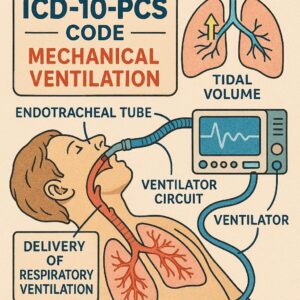
ICD-10-PCS Code for Mechanical Ventilation
2. The Foundation: Understanding the ICD-10-PCS Structure
Before we can build the specific code for mechanical ventilation, we must first understand the architectural blueprint of the ICD-10-PCS system. Unlike its ICD-10-CM counterpart, which is used for diagnosing diseases, ICD-10-PCS is used exclusively for classifying hospital-based procedures. Its structure is logical, alphanumeric, and composed of seven characters. Each character represents a specific aspect of the procedure, and each position has a defined set of values.
The Seven Characters of an ICD-10-PCS Code:
-
1st Character: Section – The broadest category, defining the type of procedure (e.g., Medical and Surgical, Administration, Measurement).
-
2nd Character: Body System – The general physiological system or anatomical region on which the procedure is performed.
-
3rd Character: Root Operation – The objective of the procedure (e.g., cutting, inserting, introducing).
-
4th Character: Body Part/Region – The specific anatomical site where the procedure is performed.
-
5th Character: Approach – The technique used to reach the procedure site (e.g., open, percutaneous, via natural orifice).
-
6th Character: Device – The type of device used, if any, and whether it is used for a diagnostic or therapeutic purpose.
-
7th Character: Qualifier – Provides additional information about the procedure, such as a specific diagnostic or therapeutic method.
This structured approach allows for immense specificity. There are over 70,000 unique PCS codes, a testament to the system’s granularity. For mechanical ventilation, we are not operating in the “Medical and Surgical” section, but rather in a different, equally important section: Administration.
3. Deconstructing the “Administration” Section
The Administration section, identified by the first character 5, is one of the “ancillary” sections of PCS. It encompasses procedures where a substance or energy is administered to a patient, either for therapeutic, diagnostic, or prophylactic purposes. The root operations in this section include:
-
Introduction: Putting in or on a therapeutic, diagnostic, nutritional, physiological, or prophylactic substance, except blood or blood products.
-
Injection: Putting in or on a blood or blood product.
-
Transfusion: Putting in or on a blood or blood product.
Mechanical ventilation falls under the root operation Introduction. But why? We are not surgically cutting into the lungs or inserting a device in the traditional sense. Instead, we are introducing atmospheric air and oxygen (the substance) into the respiratory system under positive pressure to achieve a therapeutic physiological effect: gas exchange.
4. The Heart of the Matter: Building the 5A1955Z Code
Let us now construct the code for mechanical ventilation, character by character, understanding the clinical rationale behind each choice.
1st Character: Section (5) – Administration
As established, mechanical ventilation is the administration of a gaseous substance (air/oxygen) for a therapeutic purpose, placing it squarely in this section.
2nd Character: Body System (A) – Physiological Systems and Anatomical Regions
This character can be a point of confusion. The body system for mechanical ventilation is not the anatomical “Respiratory System” in the way it is used in the Medical and Surgical section. Here, A represents “Physiological Systems.” Mechanical ventilation is a procedure that supports the physiological function of breathing, which involves the entire physiological system of respiration, including the neurological control (brainstem), muscles (diaphragm, intercostals), and lungs.
3rd Character: Root Operation (1) – Introduction
The objective is to introduce a substance—air and oxygen, often with specific pressure and volume settings—into the body. The Official Coding Guidelines reinforce this, explicitly stating that mechanical ventilation is coded to the root operation Introduction.
4th Character: Body System/Region (9) – Respiratory System
This character specifies the physiological system being supported. While the 2nd character was the broad “Physiological Systems,” the 4th character pinpoints the specific system, which is the Respiratory System.
5th Character: Approach (5) – Via Natural or Artificial Opening
This is a critical character that depends on the patient’s interface with the ventilator.
-
Via Natural or Artificial Opening (5): This is used for both endotracheal intubation (an artificial opening created by the tube through the natural orifice of the mouth or nose) and tracheostomy (an artificial opening created surgically in the trachea). In both cases, the conduit to the lungs is an “opening,” either natural or surgically created.
-
What about “External” (X)? The approach “External” is used for procedures performed directly on the skin or mucous membranes. Non-invasive ventilation (NIV), such as BiPAP or CPAP delivered via a face mask, uses the approach X. This is a crucial distinction we will explore later.
6th Character: Device (5) – Ventilator
This character identifies the technological means of delivery. The device is the Ventilator itself. It is the machine that is actively performing the work of breathing.
7th Character: Qualifier (Z) – No Qualifier
For this specific procedure, there is no further qualifier needed. The code is complete.
Therefore, the complete, seven-character code for invasive mechanical ventilation is: 5A1955Z
ICD-10-PCS Code Building for Mechanical Ventilation
| Character Position | Character Value | Description | Clinical Rationale |
|---|---|---|---|
| 1 – Section | 5 | Administration | The procedure involves administering a substance (air/oxygen) for therapeutic purpose. |
| 2 – Body System | A | Physiological Systems | The procedure supports a physiological function (breathing) of the body as a whole. |
| 3 – Root Operation | 1 | Introduction | The objective is to put in or on a therapeutic, physiological substance. |
| 4 – Body Region | 9 | Respiratory System | The specific physiological system being supported is respiration. |
| 5 – Approach | 5 | Via Natural or Artificial Opening | The substance is delivered via an endotracheal tube or tracheostomy tube. |
| 6 – Device | 5 | Ventilator | The mechanical ventilator is the device used to perform the procedure. |
| 7 – Qualifier | Z | No Qualifier | No additional information is required for this procedure. |
| Final Code | 5A1955Z | Introduction of Respiratory Gas into Respiratory System, Via Natural or Artificial Opening, Ventilator | The complete code for invasive mechanical ventilation. |
5. Beyond the Basics: Navigating Complex Ventilation Scenarios
Coding would be simple if every patient required only one type of support for a discrete period. Reality, however, is far more complex. The following scenarios test the limits of a coder’s knowledge.
The Intricate Dance of Ventilation and Extracorporeal Membrane Oxygenation (ECMO)
ECMO represents one of the most advanced forms of life support, acting as an artificial heart and/or lung. Coding for a patient on both ECMO and a ventilator requires a sophisticated understanding of what each machine is doing.
-
ECMO Code: The procedure of performing ECMO is found in the Extracorporeal Assistance and Performance section (first character 5). The common code is 5A1522F (Assistance with Cardiac Output, Continuous, VAD). However, there are codes for respiratory support: 5A0945Z (Performance of Respiratory, Continuous) for VV-ECMO (which oxygenates the blood) and 5A0525Z (Performance of Cardiac, Continuous) for VA-ECMO (which supports both heart and lung function).
-
The Key Question: Can you code both ECMO and mechanical ventilation? Yes, but only if they are performing distinct functions. The Official Coding Guidelines state that ECMO and mechanical ventilation can be coded together only if the patient has separate and distinct underlying conditions, and each device is treating a different condition.
-
Example 1: A patient with severe viral pneumonia is on a ventilator for lung failure. Their heart function is fine. They are placed on VV-ECMO to provide better oxygenation. In this case, both the ventilator and the ECMO are supporting the same organ system (the lungs) for the same underlying condition. You would code only the ECMO (5A0945Z), as it represents the more intensive level of support. The ventilator is considered a component of the ECMO management.
-
Example 2: A patient is admitted after a massive myocardial infarction, resulting in cardiogenic shock (heart failure) and secondary pulmonary edema (lung failure). They are placed on VA-ECMO to support their heart function and a mechanical ventilator to support their lung function. Here, two separate physiological systems are being supported for two distinct (though related) conditions. In this scenario, you would code both the ECMO (5A0525Z) and the mechanical ventilation (5A1955Z).
-
Coding Post-Operative Ventilation: The 24-Hour Rule and Its Nuances
A common area for audit risk is coding for post-operative ventilation. The general principle is that a procedure inherent to a surgical operation should not be coded separately. For example, you wouldn’t code the administration of anesthesia separately. The same logic applies to short-term, post-operative ventilation.
-
The Rule: According to the ICD-10-PCS Official Coding Guidelines, mechanical ventilation provided in the immediate post-operative period is not coded separately if the duration is less than 24 hours. This is considered an integral part of the surgical procedure and the patient’s recovery.
-
The Exception: If the mechanical ventilation continues for 24 hours or longer following the conclusion of the operative procedure, it must be coded separately. This indicates that the patient’s respiratory failure is a significant, ongoing clinical issue beyond routine post-anesthesia recovery.
-
Documentation is Key: The coder must meticulously review the anesthesia record, post-anesthesia care unit (PACU) notes, and ICU or floor notes to determine the exact time the patient was extubated (or the ventilator was discontinued). The clock starts when the patient leaves the operating room.
Distinguishing Between Invasive and Non-Invasive Ventilation
As alluded to earlier, the approach character changes based on how the ventilator support is delivered.
-
Invasive Mechanical Ventilation (IMV): 5A1955Z
-
Delivered via an endotracheal tube or tracheostomy.
-
Approach: 5 (Via Natural or Artificial Opening).
-
-
Non-Invasive Ventilation (NIV): 5A0935Z
-
Delivered via a tight-fitting face mask or nasal mask (e.g., BiPAP, CPAP).
-
The code structure changes:
-
Section: 5 (Administration)
-
Body System: A (Physiological Systems)
-
Root Operation: 0 (Performance) – This is a key difference. NIV is considered “assisting” the patient’s own breathing efforts, not completely controlling it.
-
Body Region: 9 (Respiratory System)
-
Approach: 3 (External) – Because the interface is a mask on the face.
-
Device: 5 (Ventilator)
-
Qualifier: Z (No Qualifier)
-
-
Final NIV Code: 5A0935Z
-
It is imperative to review the respiratory therapy notes and physician documentation to determine the exact mode of ventilation. Coding invasive when it was non-invasive, or vice versa, is a common error.
6. Common Pitfalls and Auditor Insights: Where Coders Stumble
Based on audits and denials, here are the most frequent mistakes made in ventilation coding:
-
Coding “Weaning” or “T-Piece” Trials: When a patient is being weaned from the ventilator, they may be placed on a T-piece, breathing on their own with some oxygen support. This is not considered mechanical ventilation. Do not report 5A1955Z during these trials. Only code it when the ventilator is actively providing breaths.
-
Misinterpreting the 24-Hour Rule: Coding for post-operative ventilation that lasted only 12 hours is a guaranteed denial. Conversely, failing to code for ventilation that lasted 36 hours is a missed revenue opportunity and misrepresents the patient’s acuity.
-
Confusing High-Flow Nasal Cannula (HFNC) with Ventilation: HFNC delivers heated, humidified oxygen at very high flow rates (e.g., 60 L/min). While it provides some positive airway pressure and is a advanced form of respiratory support, it is not considered mechanical ventilation. It is coded differently, typically in the Administration section under Introduction of a substance, but the device is not a ventilator. The appropriate code would be 5A0945Z (Performance of Respiratory, Continuous).
-
Overlooking the Distinction Between IMV and NIV: As detailed above, using the wrong code based on the interface is a significant accuracy and compliance issue.
-
Incorrectly Sequencing ECMO and Ventilation Codes: Failing to apply the “separate and distinct underlying conditions” rule and coding both when only ECMO support is being provided.
7. The Clinical Picture: A Brief Overview of Why Patients Need Ventilation
To code effectively, a coder must understand the “why.” Common indications for mechanical ventilation include:
-
Hypoxemic Respiratory Failure: Inadequate oxygen in the blood (e.g., from pneumonia, ARDS, pulmonary edema).
-
Hypercapnic Respiratory Failure: Inadequate removal of carbon dioxide from the blood (e.g., from COPD exacerbation, drug overdose, neuromuscular diseases like Myasthenia Gravis).
-
Airway Protection: For patients with a depressed level of consciousness (e.g., head injury, post-cardiac arrest) who cannot protect their airway from aspiration.
-
Procedural Support: During certain surgeries or procedures that require general anesthesia or deep sedation.
8. The Coder’s Toolkit: Essential Documentation for Precision
To assign the code 5A1955Z correctly, the medical record must provide clear and consistent evidence. Key documents include:
-
Physician’s History & Physical/Progress Notes: Stating the diagnosis requiring ventilation (e.g., “Acute Hypoxemic Respiratory Failure secondary to COVID-19 pneumonia”).
-
Respiratory Therapy Flowsheets: The most critical source. They document the start and stop times of ventilation, the mode (e.g., Assist-Control, SIMV, Pressure Support), settings (FiO2, PEEP, Tidal Volume), and the type of interface (Endotracheal Tube, Tracheostomy, Face Mask).
-
Anesthesia Records: For determining the end of the surgical procedure and the start of the post-operative ventilation period.
-
Nursing Notes: Often document the patient’s tolerance of the ventilator and the process of weaning and extubation.
-
Procedure Notes: For documentation of the intubation or tracheostomy procedure itself.
9. Case Studies: Applying Knowledge to Real-World Scenarios
Case Study 1: The Post-Operative Complication
-
Scenario: A 68-year-old male undergoes a scheduled 4-hour coronary artery bypass graft (CABG). He is transferred to the ICU intubated and on a ventilator at 14:00. The plan is to wean and extubate overnight. However, he develops significant pulmonary edema and remains ventilator-dependent. He is successfully extubated at 17:00 the next day.
-
Coding Decision: The total duration of post-operative ventilation was 27 hours (from 14:00 on day 1 to 17:00 on day 2). This exceeds the 24-hour threshold.
-
Action: Code 5A1955Z for mechanical ventilation in addition to the codes for the CABG surgery. The pulmonary edema is a complicating condition that justifies the separate code.
Case Study 2: The Multi-System Failure
-
Scenario: A 45-year-old female is admitted in septic shock from a urinary tract infection. She has profound hypotension and respiratory distress. She is intubated and placed on a ventilator (5A1955Z). Despite fluids and vasopressors, her heart function deteriorates, and she is placed on VA-ECMO (5A0525Z) for both cardiac and respiratory support.
-
Coding Decision: After 48 hours of dual support, her heart function recovers, and she is taken off ECMO. She remains on the ventilator for another 5 days for persistent ARDS before being weaned and extubated.
-
Action: For the period of dual support, code both 5A1955Z and 5A0525Z because the ECMO was primarily for cardiac support and the ventilator for respiratory support, representing treatment for two distinct manifestations of her sepsis. After ECMO is discontinued, continue to code 5A1955Z for the ongoing mechanical ventilation.
10. The Future of Ventilation Coding: Emerging Technologies and Trends
The field of critical care is dynamic. Coders must stay informed about new technologies:
-
Closed-Loop Ventilation: Smart ventilators that automatically adjust settings based on real-time patient data. The coding fundamentals remain the same, but documentation will reflect these advanced modes.
-
Portable and Transport Ventilators: Increased use of these devices during intra-hospital transfers. The coding does not change based on the portability of the device.
-
Artificial Intelligence (AI) in Weaning: AI algorithms are being developed to predict the optimal time for extubation. This is a clinical decision support tool and does not impact the procedure code itself.
-
Prolonged Weaning Units: The rise of specialized units for long-term ventilator-dependent patients may lead to more focused DRGs and reimbursement models in the future.
11. Conclusion
Mastering the ICD-10-PCS code for mechanical ventilation, 5A1955Z, is a critical skill for the modern HIM professional. It requires a synthesis of coding guidelines, clinical knowledge, and meticulous attention to documentation detail. By understanding its seven-character structure, navigating complex scenarios like ECMO co-treatment and the post-operative 24-hour rule, and avoiding common pitfalls, coders can ensure the medical record accurately reflects the intensive care provided, supporting appropriate reimbursement, compliance, and valuable health data.
12. Frequently Asked Questions (FAQs)
Q1: How do I code a patient who is on a ventilator for less than 24 hours but is not post-operative?
A1: The 24-hour rule only applies to ventilation provided in the immediate post-operative period. For a medical patient (e.g., admitted for a COPD exacerbation and ventilated for 18 hours before extubation), you must code 5A1955Z, regardless of the duration. The care is not considered inherent to another procedure.
Q2: What is the correct code for BiPAP or CPAP?
A2: Non-invasive ventilation with BiPAP or CPAP is coded as 5A0935Z (Performance of Respiratory, External, Ventilator). Remember the root operation is “Performance” and the approach is “External.”
Q3: A patient is on a ventilator and also receiving nebulizer treatments. Do I code the nebulizer separately?
A3: Yes. Nebulizer treatments are considered a separate procedure. They are coded in the Administration section, root operation Introduction, with the substance being the medication (e.g., Albuterol). The code would be different, such as 5A09357 (Introduction of Other Gas into Respiratory System, External, Inhalation).
Q4: How do I handle coding for a patient who is transferred from another hospital already on a ventilator?
A4: If your facility is continuing the mechanical ventilation, you code it. The code represents the procedure being performed at your facility, regardless of where it was initiated. Ensure your clinical documentation supports the ongoing need for ventilation.
Q5: Is there a code for “ventilator management” or “adjusting vent settings”?
A5: No. There is only one code for the performance of mechanical ventilation (5A1955Z or 5A0935Z). All management, monitoring, and adjustment of settings are considered inherent components of that single, continuous procedure and are not coded separately.
Date: November 19, 2025
Author: Jonathan Avery, CCS, CDIP
Disclaimer: This article is intended for educational purposes and is based on the ICD-10-PCS Official Coding Guidelines and Index as of FY 2025. It is not a substitute for official coding resources or professional clinical advice. Coders must always consult the most current year’s coding manuals and guidelines for definitive code assignment.


