
In the intricate world of modern healthcare, the act of repairing a hernia transcends the operating room. It becomes a narrative, a story told not in words, but in codes. For the surgeon, the goal is anatomical correction and patient relief; for the medical coder, it is the precise translation of that complex procedure into the universal language of ICD-10-PCS (International Classification of Diseases, Tenth Revision, Procedure Coding System). This translation is not a mere administrative task—it is a critical function that drives reimbursement, fuels health outcomes research, and paints a picture of a nation’s surgical landscape. When the procedure involves the implantation of mesh, a ubiquitous and powerful tool in the surgeon’s arsenal, the coding narrative becomes even more nuanced, demanding an unparalleled level of precision and understanding.
A single misplaced character in a seven-character code can shift the narrative from accuracy to error, potentially leading to claim denials, compliance issues, and a distorted representation of the care provided. This article is designed to be your definitive guide through this labyrinth. We will embark on a detailed journey, dissecting the anatomy of a hernia, deconstructing the ICD-10-PCS system layer by layer, and applying this knowledge to real-world clinical scenarios. Our focus will be exclusively on the Medical and Surgical section, where the vast majority of these repairs are documented. By the end of this exploration, you will not only know how to code a hernia repair with mesh but why each component is essential, empowering you to approach this task with confidence and expertise.
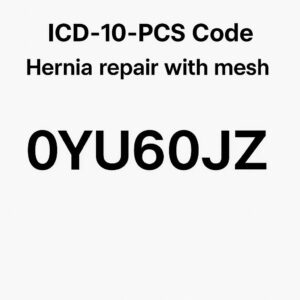
ICD-10-PCS Code for Hernia Repair with Mesh
2. Deconstructing the Foundation: Understanding Hernia Anatomy and Terminology
Before a single code can be built, one must first understand the clinical subject. A hernia is defined as the protrusion of an organ or tissue through an abnormal opening in the wall of the cavity that normally contains it. Think of a tire with a weak spot in its inner tube; the tube bulges through the weakened rubber. In the human body, this most commonly occurs in the abdominal wall, where intra-abdominal pressure forces peritoneum, fat, or even intestine through a area of muscular weakness.
The classification of hernias is paramount for accurate coding. Key types include:
-
Inguinal Hernia: The most common type, occurring in the groin area. It is subdivided into:
-
Indirect Inguinal Hernia: A congenital condition where the hernia follows the path of the spermatic cord (in males) or round ligament (in females) through the internal inguinal ring.
-
Direct Inguinal Hernia: An acquired weakness in the fascia of the abdominal wall (Hesselbach’s triangle), where the hernia protrudes directly forward.
-
-
Femoral Hernia: A less common type that occurs just below the inguinal ligament, through the canal that carries the femoral artery and vein into the upper thigh. It is more common in women and carries a higher risk of strangulation.
-
Umbilical Hernia: Occurs at the navel (umbilicus) due to a failure of the umbilical ring to close completely after birth. It can be present in infants or develop in adults, often associated with obesity or pregnancy.
-
Incisional/Ventral Hernia: A hernia that occurs through a previously made surgical incision. This is a common complication of abdominal surgery. The term “ventral hernia” is a broader category that includes any hernia on the anterior abdominal wall, including umbilical and epigastric hernias.
-
Hiatal Hernia: Unlike the others, this occurs at the diaphragm. The stomach protrudes upward through the esophageal hiatus (the opening for the esophagus). It is primarily classified as:
-
Sliding Hiatal Hernia (Type I): The gastroesophageal junction and a portion of the stomach slide up into the chest. This is the most common type.
-
Paraesophageal Hernia (Type II, III, IV): The gastroesophageal junction remains in place, but part of the stomach herniates through the hiatus next to the esophagus. This type is less common but more serious, with risks of volvulus (twisting) and strangulation.
-
Understanding these distinctions is the first and most crucial step, as they directly dictate the values for the Body Part character in the PCS code.
3. The ICD-10-PCS Framework: A Language of Seven Characters
ICD-10-PCS is a multi-axial, procedural classification system. Each code is composed of seven alphanumeric characters, with each character conveying specific information about the procedure. This structure provides a massive capacity for specificity, a stark contrast to its predecessor, ICD-9-CM.
The seven characters represent:
-
Section: The broadest category (e.g., Medical and Surgical, Obstetrics, Imaging).
-
Body System: The general physiological system involved (e.g., Gastrointestinal System, Musculoskeletal System).
-
Root Operation: The objective of the procedure—what the physician did.
-
Body Part: The specific anatomical site—where the procedure was performed.
-
Approach: The technique used to reach the site—how access was gained.
-
Device: The type of device used, if any.
-
Qualifier: Additional information that clarifies the procedure.
For hernia repair with mesh, our focus will be almost exclusively within the Medical and Surgical Section (0), specifically the Gastrointestinal System (D) and, in some cases, the Anatomical Regions, General (W) and Anatomical Regions, Lower Extremities (Y) body systems.
4. The Medical and Surgical Section (0): Our Primary Focus
Within the Medical and Surgical section, the most critical character to identify for hernia repair is the Root Operation. For the vast majority of hernia repairs involving mesh, the correct root operation is Repair (Q).
The official definition of Repair is: “Restoring, to the extent possible, a body part to its normal anatomic structure and function.” This does not include simply putting things back in place (which would be Reposition) or closing a hole (which could be Closure). Repair is used when the physician is fixing a malfunctioning or weakened body part. In the case of a hernia, the weakened abdominal or diaphragmatic wall is being reinforced.
It is vital to note that the root operation Supplement (U) is used when mesh is applied to reinforce or strengthen a body part that is not necessarily ruptured or herniated, which is a different clinical scenario. For a true hernia, the root operation is Repair.
5. Character 4: The Body Part – The “Where” of the Hernia Repair
This character is where your anatomical knowledge is put to the test. The body part value is specific to the type of hernia and its location. The PCS tables are organized by body system, so you must first determine the correct body system.
-
For most abdominal wall hernias (inguinal, femoral, umbilical, incisional): The body system is Anatomical Regions, General (W) or Anatomical Regions, Lower Extremities (Y) for femoral hernias.
-
For hiatal and other diaphragmatic hernias: The body system is Gastrointestinal System (D).
The table below provides a detailed breakdown of common hernia locations and their corresponding PCS Body Part values.
ICD-10-PCS Body Part Values for Common Hernia Repairs
| Hernia Type | Specific Location | ICD-10-PCS Body System | ICD-10-PCS Body Part Value | Body Part Name |
|---|---|---|---|---|
| Inguinal | Indirect Inguinal, Right | Anatomical Regions, General | W | Inguinal Region, Right |
| Inguinal | Direct Inguinal, Right | Anatomical Regions, General | W | Inguinal Region, Right |
| Inguinal | Indirect Inguinal, Left | Anatomical Regions, General | X | Inguinal Region, Left |
| Inguinal | Direct Inguinal, Left | Anatomical Regions, General | X | Inguinal Region, Left |
| Femoral | Femoral, Right | Anatomical Regions, Lower Extremities | 3 | Femoral Region, Right |
| Femoral | Femoral, Left | Anatomical Regions, Lower Extremities | C | Femoral Region, Left |
| Umbilical | Umbilical | Anatomical Regions, General | U | Umbilicus |
| Ventral/Incisional | Upper Anterior Abdominal Wall (e.g., epigastric) | Anatomical Regions, General | T | Upper Anterior Abdominal Wall |
| Ventral/Incisional | Lower Anterior Abdominal Wall (e.g., hypogastric) | Anatomical Regions, General | V | Lower Anterior Abdominal Wall |
| Hiatal | Sliding Hiatal Hernia | Gastrointestinal System | N | Esophageal Hiatus |
| Hiatal | Paraesophageal Hernia | Gastrointestinal System | N | Esophageal Hiatus |
(Note: For a “ventral hernia” not specified as upper or lower, the default in PCS is the “Anterior Abdominal Wall,” which is a different body part value. Always query for specificity.)
6. Character 5: The Approach – The “How” of Surgical Access
The approach describes the technique used to reach the operative site. For hernia repair, the two most common approaches are Open and Laparoscopic.
-
Open Approach (0): The surgeon makes a single, larger incision directly over the hernia site to access and repair the defect. This is the traditional method.
-
Laparoscopic Approach (4): The surgeon makes several small incisions through which a camera (laparoscope) and long, thin instruments are inserted. The abdomen is inflated with gas (pneumoperitoneum) to create a working space. The repair is performed using video guidance. This is often referred to as “minimally invasive” surgery.
-
Percutaneous Endoscopic Approach (F): This is less common for mesh placement but might be used for certain diagnostic or simple closure techniques without mesh. It involves entry through the skin via needle puncture, with endoscopic visualization.
The documentation must clearly state the approach. Terms like “laparoscopic,” “minimally invasive,” or “keyhole” indicate the laparoscopic approach. The absence of such terms typically implies an open approach, but coders should never assume.
7. Character 6: The Device – The “What” of the Mesh Implant
This character is the differentiator for a simple hernia repair versus one with mesh. The device specifies the material that remains in the body after the procedure is complete.
-
Synthetic Mesh (J): This is the most common device used. It is a prosthesis made from synthetic polymers like polypropylene, polyester, or ePTFE (e.g., Gore-Tex). It provides a strong, permanent scaffold for tissue ingrowth. In the PCS tables, this is listed as Synthetic Substitute.
-
Biologic Implant (K): This is a mesh derived from animal or human tissue (e.g., porcine small intestine submucosa, bovine pericardium). It is often used in contaminated or high-risk fields because it is remodeled by the body’s own tissues and is less prone to infection than synthetic mesh. In the PCS tables, this is listed as Nonautologous Tissue Substitute.
The Critical Distinction: Supplement vs. Replacement
It is essential to understand that the device character is used to represent the material that is being used to reinforce the repair. The root operation remains Repair. The mesh is not “replacing” the abdominal wall; it is supplementing the repaired tissue. If, in a rare and massive defect, the entire abdominal wall was resected and replaced with a mesh, the root operation might be Replacement (R), but this is not the standard procedure for a typical hernia.
8. Character 7: The Qualifier – Clarifying the Purpose
For hernia repairs in the Anatomical Regions body systems, the qualifier is almost always X for Diagnostic. This is a default value and does not necessarily mean the procedure was diagnostic; it is a function of the PCS table structure. For repairs in the Gastrointestinal system (like hiatal hernias), the qualifier is often blank or has a specific value depending on the table. Always follow the PCS table to determine the correct qualifier.
9. The Art of Code Building: Practical Application and Case Studies
Let’s synthesize all this information into practical code building.
9.1 Case Study 1: Laparoscopic Inguinal Herniorrhaphy with Synthetic Mesh
-
Documentation: “Laparoscopic repair of a right indirect inguinal hernia with placement of a polypropylene mesh.”
-
Code Breakdown:
-
Section: 0 (Medical and Surgical)
-
Body System: W (Anatomical Regions, General)
-
Root Operation: Q (Repair)
-
Body Part: W (Inguinal Region, Right)
-
Approach: 4 (Laparoscopic)
-
Device: J (Synthetic Substitute)
-
Qualifier: X (Diagnostic)
-
-
Final ICD-10-PCS Code: 0WQJ4JX
9.2 Case Study 2: Open Incisional Hernia Repair with Biologic Mesh
-
Documentation: “Open repair of a large, recurrent incisional hernia in the lower anterior abdominal wall. Due to a history of infection, a biologic mesh (porcine dermal collagen) was used to reinforce the repair.”
-
Code Breakdown:
-
Section: 0 (Medical and Surgical)
-
Body System: W (Anatomical Regions, General)
-
Root Operation: Q (Repair)
-
Body Part: V (Lower Anterior Abdominal Wall)
-
Approach: 0 (Open)
-
Device: K (Nonautologous Tissue Substitute)
-
Qualifier: X (Diagnostic)
-
-
Final ICD-10-PCS Code: 0WQV0KX
9.3 Case Study 3: Laparoscopic Paraesophageal Hernia Repair with Mesh
-
Documentation: “Laparoscopic paraesophageal hernia repair. The hernia sac was reduced, the crura were re-approximated, and a synthetic mesh was placed over the esophageal hiatus to prevent recurrence. A Nissen fundoplication was also performed.”
-
Code Breakdown:
-
Section: 0 (Medical and Surgical)
-
Body System: D (Gastrointestinal System)
-
Root Operation: Q (Repair)
-
Body Part: N (Esophageal Hiatus)
-
Approach: 4 (Laparoscopic)
-
Device: J (Synthetic Substitute)
-
Qualifier: (Blank, per the PCS table)
-
-
Final ICD-10-PCS Code: 0DQN4JZ
(Note: The Nissen fundoplication is a separate procedure and would be coded separately with root Operation Restriction (V) on the body part Stomach, Pylorus (6).)
10. Navigating Complexities and Common Pitfalls
-
Bilateral Hernia Repairs: If a surgeon repairs a right and a left inguinal hernia in the same operative session, you must code each hernia repair separately. You would assign code 0WQJ4JX for the right side and 0WQJ4JX for the left side. PCS does not have a bilateral indicator; each distinct procedure on a distinct body part is coded separately.
-
Concurrent Procedures: As seen in Case Study 3, a hernia repair is often performed with other procedures (e.g., cholecystectomy, fundoplication). Each distinct procedure defined by a unique root operation and body part combination must be assigned its own code.
-
The Use of Sutures and Tacks: The placement of sutures or tacks (to secure the mesh) is considered an integral part of the root operation Repair and is not coded separately.
11. The Role of Documentation: A Partnership with the Physician
Accurate coding is impossible without precise documentation. The operative report is the coder’s primary source. It must clearly specify:
-
The type and location of the hernia (e.g., “recurrent left direct inguinal hernia”).
-
The surgical approach (e.g., “open,” “laparoscopic”).
-
The specific type of mesh used (e.g., “polypropylene mesh,” “biologic graft”).
-
The exact procedure performed (e.g., “the mesh was placed in the preperitoneal space”).
If any of this information is missing or ambiguous, the coder has a professional responsibility to query the physician for clarification. This collaboration is essential for data integrity.
12. Conclusion: Precision as a Pathway to Quality
Mastering ICD-10-PCS coding for hernia repair with mesh requires a synthesis of anatomical knowledge, a deep understanding of the procedural classification system, and meticulous attention to clinical documentation. Each of the seven characters in the code tells a critical part of the patient’s surgical story. By correctly identifying the body part, approach, and device, coders move beyond simple data entry to become essential contributors to the healthcare ecosystem, ensuring that the narrative of care is accurately captured for reimbursement, research, and the continuous improvement of patient outcomes.
13. Frequently Asked Questions (FAQs)
Q1: What is the root operation if the surgeon only reduces the hernia and closes the defect with sutures, without mesh?
A1: The root operation is still Repair (Q). The device character would be Z (No Device), as no prosthetic device was implanted. For example, a suture repair of a right inguinal hernia via an open approach would be 0WQJ0ZX.
Q2: How do I code a laparoscopic hernia repair that was converted to an open procedure?
A2: You code the approach that was used to complete the procedure. If the surgeon started laparoscopically but then converted to an open incision to finish the repair, the approach is Open (0).
Q3: What is the difference between an ‘Incisional Hernia’ and a ‘Ventral Hernia’ in PCS?
A3: Clinically, an incisional hernia is a type of ventral hernia. In PCS, the body part is driven by the location documented by the physician. If the documentation specifies “incisional hernia,” you must query for the specific location (e.g., upper anterior abdominal wall, lower anterior abdominal wall, or the specific scar). If only “ventral hernia” is documented, the default body part is “Anterior Abdominal Wall.”
Q4: Is there a specific code for a “plug and patch” mesh technique?
A4: No, the technique (e.g., plug, patch, underlay, onlay) is not specified in ICD-10-PCS. The code will be the same as long as the root operation (Repair), body part, approach, and device type are the same.
Date: November 28, 2025
Author: The Healthcare Coding Specialist
Disclaimer: This article is intended for educational and informational purposes only. It is not a substitute for the official ICD-10-PCS Guidelines, Coding Clinic advice, or professional clinical judgment. Medical coders must always use the most current, official resources and physician documentation for accurate code assignment.


