
In the intricate world of modern healthcare, two distinct forms of language converge to define patient care: the clinical language of the surgeon and the administrative language of the medical coder. Nowhere is this intersection more complex or more critical than in the operative realm of gastrointestinal surgery, specifically the small bowel resection. This procedure, a lifeline for patients with cancer, obstruction, trauma, or devastating inflammatory diseases, represents a pinnacle of surgical problem-solving. Yet, its true story—for purposes of research, public health tracking, hospital logistics, and equitable reimbursement—is told not in operative notes alone, but in a series of alphanumeric codes.
The ICD-10-PCS (International Classification of Diseases, Tenth Revision, Procedure Coding System) is the lexicon of this story. For a small bowel resection, selecting the correct code is a nuanced analytical task. It requires a deep understanding of what the surgeon did (the root operation), where they did it (the precise body part), how they accessed it (the surgical approach), and what they left behind (devices like anastomoses). A simple misstep, such as confusing a resection for an excision or misidentifying a segment of bowel, can ripple outward, leading to claim denials, skewed clinical data, and ultimately, financial strain on healthcare institutions.
This article is designed to be the definitive guide for navigating this labyrinth. Aimed at medical coders, clinical documentation integrity specialists, surgeons, and healthcare administrators, we will embark on a detailed journey from the anatomy of the small intestine to the final, compliant ICD-10-PCS code. We will dissect the guidelines, explore challenging scenarios, and emphasize the profound importance of this behind-the-scenes work. By the end, you will not just know how to code a small bowel resection; you will understand the clinical reasoning behind each code choice, empowering you to translate surgical skill into accurate, actionable data.
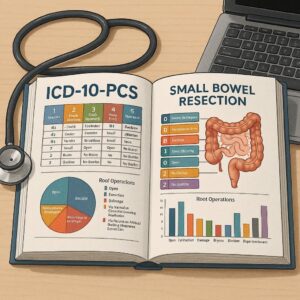
ICD-10-PCS coding for small bowel resection
2. Anatomy Refresher: Understanding the Landscape of the Small Bowel
Before a single character of a code can be assigned, one must intimately know the “geography” of the surgical field. The small bowel, or small intestine, is a marvel of digestive anatomy, a coiled tube approximately 20 feet long in adults, responsible for the vast majority of nutrient absorption.
It is subdivided into three continuous segments:
-
Duodenum: The short, C-shaped initial segment (about 10 inches long) that receives chyme from the stomach and secretions from the liver and pancreas. It is largely retroperitoneal.
-
Jejunum: The proximal two-fifths of the mobile small intestine. It lies in the left upper abdomen and is characterized by a thicker wall, more prominent plicae circulares (folds), and a richer blood supply compared to the ileum.
-
Ileum: The distal three-fifths of the mobile small intestine. It resides in the right lower abdomen and pelvis, has more lymphoid tissue (Peyer’s patches), and terminates at the ileocecal valve, where it connects to the cecum of the large intestine.
[Image: A detailed anatomical diagram of the abdominal cavity highlighting the duodenum, jejunum, and ileum, with key landmarks like the ligament of Treitz and ileocecal valve labeled.]
For ICD-10-PCS coding, this anatomical division is paramount. The system provides distinct body part values for each segment. Furthermore, the vascular and mesenteric attachments are crucial; a resection involves detaching the bowel from its mesentery, a structure that carries its blood supply. This anatomical fact is central to the definition of the root operation “Resection.”
3. Clinical Indications for Small Bowel Resection: Why is it Performed?
The decision to resect a portion of the small intestine is never trivial. It is a therapeutic intervention for a wide array of serious conditions:
-
Neoplasms: Both benign (e.g., adenomas, leiomyomas) and malignant (e.g., adenocarcinoma, carcinoid tumors, lymphoma) tumors.
-
Ischemia: Compromised blood flow leading to necrosis (tissue death), caused by arterial embolism, thrombosis, or venous occlusion.
-
Obstruction: Mechanical blockage from adhesions (most common), hernias, strictures (e.g., from Crohn’s disease), or volvulus (twisting).
-
Inflammatory Bowel Disease (Crohn’s Disease): Characterized by transmural inflammation, often requiring resection for strictures, fistulas, or refractory disease.
-
Trauma: Penetrating (gunshot, stab wounds) or blunt injury causing perforation or devascularization.
-
Congenital Anomalies: Meckel’s diverticulum, atresia, or malrotation.
-
Perforation: From any cause, including infection, ulceration, or iatrogenic injury.
The underlying indication often informs the surgical approach and extent of resection, which in turn dictates the ICD-10-PCS code.
4. The Surgical Spectrum: Techniques and Approaches
The classic image of a large midline incision (laparotomy) represents only one approach to small bowel resection. Today’s surgery offers a spectrum:
-
Open Approach: The traditional method via a laparotomy. It provides excellent exposure for complex cases, extensive disease, or trauma.
-
Laparoscopic Approach: Minimally invasive, using several small incisions for a camera and instruments. Benefits include less pain, shorter hospital stays, and faster recovery. It is the approach of choice for many elective resections.
-
Robotic-Assisted Laparoscopic Approach: A refinement of laparoscopy using a robotic surgical system, offering enhanced 3D visualization, precision, and instrument articulation.
-
Percutaneous Endoscopic Approach: Used less frequently for resection but may be relevant for certain diagnostic or adjunctive procedures.
The core steps of a resection, regardless of approach, are: 1) Identification and isolation of the diseased segment, 2) Ligation of its mesenteric blood supply, 3) Transection of the bowel proximal and distal to the disease, 4) Removal of the segment, and 5) Restoration of continuity via an anastomosis (rejoining the two ends) or creation of an ostomy.
5. Decoding ICD-10-PCS: The Foundation of Procedural Coding
ICD-10-PCS is a multi-axial, seven-character alphanumeric code. Each character has a specific meaning, and together they provide a highly detailed description of the procedure.
The Seven-Character Structure:
-
Character 1: Section (e.g., Medical and Surgical = 0)
-
Character 2: Body System (e.g., Gastrointestinal System = D)
-
Character 3: Root Operation (The objective of the procedure – e.g., Resection)
-
Character 4: Body Part (The specific site – e.g., Jejunum)
-
Character 5: Approach (How the site was accessed – e.g., Open)
-
Character 6: Device (What, if anything, was left in/on – e.g., No Device)
-
Character 7: Qualifier (Additional information – e.g., Diagnostic)
The Importance of the Medical Record: The operative report is the coder’s bible. Key phrases to look for include: “resection of,” “mobilized the mesentery,” “divided the bowel,” “stapled side-to-side functional end-to-end anastomosis,” “specimen sent to pathology,” and “closed in layers.” The indication and preoperative diagnosis are also vital for context.
6. The Heart of the Matter: Root Operations for Small Bowel Resection
This is the most critical conceptual step. The root operation defines the procedural goal.
Resection (Root Operation B)
-
Official Definition: “Cutting out or off, without replacement, all of a body part.”
-
Clinical Correlation: This is the most common root operation for a small bowel resection. The surgeon removes the entire segment of the duodenum, jejunum, or ileum. The key concept is that the body part (the segment of bowel) is completely removed. It is not replaced. The subsequent anastomosis rejoins the two remaining ends; it does not “replace” the resected segment. The anastomosis is considered an integral part of the resection procedure and is not coded separately.
-
PCS Guideline Reference: B3.10a clarifies that resection of a tubular body part (like intestine) is coded to the root operation “Resection,” regardless of whether an anastomosis is performed.
Excision (Root Operation B)
-
Definition: “Cutting out or off, without replacement, a portion of a body part.”
-
Clinical Correlation: This is used when only a portion of a body part is removed, not the whole thing. For the small bowel, this is less common but applies in specific situations. The classic example is the excision of a Meckel’s diverticulum. The diverticulum is a portion of the ileal wall. The surgeon cuts it off, but does not resect the entire ileal segment. The ileum remains, with a defect that is closed. Another example might be local excision of a small tumor from the bowel wall without a full segmental resection.
-
Key Distinction from Resection: Excision removes a portion of a body part. Resection removes the entire body part (the distinct anatomical segment).
Bypass (Root Operation 1)
-
Definition: “Altering the route of passage of the contents of a tubular body part.”
-
Clinical Correlation: This is used when the small bowel is not removed, but rather rerouted. A common scenario is a gastrojejunostomy for an inoperable duodenal obstruction (e.g., from pancreatic cancer). Here, the stomach (source) is connected to the jejunum (destination), bypassing the blocked duodenum. The duodenum remains in situ but is excluded from the alimentary stream. Small bowel-to-small bowel bypass (e.g., jejunoileal bypass) for obesity, though historical, is another example.
Other Relevant Operations:
-
Drainage (Root Operation 9): Taking/letting out fluids from a body part. May be used if an abscess is drained during the procedure.
-
Inspection (Root Operation J): Visually examining a body part. Often included in laparoscopic procedures as a diagnostic step.
-
Repair (Root Operation Q): Used for closing a perforation or defect without resection.
7. Building the Code: A Step-by-Step Character Analysis
Let’s construct a code using the ICD-10-PCS “building blocks.”
Step 1 & 2: Section and Body System (Characters 1 & 2)
For almost all small bowel resections, this will be 0D (Medical and Surgical Section, Gastrointestinal System).
Step 3: Root Operation (Character 3)
As discussed: B for Resection, B for Excision, or 1 for Bypass.
Step 4: Body Part (Character 4)
This requires precise identification from the operative report.
-
Duodenum:
5 -
Jejunum:
6 -
Ileum:
7 -
Ileocecal Valve:
8(if specifically identified) -
Small Intestine, specific segment not identified:
9
Step 5: Approach (Character 5)
-
Open:
0 -
Percutaneous Endoscopic:
3 -
Laparoscopic:
4(This is used for both straight laparoscopic and robotic-assisted procedures. Robotic assistance is captured in the Qualifier). -
Via Natural or Artificial Opening:
7(e.g., enteroscopy) -
Via Natural or Artificial Opening Endoscopic:
8
Step 6: Device (Character 6)
This is a crucial and often misunderstood character for bowel surgery.
-
No Device:
Z– This is used for Resection and Excision codes. Even though an anastomosis is performed, it is not considered a “device” in ICD-10-PCS. The anastomosis is an integral part of the resection procedure. The device character “Z” accurately reflects that no prosthetic device or material remains in the body part after the procedure is complete. The rejoined bowel is native tissue. -
Device Values for Other Operations: For a Bypass, you must code the specific type of anastomosis if it is documented. Common values include:
-
Bypass – Intestine to Intestine:
1(Bypass, Intestine to Intestine) -
Bypass – Stomach to Intestine:
2(Bypass, Stomach to Intestine)
-
Step 7: Qualifier (Character 7)
This adds specific detail.
-
No Qualifier:
Z(Routine procedure) -
Diagnostic:
X(if the primary purpose was diagnostic, e.g., resection of a segment for diagnosis of obscure bleeding) -
Robotic Assistance:
8(Used in conjunction with Approach4to denote use of a robotic surgical system)
ICD-10-PCS Code Components for Common Small Bowel Resection Scenarios
| Scenario Description | Root Operation | Body Part (Value) | Approach (Value) | Device | Qualifier | Example ICD-10-PCS Code |
|---|---|---|---|---|---|---|
| Open resection of ileum (e.g., for Crohn’s) | Resection (B) | Ileum (7) | Open (0) | No Device (Z) | Diagnostic (X) | 0DT70ZZ (Resection of Ileum, Open Approach, Diagnostic) |
| Lap. resection of jejunal tumor | Resection (B) | Jejunum (6) | Laparoscopic (4) | No Device (Z) | No Qualifier (Z) | 0DT64ZZ (Resection of Jejunum, Percutaneous Endoscopic Approach) |
| Robotic-assisted lap. resection of duodenum | Resection (B) | Duodenum (5) | Laparoscopic (4) | No Device (Z) | Robotic Assist (8) | 0DT54Z8 (Resection of Duodenum, Percutaneous Endoscopic Approach, Robotic Assisted) |
| Lap. excision of Meckel’s diverticulum | Excision (B) | Ileum (7) | Laparoscopic (4) | No Device (Z) | No Qualifier (Z) | 0DB64ZZ (Excision of Ileum, Percutaneous Endoscopic Approach) |
| Open gastrojejunostomy (bypass) | Bypass (1) | Stomach (Source) | Open (0) | Bypass Stomach to Intestine (2) | No Qualifier (Z) | 0D160ZA (Note: This code is from the stomach as the body system. Small bowel as destination.) |
Note: Bypass codes require careful identification of the source (body part character) and the qualifier often specifies the destination.
8. Common Coding Scenarios with Practical Examples
Let’s apply this knowledge to realistic operative notes.
Scenario 1: Laparoscopic Resection of Jejunal Tumor
-
Op Note Excerpt: “The patient was placed in supine position. Trocar sites were established. A mass was identified in the mid-jejunum. The mesentery to that segment was divided with a vascular stapler. The bowel was transected proximally and distally with a linear stapler. The segment was placed in a specimen bag and removed. A side-to-side functional end-to-end stapled anastomosis was created. The mesenteric defect was closed. Specimen sent to pathology.”
-
Coding Analysis:
-
What was done? The entire segment of jejunum containing the mass was removed. -> Root Operation: Resection (B)
-
Where? Jejunum. -> Body Part: Jejunum (6)
-
How? Via laparoscope. -> Approach: Laparoscopic (4)
-
Device? Anastomosis is integral, not a device. -> Device: No Device (Z)
-
Qualifier? Therapeutic resection. -> Qualifier: No Qualifier (Z)
-
-
Final Code: 0DT64ZZ (Resection of Jejunum, Percutaneous Endoscopic Approach)
Scenario 2: Open Resection of Necrotic Ileum with Temporary Ostomy
-
Op Note Excerpt: “Midline laparotomy revealed a segment of necrotic ileum due to a strangulated hernia. The necrotic segment was resected. The proximal end was brought out as a loop ileostomy (Rodin loop). The distal end was stapled off as a Hartmann’s pouch.”
-
Coding Analysis:
-
What was done? The entire necrotic ileal segment was removed. -> Resection (B)
-
Where? Ileum. -> Body Part: Ileum (7)
-
How? Via laparotomy. -> Approach: Open (0)
-
Device? No anastomosis was performed. An ostomy is not considered a “device” in the PCS sense for this root operation; it is the endpoint of the resection in this case. -> Device: No Device (Z)
-
Qualifier? Therapeutic. -> Qualifier: Z
-
-
Final Code: 0DT70ZZ (Resection of Ileum, Open Approach)
-
Important: The creation of the ileostomy is not coded separately from this resection. The root operation “Resection” includes the removal of the segment. The externalization of the bowel is considered part of the procedure’s outcome, not a separate objective.
-
Scenario 3: Laparoscopic Bypass for Inoperable Duodenal Obstruction
-
Op Note Excerpt: “Laparoscopy revealed an unresectable mass in the head of the pancreas causing duodenal obstruction. A laparoscopic antecolic gastrojejunostomy was performed using a linear stapler. The duodenum was left in situ.”
-
Coding Analysis:
-
What was done? The route of gastric contents was altered to bypass the duodenum. -> Root Operation: Bypass (1)
-
Where (Source)? The procedure is on the stomach to alter its outflow. -> Body System/Part: Stomach (0D1…) (We are now in the Upper GI table).
-
How? Laparoscopic. -> Approach: 4
-
Device? An anastomotic device (the stapled connection) was used to create the bypass. -> Device: Bypass, Stomach to Intestine (A) (Check the Stomach table for specific device values).
-
Qualifier? Therapeutic. -> Qualifier: Z
-
-
Final Code (from Stomach table): 0D164ZA (Bypass, Stomach to Jejunum, Percutaneous Endoscopic Approach)
Scenario 4: Excision of Meckel’s Diverticulum
-
Op Note Excerpt: “A Meckel’s diverticulum was identified on the antimesenteric border of the ileum, approximately 2 feet proximal to the IC valve. A diverticulectomy was performed by placing a linear stapler across the base of the diverticulum and firing. The ileal wall was intact, and no resection was needed.”
-
Coding Analysis:
-
What was done? A portion (the diverticulum) of the ileal wall was removed, not the entire ileal segment. -> Root Operation: Excision (B)
-
Where? The body part is the ileum, from which a portion was excised. -> Body Part: Ileum (7)
-
How? Open (implied if not stated as laparoscopic). -> Approach: Open (0)
-
Device? The staple line closing the ileum is not a device. -> Device: No Device (Z)
-
Qualifier? Therapeutic. -> Qualifier: Z
-
-
Final Code: 0DB70ZZ (Excision of Ileum, Open Approach)
9. Advanced Topics and Gray Areas
-
Multiple Segments: If contiguous segments of jejunum and ileum are resected together, code each distinct anatomical body part resection separately (e.g., 0DT64ZZ and 0DT74ZZ).
-
Lysis of Adhesions: This is almost always an integral part of gaining access to the abdominal cavity for the primary procedure. Per PCS Guidelines, it is not coded separately unless the lysis of adhesions is the sole procedure performed or is performed for a separately definable objective (e.g., to relieve a separate obstruction at a different site).
-
Robotic Assistance: Always captured in the Qualifier (8). The Approach remains Laparoscopic (4).
-
Concurrent Procedures: A concurrent cholecystectomy or liver biopsy during a small bowel resection should be coded separately, as each has a distinct objective and anatomical site.
10. The Compliance Imperative: Avoiding Common Errors and Audit Triggers
-
Confusing Resection with Excision: The most significant error. Using “Excision” for a full segmental resection misrepresents the procedure’s magnitude and can impact DRG assignment.
-
Incorrect Body Part: Assuming “small intestine” instead of identifying the specific segment (duodenum, jejunum, ileum).
-
Miscoding the Approach: Using “Open” for a laparoscopic case, or vice versa.
-
Incorrectly Coding the Anastomosis as a Device: Remember, for Resection and Excision, Device = Z.
-
Missing the Qualifier: Forgetting to add the “Robotic Assisted” (8) or “Diagnostic” (X) qualifier when applicable.
-
Coding Integral Procedures Separately: Coding lysis of adhesions or mesenteric defect closure separately from the main resection.
11. The Impact of Accurate Coding: From Reimbursement to Patient Care Analytics
Accurate ICD-10-PCS coding is not a clerical afterthought; it is a cornerstone of the healthcare ecosystem.
-
Reimbursement: Codes drive the assignment of Medicare Severity-Diagnosis Related Groups (MS-DRGs), which determine hospital payment. An inaccurate code can lead to underpayment or denial.
-
Quality Reporting & Analytics: Accurate procedural data is essential for tracking surgical outcomes, complication rates, and the effectiveness of different approaches (e.g., laparoscopic vs. open).
-
Public Health & Research: Coded data is aggregated to study disease trends, treatment patterns, and surgical volumes on a regional and national scale.
-
Operational Planning: Hospitals use this data to forecast resource needs, staff operating rooms, and manage supply chains.
12. Conclusion
Mastering the ICD-10-PCS coding for small bowel resection requires a synthesis of anatomical knowledge, surgical understanding, and meticulous attention to coding guidelines. By focusing on the root operation, precisely identifying the body part and approach, and correctly applying the device and qualifier characters, healthcare professionals can ensure the procedural narrative is accurately captured. This precision safeguards financial integrity, fuels vital healthcare analytics, and ultimately, contributes to a data-driven foundation for high-quality patient care.
13. Frequently Asked Questions (FAQs)
Q1: If a small bowel resection is performed laparoscopically but converted to open, which approach do I code?
A: Code the approach that accomplished the principal objective of the procedure. If the resection was completed via the open incision, you code Open Approach (0). There is no “converted” approach value.
Q2: How do I code a “small bowel resection” if the operative note just says “small bowel” and doesn’t specify jejunum or ileum?
A: Use the body part value for Small Intestine, specific segment not identified (9). However, a query to the surgeon for clarification is always the best practice to ensure the highest specificity.
Q3: Is the anastomosis technique (hand-sewn vs. stapled) specified in ICD-10-PCS?
A: No. ICD-10-PCS does not provide detail on the specific technique or materials used to perform the anastomosis. It only captures it as an integral part of the resection or, in the case of a bypass, as the “device” (the anastomotic connection itself).
Q4: Do I code the take-down of an old ostomy if I’m doing a resection and re-anastomosis at the same time?
A: The takedown of the ostomy (rejoining the bowel) is inherent in the new resection with anastomosis procedure. You would code only the new resection. The takedown itself is not a separately coded root operation in this context.
14. Additional Resources
-
CMS ICD-10-PCS Official Guidelines for Coding and Reporting: The definitive authority for coding rules and conventions. (https://www.cms.gov/)
Date: December 10, 2025
Author: Surgical Coding Specialist
Disclaimer: *This article is for informational and educational purposes only. It is not a substitute for professional medical coding advice, clinical guidance, or the official ICD-10-PCS coding guidelines. Always consult the most current official code sets and payer-specific policies for accurate coding.


