A complete blood count (CBC) is one of the most common diagnostic tests ordered in medicine. Among its key components is the white blood cell (WBC) count, a crucial sentinel of health and disease. When that count rises above the normal range—a condition termed leukocytosis—it triggers a cascade of clinical reasoning, diagnostic investigation, and administrative action. For the clinician, it is a potential clue pointing toward infection, inflammation, stress, or malignancy. For the medical coder, biller, and healthcare administrator, it is a discrete data point that must be accurately translated into the universal language of healthcare: the International Classification of Diseases, Tenth Revision, Clinical Modification (ICD-10-CM).
This article ventures far beyond a simple lookup for “ICD-10 code for leukocytosis.” It is a comprehensive, exhaustive exploration designed for medical coders, physicians, nurses, healthcare administrators, and students. We will dissect the pathophysiology of leukocytosis, master the nuanced hierarchy of the ICD-10-CM system as it applies to this finding, and examine the profound clinical stories that a simple elevated WBC count can tell. With a focus on clarity, accuracy, and practical application, this guide aims to be the definitive resource, ensuring that the bridge between clinical medicine and administrative precision is firmly built, one code at a time.
ICD-10-CM coding for leukocytosis
Chapter 1: Understanding Leukocytosis – A Deep Dive into White Blood Cell Physiology
Before a code can be assigned, the condition must be understood. Leukocytosis is not a disease; it is a laboratory abnormality, a sign of an underlying state. It is defined as a WBC count above the upper limit of the normal reference range, typically >11,000 cells/μL in adults, though ranges can vary by laboratory and age.
The Leukocyte Lineage:
White blood cells are the military of the immune system, produced primarily in the bone marrow. There are five main types, each with a specialized function:
-
Neutrophils: The first responders to bacterial infection and tissue injury.
-
Lymphocytes: The specialists in viral infection and adaptive immunity (B-cells and T-cells).
-
Monocytes: The “clean-up crew” that becomes macrophages, engulfing debris and pathogens.
-
Eosinophils: Key players in allergic reactions and parasitic infections.
-
Basophils: Involved in inflammatory and allergic responses, releasing histamine.
Leukocytosis can involve an increase in any one or a combination of these cell lines, a detail known as the differential count, which is critical for diagnosis.
Primary Pathophysiological Mechanisms:
-
Increased Bone Marrow Production: This is the most common mechanism, driven by cytokines and growth factors released in response to needs (e.g., infection, stress).
-
Increased Release from Bone Marrow Stores: The marrow holds a large reserve of mature neutrophils that can be mobilized rapidly.
-
Demargination: White cells normally cling to blood vessel walls (“marginated pool”). Stress, exercise, or epinephrine can cause them to detach and enter the circulating pool, causing a transient rise.
-
Reduced Egress from Circulation: If white cells cannot move into tissues effectively, their blood count rises.
-
Malignant Proliferation: In leukemia, a genetic mutation causes uncontrolled, clonal production of abnormal white cells.
Common Causes of Leukocytosis by Cell Type:
-
Neutrophilia (Most Common Type): Bacterial infections, inflammation (e.g., rheumatoid arthritis), tissue necrosis (e.g., myocardial infarction), physical/emotional stress, corticosteroid use, smoking, myeloproliferative neoplasms.
-
Lymphocytosis: Viral infections (e.g., mononucleosis, CMV), pertussis, chronic infections (e.g., TB), lymphocytic leukemias.
-
Monocytosis: Chronic infections (e.g., tuberculosis, subacute bacterial endocarditis), autoimmune diseases, malignancies, recovery from neutropenia.
-
Eosinophilia: Allergic disorders (asthma, hay fever), parasitic infections, drug reactions, certain cancers (e.g., Hodgkin lymphoma), eosinophilic syndromes.
-
Basophilia: Rare; seen in myeloproliferative neoplasms (e.g., chronic myeloid leukemia), hypothyroidism, allergic reactions.
Understanding this background is not academic—it directly informs the coder’s path. A diagnosis of “leukocytosis” without specification often leads to one code, but identifying it as “neutrophilia due to pneumonia” leads down a completely different, more precise coding pathway.
Chapter 2: The ICD-10-CM Coding System: A Primer for Healthcare Professionals
The ICD-10-CM is a massive, alphanumeric catalog of diseases, signs, symptoms, abnormal findings, and external causes of injury. It is used for morbidity classification, billing, reimbursement, epidemiology, and clinical research. Its structure is hierarchical and logical.
Key Structural Principles:
-
Chapters: Codes are grouped into 21 chapters based on etiology or body system (e.g., Chapter 1: Infectious Diseases, Chapter 2: Neoplasms).
-
Code Format: Codes are 3-7 characters long. The first three characters represent the category. The following characters (after a decimal) provide increasing specificity regarding etiology, anatomical site, severity, etc.
-
The Importance of Specificity: ICD-10-CM emphasizes laterality, severity, and causality. Using an unspecified code is often a last resort when more detailed information is not available in the medical record.
Where Does Leukocytosis Live?
Leukocytosis is classified in Chapter 3: Diseases of the blood and blood-forming organs and certain disorders involving the immune mechanism (D50-D89), specifically within the block D70-D77: Other disorders of blood and blood-forming organs. Its home is category D72: Disorders of white blood cells.
This placement is significant. It tells us that the system views leukocytosis primarily as a disorder of blood cell formation and function, even though it is usually a reactive process.
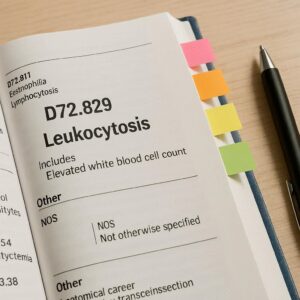
Chapter 3: The Primary Code: D72.829 – Leukocytosis, Unspecified
This is the code most directly associated with the term “leukocytosis.” Let’s dissect it:
-
D72: Disorders of white blood cells
-
D72.8: Other specified disorders of white blood cells
-
D72.82: Leukocytosis
-
D72.829: Leukocytosis, unspecified
When to Use D72.829:
This code is appropriate only when:
-
The medical record explicitly documents “leukocytosis” as a diagnosed condition.
-
The physician has not identified a specific cause for the leukocytosis, or the workup is still in progress.
-
The leukocytosis is not more specifically described as a particular type (e.g., lymphocytosis, neutrophilia). There are more specific codes for those (see below).
-
The leukocytosis is not a transient, expected finding (e.g., post-surgical, due to known corticosteroid therapy) that is already integral to the diagnosis of another condition.
Crucial Note: In many, if not most, clinical scenarios, leukocytosis is a symptom of a diagnosed underlying condition. Coding guidelines instruct that signs and symptoms that are integral to a disease process should not be assigned as additional codes. Therefore, if a patient has acute appendicitis (K35.2-) and the note mentions leukocytosis, you code only the appendicitis. The leukocytosis is a standard, expected component of that diagnosis. Using D72.829 in this case would be incorrect and could be considered “unbundling.”
Chapter 4: Specific Etiological Coding: When Leukocytosis is a Symptom, Not a Diagnosis
This is where coding becomes clinically intelligent. The astute coder must link the laboratory finding to the patient’s clinical picture.
Scenario-Based Coding Pathways:
1. Leukocytosis as an Integral Part of a Known Disease:
-
Patient with Pneumonia: Diagnosed with Streptococcal pneumonia (J15.3). Leukocytosis is a hallmark of bacterial infection. Code: J15.3 only.
-
Patient with Acute Myocardial Infarction: Diagnosed with Acute STEMI of anterior wall (I21.09). Tissue necrosis causes inflammation and leukocytosis. Code: I21.09 only.
-
Patient in Status Post-Splenectomy: The absence of the spleen, which filters blood, often leads to a chronic, mild leukocytosis. There is a specific code for this: D73.0 Postsplenectomy syndrome. This would be the primary code if this is the reason for the encounter.
2. Specific Types of Leukocytosis:
If the differential count is specified, more precise codes within D72.8 may be used:
-
Lymphocytosis (Absolute): D72.820
-
Lymphocytosis (Relative): Not typically coded alone; it’s a percentage.
-
Monocytosis: D72.824
-
Plasmacytosis: D72.825
-
Other specified disorders of white blood cells (e.g., may be used for documented neutrophilia or eosinophilia without further specification): D72.89
3. Leukocytosis of Known Drug-Induced Cause:
If a medication is definitively causing the leukocytosis, codes from Chapter 19 (Injury, poisoning) and Chapter 20 (External causes) are required.
-
Example: Drug-induced leukocytosis due to lithium therapy.
-
T43.592A: Poisoning by other antipsychotics and neuroleptics, intentional self-harm, initial encounter (Use appropriate poisoning code based on agent and intent).
-
Code from T36-T50: With 5th or 6th character 5 to identify the specific drug.
-
An external cause code (Y-series) may also be needed.
-
4. Leukocytosis as a Manifestation of a Malignancy:
This is critical. In leukemia, the leukocytosis is not a separate finding; it is the direct manifestation of the cancer.
-
Example: New diagnosis of Chronic Myeloid Leukemia (CML).
-
Code: C92.10 (Chronic myeloid leukemia, BCR/ABL-positive, not having achieved remission). You would NOT add D72.829.
-
ICD-10-CM Coding Decision Pathway for Leukocytosis
| Clinical Scenario | Documentation Key Words | Primary ICD-10-CM Code(s) | Rationale & Notes |
|---|---|---|---|
| Isolated Finding | “Leukocytosis,” “elevated WBC,” cause unknown/being evaluated | D72.829 (Leukocytosis, unspecified) | Used only when leukocytosis itself is the focus of care and no underlying cause is identified. |
| Specific Cell Type | “Lymphocytosis,” “Monocytosis,” “Neutrophilia” | D72.820 (Lymphocytosis) D72.824 (Monocytosis) D72.89 (Other specified…) |
Use when the differential is specified as the disorder, without a known underlying cause. |
| Underlying Acute Condition | “Acute cholecystitis with leukocytosis,” “Pneumonia with high WBC” | Code for the underlying condition (e.g., K81.0, J18.9). | Leukocytosis is an integral, expected symptom. Do NOT code separately. |
| Due to Medication | “Leukocytosis secondary to lithium,” “Drug-induced leukocytosis” | Poisoning code (T43.592A, etc.) + substance code. | Requires codes from Chapter 19 and 20. |
| Post-Splenectomy State | “Leukocytosis status post splenectomy” | D73.0 (Postsplenectomy syndrome) | This syndrome includes persistent leukocytosis. |
| Malignancy (Leukemia) | “Chronic Lymphocytic Leukemia,” “Acute Myeloid Leukemia” | Code for the specific leukemia (e.g., C91.10, C92.00). | The leukocytosis is the cancer manifestation. Never code D72.829 with a leukemia diagnosis. |
| Reactive to Stress | “Leukocytosis post-op day 1,” “Steroid-induced leukocytosis” | Usually not coded separately. Code the reason for the stress (surgery, steroid therapy condition). | Considered a transient, physiological response. |
Chapter 5: The Critical Role of Documentation in Accurate Coding
The physician’s documentation is the source of all truth in medical coding. Ambiguous notes lead to unspecified codes, denied claims, and lost revenue. Clear, precise documentation supports accurate, specific coding.
What Coders Need from Providers:
-
Specificity: Not just “leukocytosis,” but “neutrophilic leukocytosis” or “absolute lymphocytosis.”
-
Etiology: A clear statement linking the finding to a cause: “Leukocytosis likely secondary to the diagnosed cellulitis,” or “Leukocytosis of unclear etiology, to be monitored.”
-
Context: Is it chronic? New-onset? Changing? “Persistent leukocytosis over 3 visits” vs. “New leukocytosis on today’s labs.”
-
Plan: What is being done about it? “Will treat UTI, leukocytosis should resolve” vs. “Leukocytosis unexplained, refer to hematology.”
Querying the Physician:
If documentation is unclear, the coder must ask. A well-crafted query is a professional collaboration:
-
Poor Query: “Can you specify the leukocytosis?”
-
Effective Query: “The note documents leukocytosis with a WBC of 18,000 and a diagnosis of diverticulitis. To ensure accurate coding, can you clarify if the leukocytosis is an integral finding of the diverticulitis, or is it being evaluated as a separate unrelated condition?”
Chapter 6: Clinical Workup and Differential Diagnosis of Leukocytosis
To appreciate the coder’s task, one must understand the clinician’s thought process. The workup of leukocytosis is methodical.
1. History & Physical: Recent infections, fever, symptoms of inflammation, medication review, smoking history, history of splenectomy, or hematologic disorders.
2. Review of the CBC with Differential: This is the first critical step. Which cell line is elevated?
3. Peripheral Blood Smear: A hematologist or pathologist examines the blood cells for abnormalities in shape, size, and appearance (e.g., “left shift” = bandemia, or immature cells suggesting leukemia).
4. Additional Labs: Based on suspicion: blood cultures, inflammatory markers (CRP, ESR), viral panels, specific infection workups, vitamin B12/folate levels.
5. Imaging: Chest X-ray, CT scans to look for hidden sources of infection or malignancy.
6. Bone Marrow Biopsy: The definitive test if a primary bone marrow disorder like leukemia, myeloma, or myelodysplastic syndrome is suspected.
Each step in this workup refines the diagnosis, which in turn refines the ICD-10-CM code used.
Chapter 7: Case Studies in Coding Complexity
Case Study 1: The Post-Op Patient
-
Scenario: A 65-year-old female, post-op day 2 from a total hip replacement (Z48.3, aftercare). She is afebrile, wound clean, but routine CBC shows WBC 13,500. The surgeon notes: “Mild leukocytosis, likely post-operative stress response. Continue current care.”
-
Coding: Code Z48.3 (Aftercare following joint replacement surgery). Do NOT code D72.829. The leukocytosis is a documented, expected physiological response to surgery.
Case Study 2: The Patient with Multiple Conditions
-
Scenario: A 50-year-old male with known Rheumatoid Arthritis (M06.9) on chronic prednisone presents with cough and fever. CXR shows pneumonia. CBC shows WBC 22,000. The physician documents: “Community-acquired pneumonia, likely exacerbated by immunosuppression. Leukocytosis present. Will start antibiotics.”
-
Coding: Code J18.9 (Pneumonia, unspecified organism) as primary. Code M06.9 (Rheumatoid arthritis) as a chronic comorbidity. Do NOT code D72.829. The leukocytosis is an integral part of the acute pneumonia.
Case Study 3: The Hematology Referral
-
Scenario: A 40-year-old asymptomatic woman has a routine pre-op CBC showing a persistent WBC of 35,000 with a lymphocytosis. Her PCP notes: “Marked, persistent lymphocytosis, etiology unknown. No signs of infection. Refer to hematology for evaluation of possible lymphoproliferative disorder.”
-
Coding: This is a case where the leukocytosis/lymphocytosis is the reason for the encounter. Code D72.820 (Lymphocytosis). The note clearly indicates it is not due to an active infection. The hematology visit may later yield a more specific diagnosis (e.g., CLL).
Chapter 8: The Financial and Compliance Implications of Accurate Coding
Incorrect coding is not a victimless administrative error. It has real-world consequences.
-
Claim Denials: Insurers may deny payment for unspecified codes (D72.829) when a more definitive code is warranted, or for “unbundling” when coding a symptom integral to a larger diagnosis.
-
Audit Risk: Improper coding attracts scrutiny from Recovery Audit Contractors (RACs) and other auditors, leading to costly repayments and penalties.
-
Distorted Data: Public health data, disease tracking, and hospital funding models rely on accurate ICD-10 data. Inaccurate codes skew this vital information.
-
Compliance Violations: Consistently upcoding (using a more severe code) or downcoding can violate the False Claims Act, leading to severe legal and financial repercussions.
Chapter 9: The Future – ICD-11 and Beyond
The World Health Organization’s ICD-11 is already live. While the US has not yet set a transition date, its structure offers even greater detail. In ICD-11, leukocytosis is found under 3A70.0. The move to ICD-11 will demand continued education and adaptation from coding professionals, emphasizing the need to understand concepts, not just memorize codes.
Conclusion
Leukocytosis, a common laboratory sign, serves as a perfect case study in the intricate dance between clinical medicine and administrative precision. The accurate translation of this finding into ICD-10-CM code D72.829, or its more specific alternatives, hinges on a deep understanding of pathophysiology, rigorous clinical documentation, and strict adherence to coding guidelines. It is a process that demands vigilance, continuous learning, and a collaborative spirit between providers and coders to ensure patient care is properly documented, billed, and understood within the larger healthcare ecosystem.
Frequently Asked Questions (FAQs)
Q1: What is the direct ICD-10-CM code for leukocytosis?
A: The most direct code is D72.829, Leukocytosis, unspecified. However, this should only be used when leukocytosis is a standalone finding of unknown cause. Often, a more specific code or the code for the underlying condition is more appropriate.
Q2: When should I NOT use code D72.829?
A: Do not use D72.829 when: 1) The leukocytosis is a known, integral symptom of a diagnosed condition (e.g., infection, inflammation). Code the condition instead. 2) The type of leukocytosis is specified (use D72.820, D72.824, etc.). 3) It is due to a known cause like a drug (use poisoning codes) or post-splenectomy state (D73.0). 4) The patient has a hematologic malignancy like leukemia.
Q3: How does the “differential” WBC count affect coding?
A: If the medical record specifies the type of elevated white cell—such as “lymphocytosis” or “monocytosis”—you must use the more specific code (e.g., D72.820 for lymphocytosis) instead of the unspecified D72.829.
Q4: A patient has sepsis and a very high WBC. Do I code the leukocytosis?
A: No. In sepsis, leukocytosis (or sometimes leukopenia) is a key diagnostic criterion outlined in the systemic inflammatory response syndrome (SIRS) criteria. It is an integral part of the diagnosis of sepsis (coded from A41.9). You would only code the sepsis.
Q5: Where can I find official coding guidelines and updates?
A: The Centers for Medicare & Medicaid Services (CMS) and the American Hospital Association’s Central Office (AHA) jointly publish the official ICD-10-CM Guidelines for Coding and Reporting, updated annually. The National Center for Health Statistics (NCHS) is the US maintainer of the classification.
Additional Resources & References
-
Official Sources:
-
CDC/NCHS ICD-10-CM Official Guidelines: https://www.cdc.gov/nchs/icd/icd-10-cm.htm
-
CMS ICD-10 Provider Resources: https://www.cms.gov/medicare/coding/icd10
-
World Health Organization ICD-11 Browser: https://icd.who.int/browse11/l-m/en
-
-
Professional Organizations:
-
American Health Information Management Association (AHIMA): https://www.ahima.org
-
American Academy of Professional Coders (AAPC): https://www.aapc.com
-
Date: December 16, 2025
Author: Medical Coding & Clinical Education Team
Disclaimer: This article is for educational and informational purposes only. It is not a substitute for official ICD-10-CM coding guidelines, payer-specific policies, or professional clinical or coding advice. Always consult the most current official guidelines and the patient’s complete medical record to make final coding decisions.