In the intricate world of healthcare, where patient care meets administrative necessity, few scenarios demand as much precision and clinical understanding as coding for a surgical abdomen. At the heart of many acute abdominal emergencies lies the small bowel obstruction (SBO). For the clinician, it is a race against time—a battle against distension, ischemia, and potential perforation. For the medical coder, it is a complex puzzle where every documented detail—the “why,” the “what,” and the “how”—translates into a specific alphanumeric code that tells the patient’s story to payers, researchers, and quality registries.
An erroneous code is not merely a clerical error. Coding “unspecified ileus” (K56.7) when the record clearly describes a “post-laparotomy adhesive small bowel obstruction” (K56.5) does a disservice. It obscures the true morbidity of surgical complications, skews hospital quality data, and can directly impact reimbursement. This article aims to bridge the clinical and coding domains, offering an exhaustive, professionally detailed guide exceeding 10,000 words on ICD-10-CM coding for SBO. We will dissect the anatomy, unravel the pathophysiology, and, most importantly, provide a masterclass in navigating the nuanced code set from K56.0 to K56.7. This is not just about looking up a code; it’s about understanding the clinical narrative it represents.
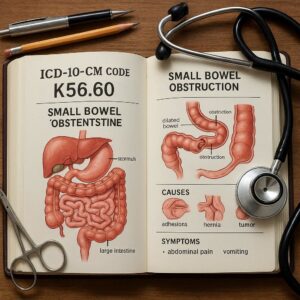
ICD-10-CM code for small bowel obstruction
2. Anatomy and Physiology of the Small Bowel: A Primer for Coders
To code accurately, one must first understand the terrain. The small intestine, a coiled tube approximately 20 feet long, is the central organ for nutrient absorption. It is divided into three contiguous segments:
-
Duodenum: The short, C-shaped initial segment receiving chyme from the stomach and secretions from the pancreas and liver.
-
Jejunum: The primary site of nutrient absorption, constituting the proximal two-fifths of the mobile small bowel.
-
Ileum: The distal three-fifths, responsible for absorbing vitamin B12 and bile salts, terminating at the ileocecal valve.
This anatomical continuity is crucial. An obstruction at any point halts the aboral (forward) movement of intestinal contents, leading to the classic sequelae of proximal distension, fluid sequestration, and eventual compromise of the bowel wall. The mesentery, a fan-shaped fold of peritoneum, carries the blood supply (superior mesenteric artery) and nerves to the jejunum and ileum. When the bowel twists (volvulus) or becomes entrapped (hernia), the mesentery is compressed, leading to the dreaded complication of strangulation—a surgical emergency coded distinctly from simple mechanical obstruction.
3. The Pathophysiology of Small Bowel Obstruction: Mechanics, Strangulation, and Ileus
SBO is not a single disease but a final common pathway for multiple disorders. Coders must recognize three fundamental pathophysiologic types:
A. Mechanical Obstruction: A physical blockage. This is further subdivided:
-
Luminal: Obstruction from within the bowel (e.g., gallstones, bezoars, tumors).
-
Intrinsic: Disease of the bowel wall itself (e.g., Crohn’s disease stricture, malignancy).
-
Extrinsic: External compression or tethering of the bowel (e.g., adhesions, hernias, carcinomatosis).
B. Strangulating Obstruction: A progression of mechanical obstruction where the blood supply is compromised. This leads to ischemia, necrosis, and perforation within hours. Time-to-intervention is critical, and coding must reflect this severity. Strangulation is often, but not always, implied by terms like “ischemic bowel,” “necrotizing enteritis,” or “compromised vasculature.”
C. Functional Obstruction (Ileus): A failure of motility without a mechanical lesion. The bowel is paralyzed. Common causes include postoperative states (especially after abdominal surgery), electrolyte imbalances, infections, medications (opioids), and spinal injuries. The key distinction for coding is the absence of a mechanical cause.
Understanding this triad is the first step in selecting the correct code family.
4. Clinical Presentation and Diagnostic Journey of SBO
The clinical picture informs the documentation, which in turn dictates the code. A typical high-grade SBO presents with:
-
Symptoms: Colicky periumbilical pain, vomiting (often bilious then feculent), absolute constipation (obstipation), and abdominal distension.
-
Signs: Abdominal tenderness, high-pitched “tinkling” bowel sounds, signs of dehydration.
-
Diagnostics:
-
Imaging: Abdominal X-ray shows dilated loops of small bowel with air-fluid levels. CT scan of the abdomen/pelvis is the gold standard, identifying the transition point, suggesting the cause (e.g., “beak sign” in volvulus, “fat notch sign” in adhesions), and detecting signs of ischemia (pneumatosis, portal venous gas).
-
Labs: Elevated white blood cell count, lactic acidosis (suggests strangulation), and electrolyte derangements.
-
The radiologist’s report and the surgeon’s operative note are goldmines of information for the coder, containing the specific descriptors needed for precise code assignment.
5. The Cornerstone of Coding: Documentation Requirements
The physician’s documentation is the sole source of truth for the coder. Key questions the documentation must answer:
-
Type: Is it mechanical or functional (ileus)?
-
Cause: If mechanical, what is the specific etiology? Adhesions, hernia, malignancy, volvulus, intussusception?
-
Location: Is it specifically the small bowel? (Codes for large bowel obstruction are in the K56.3-K56.5 range).
-
Severity/Complication: Is there any mention of ischemia, necrosis, strangulation, or perforation? These may require additional complication codes.
-
Laterality: For hernias causing obstruction, is it inguinal, femoral, umbilical, etc., and is it unilateral? Hernia codes (K40-K46) are often used as the primary code with an obstruction code secondary.
-
Acuity: Is it acute, chronic, or recurrent?
Coders must be trained to query physicians for clarification when documentation is ambiguous, e.g., “ileus” without specification (postoperative vs. other).
6. ICD-10-CM Coding for Small Bowel Obstruction: A Deep Dive
Here we explore the specific codes within the K56 category, focusing on small bowel.
6.1 Code K56.0 – Paralytic Ileus
-
Definition: Functional obstruction due to failure of peristalsis. No mechanical blockage exists.
-
Documentation Clues: “Postoperative ileus,” “opiate-induced ileus,” “ileus due to hypokalemia,” “adynamic ileus.”
-
Key Consideration: If the ileus occurs immediately after surgery, it is often considered an integral part of the postoperative course. However, if it is prolonged or a primary reason for readmission/enhanced care, K56.0 is assigned. Do not use for mechanical obstruction.
6.2 Code K56.1 – Intussusception
-
Definition: A “telescoping” of a proximal segment of bowel (intussusceptum) into a distal segment (intussuscipiens). Common in children (often idiopathic) but in adults is usually “tumor-led” (a polyp or malignancy acting as the lead point).
-
Documentation Clues: “Intussusception,” “telescoping bowel,” often seen on CT or ultrasound as a “target sign.”
-
Note: In adults, you will often code both the intussusception and the underlying neoplasm (C17.-, D37.2) if identified.
6.3 Code K56.2 – Volvulus
-
Definition: A twist of a loop of bowel on its mesentery, causing both obstruction and vascular compromise. In the small bowel, this often involves the midgut and is a surgical emergency.
-
Documentation Clues: “Volvulus,” “twisted bowel,” “midgut volvulus.” Imaging may describe a “whirl sign” or “beak sign.”
-
Note: Code also any associated condition like malrotation (Q43.3).
6.4 Code K56.5 – Intestinal Adhesions [Bands] with Obstruction
-
This is the most common code for SBO in adults. Post-surgical adhesions are the leading cause.
-
Definition: Obstruction caused by fibrous bands (adhesions) from prior surgery, infection, or inflammation.
-
Documentation Clues: “Adhesive SBO,” “SBO due to adhesions,” “band obstruction.” The operative note might state “lysis of adhesions.”
-
Critical Point: The documentation must explicitly link the obstruction to adhesions. Do not assume. If the record just says “SBO,” you cannot default to K56.5.
6.5 Code K56.69 – Other Specified Intestinal Obstruction
-
This is a catch-all for mechanical obstructions with a known cause not represented by the previous specific codes.
-
Common Uses: Gallstone ileus (a fistula between gallbladder and bowel allows a large stone to obstruct, typically at the ileocecal valve). Obstruction due to Crohn’s disease stricture (code first K50.0- for Crohn’s). Obstruction due to a bezoar (foreign material mass). Obstruction from peritoneal carcinomatosis.
-
Documentation Clues: The cause is specified but doesn’t have its own code under K56.
6.6 Code K56.7 – Ileus, unspecified
-
Use with Extreme Caution. This is for when the physician documents “ileus” but does not specify paralytic (functional) vs. mechanical, and no further clinical information allows clarification.
-
Best Practice: This should be a driver for a physician query. Is it postoperative paralytic ileus (K56.0)? Is it an adhesive obstruction (K56.5)? K56.7 is a last resort.
7. ICD-10-CM Code Set for Small Bowel Obstruction
| ICD-10-CM Code | Code Description | Clinical Scenario & Documentation Keywords | Key Notes & Sequencing Instructions |
|---|---|---|---|
| K56.0 | Paralytic ileus | Postoperative ileus, adynamic ileus, opiate-induced ileus, ileus due to electrolyte imbalance. | Assigned only for functional obstruction. Not for mechanical causes. |
| K56.1 | Intussusception | Intussusception, telescoping bowel. Often with “lead point” in adults. | In adults, code first any underlying neoplasm (C17.-, D37.2). |
| K56.2 | Volvulus | Volvulus, twisted bowel, midgut volvulus. Often acute with severe pain. | Consider associated malrotation (Q43.3). A strangulation risk. |
| K56.5 | Intestinal adhesions [bands] with obstruction | Adhesive small bowel obstruction (SBO), SBO due to postsurgical adhesions, band obstruction. | Must have explicit link in documentation. Most common cause of SBO. |
| K56.69 | Other specified intestinal obstruction | Gallstone ileus, bezoar obstruction, obstruction due to Crohn’s stricture, carcinomatosis. | Use for known mechanical causes not listed above. Often requires a primary code for the underlying condition. |
| K56.7 | Ileus, unspecified | Documented “ileus” with no further specification as to type or cause. | Low-specificity code. Use only after thorough record review and if query is not possible. |
*(Graphic: A flowchart for coding SBO. Start: “Documented Small Bowel Obstruction.” Decision 1: “Mechanical or Functional?” If Functional -> K56.0. If Mechanical -> Decision 2: “Specific Cause Known?” If Yes -> Choose from K56.1, K56.2, K56.5, K56.69. If No -> Query Physician. If no answer, then -> K56.7.)*
8. Navigating Postoperative Obstructions and Complications
Coding for SBO in the postoperative period requires careful attention to timing and etiology.
-
Early Postoperative Ileus (within 3-7 days): Often considered a normal part of recovery. If it is the reason for prolonging the stay or requiring specific intervention, code K56.0 (Paralytic ileus). Also, code a complication code from T81.83- (Other complications of procedures) to indicate the postprocedural nature.
-
Postoperative Adhesive SBO (days to years later): This is not a complication of the recent surgery but a late effect of a past surgery. Code K56.5. Do not use a T81.83- code here unless the adhesion/obstruction is a direct result of a very recent procedure (e.g., occurring during the same admission).
-
Strangulation/Perforation: If the SBO progresses to bowel necrosis or perforation, you must add an additional code for the complication:
-
Perforation: K63.1 (Perforation of intestine)
-
Acute vascular insufficiency/ischemia: K55.0 (Acute vascular disorders of intestine)
-
Peritonitis: K65.0 (Generalized peritonitis)
-
9. Real-World Coding Scenarios and Case Studies
Case 1: A 65-year-old male with a history of open appendectomy 20 years ago presents with 24 hours of cramping pain, vomiting, and distension. CT shows a transition point in the mid-ileum with a “fat notch sign,” consistent with adhesive band. Admitted for nasogastric decompression.
-
Diagnosis: Acute small bowel obstruction due to post-surgical adhesions.
-
Code: K56.5
Case 2: A 70-year-old female presents with intermittent obstruction. CT shows a small bowel intussusception. During surgery, a jejunal polyp is found to be the lead point. Pathology returns as a benign adenoma.
-
Primary Diagnosis: Benign neoplasm of jejunum causing intussusception.
-
Coding: D13.2 (Benign neoplasm of small intestine) is sequenced first, followed by K56.1 (Intussusception).
Case 3: A patient is 3 days post-op total colectomy. He has absent bowel sounds, abdominal distension, and is not passing flatus. The surgeon diagnoses “postoperative ileus” and holds feeds.
-
Diagnosis: Paralytic ileus following digestive system surgery.
-
Coding: K56.0, T81.83XA (Other complications of procedures, initial encounter).
10. The Impact of Accurate SBO Coding on Reimbursement and Quality Metrics
Inaccurate SBO coding has tangible consequences:
-
MS-DRG Assignment: A case of “unspecified ileus” (K56.7) may group to a simpler, lower-weighted Medical-Surgical DRG. The same case correctly coded as “adhesions with obstruction” (K56.5) and “acute renal failure” (due to dehydration) may group to a more complex DRG with significantly higher reimbursement, justified by the greater resource use.
-
Quality Reporting: Hospitals are graded on complication rates (e.g., postoperative sepsis, respiratory failure). Miscoding a present on admission adhesive SBO as a postoperative complication incorrectly inflates the hospital’s complication rate, harming its public reporting and performance scores.
-
Research and Public Health: Aggregated coded data is used for research on disease prevalence and treatment outcomes. Nonspecific codes (K56.7) muddy the data, making it harder to study the true impact and best treatments for specific SBO types like adhesions.
11. Common Documentation Pitfalls and How to Avoid Them
-
Pitfall 1: The discharge summary states “SBO” without an etiology.
-
Action: Query the physician. Review the CT report and operative note (if applicable). The cause is almost always identified in these documents.
-
-
Pitfall 2: The surgeon documents “lysis of adhesions” but the diagnosis list says “ileus.”
-
Action: The procedure implies a mechanical cause. A query can confirm: “Can the ileus/SBO be attributed to adhesions?” to assign K56.5.
-
-
Pitfall 3: The record mentions “possible ileus” or “ileus vs. obstruction.”
-
Action: Query for a definitive diagnosis. Do not code uncertain diagnoses in the inpatient setting except under very specific circumstances (per ICD-10-CM guidelines).
-
-
Pitfall 4: The coder defaults to K56.5 (adhesions) because it’s most common.
-
Action: This is incorrect without documentation support. You must code what is documented.
-
12. Conclusion: The Art and Science of SBO Coding
Mastering ICD-10-CM coding for small bowel obstruction transcends mere code lookup. It demands a foundational grasp of gastrointestinal anatomy and pathology, a meticulous eye for clinical detail within the medical record, and the analytical skill to map that narrative precisely to the K56 code family. From the functional paralysis of K56.0 to the specific mechanical causes of K56.1, K56.2, K56.5, and K56.69, each code tells a distinct clinical story with significant implications for patient care analytics, hospital reimbursement, and healthcare quality measurement. The coder, therefore, acts as an essential translator, ensuring the language of medicine is accurately converted into the data that drives modern healthcare.
13. Frequently Asked Questions (FAQs)
Q1: What is the default code for small bowel obstruction?
A: There is no true “default.” You must code based on documented etiology. If only “small bowel obstruction” is documented without cause, you may need to query. The unspecified code K56.7 (Ileus, unspecified) should be a last resort.
Q2: How do I code a hernia causing a small bowel obstruction?
A: The hernia code (from K40-K46) is usually sequenced as the principal diagnosis, as it is the underlying cause. You then add an additional code for the obstruction, which will typically be K56.69 (Other specified intestinal obstruction) unless the hernia has caused a volvulus (K56.2) or another specific condition. Always follow coding guidelines for hernia with obstruction.
Q3: What is the difference between K56.0 (Paralytic ileus) and K56.7 (Ileus, unspecified)?
A: K56.0 is used when the physician has determined the ileus is functional/paralytic (no mechanical block). K56.7 is used when the physician simply documents “ileus” without specifying the type, and you cannot determine from the record whether it is paralytic or mechanical.
Q4: When do I use a complication code (T81.83-) with an SBO code?
A: Use a T81.83- code when the obstruction/ileus is a direct complication of a procedure performed during the current encounter. For example, a paralytic ileus prolonging the hospital stay after a colectomy. Do not use it for an adhesive SBO from surgery performed years ago.
Q5: How do I code a small bowel obstruction with perforation?
A: You will code both the obstruction (based on its etiology, e.g., K56.5) and the perforation (K63.1, Perforation of intestine). The perforation code is added as an additional diagnosis.
14. Additional Resources and References
-
The Official Source: ICD-10-CM Official Guidelines for Coding and Reporting FY 2026. (Centers for Medicare & Medicaid Services and the National Center for Health Statistics).
-
Clinical Reference: Townsend, C. M., Beauchamp, R. D., Evers, B. M., & Mattox, K. L. (2021). Sabiston Textbook of Surgery: The Biological Basis of Modern Surgical Practice (21st ed.). Elsevier. (Chapter on Small Bowel Obstruction).
-
Coding Education: American Health Information Management Association (AHIMA) – www.ahima.org. (Offers credentials, webinars, and articles on advanced coding topics).
-
American College of Surgeons (ACS): Clinical resources and quality programs often address surgical complications like SBO.
-
Radiology Reference: Radiopaedia.org – “Small Bowel Obstruction.” (An excellent resource for understanding the imaging findings that inform clinical documentation).