In the intricate landscape of modern healthcare, few conditions exemplify the necessity of precise, interdisciplinary communication as vividly as neurogenic bladder. It is a disorder that sits at a complex crossroads, where the delicate electrical pathways of the nervous system dictate the function of the muscular reservoir of the urinary bladder. When this communication fails, the consequences are more than clinical; they are profoundly personal, affecting dignity, independence, and quality of life. For the clinician, the challenge is diagnosis and management. For the medical coder and billing specialist, the challenge is translating this multifaceted clinical picture into a precise alphanumeric language: the International Classification of Diseases, Tenth Revision, Clinical Modification (ICD-10-CM).
Accurate coding for neurogenic bladder is not a mere administrative formality. It is a critical linchpin in the healthcare ecosystem. It drives appropriate reimbursement, ensuring healthcare facilities have the resources to provide necessary care. It fuels vital clinical research and epidemiological tracking, helping us understand the prevalence and impact of neurological diseases. It ensures compliance with a web of regulatory requirements, protecting both provider and patient. An incorrect code can trigger claim denials, audit flags, and even allegations of fraud, while simultaneously muddying the data essential for advancing medical science.
This article is designed as a definitive, exhaustive guide to ICD-10-CM coding for neurogenic bladder. Aimed at medical coders, health information management (HIM) professionals, clinical documentation integrity (CDI) specialists, and treating clinicians who wish to understand the coding implications of their work, we will delve deep. We will move beyond simple code lookup tables to explore the “why” behind the codes. We will dissect the pathophysiology that informs code structure, analyze complex documentation to extract key details, and navigate the nuanced rules that govern combination coding and sequencing. By the end of this guide, you will possess not just a list of codes, but a sophisticated framework for accurately and confidently classifying neurogenic bladder in any clinical scenario.
ICD-10-CM Code for Neurogenic Bladder
2. Understanding Neurogenic Bladder: Pathophysiology and Clinical Significance
To code a condition accurately, one must first understand it. Neurogenic bladder, also known as neurogenic lower urinary tract dysfunction (NLUTD), is not a single disease but a spectrum of voiding dysfunctions caused by an interruption of the neural pathways that control bladder storage and emptying.
The Neurological Control Centers:
Normal bladder function relies on a sophisticated, hierarchical control system:
-
The Spinal Cord (Sacral Micturition Center, S2-S4): Acts as a primary reflex center. When the bladder fills, stretch signals are sent here, which can trigger a voiding reflex via the pelvic nerve.
-
The Brainstem (Pontine Micturition Center): Serves as the major switch. It coordinates the relaxation of the urethral sphincter with the contraction of the detrusor muscle for efficient voiding.
-
The Cerebral Cortex (Frontal Lobe): Provides voluntary, inhibitory control over the brainstem and spinal reflexes. This is what allows us to decide when and where to void.
Classification by Dysfunction:
Damage at any level of this system leads to predictable patterns of dysfunction:
-
Suprasacral Lesions (Above the Sacral Spinal Cord): Examples include spinal cord injury above T12, multiple sclerosis, stroke, and Parkinson’s disease. These lesions typically disconnect the bladder from the brain’s inhibitory control, leaving the sacral reflex arc intact but unmoderated. This results in a hyperreflexic, overactive bladder (detrusor overactivity) that contracts involuntarily, often against a closed or dyssynergic sphincter (detrusor-sphincter dyssynergia – DSD), causing high bladder pressures, incontinence, and significant risk of kidney damage.
-
Sacral/Infrasacral Lesions: Examples include cauda equina syndrome, diabetic cystopathy, pelvic surgery (e.g., radical prostatectomy), and spina bifida. Damage to the sacral cord, conus medullaris, or peripheral nerves destroys the reflex arc itself. This leads to an areflexic, underactive bladder (detrusor underactivity). The bladder becomes flaccid, distended, and loses sensation, leading to urinary retention, overflow incontinence, and recurrent infections.
Clinical Impact: The ramifications extend far beyond urinary symptoms. Patients face recurrent urinary tract infections, nephrolithiasis (kidney stones), vesicoureteral reflux (causing renal scarring), and ultimately, chronic kidney disease. The psychosocial burden—anxiety, depression, social isolation—is immense. Management is lifelong and may involve anticholinergic/beta-3 agonist medications, clean intermittent catheterization (CIC), indwelling catheters, neuromodulation (e.g., sacral nerve stimulation), or major reconstructive surgery.
3. The ICD-10-CM Coding System: A Primer on Structure and Logic
ICD-10-CM is a detailed, alphanumeric system of over 70,000 codes used to report diagnoses and reasons for encounters. Its structure is logical and hierarchical.
-
Chapters: Codes are grouped into chapters based on etiology or body system (e.g., Chapter 6: Diseases of the Nervous System; Chapter 14: Diseases of the Genitourinary System).
-
Categories: The first three characters represent the category (e.g., N31 for “Neuromuscular dysfunction of bladder”).
-
Subcategories & Codes: Characters four through six provide increasing specificity regarding etiology, anatomic site, or severity (e.g., N31.0, N31.2).
-
The 7th Character: Used for certain categories (primarily injuries and external causes) to denote encounter type (initial, subsequent, sequela). It is not typically used for neurogenic bladder codes themselves but may be required for the underlying cause (e.g., spinal cord injury).
Coding Conventions:
-
“Code first” notes: Indicate the underlying disease should be sequenced before the manifestation (e.g., code first the spinal cord injury, then the neurogenic bladder).
-
“Use additional code” notes: Instruct to add a code for a related condition or etiology.
-
Excludes1: Means “NOT CODED HERE”—the conditions are mutually exclusive.
-
Excludes2: Means “NOT INCLUDED HERE”—the condition is not part of the code, but both can be coded if present.
4. Deconstructing the Neurogenic Bladder Code Family: N31
All neurogenic bladder codes reside within Chapter 14 (Diseases of the Genitourinary System), block N30-N39 (Other diseases of the urinary system), specifically under category N31 – Neuromuscular dysfunction of bladder, not elsewhere classified.
It is crucial to note the parent code Excludes1 notes: neurogenic bladder due to cauda equina syndrome (G83.4) and psychogenic disorders of bladder function (F45.8). These must be coded to their respective categories, not N31.
The N31 subcategories are:
-
N31.0 – Uninhibited neurogenic bladder, not elsewhere classified
-
N31.1 – Reflex neurogenic bladder, not elsewhere classified
-
N31.2 – Flaccid neurogenic bladder, not elsewhere classified
-
N31.8 – Other neuromuscular dysfunction of bladder
-
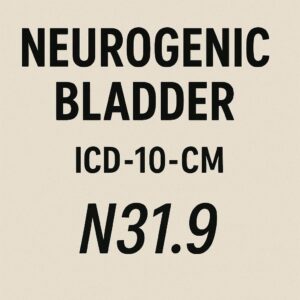
N31.9 – Neuromuscular dysfunction of bladder, unspecified
5. The Foundation: N31.9 – Unspecified Neurogenic Bladder
N31.9 is the most general code. It is used when the medical documentation states “neurogenic bladder” but does not specify the type (hyperreflexic/uninhibited vs. flaccid) or when the type cannot be determined from the available record.
-
Clinical Context: Often used in initial encounters before urodynamic studies are completed, or in general practice notes where the specific neurology has not been detailed.
-
Coding Guidance: While sometimes necessary, this code is less desirable from a compliance and specificity standpoint. CDI initiatives should focus on prompting clinicians to specify the type.
6. The Hyperreflexic State: N31.0 – Uninhibited Neurogenic Bladder
N31.0 describes a bladder with detrusor overactivity due to a neurological cause where the sacral reflex arc is intact but supra-sacral inhibitory control is lost. Key terms in documentation that point to N31.0 include:
-
Uninhibited neurogenic bladder
-
Hyperreflexic bladder
-
Neurogenic detrusor overactivity (NDO)
-
Spastic neurogenic bladder
-
Automatic bladder (in context of spinal cord injury)
-
Documentation of detrusor-sphincter dyssynergia (DSD)
Common Etiologies to Code First: Multiple sclerosis (G35), spinal cord injury (S14, S24, S34 series), Parkinson’s disease (G20), cerebrovascular accident (I63.-), brain tumor (D43.-, C71.-).
7. The Areflexic State: N31.2 – Flaccid Neurogenic Bladder
N31.2 describes a bladder with detrusor underactivity or acontractility due to a neurological cause where the sacral reflex arc or peripheral innervation is damaged. Key terms include:
-
Flaccid neurogenic bladder
-
Areflexic bladder
-
Neurogenic detrusor underactivity
-
Atomic bladder (when neurologic)
-
Non-reflex neurogenic bladder
Common Etiologies to Code First: Cauda equina syndrome (G83.4 – Note: This is an Excludes1 from N31, so code only G83.4, not N31.2 ), diabetic autonomic neuropathy (E08-E13 with .43), spina bifida (Q05.-), post-radical pelvic surgery (coded as a complication, e.g., N99.82).
8. Specifying the Cause: The Imperative of Etiology Coding
This is the most critical step for accurate coding of neurogenic bladder. ICD-10-CM mandates coding the underlying neurological condition. Neurogenic bladder is almost always a manifestation of a primary disease.
Coding Structure: The sequencing follows the “code first” notes.
Sequence: [Underlying Neurological Etiology Code] + [Specific N31.x Code]
Common Etiologies and Corresponding ICD-10-CM Codes for Neurogenic Bladder
| Underlying Etiology | ICD-10-CM Code for Etiology | Likely Neurogenic Bladder Type (N31.x) | Coding Notes & Sequencing |
|---|---|---|---|
| Multiple Sclerosis | G35 | N31.0 (Hyperreflexic) | Code first G35, then N31.0. |
| Spinal Cord Injury, Thoracic Level | S24.1- -, S24.0- – | N31.0 (Hyperreflexic) | Code first the specific SCI code (7th char required), then N31.0. |
| Cerebrovascular Accident (Stroke) | I63.- | N31.0 (Hyperreflexic) | Code first the specific I63 code, then N31.0. |
| Parkinson’s Disease | G20 | N31.0 (Hyperreflexic) | Code first G20, then N31.0. |
| Cauda Equina Syndrome | G83.4 | Flaccid (but DO NOT use N31.2) | Code only G83.4. It Excludes1 neurogenic bladder classified to N31. |
| Diabetic Polyneuropathy | E11.42 (Type 2) | N31.2 (Flaccid) | Code first the diabetes code (E11.42), then N31.2. |
| Spina Bifida (Myelomeningocele) | Q05.- | Varies (Often mixed) | Code first Q05.-, then the appropriate N31.x based on doc. |
| Post-Operative (Radical Prostatectomy) | N99.82 | N31.2 (Flaccid) | Code N99.82 (Postprocedural bladder dysfunction). This is used instead of N31.x for iatrogenic causes. |
9. Documenting for Accuracy: Bridging Clinical Language and Code Selection
Clear clinical documentation is the raw material of accurate coding. Coders cannot interpret or assume.
What Clinicians Should Document:
-
Specific Type: “Patient with flaccid neurogenic bladder secondary to diabetic autonomic neuropathy.”
-
Clear Etiology: “Neurogenic detrusor overactivity due to multiple sclerosis.”
-
Urodynamic Findings: “Urodynamics confirm detrusor-sphincter dyssynergia with high voiding pressures, consistent with spinal reflex bladder.” (Points to N31.0).
-
Avoid Vague Terms: Simply “neurogenic bladder” or “bladder dysfunction” forces the use of the unspecified code (N31.9).
The CDI Professional’s Role: Query the provider when documentation is unclear: “Can you specify the type of neurogenic bladder (e.g., hyperreflexic/uninhibited or flaccid/areflexic) and its confirmed or suspected etiology?”
10. Advanced Coding Scenarios and Case Studies
Case Study 1: The Patient with Advanced MS
*A 48-year-old female with longstanding multiple sclerosis presents for urodynamics for worsening urgency incontinence. Urodynamic report states: “Neurogenic detrusor overactivity with impaired bladder compliance. No detrusor-sphincter dyssynergia noted.” The clinician’s assessment is “Neurogenic overactive bladder from MS.”*
-
Analysis: Etiology is clear (MS). The documentation, while using “overactive bladder,” specifies it is “neurogenic” and “from MS.” Urodynamics confirm detrusor overactivity. This aligns with hyperreflexic dysfunction.
-
Codes: G35 (Multiple sclerosis), N31.0 (Uninhibited neurogenic bladder).
Case Study 2: Post-SCI Management
*A 32-year-old male, status post T6 complete spinal cord injury 1 year ago, presents for routine follow-up. He manages with intermittent catheterization. Note states: “Patient with neurogenic bladder, spastic type, secondary to traumatic SCI. No UTIs currently.”*
-
Analysis: Etiology is traumatic SCI at T6 (“spastic type” indicates hyperreflexia). We need the specific SCI code.
-
Codes: S24.149A (Other injury at T6 level, initial encounter for injury sequela – using appropriate 7th char) N31.0 (Uninhibited neurogenic bladder).
Case Study 3: Diabetic Complications
*A 70-year-old male with uncontrolled type 2 diabetes presents with difficulty voiding and feeling of incomplete emptying. Post-void residual is 450mL. Workup reveals “diabetic cystopathy with areflexic bladder.”*
-
Analysis: Etiology is diabetic neuropathy. “Areflexic bladder” clearly points to flaccid type.
-
Codes: E11.42 (Type 2 diabetes mellitus with diabetic polyneuropathy), N31.2 (Flaccid neurogenic bladder).
11. The Role of Technology and EHRs in Coding Accuracy
Modern Electronic Health Records (EHRs) and Computer-Assisted Coding (CAC) software can be powerful tools. They can:
-
Prompt Providers: Use templates with specific dropdowns for “neurogenic bladder type.”
-
Link Diagnoses: Automatically suggest coding the underlying etiology when a neurogenic bladder diagnosis is selected.
-
Flag Inconsistencies: Alert if “flaccid bladder” is documented with an etiology typically causing hyperreflexia (e.g., stroke).
However, technology is an aid, not a replacement for human expertise. The coder’s knowledge of pathophysiology and coding guidelines is essential to validate and correct automated suggestions.
12. Conclusion
Accurate ICD-10-CM coding for neurogenic bladder is a precise exercise in clinical translation, requiring a firm grasp of neurological pathophysiology, meticulous attention to documentation detail, and strict adherence to coding conventions. By moving beyond the unspecified code to specify the dysfunction type (N31.0 or N31.2) and, most importantly, by correctly identifying and sequencing the underlying neurological etiology, healthcare professionals ensure data integrity, support optimal patient care pathways, and maintain compliance in a complex regulatory environment.
13. Frequently Asked Questions (FAQs)
Q1: What is the difference between N31.0 and N31.1 (Reflex neurogenic bladder)?
A1: Both indicate hyperreflexia, but N31.0 is used when the loss of inhibitory control is from a supra-sacral lesion (e.g., brain or spinal cord above S2). N31.1 is more specific to a complete spinal cord lesion where the bladder empties solely by a simple sacral reflex arc without any conscious control or sensation (a “true” reflex bladder). In practice, N31.0 is used more broadly, and N31.1 is reserved for classic, complete SCI cases. Documentation must specify “reflex neurogenic bladder” to use N31.1.
Q2: How do I code neurogenic bladder in a patient with both diabetes and a prior stroke?
A2: This requires careful review of the documentation to determine the cause most relevant to the current bladder dysfunction. If the clinician attributes the neurogenic bladder to diabetic neuropathy, code E11.43/E10.43 etc. with N31.2. If it is attributed to the old CVA, code the sequelae of the CVA (I69.91-) with N31.0. If both are contributing, both etiologies may be coded, but you must follow the provider’s linked diagnosis. A query may be necessary.
Q3: Can I use a code from N31 if the neurogenic bladder is due to a medication or surgery?
A3: Generally, no. Iatrogenic (treatment-caused) bladder dysfunction has specific codes. For drug-induced, you would use a code from T36-T50 with a 5th or 6th character for adverse effect, plus N39.8 (Other specified disorders of urinary system) or a more specific symptom code. For post-surgical cases, use a code from the N99.8- series (e.g., N99.82 for postprocedural bladder dysfunction after pelvic surgery).
Q4: Is a 7th character required for neurogenic bladder codes (N31.x)?
A4: No. The 7th character extension is not applicable to codes in category N31. However, you must use a 7th character when coding an active spinal cord injury (S14, S24, S34 codes) as the underlying cause. For the sequela of an old SCI, you would use the injury code with the 7th character “S”.
Q5: What is the single most common coding error for neurogenic bladder?
A5: The most significant error is failing to code the underlying etiology or coding the neurogenic bladder alone (N31.9). This omits crucial clinical information, often leads to claim denials as the medical necessity for treatments (like urodynamics or advanced therapies) is not supported, and corrupts epidemiological data.
Date: December 28, 2025
Author: Clinical Coding Specialist
Disclaimer: The information contained in this article is for educational and informational purposes only and is not intended as a substitute for professional medical coding advice, diagnosis, or treatment. Always consult official ICD-10-CM coding manuals, payer-specific guidelines, and certified coding professionals for specific cases. The author and publisher assume no responsibility for errors, omissions, or any outcomes related to the application of information presented herein.