If you’ve been told it’s time to have your wisdom teeth removed, you’ve likely entered a world of unfamiliar terms. Between the clinical diagnosis and the final bill, there is a string of numbers and letters known as “dental codes.” Specifically, you are looking for the dental code for wisdom tooth extraction.
Understanding this code isn’t just about satisfying curiosity. It is the key to unlocking what your dental insurance will cover, why the cost varies so much from one patient to the next, and how to prepare for the financial aspect of your procedure. This guide will walk you through everything you need to know about these codes, from the moment your dentist recommends the extraction to the moment you understand your Explanation of Benefits (EOB).
We’ll keep things simple, clear, and practical, so you can walk into your appointment feeling informed and confident.
Dental Code for Wisdom Tooth Extraction
What is a Dental Code, and Why Does It Matter?
Before we dive into the specifics of the wisdom tooth codes, let’s take a step back. Dental procedure codes, officially known as Current Dental Terminology (CDT) codes, are the universal language of dentistry. They are maintained by the American Dental Association (ADA) and are used to standardize the description of dental procedures.
Think of them as the SKU numbers in a store. Every procedure—from a simple cleaning to a complex root canal—has a specific code assigned to it.
The Role of CDT Codes in Your Treatment
When your dentist or oral surgeon submits a claim to your insurance company, they don’t write “took out a tricky tooth on the top right.” They use a code. This code tells the insurance company:
-
What was done: The specific procedure performed.
-
Where it was done: The location in the mouth (tooth number).
-
How it was done: The complexity of the procedure.
For you, the patient, understanding these codes helps you:
-
Verify your insurance benefits: You can call your provider and ask, “What is my coverage for code D7240?”
-
Compare treatment plans: If you get a second opinion, you can compare the proposed codes to ensure you’re comparing apples to apples.
-
Avoid billing surprises: You’ll understand exactly what you’re being charged for.
The Main Event: Dental Code for Wisdom Tooth Extraction
All wisdom tooth extraction codes fall under a specific category in the CDT manual. The primary codes you will encounter are the D7000 series, which covers surgical extractions.
It’s crucial to understand that there isn’t just one code. The code your dentist uses depends entirely on the condition of the tooth. Is it fully visible in the mouth? Is it broken? Is it still completely hidden under the gum and bone?
Let’s break down the three most common codes you will see.
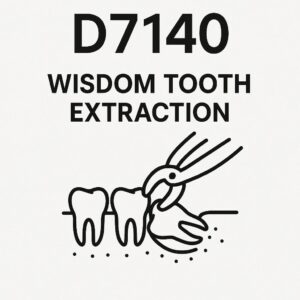
D7140: The Simple Extraction
This code is used for a simple extraction. It applies to a tooth that is visible in the mouth and can be removed with forceps. Generally, this is reserved for teeth with a simple root structure that are fully erupted.
When is this used for wisdom teeth?
This is the least common code for wisdom teeth, but it applies if your third molar has fully grown in without any issues, is straight, and looks like a regular tooth. The dentist can grasp it easily and remove it with minimal effort.
D7210: The Complicated Simple Extraction
This is where things get a little nuanced. Code D7210 is for the removal of an erupted tooth that requires more effort than a standard simple extraction.
What does that mean?
It often involves the removal of bone and/or the sectioning of the tooth (cutting the tooth into smaller pieces) to get it out. It might also involve the removal of soft tissue that is growing over the tooth.
When is this used for wisdom teeth?
Imagine a wisdom tooth has partially erupted. It’s visible, but maybe a flap of gum tissue (an operculum) is still partially covering it, or it’s starting to decay and is fragile. The dentist might need to cut the tissue, remove some bone to get a better grip, or break the tooth to remove it safely. Even though the tooth is technically “erupted,” the procedure is more complex, warranting the D7210 code.
D7220 – D7240: The Surgical Extraction Codes
This is the category most people think of when they hear “wisdom tooth removal.” These codes cover surgical extractions, which involve the removal of soft tissue (gums) and/or hard tissue (bone) to access the tooth.
Here is a breakdown of the specific codes:
-
D7220: Removal of Soft Tissue Impacted Tooth
This is the mildest form of an impacted tooth. The tooth has not broken through the gum, but it is not trapped in the jawbone either. It is completely covered by gum tissue. The dentist or surgeon will make a small incision in the gum to expose the tooth and remove it. The bone remains untouched. -
D7230: Removal of Partially Bony Impacted Tooth
This is a more complex scenario. The tooth is still covered by gum, but part of it is also encased in the jawbone. To access the tooth, the surgeon must cut through the gum and then remove some of the bone that is covering the top of the tooth. -
D7240: Removal of Completely Bony Impacted Tooth
This is the most complex and expensive extraction code. The tooth is fully encased in the jawbone and covered by gum tissue. There is no part of the tooth visible. The surgeon must make an incision, reflect the gum tissue, and drill into the bone to expose the entire tooth. The tooth may then need to be sectioned and removed in pieces to minimize trauma to the surrounding area (like the inferior alveolar nerve, which is near the lower wisdom teeth). -
D7241: Removal of Completely Bony Impacted Tooth with Unusual Surgical Complications
This is an add-on or alternative code used when the completely bony impaction presents additional challenges. This could involve a tooth that is in an abnormal position (like horizontal), has curved or hooked roots that are wrapped around a nerve, or requires an extraordinary amount of bone removal. This code justifies a higher fee due to the increased surgical skill and time required.
Summary Comparison Table
To make it easier to see the differences at a glance, here is a simple table.
| CDT Code | Procedure Description | Typical Scenario for Wisdom Teeth | Complexity Level |
|---|---|---|---|
| D7140 | Simple Extraction | Fully erupted, straight, healthy tooth. | Low |
| D7210 | Erupted Tooth Removal (w/ bone/soft tissue) | Partially erupted, decayed, or fragile tooth. | Low-Medium |
| D7220 | Soft Tissue Impaction | Tooth covered by gum, but not bone. | Medium |
| D7230 | Partially Bony Impaction | Tooth partially covered by gum AND bone. | High |
| D7240 | Completely Bony Impaction | Tooth fully encased in jawbone. | Very High |
| D7241 | Completely Bony w/ Complications | Difficult angle (horizontal) or roots near a nerve. | Highest |
Understanding Your Treatment Plan
When you receive a treatment plan from your dentist or oral surgeon, it will list these codes alongside the specific tooth numbers. The Universal Numbering System for permanent teeth identifies wisdom teeth as:
-
Tooth #1: Upper Right Wisdom Tooth
-
Tooth #16: Upper Left Wisdom Tooth
-
Tooth #17: Lower Left Wisdom Tooth
-
Tooth #32: Lower Right Wisdom Tooth
So, a treatment plan might look like this:
-
D7240 – Tooth #17 (Lower left completely bony impaction)
-
D7240 – Tooth #32 (Lower right completely bony impaction)
-
D7220 – Tooth #1 (Upper right soft tissue impaction)
-
D7220 – Tooth #16 (Upper left soft tissue impaction)
This tells you that the lower teeth are complex, fully impacted cases, while the upper teeth are simpler, only covered by gum tissue. This perfectly explains why the cost is often higher for the bottom teeth.
The Insurance Puzzle: How Codes Determine Your Coverage
This is where understanding the code becomes financially beneficial. Dental insurance plans are not one-size-fits-all. They have different levels of coverage for different types of procedures.
Insurance companies typically categorize procedures into three tiers:
-
Preventive: Cleanings, exams, x-rays (usually covered at 80-100%).
-
Basic: Fillings, simple extractions (like D7140). Often covered at 70-80%.
-
Major: Crowns, bridges, dentures, and surgical extractions (like D7210, D7220, D7230, D7240). Often covered at 50% or less.
A Common Insurance Scenario
Let’s say your plan covers “Basic” procedures at 80% and “Major” procedures at 50%. You have an annual maximum of $1,500 (the most your insurance will pay in a year).
-
If your surgeon uses D7140 (Simple Extraction) for all four teeth, the insurance company might process this as a “Basic” procedure, paying a higher percentage.
-
However, because wisdom teeth are almost always surgical, the correct codes are the D7000 series (Major) . Your insurance will apply the lower 50% coverage rate.
This is why you cannot assume your extraction will be cheap just because a friend said theirs was. Their teeth may have been fully erupted (D7140), while yours are completely bony (D7240). The code tells the whole story.
Important Insurance Note
Do not be surprised if your insurance covers the surgical removal of impacted teeth (D7220-D7240) but offers very little for the removal of erupted wisdom teeth (D7140, D7210). Many plans consider the removal of fully erupted, non-impacted wisdom teeth to be a prophylactic (preventive) measure that falls outside of the basic “sick” care, and may have a separate, lower coverage limit for it. Always ask your provider to break down the coverage by the specific code.
What Influences the Cost of Each Code?
The fee associated with each code is not an arbitrary number. It is a reflection of the time, skill, risk, and resources required to perform the procedure.
-
Time: A simple extraction (D7140) might take 5-10 minutes. A completely bony impaction (D7240) can take 30-60 minutes or more. You are paying for the surgeon’s time and the staff’s time.
-
Expertise: A general dentist can perform simple extractions. A complex bony impaction often requires the advanced training of an oral surgeon. That specialized skill set commands a higher fee.
-
Facility and Equipment: The overhead for a surgical suite, sterilization equipment, and surgical instruments is higher than for a standard exam room. For complex cases done under IV sedation, there are additional costs for the anesthesiologist or nurse anesthetist.
-
Risk: Procedures involving close proximity to nerves (like the inferior alveolar nerve in the lower jaw) carry a higher risk. The code D7241 acknowledges this increased risk and the surgical care taken to avoid it, which is reflected in the cost.
A Note on Anesthesia:
It is important to remember that the extraction codes above cover the surgery itself. They do not typically include anesthesia. Sedation (like nitrous oxide or IV sedation) or general anesthesia will have its own set of codes (often in the D9200 series) and will be an additional cost. Always ask your office for a full breakdown that includes both the surgical fees and the anesthesia fees.
Frequently Asked Questions (FAQ)
Q: Can a general dentist use the surgical extraction codes (D7220-D7240)?
A: Yes, absolutely. If a general dentist performs a surgical extraction, they will use the same CDT codes as an oral surgeon. The code describes the procedure, not the type of dentist performing it. Many general dentists are fully trained and equipped to handle surgical extractions, especially soft tissue and partial bony impactions.
Q: My dentist used code D7210, but my tooth was impacted. Is that wrong?
A: Not necessarily. There is often a “gray area” between a complicated erupted tooth and an impacted one. If part of the tooth was visible, and the dentist had to remove gum and/or bone to get it out, D7210 is the appropriate code, even if you thought of it as impacted. The key distinction for D7210 is that the tooth has some eruption into the mouth.
Q: Will my insurance cover all four codes if I get all four wisdom teeth out at once?
A: Most insurance plans will cover extractions that are deemed medically necessary. If all four are impacted or pose a risk to your oral health, they will typically be covered (subject to your plan’s deductible and coinsurance). However, some plans have limitations on coverage for “non-impacted” wisdom teeth. Your surgeon’s office will usually handle pre-authorization to confirm coverage before the procedure.
Q: I see a code on my bill I don’t recognize. What should I do?
A: First, don’t panic. Call the dental office’s billing department. They are used to these questions. Ask them to explain what the code represents and why it was necessary for your specific procedure. They should be happy to walk you through it. A reputable office wants you to understand your bill.
Q: What is a “write-off” on my EOB?
A: This is a good thing! If your dentist is “in-network” with your insurance, they have agreed to a contracted fee for each code. The “write-off” is the difference between the dentist’s original fee and that contracted rate. It is money you do not have to pay.
Additional Resources
Navigating dental codes and insurance can still feel overwhelming. For the most authoritative information, you can refer directly to the source.
-
[Link to the American Dental Association’s Guide to CDT Codes]: (Placeholder link – We recommend visiting the ADA’s official website for the most up-to-date information on Current Dental Terminology.)
Conclusion
Understanding the dental code for wisdom tooth extraction—from D7140 for a simple pull to D7240 for a complex, bony impaction—empowers you to take control of your healthcare decisions. These codes are not just administrative details; they are the blueprint for your procedure and the key to understanding your insurance benefits. By recognizing what each code signifies, you can have more informed conversations with your dental team, ask better questions about your treatment plan, and navigate the financial side of your surgery with confidence.
Disclaimer
This article is for informational purposes only and does not constitute medical, dental, or legal advice. Dental coding and insurance policies are complex and subject to change. You should always consult with a qualified dental professional regarding your specific condition and treatment, and with your insurance provider regarding the details of your coverage. The codes discussed are based on the ADA CDT manual but may vary in application.