Let’s be honest for a second. Dental codes can feel like a secret language. You sit in the dentist’s chair, hear the word “veneer,” and then get handed a treatment plan full of letters and numbers that make zero sense. What does D2960 mean? Why is there a D2962? And most importantly, what are you actually paying for?
You are not alone. Thousands of patients search for the right dental code for anterior veneer every single month. They want clarity. They want to understand their insurance form. And they definitely want to avoid surprise bills.
This guide is here to help. We will walk through every single code related to front teeth veneers. No confusing jargon. No hidden tricks. Just honest, useful information you can trust.
By the time you finish reading, you will know exactly which code applies to your situation. You will understand what is included. And you will feel confident talking to your dental office about pricing and insurance.
What Exactly Is an Anterior Veneer? (A Quick Refresher)
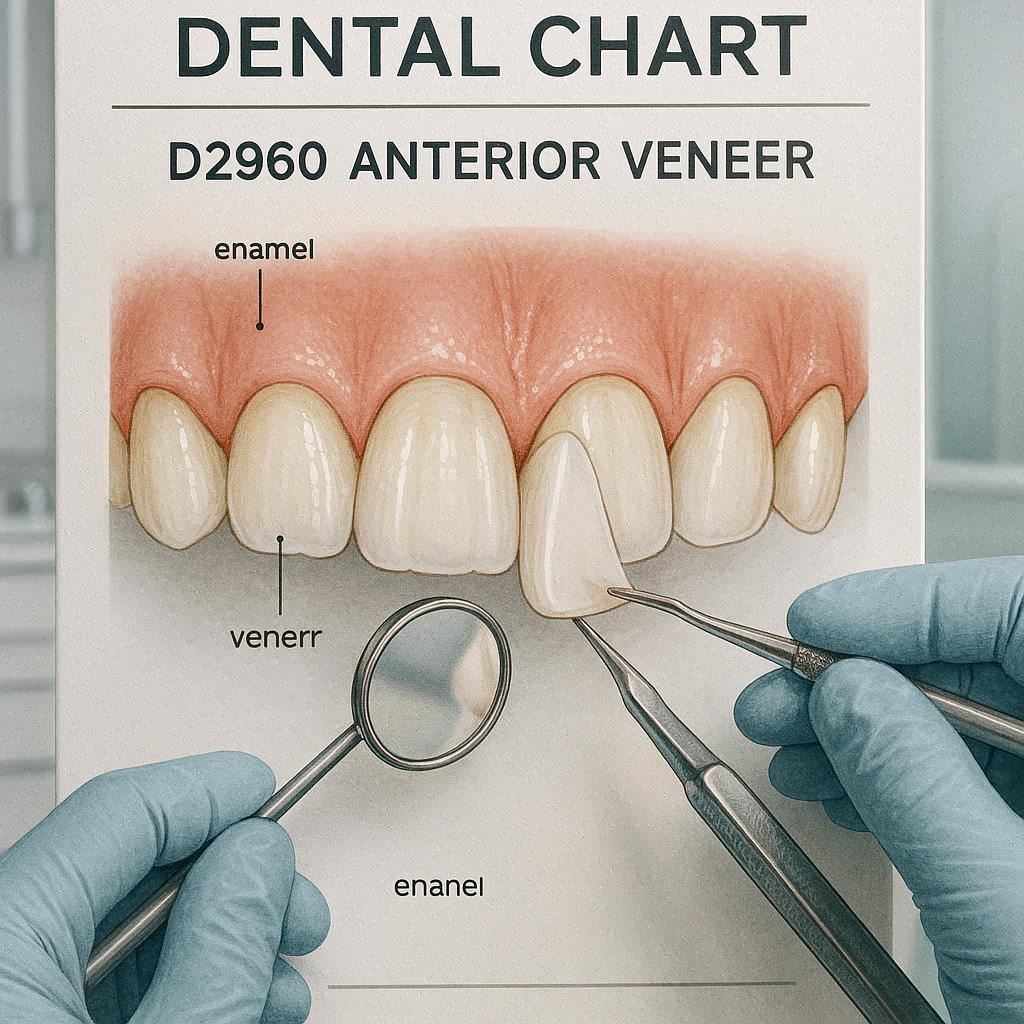
Before we talk about codes, we need a clear picture of the procedure itself. An anterior veneer is a thin shell. It is custom-made to cover the front surface of a tooth. The word “anterior” simply means the teeth at the front of your mouth. These are your incisors and canines. The teeth you see when you smile.
Veneers fix several cosmetic and structural problems. For example:
- Chipped or cracked front teeth
- Stains that whitening cannot remove
- Small gaps between teeth
- Slightly crooked or uneven teeth
- Worn-down edges
Most veneers are made from porcelain or composite resin. Porcelain lasts longer and looks more natural. Resin is usually cheaper but may need replacement sooner.
The procedure itself takes two or three visits. First, your dentist prepares the tooth. They remove a tiny amount of enamel. Then they take an impression. A dental lab builds your custom veneer. Finally, your dentist bonds the veneer to your tooth with special cement.
Now, here is the important part. Not all veneers use the same dental code. The code changes based on the material and how many surfaces of the tooth are covered. That is why understanding the difference matters so much.
The Main Dental Code for Anterior Veneer: D2960
Let’s get straight to the answer you came for.
The most common dental code for an anterior veneer is D2960.
In the Current Dental Terminology (CDT) code set, D2960 means: Labial veneer (resin laminate) – anterior.
Let’s break that down into plain English.
- Labial veneer: The veneer covers the lip side of the tooth. That is the front surface you see when you smile.
- Resin laminate: The veneer is made from composite resin material, built in a dental lab.
- Anterior: This code only applies to front teeth. Not premolars. Not molars. Front teeth only.
When Does Your Dentist Use D2960?
Your dentist will use D2960 when they create a resin veneer in a laboratory setting. This is a multi-step process. The dentist takes an impression. A technician builds the veneer from high-quality resin. Then the dentist bonds it to your tooth.
This code includes the lab work. It includes the bonding. It includes the follow-up adjustments. But it does not include initial exams, X-rays, or tooth whitening.
What D2960 Does Not Cover
This is where patients often get confused. D2960 does not include:
- Direct composite veneers (those built chairside in one visit)
- Porcelain veneers
- Repairs to existing veneers
- Replacement of an old veneer
So if your dentist uses a different material or method, you will see a different code. Let’s talk about that next.
Porcelain Veneers and the Alternative Code: D2962
Many patients want porcelain veneers. They look incredibly natural. They resist stains better than resin. They can last fifteen years or more with good care.
Here is the catch. Porcelain veneers have their own dental code.
The code for a porcelain anterior veneer is D2962.
D2962 means: Labial veneer (porcelain laminate) – anterior.
The only difference between D2960 and D2962 is the material. Both are lab-made. Both cover the front surface. Both apply only to front teeth. But one is resin. The other is porcelain.
Why Does the Material Change the Code?
Insurance companies and dental billing systems separate codes by material for a simple reason. Cost. Porcelain costs more to manufacture. It requires more skill from the lab technician. It also demands more clinical precision from the dentist during bonding.
Because porcelain is more expensive, D2962 has a higher fee than D2960 in most dental offices. We will talk about pricing shortly.
Direct Composite Veneers: No Lab Code at All
Now, here is something many online guides get wrong. Some dentists offer “direct composite veneers.” They build the veneer directly on your tooth in a single visit. No lab. No impression sent away. No second appointment.
For that procedure, dentists do not use D2960 or D2962. Instead, they use a different category entirely.
Direct composite veneers are billed using D2330 through D2394. These codes cover resin-based composite restorations. They are the same codes used for tooth-colored fillings.
Why? Because technically, a direct composite veneer is a large, cosmetic filling on the front of the tooth. The dentist sculpts and cures the resin right there in the chair.
Here is a quick comparison.
| Procedure | Dental Code | Material | Lab Needed | Visits |
|---|---|---|---|---|
| Lab-made resin veneer | D2960 | Composite resin | Yes | 2-3 |
| Lab-made porcelain veneer | D2962 | Porcelain | Yes | 2-3 |
| Direct composite veneer | D2330–D2394 | Composite resin | No | 1 |
| Repair to existing veneer | D2980 | Varies | No | 1 |
Important note: Some dentists use D2960 for both resin and porcelain if their billing system is outdated. Always ask your dentist to confirm the exact code before treatment. This protects you if you plan to submit an insurance claim.
How Much Does an Anterior Veneer Actually Cost?
Let’s talk money. This is what most people really want to know.
Prices vary wildly based on where you live, your dentist’s experience, and the dental lab they use. But we can give you realistic, honest ranges.
Average Costs for D2960 (Lab-Made Resin Veneer)
- Without insurance: $800 to $1,500 per tooth
- With insurance: You may pay $400 to $900 per tooth, depending on your plan
Average Costs for D2962 (Porcelain Veneer)
- Without insurance: $1,200 to $2,500 per tooth
- With insurance: $700 to $1,800 per tooth
Average Costs for Direct Composite Veneers (No D2960/D2962)
- Without insurance: $300 to $600 per tooth
- With insurance: $150 to $400 per tooth
Why are direct composites cheaper? Less lab time. Fewer appointments. Simpler materials. But they do not last as long. Most direct composite veneers need replacement every three to five years. Porcelain veneers can last ten to fifteen years or longer.
Here is a helpful breakdown.
| Veneer Type | Code(s) | Cost per tooth (no insurance) | Average Lifespan |
|---|---|---|---|
| Direct composite | D2330–D2394 | $300–$600 | 3–5 years |
| Lab resin | D2960 | $800–$1,500 | 5–7 years |
| Porcelain | D2962 | $1,200–$2,500 | 10–15+ years |
Quote from a real billing specialist: “I have seen patients choose D2960 thinking they were saving money. But when their resin veneer failed after four years and they paid for a replacement, they ended up spending more than if they had chosen D2962 porcelain from the start. Always ask about long-term value, not just the upfront price.” — Maria S., RDH, Dental Billing Consultant.
Does Insurance Cover the Dental Code for Anterior Veneer?
This is the most disappointing part for many patients. Most dental insurance plans do not cover anterior veneers. At least, not fully.
Why? Because insurance companies classify veneers as cosmetic procedures. They pay for health and function. They do not pay for beauty.
However, there are exceptions. Three specific situations might get you partial coverage.
Situation One: Structural Damage
If your anterior tooth is chipped, cracked, or fractured, a veneer can restore its structure. In this case, the procedure is not purely cosmetic. It is reconstructive. Some plans will cover part of the cost under D2960 or D2962.
You will still likely pay a deductible and coinsurance. But coverage of 50% to 80% is possible.
Situation Two: Tooth Wear from Grinding
If you grind your teeth and have worn down your front teeth, a veneer can protect what remains. Some medical dental plans (often linked to sleep apnea or TMJ disorders) offer coverage here. You will need documentation from your dentist.
Situation Three: Congenital Defects
If you were born with enamel hypoplasia, fluorosis, or other developmental defects, veneers can be considered medically necessary. This is rare. But it happens. Your dentist will need to submit X-rays, photos, and a written narrative to your insurance company.
What Most Plans Will Say
For a standard, healthy tooth that simply looks stained or small? Denied. Insurance will call it cosmetic. And they will pay nothing.
That does not mean you should skip the procedure. It just means you need to budget carefully. Many dental offices offer payment plans. Some work with third-party financing companies like CareCredit.
A note on pre-determination: Always ask your dentist to send a pre-determination of benefits to your insurance company before starting treatment. This is not a guarantee of payment, but it gives you a realistic estimate. Never assume coverage.
Step-by-Step: What to Expect with Code D2960 or D2962
Let us walk through the entire process. This will help you understand what you are paying for when you see one of these codes on a treatment plan.
First Visit: Consultation and Records
- Your dentist examines your teeth and gums.
- They take X-rays to check for hidden decay.
- They discuss your goals. Shape, color, size.
- They give you a treatment plan with the correct dental code for anterior veneer.
- Cost estimate is provided.
Second Visit: Preparation and Impressions
- Your dentist numbs the area (usually not needed for shallow preparations).
- They remove a thin layer of enamel. About 0.3 to 0.5 millimeters.
- They take a highly accurate impression of your teeth.
- A temporary veneer may be placed if needed.
- Impression is sent to the dental lab.
Lab time: 1 to 3 weeks for resin (D2960). 2 to 4 weeks for porcelain (D2962).
Third Visit: Bonding and Finishing
- Your dentist removes the temporary veneer.
- They clean and etch your natural tooth.
- The lab-made veneer is tried on. Shape and color are checked.
- Special cement is applied.
- A curing light hardens the cement instantly.
- Final adjustments are made. Your bite is checked.
Total treatment time: Two to four weeks from start to finish.
Direct Composite Veneers: Why They Use Different Codes
Remember the D2330–D2394 range we mentioned earlier? Let’s break those down. These codes describe resin-based composite restorations. They are organized by how many tooth surfaces are involved.
- D2330: Resin – one surface, anterior
- D2331: Resin – two surfaces, anterior
- D2332: Resin – three surfaces, anterior
- D2335: Resin – four or more surfaces, anterior
When a dentist builds a direct composite veneer, they usually use D2335. That is because a veneer typically covers the entire front (labial) surface. It may wrap around the biting edge (incisal) and the sides (mesial and distal). That adds up to four surfaces.
The cost difference between D2335 and D2960 is significant. D2335 includes no lab fee. No second appointment for bonding. No temporary veneer. That is why it costs less.
But here is the trade-off. Direct composite veneers stain faster. They chip more easily. And they do not look as natural under magnification.
Which one is right for you? That depends on your budget, your expectations, and your dentist’s skill level.
Expert opinion: “I tell my patients that direct composites are like a luxury paint job on a car. They look great for a few years. But if you want showroom quality for a decade, you need porcelain or lab resin.” — Dr. Alan Foster, DDS, cosmetic dentist.
Repairing or Replacing an Existing Veneer: The Right Codes
Veneers do not last forever. Even the best porcelain veneers eventually need replacement. So what happens when your veneer chips, cracks, or falls off?
Repairing a Veneer: Code D2980
If your veneer has a small chip or minor damage, your dentist may repair it instead of replacing the whole thing. The code for this is D2980. This means: Repair to a resin or porcelain veneer, direct.
D2980 covers the dentist’s time and materials to fix the damage. It does not include removing the veneer entirely. It is a patch, not a redo.
Cost for D2980: $100 to $300 on average.
Replacing a Full Veneer: Back to D2960 or D2962
If the veneer is too damaged to repair, your dentist will remove it completely. Then they will make a new one. When that happens, they use the same code as the original veneer. D2960 or D2962.
Important note: Do not let a dentist bill you for a “replacement code” that does not exist. There is no separate code for veneer replacement. The dentist simply bills the original procedure again.
Removing a Veneer Without Replacement: Code D2990
Sometimes patients decide they no longer want a veneer. They ask the dentist to remove it. That service has its own code. D2990 means: Resin infiltration of enamel lesions, but in modern billing, many offices use a different approach. Actually, let me clarify.
There is no specific “veneer removal only” code in the CDT manual. Most dentists will use an adhesive removal code or a cleanup code. In practice, they may use D2999 (unspecified procedure). Always ask how removal will be billed before agreeing to it.
Common Billing Mistakes and How to Avoid Them
Mistakes happen. Dental offices are busy. Billing staff sometimes choose the wrong code. When that happens, you pay the price. Literally.
Here are the most common errors with anterior veneer codes.
Mistake One: Using D2960 for Direct Composite
Some offices use D2960 for any cosmetic resin on the front tooth. That is wrong. D2960 requires a lab-made restoration. If the dentist built it by hand in the chair, the correct code is D2335 or similar.
Why does this matter? D2960 usually costs more than D2335. If you get billed D2960 for a direct composite, you are overpaying.
Mistake Two: Using D2962 for Resin
This happens less often, but it does happen. A dentist uses D2962 (porcelain) when they actually placed a resin veneer. Resin costs less. If your insurance covers D2962 but not D2960, this could be insurance fraud. Never allow a dentist to upcode to get coverage.
Mistake Three: Billing Per Tooth When Multiple Veneers Are Done Together
Some offices try to bill each veneer as a separate set of procedures. That is fine. Veneers are per-tooth codes. But watch out for duplicate charges like “impression fee” multiplied by the number of teeth. One impression covers many teeth.
Mistake Four: Forgetting the Build-Up Code
If your tooth has significant decay or damage under the veneer, your dentist may need to place a foundation first. That is a D2950 (core build-up) . This is a separate code. It is legitimate. But you should see it clearly listed on your treatment plan. Not hidden.
What you can do:
- Ask for a written treatment plan with all codes before starting.
- Compare the codes to this guide.
- If anything looks wrong, ask for an explanation.
- Get a second opinion if you feel unsure.
When a Veneer Is Not the Right Choice (And What Else to Use)
An anterior veneer is a fantastic solution for many people. But not everyone. Sometimes another procedure makes more sense. Let us look at alternatives and their codes.
Alternative One: Teeth Whitening (D9975)
If your only problem is color, do not jump straight to veneers. Professional whitening costs less and involves no drilling. Code D9975 covers external bleaching. Cost: $300 to $800 total.
Alternative Two: Orthodontic Treatment
If your front teeth are crooked or have gaps, veneers hide the problem. But braces or clear aligners fix the problem. Codes for orthodontics follow a different system (D8000 series). Not every dentist offers this. But it is worth considering.
Alternative Three: Enamel Microabrasion (D9970)
For very mild stains or fluorosis spots, microabrasion removes a thin layer of enamel. It is gentle. It is cheap. Code D9970. Cost: $100 to $300.
Alternative Four: Dental Bonding (Same as Direct Composite Veneers)
We already covered this. Code D2335. For small chips or minor shape changes, bonding works beautifully. It is reversible. It does not require enamel removal. Cost: $300 to $600 per tooth.
Alternative Five: Full Crown (D2740)
If half or more of your tooth is missing, a veneer is not strong enough. You need a full crown. Code D2740 covers a ceramic crown. This is a very different procedure. It covers the entire tooth, not just the front. Cost: $1,000 to $2,500.
| Problem | Best Solution | Dental Code | Cost Range |
|---|---|---|---|
| Stains only | Whitening | D9975 | $300–$800 |
| Small chip | Bonding | D2335 | $300–$600 |
| Crooked teeth | Orthodontics | D8000 series | $3,000–$7,000 |
| Large chip or fracture | Veneer (D2960/D2962) | D2960 or D2962 | $800–$2,500 |
| Severe damage | Crown | D2740 | $1,000–$2,500 |
A friendly warning: Some dentists push veneers for every cosmetic concern because they are profitable. That does not mean they are always best for you. If a dentist recommends veneers without discussing whitening, bonding, or orthodontics first, ask why. A good dentist presents all options, not just the expensive one.
How to Talk to Your Dentist About the Dental Code for Anterior Veneer
You now know more about dental codes than 99% of patients. That is powerful. But knowing is only half the battle. You also need to communicate effectively.
Here is a script you can use at your next appointment.
You: “I am considering an anterior veneer. Can you tell me which code you will use?”
Dentist: “We use D2960 for our lab-made resin veneers.”
You: “Great. Is that a porcelain or resin material?”
Dentist: “Resin.”
You: “Understood. What is the total fee per tooth, and does that include the lab fee, anesthesia, and adjustments?”
Dentist: “$1,200 per tooth. Yes, everything included except the initial exam.”
You: “And if I later need a repair, what code and fee would that be?”
Dentist: “D2980, around $200.”
Now you have clear answers. No confusion. No hidden fees.
Questions You Should Always Ask
- Can I see before-and-after photos of your veneer cases?
- How many veneers have you placed using this code?
- What is your policy if the veneer breaks within one year?
- Do you offer a payment plan?
- Will you submit a pre-determination to my insurance?
If the dentist hesitates or gives vague answers, consider a second opinion. A confident, experienced dentist answers these questions easily.
Long-Term Care for Your Anterior Veneers (Protect Your Investment)
You spent good money on that smile. Protect it. Veneers are durable, but they are not indestructible. Follow these rules.
Do This Every Day
- Brush twice daily with a non-abrasive toothpaste. No baking soda. No whitening toothpastes with harsh grit.
- Floss gently. Pull the floss out through the side. Do not snap it up and down. That can loosen the veneer.
- Use a soft toothbrush. Hard bristles scratch porcelain and resin.
Avoid These Things
- Biting your nails, pens, or ice. Veneers chip when you bite hard objects.
- Chewing on hard candy or bones.
- Using your teeth as tools to open packages.
- Grinding your teeth. If you grind at night, ask your dentist for a night guard. This is non-negotiable for veneer longevity.
Regular Maintenance
- See your dentist every six months for check-ups.
- Mention if a veneer feels rough or looks discolored at the edges.
- Do not skip professional cleanings. Plaque buildup can damage the bonding layer.
When to Call Your Dentist Immediately
- A veneer feels loose or moves when you touch it.
- You see a crack or chip.
- Your gum looks red or swollen around the veneer.
- You feel pain when biting.
Do not wait. Small problems are easy to fix. Large problems may require a whole new veneer.
Real Patient Scenarios (What Codes Look Like on a Bill)
Sometimes examples help more than explanations. Here are three real-world scenarios. Names are changed. But the codes and costs are accurate.
Scenario One: Maria, age 34
Problem: Chipped front tooth from a fall as a child.
Solution: Lab-made porcelain veneer on tooth #8.
Codes on her treatment plan:
- D2962 – Porcelain veneer, anterior: $1,800
- D0220 – Intraoral X-ray (periapical, first image): $35
Insurance paid: $0 (cosmetic exclusion).
Maria paid: $1,835 out of pocket.
Scenario Two: James, age 28
Problem: Small gap between central incisors. Wants a quick fix before his wedding.
Solution: Direct composite veneers on teeth #8 and #9.
Codes on his treatment plan:
- D2335 – Resin, four+ surfaces, anterior (two times): $450 each = $900
Insurance paid: 50% after $50 deductible. Total paid by insurance: $425.
James paid: $525.
Scenario Three: Linda, age 52
Problem: Old, stained resin veneers from fifteen years ago. Wants porcelain replacements.
Solution: Remove old veneers. New porcelain veneers on teeth #7 through #10.
Codes on her treatment plan:
- D2962 (four times): $1,500 each = $6,000
- D2999 (veneer removal – unspecified procedure): $50 per tooth = $200
Insurance paid: $0. Plan explicitly excludes cosmetic veneers.
Linda paid: $6,200 total. She used a 12-month payment plan at $517 per month.
Each scenario is different. Your situation will be unique. But these examples show you how codes multiply when you have multiple teeth treated.
Frequently Asked Questions (FAQ)
1. What is the exact dental code for anterior veneer?
The most common code is D2960 for lab-made resin veneers on front teeth. For porcelain, use D2962. For direct composite veneers made in one visit, use D2335.
2. Will my insurance cover D2960 or D2962?
Usually not. Most plans call veneers cosmetic. But if your tooth is cracked, worn, or has a congenital defect, you may get partial coverage. Always ask for a pre-determination.
3. How long does a D2960 veneer last?
Lab-made resin veneers last five to seven years with good care. Porcelain D2962 veneers last ten to fifteen years or longer.
4. Can a dentist use D2960 for a direct composite?
No. That is incorrect billing. Direct composites belong in the D2330–D2394 range. If your dentist uses D2960 for a chairside composite, ask why. You may be overpaying.
5. What code is used to repair a chipped veneer?
D2980 covers repair to an existing resin or porcelain veneer. Cost is usually $100 to $300.
6. Do I need a separate code for anesthesia with veneers?
No. Anesthesia (local numbing) is included in the veneer code. If your dentist adds a separate anesthesia code like D9210, ask why. Most simple veneers do not require separate anesthesia billing.
7. How many veneers can be billed at once?
As many as you need. Each tooth gets its own line item with the same code. There is no limit except your budget and your dentist’s schedule.
8. What if my dentist uses a code I do not recognize?
Ask immediately. Say: “Can you explain what that code means and why it applies to my case?” If the answer is unclear, pause treatment and research the code online or call your insurance company.
Additional Resource
For the official, annually updated list of all CDT dental codes, visit the American Dental Association’s code resource page:
🔗 www.ada.org/en/publications/cdt
This is the only official source. Do not rely on third-party websites for current codes. The ADA updates codes every year. What was accurate in 2025 may have changed for 2026 and beyond.
Final Conclusion (Three Lines)
The correct dental code for an anterior veneer depends on material and method: D2960 for lab-made resin, D2962 for porcelain, and D2335 for direct composite. Insurance rarely covers these codes because veneers are considered cosmetic, but structural damage or congenital defects may qualify for partial benefits. Always ask for a written treatment plan, verify every code, and protect your investment with proper long-term care.
Disclaimer: This article is for informational purposes only. It does not constitute medical or dental advice. Always consult a licensed dentist for diagnosis and treatment. Dental codes and insurance policies change. Verify all information with your provider and insurance company before proceeding with treatment.