If you have ever sat in a dentist’s chair and heard the words “open face gold crown,” you probably had two immediate questions.
First, what exactly is that?
Second, how much is this going to cost me—and will my insurance help?
You are not alone. The terminology around dental crowns can feel like alphabet soup. But when you add precious metal into the mix, things get even more confusing.
This guide focuses on one specific question: What is the dental code for an open face gold crown?
More importantly, we will walk through when this code applies, how it differs from other crown codes, what you should expect to pay, and how to avoid common billing mistakes.
What Is an Open Face Gold Crown?
Before we talk about codes, we need to talk about the crown itself.
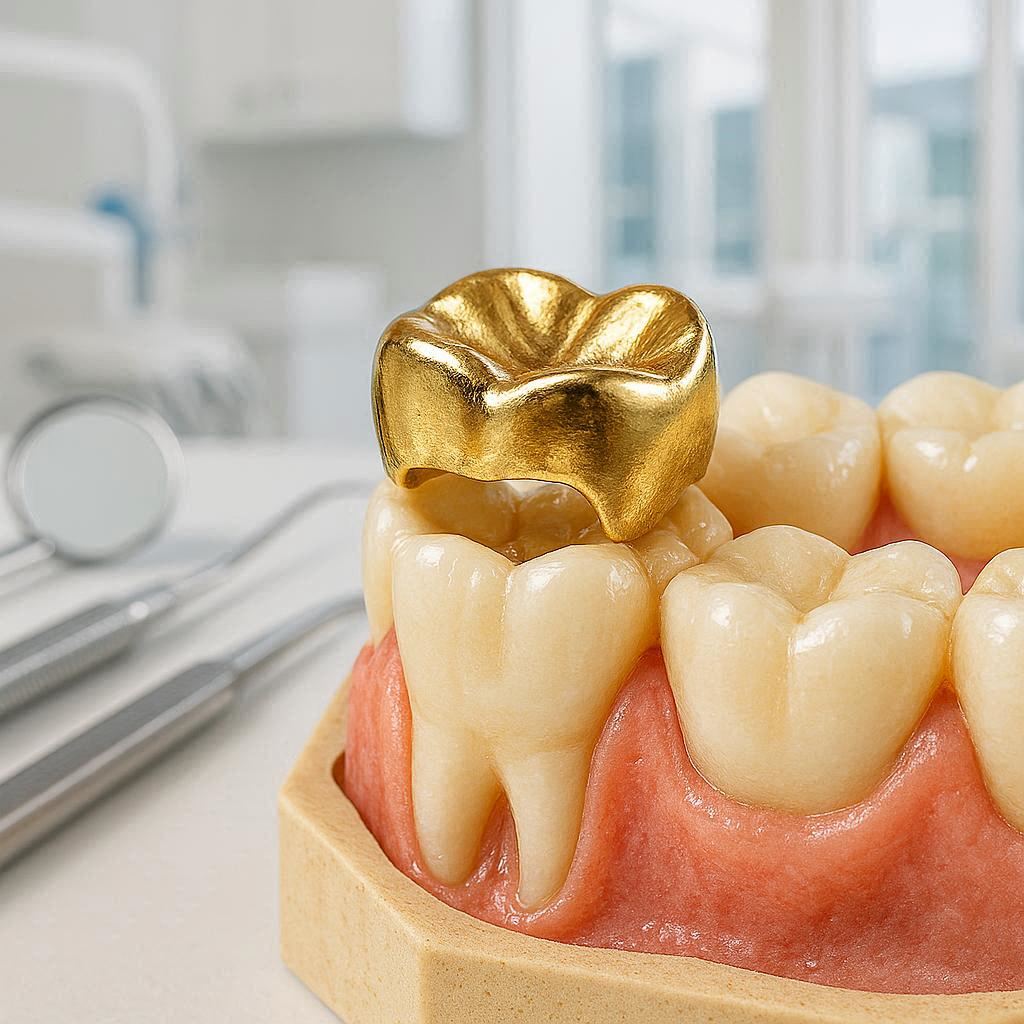
An open face gold crown is a type of partial coverage restoration. That is the key difference right there. Most people think of a dental crown as a cap that covers the entire tooth. And for many restorations, that is exactly what happens.
But an open face crown is different.
This crown has a metal substructure—usually a high-noble gold alloy—but the “face” or the visible portion (usually the front or chewing surface) is left open or filled with a different material like composite resin or porcelain.
Think of it this way. Imagine a thimble with the tip cut off. That is the general idea.
Why Choose an Open Face Gold Crown?
Dentists do not recommend this restoration for every situation. They choose it for specific clinical reasons.
- Preservation of tooth structure. An open face crown requires less aggressive drilling. The dentist leaves more natural tooth behind, especially on the facial or buccal surface.
- Reduced risk of fracture. All-metal crowns are incredibly strong. An open face design removes some metal to improve aesthetics without sacrificing strength entirely.
- Patient with a heavy bite. Patients who grind or clench benefit from the durability of gold, but the open face allows for some enamel preservation.
- Financial consideration. Sometimes an open face crown costs less than a full gold crown because less material and lab time are involved.
The Aesthetic Trade-Off
Let us be honest with each other.
An open face gold crown is not invisible. A full ceramic crown looks more natural. But for back teeth—especially molars—many patients and dentists agree that the durability of gold outweighs the aesthetic concern.
The open face design attempts to give you the best of both worlds. You get the strength of gold on the functional areas, but the visible portion matches your natural tooth more closely.
Today, most “open face” restorations use a porcelain or composite facing bonded to a metal backing. That design has its own billing code, which we will cover shortly.
The Exact Dental Code for Open Face Gold Crown
Let us get straight to the answer you came for.
The most commonly accepted dental code for an open face gold crown is D2792.
In the Current Dental Terminology (CDT) code set published by the American Dental Association (ADA), D2792 is defined as:
Crown, ¾, cast high noble metal
That definition requires some unpacking.
What Does “¾ Crown” Mean?
A three-quarter crown is a type of partial coverage restoration. It covers most of the tooth but leaves one entire surface exposed—usually the facial (front) surface.
In the case of an open face gold crown, the exposed surface is the one people see when you smile or talk. Therefore, D2792 is the correct open face crown code for high noble metal.
| Term | Meaning |
|---|---|
| ¾ Crown | Covers three of four tooth surfaces; one surface remains uncovered |
| Cast | Fabricated in a dental lab from a mold of your prepared tooth |
| High Noble Metal | Contains at least 60% noble metals (gold, platinum, palladium), with at least 40% gold |
Is D2792 Always the Right Code?
Not always. And this is where billing gets tricky.
If your open face crown uses a base metal or predominantly base metal alloy, the code changes. The ADA provides separate codes for those materials.
- D2793 – Crown, ¾, cast predominantly base metal
- D2794 – Crown, ¾, cast noble metal (less than 60% noble metal content but still contains some noble metal)
The difference between D2792 (high noble) and D2794 (noble) is the gold percentage. D2792 requires at least 40% gold by weight. D2794 requires a total noble metal content of at least 25% (gold, platinum, palladium) but less than 60%.
For most private practices that still offer gold crowns, D2792 is the preferred code because high-noble alloys offer the best biocompatibility and marginal fit.
Important Note: Some dental offices mistakenly bill a full crown code (D2740 for ceramic or D2750 for porcelain fused to metal) for an open face design. This is incorrect. The ¾ crown codes exist for a reason. If your dentist bills a full crown code for a partial crown, the insurance company may reject the claim or reduce the benefit.
How D2792 Compares to Other Crown Codes
Understanding where D2792 fits in the bigger picture helps you avoid confusion.
Below is a comparison table of the most common crown-related codes.
| CDT Code | Description | Coverage | Typical Material |
|---|---|---|---|
| D2710 | Crown, resin-based composite (indirect) | Full | Composite |
| D2712 | Crown, ¾, resin-based composite | Partial (¾) | Composite |
| D2740 | Crown, porcelain/ceramic substrate | Full | Ceramic |
| D2750 | Crown, porcelain fused to high noble metal | Full | Porcelain + high noble metal |
| D2790 | Crown, full cast high noble metal | Full | High noble metal |
| D2792 | Crown, ¾ cast high noble metal | Partial (¾) | High noble metal |
| D2794 | Crown, ¾ cast noble metal | Partial (¾) | Noble metal (less than 60%) |
Notice the pattern.
Full crown codes start with “D27” but have different ending digits. The ¾ codes (D2712, D2792, D2794) are specifically designated for partial coverage restorations.
Why Material Matters to Insurers
Insurance companies care deeply about the material used in a crown. Why?
Because the material directly affects the cost, longevity, and appropriateness of the treatment.
High noble metal (D2792) is the most expensive material. It is also the most durable and biocompatible. Most insurance plans cover D2792, but they may apply a downgrade if a less expensive material (like base metal) would have been clinically acceptable.
Some plans have a specific exclusion for “partial coverage crowns.” You must check the patient’s benefit booklet before assuming D2792 is covered.
When Is D2792 the Right Choice?
Knowing the code is one thing. Knowing when to use it is another.
A dentist should only bill D2792 under specific clinical circumstances. Here is a list of situations where a ¾ cast high noble metal crown is appropriate.
- A tooth with extensive decay or fracture on the lingual (tongue side) and interproximal surfaces, but the facial surface remains intact and healthy.
- A tooth that serves as an abutment for a removable partial denture. The open face allows the denture clasp to engage the natural tooth surface.
- A mandibular molar with a previously placed large amalgam filling. The dentist can prepare the tooth for a ¾ crown without reducing the healthy facial wall.
- A tooth with a short clinical crown. Full crown preparation might expose the pulp. A ¾ crown allows for a more conservative preparation.
- Patient preference for metal strength but with improved aesthetics on the visible surface.
A Note on Anterior Teeth
D2792 is rarely used on anterior teeth (canine to canine). The aesthetic demands are simply too high. Even with an open face design, the metal margins may become visible over time as gum tissue recedes.
For anterior teeth requiring partial coverage, most dentists opt for D2712 (¾ resin-based composite) or a full ceramic crown (D2740).
Insurance Coverage for D2792: What to Expect
Let us talk about the subject that matters most to patients and practice managers alike.
Money.
Insurance coverage for dental code D2792 varies wildly from one plan to another. However, certain patterns exist.
Typical Coverage Scenarios
PPO and Indemnity Plans
Most traditional plans cover D2792 at 50% to 80% after you meet your deductible. However, many plans have a “crown benefit” that applies to any crown code—full or partial—up to a maximum allowable amount.
The catch is that some plans reimburse D2792 at the same rate as a full crown. Others pay less because they consider a ¾ crown a less expensive procedure. You must check the fee schedule.
Dental HMO Plans
HMO plans work differently. You pay a fixed copay per procedure, regardless of the material or complexity. With an HMO, D2792 may have a specific copay listed in your schedule of benefits.
Medicaid
Medicaid coverage for D2792 is extremely rare. Most state Medicaid programs only cover full crowns on posterior teeth, and even then, often only for patients under 21. If you have Medicaid, call your plan before scheduling this procedure.
Common Reasons for Denial
Insurance companies deny claims for D2792 for several reasons.
- Missing pretreatment radiographs. Insurers want to see proof that a ¾ crown is clinically necessary. A full crown often appears on radiographs as more “complete” coverage.
- Downgrade to a less expensive code. Some plans automatically downgrade D2792 to D2794 (noble metal) or D2793 (base metal) if the dentist does not submit a narrative explaining why high noble metal is medically necessary.
- Frequency limitation. Most plans limit crown replacements to once every five to ten years per tooth. If a previous crown on that tooth was billed within that window, the claim will deny.
- Code not a benefit. Some plans explicitly exclude “partial coverage restorations.” In that case, neither D2792 nor D2794 will be paid.
How to Improve Your Chances of Approval
Do not leave things to chance.
- Always submit a pre-treatment estimate. This is the single most important step. A predetermination tells you exactly what the plan will pay before the dentist does any work.
- Include a narrative. Write a short note explaining why a ¾ crown is necessary instead of a full crown. Mention tooth preservation, opposing dentition, and parafunctional habits.
- Use the correct tooth number. This sounds basic, but errors happen. Double-check the tooth quadrant and number.
- Attach current radiographs and intraoral photos. Visual evidence strengthens your case.
Step-by-Step: Billing D2792 Correctly
For dental billers and office managers, accuracy is everything.
Follow this process to submit a clean claim for D2792.
Step 1: Confirm the Restoration Type
Review the dentist’s treatment plan. Does the procedure note say “¾ crown,” “open face gold crown,” or “partial coverage cast metal?” If not, ask the dentist before proceeding.
Step 2: Verify the Alloy Type
Ask the dentist or the lab: Is the alloy high noble (at least 60% noble metal, 40% gold)? If yes, D2792 is correct.
If the alloy is noble but below 60% total noble content, use D2794.
If the alloy is base metal (no noble metals), use D2793.
Step 3: Check for Additional Codes
An open face crown may involve other procedures that require separate codes.
| Additional Service | CDT Code | Notes |
|---|---|---|
| Core buildup | D2950 | Needed if tooth lacks sufficient structure |
| Pin retention | D2951 | Occasionally used with ¾ crowns |
| Post and core | D2954 | For endodontically treated teeth |
| Sedative filling | D2940 | Temporary before crown preparation |
Do not bundle these into the crown fee. Bill them separately if the plan allows.
Step 4: Complete the ADA Claim Form
On the current ADA 2023 (or later) claim form, enter:
- Box 27: D2792
- Box 28: Tooth number (use quadrant and tooth number, e.g., #19 for a mandibular first molar)
- Box 29: Surface (usually OL for occlusal-lingual or O for occlusal only, but check the treatment plan)
- Box 30: The fee for the crown
Step 5: Attach Supporting Documentation
Always attach:
- Pre-op radiograph showing the existing condition
- Post-op radiograph after crown seat (for payment)
- Clinical narrative (one short paragraph is enough)
Step 6: Submit and Track
Submit electronically if possible. Paper claims take longer and have higher error rates.
Track the claim in your clearinghouse or payer portal. If it is not adjudicated within 30 days, follow up.
Costs: What Does an Open Face Gold Crown Actually Cost?
Let us talk numbers.
The cost of a D2792 crown includes several components.
- Exam and diagnostic (D0150 or D0140)
- Radiographs (D0220, D0230, or D0270)
- Tooth preparation and impression (included in the crown fee for most offices)
- Lab fee for the cast high noble metal crown
- Crown placement and adjustment
National Average Fees
According to fair health consumer resources and dental fee surveys, here is what you can expect to pay for D2792.
| Payer Type | Typical Fee Range |
|---|---|
| In-network PPO fee | $600 – $900 |
| Out-of-network PPO fee | $800 – $1,200 |
| Dental HMO copay | $200 – $400 |
| Cash/FFS (no insurance) | $1,100 – $1,800 |
These amounts do not include the core buildup, radiographs, or exam. If you need D2950 (core buildup), add $150 to $300.
Why is D2792 sometimes more expensive than a full crown?
Because high-noble metal alloys are expensive. The gold content alone drives up the lab fee. A full high-noble crown (D2790) costs roughly the same or slightly more. A ¾ crown uses less metal, so the lab fee is often lower. But not dramatically lower. The technical difficulty of casting a partial coverage crown is actually higher than a full crown.
How to Save Money
- Use an in-network provider. This is the single biggest factor.
- Ask for a cash discount. Many offices offer 5% to 10% off if you pay in full at the time of service.
- Consider a dental savings plan. These are not insurance. They are discount programs. Some offer 15% to 25% off crown fees.
- Check with a dental school. Teaching clinics offer D2792 at 40% to 60% less than private practice. The trade-off is longer appointment times.
D2792 vs. Porcelain Fused to Metal Open Face
You may hear a dentist say “open face crown” but mean something completely different.
Modern dentistry sometimes uses the term “open face” to describe a porcelain-fused-to-metal (PFM) crown where the metal substructure is covered with porcelain on all but one surface. That is not a true ¾ crown.
That restoration is billed using the full crown PFM codes.
- D2750 – Crown, porcelain fused to high noble metal (full coverage)
- D2751 – Crown, porcelain fused to predominantly base metal
- D2752 – Crown, porcelain fused to noble metal
Why does this matter?
Because the insurance reimbursement for a PFM full crown is often higher than for a ¾ cast metal crown. Some dentists intentionally use the full crown code even when the restoration only covers three surfaces. This is technically fraud. Do not do it.
If the restoration leaves an entire surface of natural tooth exposed, use D2792 (or D2794/D2793). If the restoration covers all surfaces, use the appropriate full crown code.
Real-World Clinical Example
Let us walk through a typical case.
Patient: John, age 58
Tooth: #31 (mandibular right second molar)
Clinical finding: Large distal occlusal fracture extending subgingivally on the distal margin. Facial wall is intact and healthy. No decay on the facial surface.
Treatment plan: Prepare tooth for a ¾ cast high noble metal crown. Leave facial surface untouched.
Codes billed:
- D0150 – Comprehensive oral evaluation
- D0270 – Bitewing radiograph (single film)
- D2792 – Crown, ¾ cast high noble metal
- D2950 – Core buildup (due to loss of distal wall)
Insurance outcome: Predetermination approved D2792 at 70% of the plan’s allowable fee of $850. Patient owed 30% plus the core buildup copay.
Total patient out-of-pocket: $255 (crown) + $75 (core buildup copay) = $330
This is a realistic, common scenario.
Common Myths About the Dental Code for Open Face Gold Crown
Let us clear up some misinformation floating around online.
Myth 1: “There is no code for a ¾ gold crown anymore.”
False. D2792 is active and current in the CDT code set. It has not been deleted or replaced.
Myth 2: “Insurance never covers ¾ crowns.”
False. Many plans cover them. But they are less common, so some front-office staff assume incorrectly that coverage is impossible. Always verify.
Myth 3: “An open face crown is the same as a veneer.”
False. A veneer (D2960) covers only the facial surface. A ¾ crown covers the occlusal, mesial, distal, and lingual surfaces. These are very different procedures with different codes.
Myth 4: “You can bill D2792 for any metal crown that is not full coverage.”
False. The material must be high noble metal. If it is not, use D2794 or D2793. Using the wrong code is insurance fraud.
Step-by-Step Workflow for Patients (What You Will Experience)
If you are a patient scheduled for an open face gold crown, here is what your journey will look like.
Appointment 1: Consultation and Diagnosis
- The dentist examines your tooth.
- X-rays are taken to evaluate decay and bone level.
- The dentist discusses treatment options.
Appointment 2: Tooth Preparation
- Local anesthesia is administered.
- The dentist removes decay and old filling material.
- The tooth is shaped to accept a ¾ crown. This is less aggressive than full crown prep.
- An impression is taken (digital or physical).
- A temporary ¾ crown is fabricated and cemented.
- The impression is sent to the dental lab.
Time: 60 to 90 minutes
Between Appointments: Lab Fabrication
- The lab pours the model.
- The wax pattern is created.
- The crown is cast in high noble metal.
- The crown is finished, polished, and inspected.
Time: 1 to 3 weeks depending on the lab
Appointment 3: Crown Seat
- The temporary crown is removed.
- The tooth is cleaned.
- The dentist tries in the gold crown. They check margins, contact points, and bite.
- Adjustments are made as needed.
- The crown is cemented with permanent cement.
- Bite is rechecked.
Time: 45 to 60 minutes
Post-Operative Care
- Avoid chewing on that side for 24 hours.
- Expect mild sensitivity to cold for a few days. This is normal.
- Return to the office if the crown feels high or if sharp edges are present.
Longevity of an Open Face Gold Crown
How long will a D2792 crown last?
Studies on modern adhesive dentistry show that a well-made ¾ cast high noble metal crown can last 15 to 25 years or longer. Some last a lifetime.
The weak point is not the metal. It is the margin where the crown meets the tooth. If you maintain excellent oral hygiene and attend regular cleanings, the margins can stay intact for decades.
Compare this to other materials.
| Restoration Type | Average Lifespan | Main Risk |
|---|---|---|
| Full gold crown (D2790) | 20–30+ years | Margin decay |
| ¾ gold crown (D2792) | 15–25 years | Facial surface decay |
| PFM crown (D2750) | 10–15 years | Porcelain fracture |
| All-ceramic crown (D2740) | 10–15 years | Fracture |
The open face design exposes the facial surface of the natural tooth. That surface can still develop decay if you do not brush and floss properly. That is the trade-off for preserving more tooth structure during preparation.
Documentation Requirements for D2792
Insurance audits happen. When they do, you need proper documentation.
For D2792, keep the following in the patient’s chart.
- Periodic radiographs showing the tooth before and after treatment
- Intraoral photographs (if available)
- Study models (if taken)
- Treatment plan signed by the patient
- Lab prescription and invoice showing the high noble metal content
- Clinical notes detailing why a ¾ crown was chosen over a full crown
If an auditor asks, “Why didn’t you do a full crown?” you need an answer in the chart. Write something like:
“Facial wall intact without decay or fracture. ¾ crown selected to preserve healthy tooth structure and minimize pulpal exposure. Patient informed of open face design and associated risks.”
That one sentence protects you.
Frequently Asked Questions (FAQ)
1. Is D2792 the same as a “three-quarter crown”?
Yes. The terms “¾ crown” and “three-quarter crown” are interchangeable. D2792 specifically refers to a ¾ crown made of cast high noble metal.
2. Will my insurance cover D2792?
It depends on your plan. Many PPO and indemnity plans cover it at the same percentage as a full crown. Some exclude partial coverage crowns entirely. Call your insurer and ask, “Is D2792 a covered benefit under my plan?”
3. Can D2792 be used on a front tooth?
Technically, yes. Clinically, rarely. Aesthetics usually prevent anterior use of a visible metal crown.
4. What is the difference between D2792 and D2790?
D2790 is a full cast high noble metal crown. It covers 100% of the tooth. D2792 covers approximately 75% of the tooth.
5. My dentist billed D2750 but I got an open face crown. Is that wrong?
It is likely incorrect. If the restoration left any natural tooth surface exposed, D2792 (or D2794/D2793) is the proper code. Ask your dentist for a corrected claim.
6. How much gold is in a D2792 crown?
At least 40% gold by weight, and the total noble metal content (gold + platinum + palladium) must be at least 60%.
7. Does Medicaid cover D2792?
Almost never for adults. Some state programs may cover it for patients under 21. Verify with your specific state Medicaid office.
8. Can I bill D2792 and D2950 on the same tooth on the same day?
Yes. A core buildup (D2950) is a separate service that supports the crown. It is billable on the same date of service. However, some plans bundle core buildup into the crown fee. Check the patient’s plan.
9. Is an open face gold crown cheaper than a full gold crown?
Usually, yes, but not by a large margin. The lab fee is somewhat lower because less metal is used. The complexity of casting a ¾ crown offsets some of that savings.
10. How do I find a dentist who offers D2792?
Not all dentists offer cast gold restorations. Call offices and ask: “Do you still do traditional gold crowns? Specifically, ¾ gold crowns?” Older dentists or those with training in operative dentistry are more likely to offer them.
Additional Resources
For more information on dental coding for crowns and other restorative procedures, visit the American Dental Association’s CDT Code on Dental Procedures and Nomenclature page:
👉 ADA CDT Code Portal (external link)
This is the official source for all current dental codes. Do not rely on third-party summaries for final billing decisions.
Conclusion
Let us quickly recap what you have learned.
Dental code D2792 is the proper code for an open face cast high noble metal crown. This ¾ crown preserves healthy tooth structure while providing the durability of gold. Insurance coverage is possible but varies widely, so always verify benefits before treatment. For patients, expect to pay between $600 and $1,800 depending on your coverage and location.