Navigating the world of dental insurance and procedural codes can often feel like trying to read a foreign language. If you are considering the transformative All-on-4 dental implant procedure, you have likely encountered a maze of numbers and abbreviations that seem impossible to decipher. Understanding the correct “dental code for all on 4 dentures” is not just an administrative task; it is the key to unlocking your insurance benefits, understanding your financial responsibility, and planning your journey to a new smile with confidence.
This guide is designed to be your roadmap. We will demystify the complex coding system, explain why there isn’t one single “magic” code, and break down the individual components that make up the procedure. Whether you are a patient doing your research or a dental professional looking for a clear reference, our goal is to provide a realistic, honest, and comprehensive overview to help you navigate the billing process with ease.
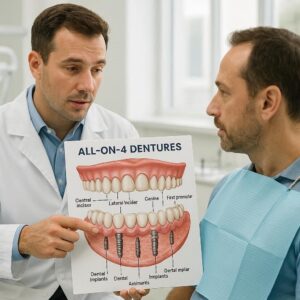
Dental Code for All-on-4 Dentures
The Big Misconception: Why There’s No Single “All-on-4” Code
Let’s address the elephant in the room right from the start. If you search for “the dental code for all on 4 dentures,” you might be hoping to find one simple, five-digit number that covers everything. The honest reality is more complex: there is no single, specific CDT (Current Dental Terminology) code for the All-on-4 procedure.
Think of the All-on-4 treatment not as a single tooth replacement, but as a comprehensive dental restoration project. It’s like building a house. You wouldn’t use one code for the entire house; you would have separate line items for the foundation, the framing, the plumbing, and the roof.
Similarly, the All-on-4 procedure is a combination of several distinct clinical steps, each with its own specific code. The ADA (American Dental Association) maintains the CDT code set, and it categorizes these steps into three main buckets:
-
Surgical Procedures: The placement of the implants themselves into the jawbone.
-
Prosthetic Procedures: The creation and fitting of the replacement teeth (the bridge/dentures).
-
Adjacent Services: Necessary diagnostic work like CT scans, consultations, and temporary restorations.
Understanding this fundamental concept is the first and most important step in decoding your treatment plan and insurance estimate. A proper treatment plan will list multiple codes, each representing a part of your overall care.
The Core Components: The CDT Codes That Build Your All-on-4 Treatment Plan
To understand the final cost and insurance claim, you need to recognize the individual building blocks. Below, we break down the most common CDT codes used in an All-on-4 procedure. We will group them into the surgical and prosthetic phases.
Surgical Phase: Placing the Implants
This phase covers the actual surgery where the dental implants (the titanium posts that act as artificial tooth roots) are placed into your jawbone. The codes used depend on the specific type of implant and the surgical protocol.
| CDT Code | Descriptor | How It Applies to All-on-4 |
|---|---|---|
| D6010 | Surgical placement of implant body: endosteal implant | This is the most common code for placing a standard, cylindrical implant. In an All-on-4 procedure, you would typically see this code listed four times—once for each implant placed. |
| D6066 | Implant supported prosthesis – fixed – retaining – complete arch | Caution: While this code relates to the final teeth, it is often used in conjunction with the surgical codes. It describes the abutment (the connector piece) for a fixed complete arch prosthesis. Your surgeon or prosthodontist will clarify how they bill for abutments. |
| D6100 | Implant removal, by report | Not a common part of the initial placement, but it’s good to know. This code is used if an existing failing implant needs to be removed before the new ones can be placed. |
| D6190 | Radiographic/surgical implant index, by report | This code may be used for the surgical guide or stent. This is a custom-made template (often created from a CBCT scan and 3D-printed) that ensures your surgeon places the implants in the exact pre-planned positions for optimal support and aesthetics. |
Prosthetic Phase: Creating Your New Smile
Once the implants are placed and have integrated with your bone (a process called osseointegration), the focus shifts to creating and attaching your new permanent teeth. This phase is the most complex in terms of coding.
| CDT Code | Descriptor | How It Applies to All-on-4 |
|---|---|---|
| D6057 | Custom abutment – includes placement | This code is used for the custom-made abutments. These are the small connectors that attach to the top of each implant and act as the foundation for your new teeth. Because the implants in an All-on-4 procedure are often angled, custom abutments are almost always necessary. You would likely see this code listed four times. |
| D6058 | Abutment supported porcelain/ceramic crown | This code is for a single crown. It is not typically used for the full-arch bridge in an All-on-4 procedure. |
| D6065 | Implant supported complete fixed denture – maxillary | This is the “star player” for the upper arch. This code represents the final, permanent, screw-retained bridge that replaces all the teeth in your upper jaw. It is made of acrylic, porcelain, or a hybrid material and is designed to be removed only by your dentist. |
| D6066 | Implant supported complete fixed denture – mandibular | This is the exact same concept as D6065, but specifically for the lower arch. It is a complete, fixed, screw-retained bridge. |
| D6080 | Implant maintenance procedures, including removal and reapplication of prosthesis, when performed | This is a crucial code for your long-term care. This is the code your dentist will use for your annual or semi-annual implant maintenance visits, where they unscrew your bridge, clean underneath it, and check the implants and abutments. |
A Crucial Note on Terminology: You may hear the final prosthesis referred to as a “fixed denture,” a “hybrid denture,” or a “permanent bridge.” While the terms are often used interchangeably by patients, the CDT codes D6065 and D6066 specifically describe a “fixed complete denture.” This is the official terminology for the type of prosthesis used in the classic All-on-4 technique.
Comparing the Codes: Upper vs. Lower Arch
The prosthetic codes are arch-specific. This is an important distinction when reviewing a treatment plan.
| Feature | Maxillary (Upper) Code: D6065 | Mandibular (Lower) Code: D6066 |
|---|---|---|
| What it Describes | A fixed, complete-arch prosthesis for the upper jaw. | A fixed, complete-arch prosthesis for the lower jaw. |
| Typical Material | Often a high-strength acrylic or ceramic base with acrylic or porcelain teeth. | Often a high-strength acrylic or ceramic base with acrylic or porcelain teeth. |
| Attachment | Screw-retained onto custom abutments (D6057). | Screw-retained onto custom abutments (D6057). |
| Why the Distinction? | The upper and lower jaws have different bone densities, anatomical structures, and aesthetic requirements, which is reflected in the separate code designations. |
Beyond the Basics: Other Important Codes You Might See
A complete treatment plan is comprehensive. Beyond the surgical and major prosthetic codes, you will likely see codes for the diagnostic and preparatory work that ensures your treatment is successful.
-
D0367 (Cone Beam CT Capture and Interpretation): This is arguably one of the most important codes. A CBCT scan is a 3D x-ray that allows your surgeon to see your bone structure in minute detail. It is essential for planning the precise angulation and position of the four implants to avoid nerves and sinuses. This is non-negotiable for a safe and predictable All-on-4 procedure.
-
D9310 (Consultation – diagnostic service provided by dentist other than practitioner providing treatment): If you see a specialist surgeon for a second opinion or initial planning before being treated by your primary dentist, this code may be used.
-
D1354 (Interim caries arresting medicament application): In some cases, if you have remaining teeth that need to be managed temporarily before extraction, a fluoride varnish or other agent may be applied.
-
D7140 (Extraction, erupted tooth or exposed root): Since All-on-4 often follows the extraction of failing teeth, you will see codes for tooth extraction. The specific code varies based on the complexity of the extraction (e.g., surgical extraction D7210). You would have a code for each tooth being removed.
-
D2999, D9999, etc. (Unspecified Codes): Sometimes, a specific aspect of the procedure (like a complex temporary prosthesis) doesn’t fit perfectly into a standard code. In these cases, the office may use an “unspecified” code, which almost always requires them to submit a narrative report (explaining what was done) to your insurance company.
Why Coding Varies: A Look at Treatment Philosophy and Materials
You might visit two different dental offices for an All-on-4 consultation and receive two treatment plans with different sets of codes. Why? The devil is in the details.
1. The Abutment Question:
Will the dentist use stock (pre-fabricated) abutments or custom-milled abutments? For the angled implants in an All-on-4, custom abutments (D6057) are the gold standard for a passive fit and long-term success. A plan using stock abutments might look different and could be less expensive upfront, but potentially more problematic later.
2. The Prosthesis Material:
While D6065/D6066 are the primary codes for the final fixed denture, the materials used can vary widely. Some are standard acrylic, while others are high-performance polymers or zirconia. The insurance company will reimburse a standard amount for the code, but the lab fee the dentist pays can be vastly different depending on the material chosen. This difference contributes to the overall fee.
3. The “Teeth-in-a-Day” Approach:
Many patients opt for a protocol where they receive a set of non-removable temporary teeth on the same day as their surgery. This immediate loading protocol requires a separate, carefully crafted temporary prosthesis. This prosthesis might be coded with an unspecified procedure code (like D5999) or bundled into the overall surgical fee, as there isn’t a perfect CDT code for it.
How Insurance Interprets the Codes: The Reality of Coverage
This is where the conversation can get a little disheartening, but it’s vital to be realistic. Because All-on-4 is a major reconstructive procedure, most traditional dental insurance plans were not designed to cover it fully.
-
The Annual Maximum: Most dental insurance plans have a low annual maximum, often between $1,000 and $2,000. The total cost for an All-on-4 procedure is typically tens of thousands of dollars. Even if your insurance covers a portion, they will only pay up to that annual maximum.
-
The “Medically Necessary” Clause: Insurance companies will look at the codes. They may view the extractions (D7140 series) as “medically necessary.” They may view the implant placement (D6010) as “medically necessary” to restore function. However, they often view the final, cosmetic prosthesis (D6065/D6066) as having a significant “cosmetic” component.
-
Benefit Categories: Insurance plans categorize services into three tiers: Preventive, Basic, and Major. Implant surgery and the final prosthesis almost always fall under “Major” services, which have the lowest coverage percentage (often 50% or less) after you meet your deductible.
-
The “Alternative Benefit” Clause: This is a common and frustrating insurance practice. An insurance company may look at a complex implant procedure and decide that a less expensive treatment, like a traditional removable denture (code D5110 or D5120), would also restore your ability to chew. They may then base their reimbursement on the cost of that traditional denture, rather than the implant procedure you actually received. This means you get a check for a fraction of the cost, based on a completely different code.
Realistic Expectation: It is best to view dental insurance as a benefit that helps offset a portion of the cost, rather than a comprehensive coverage plan. A typical insurance payout for a full-arch implant case might be a few thousand dollars—a welcome contribution, but only a fraction of the total investment.
A Golden Rule for Patients: Before any work begins, ask your treatment coordinator for a “predetermination of benefits.” They will send your treatment plan (with all the codes) to your insurance company, who will provide a written estimate of what they will pay. This gives you a clear, no-surprises picture of your financial responsibility.
A Practical Example: What a Full Treatment Plan Looks Like
To bring all this information together, let’s look at a simplified example of what an All-on-4 treatment plan for a lower arch might look like on paper.
Patient: John Doe
Procedure: All-on-4, Implant-Supported Fixed Prosthesis – Mandibular
| Code | Description | Quantity | Fee |
|---|---|---|---|
| D0367 | Cone Beam CT Scan and Interpretation | 1 | $750 |
| D7140 | Extraction, erupted tooth | 3 | $600 |
| D6010 | Surgical Placement of Implant Body | 4 | $12,000 |
| D6057 | Custom Abutment | 4 | $4,000 |
| D6066 | Implant Supported Complete Fixed Denture – Mandibular | 1 | $15,000 |
| Total Estimated Fee | $32,350 |
Note: This is a simplified example. Actual fees vary widely by geographic location, doctor expertise, and materials chosen. This does not include the cost of anesthesia/sedation or the temporary prosthesis.
Your Action Plan: Questions to Ask Your Dental Provider
Armed with your new knowledge of dental codes, you can now have a much more productive conversation with your dental team. Here are key questions to ask:
-
“Can you provide me with a detailed treatment plan that includes all the CDT codes for both the surgical and prosthetic phases?”
-
“Will you be performing a CBCT scan (D0367) for 3D treatment planning?”
-
“Will I be receiving custom abutments (D6057) or stock abutments?”
-
“Will you be sending a predetermination of benefits to my insurance company using these codes before we schedule the surgery?”
-
“What happens if my insurance company denies coverage or applies the ‘alternative benefits’ clause to the prosthetic code (D6065/D6066)?”
-
“What are the long-term maintenance codes (like D6080) and their associated fees for future visits?”
Conclusion
Understanding the “dental code for all on 4 dentures” is not about becoming an insurance expert overnight. It is about gaining the knowledge and confidence to have an honest, transparent conversation with your dental provider. By recognizing that the procedure is built from multiple codes—from the surgical placement (D6010) to the final prosthesis (D6065/D6066)—you can better understand your treatment plan, ask the right questions, and set realistic expectations for your insurance coverage. Your journey to a new smile is a partnership, and being informed is the best way to ensure a smooth and successful experience.
Frequently Asked Questions (FAQ)
1. What is the main dental code for the All-on-4 procedure?
There isn’t one single code. The procedure is billed using multiple codes, most importantly D6010 (implant placement) for each implant and either D6065 (upper) or D6066 (lower) for the final set of teeth.
2. Will my dental insurance cover the All-on-4 codes?
Most traditional plans will provide some coverage, but it is usually limited. They may cover a percentage of the extractions and implant placement as “major” services. However, the payout is capped by your plan’s low annual maximum. It is best to view insurance as a contribution, not full coverage.
3. What does D6066 mean in dental coding?
D6066 is the CDT code for an “implant supported complete fixed denture – mandibular.” It refers to the permanent, screw-retained bridge that replaces an entire arch of teeth in the lower jaw.
4. Why is there a code for a CT scan (D0367) on my All-on-4 plan?
The CT scan (CBCT) is an essential diagnostic tool. It provides a 3D map of your jaw, allowing the surgeon to plan the exact position of the four implants to avoid nerves and sinuses, ensuring the procedure is safe and predictable.
5. What is the code for All-on-4 dentures on the upper arch?
The primary code for the final upper prosthesis is D6065 (Implant supported complete fixed denture – maxillary).
Additional Resource
For the most up-to-date and official information on dental procedure codes, you should always refer to the American Dental Association. Their website offers resources on the CDT code set. While you need a license to access the full code set, you can find valuable information here: ADA.org – CDT (This link is for informational purposes and leads to the official source).
Disclaimer: This article is for informational purposes only and does not constitute legal, financial, or professional medical/dental advice. Dental coding, insurance policies, and treatment protocols are complex and subject to change. You should always consult with qualified dental professionals and your insurance provider for advice tailored to your specific situation.