Navigating the world of dental insurance can often feel like learning a new language. Between your dentist’s treatment plan and your Explanation of Benefits (EOB) from Blue Cross, you’ll encounter a series of mysterious numbers and abbreviations. These are known as dental codes, and they are the backbone of how dental procedures are communicated, billed, and reimbursed.
If you’ve ever looked at a statement and wondered, “What does D0270 mean?” or “Why did Blue Cross only pay for part of my crown?”, you are in the right place. This guide is designed to demystify the system for you.
We will explore the world of Current Dental Terminology (CDT) codes, explain how Blue Cross Blue Shield interprets them, and give you the tools you need to read your treatment plans and insurance forms with confidence. Our goal is to turn confusion into clarity, helping you make informed decisions about your oral health and your wallet.
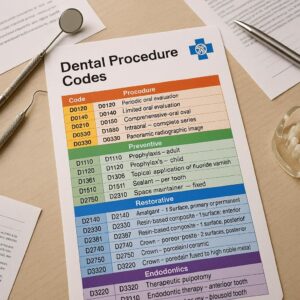
Dental Codes for Blue Cross
Table of Contents
ToggleWhat You Will Learn in This Guide
-
The basics: What dental codes are and why they matter.
-
The connection: How these codes interact specifically with Blue Cross Blue Shield plans.
-
Common scenarios: Understanding codes for cleanings, fillings, crowns, and major work.
-
Troubleshooting: What to do if a code is denied or if you receive a surprise bill.
-
Resources: How to look up codes and communicate effectively with your dentist and insurer.
Let’s get started on the path to becoming a savvy dental insurance consumer.
What Are Dental Codes? The Language of Your Dental Benefits
Before we dive into the specifics of Blue Cross, we need to understand the fundamental language used by all dental insurance companies in the United States: the CDT Code.
The CDT Code: A National Standard
CDT stands for Current Dental Terminology. It is a set of codes maintained and published by the American Dental Association (ADA). Think of it as the dictionary of dentistry. Every year, the ADA updates these codes to reflect new technologies, procedures, and best practices.
Every time your dentist performs a procedure—from a simple oral exam to a complex surgical extraction—they assign a specific five-character alphanumeric code to that service. This code starts with the letter “D” (for Dental) followed by four numbers (e.g., D0150, D2740).
These codes are essential for several reasons:
-
Standardization: They ensure that a “comprehensive oral evaluation” means the same thing to a dentist in California as it does to a dentist in New York.
-
Billing: Dentists use these codes to submit claims to insurance providers like Blue Cross.
-
Coverage Determination: Blue Cross uses these codes to determine if a procedure is a covered benefit under your specific plan and how much they will pay.
The Two-Part System: Procedure Code + Tooth Number/Surface
Often, a simple code isn’t enough. For many procedures, the insurance company also needs to know the exact location in your mouth.
-
Procedure Code: Tells them what was done. (e.g., D2391 – Resin-based composite filling, one surface, posterior).
-
Toeth Numbering System: Tells them where it was done. Most dentists in the U.S. use the Universal Numbering System, where adult teeth are numbered 1 to 32 (starting with the upper right wisdom tooth as #1 and ending with the lower right wisdom tooth as #32).
-
Surface Code: For fillings, they also need to know which surfaces of the tooth were worked on (e.g., M = Mesial, O = Occlusal, D = Distal, B = Buccal, L = Lingual).
So, a complete claim for a filling might look like: D2391 – Tooth #19 – MOD. This tells Blue Cross exactly what was done (a three-surface composite filling) on a specific tooth (lower left first molar).
Blue Cross and Dental Codes: How They Work Together
Blue Cross Blue Shield (BCBS) is not just one company. It is a federation of 34 separate and independent companies that operate in different states. This means a Blue Cross plan in Texas (BCBSTX) might have slightly different coverage rules than a plan in Illinois (BCBSIL).
However, they all rely on the same foundation: the CDT codes. Understanding how BCBS applies these codes to your specific policy is the key to avoiding surprises.
Your Benefits Are Tied to Codes
Your dental insurance policy is a contract. In that contract, it lists which CDT codes are covered and at what percentage. Generally, dental benefits are categorized into three tiers:
-
Preventive Care (Class 1): Typically covered at 80%-100%. These codes include routine exams (D0120), cleanings (D1110), and fluoride treatments (D1208). Blue Cross usually wants you to get these services because they prevent more costly problems down the road.
-
Basic Restorative Care (Class 2): Usually covered at 50%-80%. These codes cover fillings (D2140-D2394), simple extractions (D7140), and root canals (D3310-D3330).
-
Major Restorative Care (Class 3): Often covered at 50% or less. This tier includes crowns (D2710-D2799), bridges (D6200-D6999), dentures (D5110-D5899), and implants (D6000-D6199).
The key takeaway is that your out-of-pocket cost is directly linked to the code assigned to your procedure. If your dentist says you need a “white filling,” the specific code (e.g., D2330 for a one-surface front tooth filling vs. D2394 for a four-surface back tooth filling) will determine the final cost and how much Blue Cross contributes.
In-Network vs. Out-of-Network and Code Pricing
Another critical factor is whether your dentist is “in-network” with Blue Cross.
-
In-Network: Your dentist has agreed to a contracted rate for each CDT code. They cannot bill you for more than this amount. Blue Cross calculates their payment based on this rate.
-
Out-of-Network: Your dentist has not agreed to a specific rate. They may charge their usual fee. Blue Cross will still pay their portion based on what they deem the “reasonable and customary” charge for that code in your area. You may be responsible for the difference between your dentist’s fee and what Blue Cross pays, a practice known as “balance billing.”
Important Note for Readers:
Always check with your dentist’s office to confirm if they are in-network with your specific Blue Cross plan. An office might be in-network with Blue Cross of Alabama but out-of-network with Blue Cross of California, even if you have a Blue Cross card. It is best to verify before your appointment.
A Walkthrough of Common Dental Codes by Category
To make this guide practical, let’s break down the most common dental codes you are likely to encounter. This list is not exhaustive but covers the vast majority of routine and restorative dental visits.
Preventive Codes (D1000-D1999)
These are the codes for services that prevent the onset or progression of dental disease. Blue Cross plans usually cover these generously.
| Code | Description | What It Means for You |
|---|---|---|
| D0120 | Periodic oral evaluation | This is the code for a routine check-up of an established patient. It’s what you typically get during your six-month recall visit. |
| D0150 | Comprehensive oral evaluation | This is a more thorough exam, usually for new patients. It involves reviewing your medical history, diagnosing conditions, and creating a treatment plan. |
| D0210 | Intraoral – complete series of radiographic images | The full set of 14-20 X-rays often taken at a first visit or every few years to see the entire mouth. |
| D0270-D0277 | Bitewing radiographic images | The “bitewing” X-rays taken during a routine check-up to look for cavities between teeth. D0270 is for one film, while D0274 is for four films. |
| D1110 | Prophylaxis – adult | This is the standard code for a routine dental cleaning for an adult. It involves removing plaque, calculus, and stains. |
| D1120 | Prophylaxis – child | A routine cleaning for a patient under 14. |
| D1208 | Topical application of fluoride | The fluoride gel, foam, or varnish applied after a cleaning to help prevent cavities. |
| D1351 | Sealant – per tooth | A plastic resin applied to the chewing surfaces of back teeth (usually in children) to prevent decay. |
Diagnostic Codes (D1000-D1999)
While often grouped with preventive care, diagnostic codes are specifically for identifying dental problems.
| Code | Description | What It Means for You |
|---|---|---|
| D0220 | Intraoral – periapical first radiographic image | An X-ray focused on one or two specific teeth, from root to crown. Often used to diagnose pain in a specific area. |
| D0230 | Intraoral – periapical each additional radiographic image | If your dentist needs X-rays of more individual teeth. |
| D0310 | Sialography | A rarely used but interesting code for an X-ray of the salivary glands and ducts. |
| D0460 | Pulp vitality tests | Tests used to determine if a tooth’s nerve is healthy or dying. |
Restorative Codes (D2000-D2999) – Fillings
This is where codes get specific. The code depends on the material used, the tooth’s location (anterior/front vs. posterior/back), and the number of surfaces.
| Code | Description | What It Means for You |
|---|---|---|
| D2140 | Amalgam – one surface, primary or permanent | A silver filling on one surface of a back tooth. |
| D2150 | Amalgam – two surfaces | A silver filling on two surfaces (e.g., between teeth and on top). |
| D2160 | Amalgam – three surfaces | A large silver filling covering three surfaces. |
| D2330 | Resin-based composite – one surface, anterior | A tooth-colored filling on one surface of a front tooth (canine to canine). |
| D2331 | Resin-based composite – two surfaces, anterior | A tooth-colored filling on two surfaces of a front tooth. |
| D2391 | Resin-based composite – one surface, posterior | A tooth-colored filling on one surface of a back tooth (premolar or molar). |
| D2392 | Resin-based composite – two surfaces, posterior | A tooth-colored filling on two surfaces of a back tooth. |
| D2393 | Resin-based composite – three surfaces, posterior | A tooth-colored filling on three surfaces of a back tooth. |
| D2394 | Resin-based composite – four or more surfaces, posterior | A very large tooth-colored filling covering most of the tooth. |
A Note on “White Fillings”: Many Blue Cross plans use the “Downgrade Rule” or “Alternate Benefit Provision.” If a back tooth needs a filling, your plan may only cover the cost of a silver (amalgam) filling, even if you choose a white (composite) one. You will then have to pay the difference in cost out-of-pocket. Always ask your dentist to clarify this before the procedure.
Endodontics (D3000-D3999) – Root Canals
Root canal codes are categorized by the type and number of roots a tooth has.
| Code | Description | What It Means for You |
|---|---|---|
| D3310 | Endodontic therapy, anterior tooth (excluding final restoration) | A root canal on a front tooth (incisor or canine), which typically has one root. |
| D3320 | Endodontic therapy, bicuspid tooth (excluding final restoration) | A root canal on a premolar, which usually has one or two roots. |
| D3330 | Endodontic therapy, molar (excluding final restoration) | A root canal on a back molar, which typically has three or four roots. This is the most complex and expensive root canal. |
| D3346 | Retreatment of previous root canal, anterior | If an old root canal on a front tooth fails and needs to be done again. |
| D3351 | Apexification/recalcification – initial visit | A procedure to encourage bone formation at the tip of an immature root. |
Periodontics (D4000-D4999) – Gum Health
These codes are for treating the gums and supporting structures of the teeth. A routine cleaning (prophylaxis) is for healthy gums. If you have gum disease, you will need periodontal procedures.
| Code | Description | What It Means for You |
|---|---|---|
| D4341 | Periodontal scaling and root planing – four or more teeth per quadrant | A deep cleaning procedure to treat gum disease by removing tartar and bacteria from below the gum line. This is often the first line of defense against periodontitis. |
| D4342 | Periodontal scaling and root planing – one to three teeth per quadrant | A deep cleaning for a smaller area. |
| D4355 | Full mouth debridement to enable comprehensive evaluation | This is a preliminary cleaning to remove heavy tartar buildup that prevents the dentist from doing a proper exam. A full cleaning (prophylaxis) would be scheduled later. |
| D4910 | Periodontal maintenance | A maintenance cleaning for patients with a history of gum disease. It is more involved than a standard prophy and is typically done every 3-4 months. |
Prosthodontics – Crowns, Bridges, and Dentures
This is major restorative work and involves the highest codes, both in number and in cost.
Crowns (D2700-D2799)
Crown codes specify the material used.
| Code | Description | What It Means for You |
|---|---|---|
| D2710 | Crown – resin-based composite (indirect) | A crown made of composite material, often used as a more economical option. |
| D2740 | Crown – porcelain/ceramic substrate | An all-porcelain crown, popular for front teeth due to its natural look. |
| D2750 | Crown – porcelain fused to high noble metal | A crown with a metal core and porcelain baked on top. It is very strong and durable. |
| D2751 | Crown – porcelain fused to predominantly base metal | Similar to D2750 but with a less expensive, non-precious metal core. |
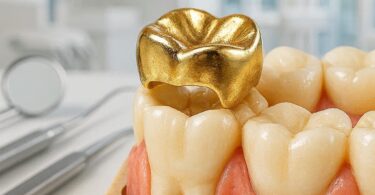
| D2790 | Crown – full cast high noble metal | A solid gold or other high-noble metal crown, prized for its excellent fit and wear resistance. |
Bridges and Dentures (D5000-D6999)
These codes are for replacing missing teeth. A bridge is fixed, while dentures are removable.
| Code | Description | What It Means for You |
|---|---|---|
| D5110 | Complete denture – maxillary | A full upper denture. |
| D5120 | Complete denture – mandibular | A full lower denture. |
| D5211 | Partial denture – maxillary, resin base | An upper removable partial denture (flipper) with a plastic base. |
| D5213 | Partial denture – maxillary, cast metal framework with resin saddles | A higher-quality upper partial denture with a metal framework for better fit and durability. |
| D6240 | Pontic – porcelain fused to high noble metal | This is the code for the fake tooth (pontic) in a bridge that replaces the missing one. |
Oral Surgery (D7000-D7999) – Extractions
| Code | Description | What It Means for You |
|---|---|---|
| D7140 | Extraction, erupted tooth or exposed root (elevation and/or forceps removal) | A simple, routine tooth removal where the tooth is visible in the mouth. |
| D7210 | Extraction, erupted tooth requiring removal of bone and/or sectioning of tooth | A more complicated extraction where the tooth may be broken or the dentist needs to cut it into pieces to remove it. |
| D7220 | Removal of impacted tooth – soft tissue | Removing a wisdom tooth that is covered only by gum tissue. |
| D7230 | Removal of impacted tooth – partially bony | Removing a wisdom tooth that is partially covered by bone. |
| D7240 | Removal of impacted tooth – completely bony | The most complex wisdom tooth removal, where the tooth is fully encased in the jawbone. |
How to Read Your Blue Cross Explanation of Benefits (EOB)
After your dental visit, Blue Cross will send you an EOB. This is not a bill, but an explanation of how your claim was processed. Learning to read it helps you verify that everything was coded correctly.
Here are the key sections you will find:
-
Patient and Provider Information: Your name, your dentist’s name, and the date of service.
-
Procedure Codes (CDT): The specific codes we discussed above (e.g., D1110).
-
Tooth and Surface: The specific tooth number and surfaces, if applicable.
-
Provider Charge: The full amount your dentist billed for the procedure.
-
Plan Discount / Allowed Amount: If your dentist is in-network, this is the pre-negotiated rate that Blue Cross has agreed is the maximum allowable fee. Your dentist must accept this as full payment.
-
Amount Paid by Plan: What Blue Cross paid the dentist.
-
Patient Responsibility: What you owe. This could be your copay, coinsurance, or deductible.
-
Plan Remarks: This is the most important section. If a code was not covered, or if they paid for a different code (like an amalgam instead of a composite), the reason will be explained here in code or short phrases (e.g., “Benefit provided is for least expensive alternate treatment”).
What To Do When a Code is Denied or Underpaid
Sometimes, things go wrong. A claim might be denied, or you might receive a bill that is much higher than expected. Here is a step-by-step approach to resolving it.
-
Review the EOB: Check the “Plan Remarks” section. Why was it denied? Common reasons include:
-
Frequency Limitation: Your plan only covers two cleanings a year, and this was your third.
-
Missing Information: A tooth number or surface wasn’t included.
-
Alternate Benefit: They paid for a different code (e.g., D2140 amalgam instead of D2391 composite).
-
Not a Covered Benefit: Your specific plan does not cover that particular code (common for some cosmetic procedures).
-
-
Call Your Dentist’s Billing Office: They are your best ally. They have dealt with insurance companies before. Ask them:
-
“Did you receive the payment from Blue Cross?”
-
“Can you explain this charge to me?”
-
“Would you be willing to resubmit the claim with a different code or more information if there was an error?”
-
-
Contact Blue Cross Customer Service: The number is on the back of your insurance card. Have your EOB and policy information ready. Ask them to explain the denial in plain English. If you believe it was a mistake, they can initiate a review.
Quote from a Dental Billing Specialist:
“The vast majority of insurance issues are due to simple coding errors or missing information. A tooth number might be missing, or a surface code was left off. Before you panic, just call your dentist’s office. We see this every day, and we are usually the fastest way to get it fixed for you.”
Conclusion
Understanding dental codes for Blue Cross doesn’t require a degree in medical billing. It simply requires a bit of curiosity and a willingness to look at the paperwork. By learning the basic structure of CDT codes and knowing where to find the key information on your treatment plan and EOB, you transform from a passive patient into an active participant in your healthcare.
Remember, the codes are just a tool. A tool for your dentist to accurately describe your treatment, and a tool for Blue Cross to apply your benefits consistently. The more comfortable you are with this system, the better equipped you’ll be to manage your oral health and your budget for years to come.
Frequently Asked Questions (FAQ)
1. What is the difference between a CDT code and a CPT code?
CDT (Current Dental Terminology) codes are specifically for dental procedures and are published by the ADA. CPT (Current Procedural Terminology) codes are used for medical procedures and are published by the AMA. Dental insurance claims use CDT codes; medical insurance claims use CPT codes.
2. My dentist gave me a treatment plan with a code D9999. What is that?
D9999 is a “unspecified” administrative code. It is often used for a service that doesn’t have its own specific code yet, such as certain types of case management or coordination of benefits. You should ask your dentist for a detailed explanation of what this charge represents.
3. Will Blue Cross cover a code for a dental implant (D6010)?
Coverage varies widely by plan. Many traditional Blue Cross dental PPO plans may not cover implants or may cover them only under the major services category with a high coinsurance. However, some newer or employer-sponsored plans are starting to include implant coverage. You must check your specific plan’s Summary of Benefits.
4. Why did Blue Cross pay for a different code than my dentist used?
This is often due to the “Least Expensive Alternate Treatment” (LEAT) clause. If your plan considers a procedure (like a composite filling on a back tooth) to have a less expensive, clinically acceptable alternative (like an amalgam filling), they will base their payment on the cheaper code. You are responsible for the difference.
5. Can I look up a dental code myself?
Yes. The American Dental Association publishes the CDT codebook, which is the definitive source. However, you can often find descriptions by searching online for the specific code (e.g., “what is D4341”). Keep in mind that online sources should be used for informational purposes only, and you should always confirm with your dentist.
Additional Resource
For the most authoritative and up-to-date information on dental codes, including the official coding manual and coding changes for the current year, please visit the American Dental Association’s official store: ADA.org/Shop
-
Disclaimer: This article is for informational purposes only and does not constitute legal, financial, or medical advice. Insurance plans and coverage details vary. Always consult with your dental provider and your specific Blue Cross Blue Shield plan documents for information regarding your individual coverage.
-
Author: American Web Writing Team
-
Date: March 07, 2026