If you’ve recently left the dentist’s office with a sore jaw or a nagging feeling that your teeth just aren’t fitting together the way they used to, you might have heard the term “bite adjustment.” Later, when reviewing your treatment plan or the claim sent to your insurance, you probably saw a strange code: D9952.
It looks clinical and confusing, but understanding this code is the key to understanding a procedure that can save your teeth from years of damage. Whether you are dealing with a new dental crown that feels “too high,” grinding your teeth at night, or simply experiencing unexplained tooth sensitivity, a bite adjustment—officially known as an occlusal adjustment—might be the solution.
This guide is designed to walk you through everything you need to know about the dental code for bite adjustment. We’ll cut through the dental jargon, explain what the procedure entails, discuss how much it might cost, and help you understand why your dentist might recommend it.
Dental Code for Bite Adjustment
Important Note for Readers: The world of dental coding (CDT codes) is standardized by the American Dental Association (ADA). This article focuses on the most common code used for bite adjustments in general practice. However, your specific situation may vary, and your dentist will always choose the code that best fits the procedure performed.
Table of Contents
ToggleWhat is a Bite Adjustment (Occlusal Adjustment)?
Before we dive into the code itself, let’s talk about the procedure. In the dental world, your “bite” is technically called your occlusion. It refers to the way your upper and lower teeth come together when you close your mouth.
An occlusal adjustment (bite adjustment) is a procedure designed to perfect this meeting. It involves the careful and precise reshaping of the chewing surfaces of your teeth to improve how they contact each other. The goal is to create harmony so that all your teeth are doing their fair share of the work when you chew, and no single tooth is taking the brunt of the force.
Think of it like a finely tuned engine. If one piston is firing too hard, the whole system is off-balance. A bite adjustment re-balances the engine of your mouth.
Why Would You Need a Bite Adjustment?
There are several reasons your dentist might recommend this procedure. It’s not just about comfort; it’s about long-term dental health.
-
After a New Restoration: This is the most common reason. After getting a new crown, filling, or bridge, the restoration might be ever-so-slightly too high. Because your teeth are embedded in ligaments that have “memory,” you might not notice it immediately, but over time, that high spot can cause significant pain, sensitivity to cold, and even loosen the new crown.
-
Teeth Grinding (Bruxism): Chronic grinding or clenching wears down the enamel unevenly. Over the years, this creates flat spots and an unstable bite. An adjustment can smooth these uneven surfaces, creating a more stable platform and potentially reducing muscle strain.
-
Orthodontic Relapse: After braces, teeth can shift slightly over time. This subtle movement can alter your bite.
-
TMD/TMJ Symptoms: If you suffer from jaw pain, popping, or headaches, an uneven bite might be a contributing factor. By creating a balanced occlusion, the muscles of the jaw can relax.
-
Sensitive Teeth: A single tooth receiving too much force can become mobile or sensitive. Balancing the bite relieves that pressure.
The Procedure: What Actually Happens?
Let’s demystify the process. It sounds aggressive—reshaping your teeth—but it’s actually a very gentle, painless procedure.
-
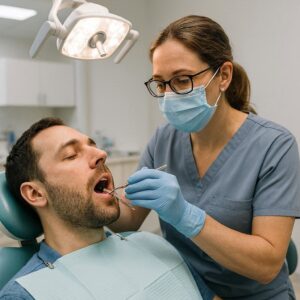
Analysis: Your dentist will have you bite down on a special colored paper or wax. This marks your teeth, showing the high points of contact.
-
Marking: They will look at these marks, often using a microscope or loupes for precision.
-
Adjustment: Using a fine, high-speed handpiece (dental drill) with a very fine bur, they will gently polish and reshape the identified spots. This removes only a microscopic layer of enamel—thinner than a piece of hair.
-
Re-check: You’ll bite down on the paper again to see if the adjustment worked. This process is repeated until the dentist achieves a harmonious balance.
It is important to know that you will not need anesthesia for this. They are working on enamel, which has no nerves.
The Specific Dental Code: D9952
Now, let’s get to the heart of the matter. In the Current Dental Terminology (CDT) code set, the primary code for this procedure is:
D9952 – Occlusal Adjustment – Complete
This is the code you will see on 99% of treatment plans for a bite adjustment. But what does “complete” mean?
-
D (Diagnostic): The “D” simply denotes that it is a dental procedure code.
-
9952: This is the specific number assigned to the procedure.
The term “Complete” is crucial. It indicates that the dentist is performing an adjustment of the entire dentition (all the teeth) to achieve a harmonious relationship. This is different from a “limited” adjustment, which might be done on a single tooth or a small area.
D9952 vs. Other Related Codes
To avoid confusion, it’s helpful to see how D9952 fits in with other codes you might encounter.
| CDT Code | Procedure Name | Description | When It’s Used |
|---|---|---|---|
| D9952 | Occlusal Adjustment – Complete | Reshaping all or most of the teeth in both arches to create a balanced bite. | For generalized bite issues due to grinding, TMD, or overall wear. |
| D9951 | Occlusal Adjustment – Limited | Reshaping a small area, or just one or two teeth. | Primarily used after placing a single filling or crown to correct a “high spot.” |
| D9930 | Treatment of Complications | A broad code for handling post-surgical issues. | Rarely used for bite issues; more for infection or bleeding. |
| D4910 | Periodontal Maintenance | Cleaning procedure for patients with gum disease. | Sometimes confused because bite adjustment can be part of complex periodontal therapy, but it is a separate procedure with its own code. |
Key Takeaway: If you go in for a simple “my new crown feels high,” and the dentist spends 5 minutes adjusting it, they will likely use D9951 (Limited) . If you are undergoing comprehensive treatment for jaw pain or severe wear, the dentist will use D9952 (Complete) . Always ask your dentist which code they are using so you understand the scope of the work.
The Step-by-Step Process of a Complete Occlusal Adjustment (D9952)
A complete occlusal adjustment is a meticulous art. It requires skill, patience, and a keen eye. Here is a breakdown of what happens during a D9952 procedure, from start to finish.
Phase 1: The Diagnosis and Treatment Planning
Your dentist won’t just start drilling. The process begins with a thorough evaluation.
-
Medical and Dental History: Discussing symptoms like headaches, jaw pain, or muscle fatigue.
-
Clinical Examination: Feeling the jaw muscles for tenderness, listening for jaw joint clicks, and observing wear patterns on your teeth.
-
Study Models: Sometimes, the dentist will take impressions of your teeth to create plaster models. They can study these models on a special instrument (an articulator) to see exactly how your teeth hit each other without you in the chair.
-
Photographs: Intraoral photos are taken to document the wear patterns before starting.
Phase 2: The Adjustment Session(s)
Depending on the complexity of your case, a complete adjustment (D9952) might take one or multiple visits.
-
Initial Equilibration: The dentist will begin by using articulation paper to mark the “premature contacts”—the spots where your teeth hit first and hardest.
-
Selective Reduction: Using a fine diamond or carbide bur, they will gently reshape these high spots. This is done with a “spritz” of water to keep the tooth cool and prevent any heat sensitivity.
-
Refinement: The process of marking and adjusting is repeated, often with different colors of paper. A thinner, lighter color might be used to find more subtle contacts after the heavy ones are removed.
-
Smoothing and Polishing: Once the bite is balanced, the dentist will polish all the adjusted surfaces. This leaves the enamel smooth and glossy, which helps prevent plaque buildup.
Phase 3: Post-Treatment Evaluation and Follow-Up
-
Muscle Relaxation: After the appointment, your jaw muscles may feel “different” or more relaxed. This is normal as they are no longer having to work overtime to avoid the high spots.
-
Sensitivity: It is common to experience mild sensitivity to cold or air for a few days. This usually subsides quickly.
-
Follow-Up: Your dentist may want to see you in a week or two to re-evaluate the bite and make sure it feels perfect now that your muscles have fully relaxed.
Cost, Insurance, and Coverage for D9952
Money is often the biggest question mark when it comes to dental procedures. The cost for a bite adjustment can vary wildly based on where you live and the complexity of your case.
How Much Does a Bite Adjustment Cost?
Because it is a time-intensive, skill-based procedure, the cost reflects the dentist’s expertise and the time spent.
-
Limited Adjustment (D9951): You might pay between $100 and $300 for a simple, quick adjustment of a single tooth or crown.
-
Complete Adjustment (D9952): This is more involved and requires significantly more chair time. The cost typically ranges from $350 to $900 or more per arch (upper or lower jaw). If both arches are done, the total can be between $700 and $1,800.
Factors influencing cost:
-
Geographic location (urban areas tend to be higher).
-
The dentist’s experience and specialty (a Prosthodontist may charge more).
-
The number of appointments required.
Will My Dental Insurance Cover D9952?
This is where it gets tricky. Dental insurance is designed to fix problems, not necessarily to perfect your bite. Coverage depends entirely on your specific plan and the reason for the procedure.
| Scenario | Insurance Classification | Likelihood of Coverage |
|---|---|---|
| Adjusting a new crown that is too high (D9951). | This is often considered part of the crown procedure. Some insurance plans bundle it into the crown cost. Others see it as a separate, necessary step for the success of the crown. | Moderate. Many plans will cover it, but you may have to pay a separate copay. |
| Adjusting due to grinding/wear (D9952). | This is frequently classified as “Cosmetic” or “Not a Covered Benefit” by many basic insurance plans. | Low. Standard PPOs and HMOs often exclude occlusal adjustments for wear and tear. |
| Adjusting as part of TMD treatment (D9952). | If the adjustment is deemed medically necessary for treating Temporomandibular Joint Disorder (TMD), it may have separate, higher medical benefits. | Variable. You might need to submit it to your medical insurance, not dental. Pre-authorization is crucial. |
How to Talk to Your Insurance Company
Before scheduling a D9952 procedure, take these steps:
-
Ask for a Pre-Determination of Benefits: Your dentist’s office can send a claim to your insurance company before the work is done. The insurance will send back an estimate of what they will pay (if anything).
-
Clarify the “Why”: Ask your dentist to write a detailed narrative in the claim explaining the medical necessity. For example, instead of just “occlusal adjustment,” the notes might say “occlusal adjustment to alleviate chronic myofascial pain and prevent further tooth structure loss due to bruxism.”
-
Check Your Benefits Booklet: Look for exclusions related to “occlusal therapy” or “bite problems.”
The Long-Term Benefits: Why Bite Health Matters
Undergoing a bite adjustment is an investment in the longevity of your teeth. Here’s why taking this step is so important.
Preventing Catastrophic Fractures
Teeth are strong, but they aren’t designed to handle pinpoint, excessive force. When a single cusp is taking all the pressure every time you swallow (which you do about 2,000 times a day!), it acts like a wedge. Over time, this can cause the tooth to crack or even split. A split tooth often cannot be saved and requires extraction. A simple bite adjustment relieves that pressure, preventing this worst-case scenario.
Protecting Your Restorations
Dental crowns, bridges, veneers, and large fillings are expensive investments. An unbalanced bite can cause these restorations to chip, crack, or become loose. By ensuring the bite is balanced, you are protecting the thousands of dollars you may have already spent on your smile.
Alleviating Chronic Pain
The muscles that move your jaw are some of the most used muscles in your body. When your bite is off, these muscles have to work harder to guide your jaw around the “bumps.” This constant tension can lead to chronic tension headaches, neck pain, shoulder pain, and earaches. Balancing the bite allows these muscles to relax, often providing significant pain relief.
Common Myths About Bite Adjustments
Let’s clear up some common misconceptions about this procedure.
-
Myth: “It will wear my teeth down.”
-
Fact: The procedure removes an incredibly tiny amount of enamel—far less than what is lost during a professional polishing or what is worn away by years of grinding. The goal is to prevent further uneven wear.
-
-
Myth: “It’s a painful procedure.”
-
Fact: There is no pain during the procedure because the dentist is only working on enamel. You might feel vibration, but no sharp pain. Any post-treatment sensitivity is usually mild and temporary.
-
-
Myth: “Once you do it, you have to keep doing it forever.”
-
Fact: A properly done complete occlusal adjustment is usually permanent. Unless you have significant orthodontic movement or major dental work later, the bite should remain stable for years, if not a lifetime.
-
-
Myth: “It’s just cosmetic.”
-
Fact: While it can make your teeth look more even, it is primarily a functional procedure aimed at preserving dental health, preventing fractures, and alleviating pain.
-
Bite Adjustment After Crowns and Fillings (D9951)
Because this is the most frequent scenario for patients, it deserves a closer look. You just got a beautiful new crown. It looks perfect. But something feels… off.
The “High Crown” Feeling
When a crown is cemented, the dentist checks the bite, but the local anesthesia (Novocaine) used during the procedure can make it difficult for you to feel if it’s truly perfect. Once the numbness wears off, your proprioception (the sense of where your body is in space) kicks in, and you feel it immediately.
Signs your new crown needs an adjustment:
-
The tooth hits before all your other teeth touch.
-
Sensitivity to tapping or percussion.
-
A feeling that the tooth is “loose” (it’s not loose; the ligament is just being compressed by the high spot).
-
Pain when chewing on that side.
What to Do
Don’t wait. If your new crown feels high, call your dentist immediately. They will bring you in for a quick visit. Using code D9951, they will mark the high spot on the crown (or the opposing tooth) and polish it down. The relief is usually immediate. This is a normal part of the restorative process and is handled routinely by dental offices.
Frequently Asked Questions (FAQ)
Q: Is a bite adjustment the same as getting my teeth “shaved down”?
A: That is a common way to describe it, but it’s not entirely accurate. “Shaving down” implies taking a lot off. In reality, a bite adjustment is a precise, artistic reshaping of microscopic high points to improve function, not a drastic reduction of tooth structure.
Q: Will my teeth look different after a D9952 procedure?
A: In most cases, no. The changes are so subtle that no one will notice a difference in your smile. If the adjustment is being done for severe wear, the dentist might reshape the edges slightly, but the goal is always to make the teeth look natural and even, not shorter or smaller.
Q: How long does a complete occlusal adjustment take?
A: A complete adjustment (D9952) can take anywhere from 45 minutes to 2 hours, depending on the complexity of your bite. It may also be broken up into two or more appointments to prevent jaw fatigue.
Q: Is there any age limit for this procedure?
A: No. However, it is rarely performed on children and adolescents whose teeth and jaws are still growing and changing. It is most common in adults with a stable, mature bite.
Q: What happens if I don’t fix a bad bite?
A: Ignoring it can lead to a cascade of problems: chipped teeth, loose teeth, chronic jaw pain, headaches, and the eventual need for more complex and expensive dental work like root canals or implants.
Conclusion
Navigating the world of dental codes can feel overwhelming, but understanding D9952 (Occlusal Adjustment – Complete) and its counterpart D9951 (Limited) empowers you to have informed conversations with your dentist. Whether you’re dealing with a bothersome high spot on a new crown or chronic jaw pain from years of grinding, a bite adjustment is a safe, minimally invasive, and highly effective procedure. It’s a preventative measure that protects your teeth, preserves your dental investments, and can dramatically improve your overall comfort.
Additional Resources
For further reading and to verify the official coding standards, you can visit the American Dental Association’s official page for the CDT code set:
ADA.org – CDT (Code on Dental Procedures and Nomenclature) (This link provides the authoritative source for all dental codes.)
Disclaimer:
The information contained in this article is for informational and educational purposes only and is not a substitute for professional dental advice, diagnosis, or treatment. Always seek the advice of your qualified dentist or other qualified health provider with any questions you may have regarding a medical condition or treatment. Reliance on any information provided in this article is solely at your own risk.