If you have white spots, dull patches, or mild stains on your teeth, you may have heard about a gentle treatment called enamel microabrasion. It is a simple, non-invasive procedure that can make those imperfections almost disappear.
But when you look at a dental bill or an insurance claim form, one question often comes up:
What is the dental code for enamel microabrasion?
The answer is not as straightforward as you might think. And that is exactly why I wrote this guide.
In this article, we will walk through the correct CDT codes, when to use them, how insurance works (or does not work), and what you should expect to pay. No jargon overload. No fake codes. Just honest, practical information.
What Is Enamel Microabrasion? (A Quick Refresher)
Before we dive into codes, let us make sure we are talking about the same procedure.
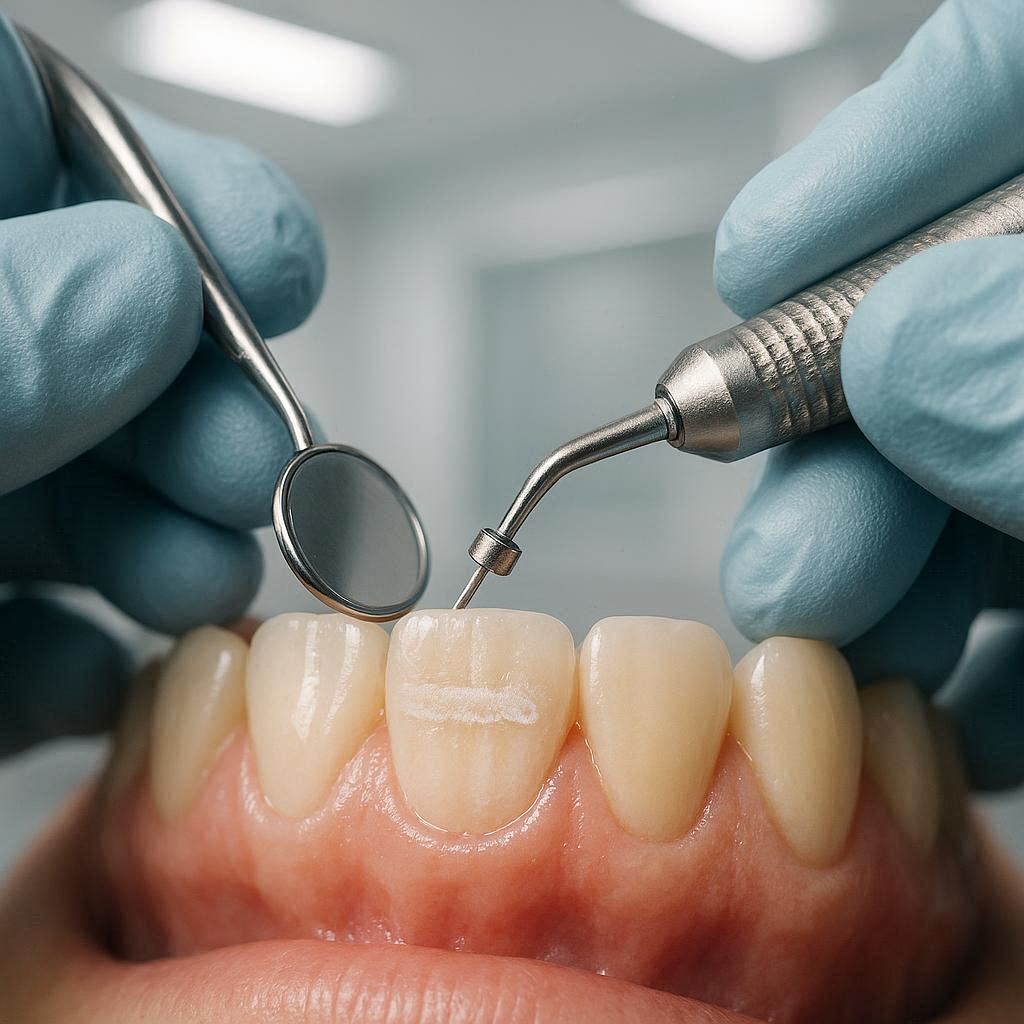
Enamel microabrasion is a technique used to remove superficial stains and irregularities from the outer layer of your teeth—the enamel. It uses a mix of mild acid and fine pumice (a grainy paste) that is rubbed gently on the tooth surface. This removes a very thin layer of enamel, taking stains with it.
Common uses include:
- White spot lesions (often from braces or too much fluoride)
- Mild fluorosis stains
- Enamel hypoplasia (thin or patchy enamel)
- Dull, mottled appearance
It is not for deep stains, cavities, or severe discoloration. That is usually the job of whitening, veneers, or crowns.
Important note: Enamel microabrasion removes a tiny amount of enamel—usually less than 0.1mm. It is safe when done by a trained professional, but it cannot be repeated many times on the same tooth.
Now, let us get to the code.
The Main Dental Code for Enamel Microabrasion: D9970
The most widely accepted and correct dental code for enamel microabrasion is D9970.
This code belongs to the CDT (Current Dental Terminology) code set, published by the American Dental Association (ADA). Here is the official description:
D9970 – Enamel microabrasion
Mechanical and chemical removal of superficial enamel stains and irregularities.
That is the code you will see on dental claim forms and treatment estimates.
What D9970 includes
When a dentist bills D9970, it typically covers:
- Isolation of the tooth or teeth (keeping them dry)
- Application of the abrasive compound (acid + pumice)
- Mechanical rubbing (often with a rubber cup or brush)
- Rinsing and drying
- Polishing the treated area
Most dentists perform it on one to several teeth in the same session. The code is usually billed per tooth, but sometimes per arch or per session depending on the office. Always ask for a written estimate.
What D9970 does NOT include
Do not confuse D9970 with:
- D9972 – External bleaching (tray whitening)
- D9973 – Internal bleaching (for root canal treated teeth)
- D2980 – Enameloplasty (reshaping teeth without abrasion)
- D1351 – Sealants (preventive resin coating)
If your dentist suggests microabrasion but uses a different code, ask why. It could be a mistake or a billing workaround. We will talk about that later.
Is D9970 the Only Code? Here Is the Honest Truth
Officially, D9970 is the only specific code for enamel microabrasion in the current CDT manual (as of 2024–2026). However, in real-world dental practice, you may see other codes used for similar or combined procedures.
Common alternative or adjacent codes
| CDT Code | Description | When it might be used instead of D9970 |
|---|---|---|
| D9910 | Application of desensitizing agent | If microabrasion causes sensitivity and treatment focuses on relief |
| D9930 | Treatment of complications (post-op) | Rare. Only if microabrasion leads to unexpected enamel damage |
| D9986 | Missed appointment | Not for the procedure itself |
| D2990 | Resin infiltration (e.g., Icon) | For white spots – different mechanism but similar result |
Why would a dentist use a different code?
- Some insurance plans do not recognize D9970.
- The dentist may combine microabrasion with another service (e.g., polishing under D1120 for a child).
- The office uses outdated software.
Reader note: If your dentist uses a code you do not recognize, ask them: “Is this code the same as D9970 for enamel microabrasion?” A good dentist will explain without hesitation.
Does Dental Insurance Cover Enamel Microabrasion (D9970)?
This is where most people get frustrated. Let me be direct.
Most dental insurance plans do NOT cover enamel microabrasion under D9970.
Why? Because insurance companies often classify it as a cosmetic procedure rather than a medically necessary treatment.
When insurance might pay
There are a few exceptions:
- Medical necessity – If the enamel defect causes pain, sensitivity, or leads to decay (very rare).
- Orthodontic complications – Some plans cover white spot removal after braces if it is part of post-orthodontic care.
- State Medicaid programs – A few states cover D9970 for children with severe fluorosis. Call your local Medicaid dental office to confirm.
What you can expect to pay out-of-pocket
Since most patients pay for enamel microabrasion without insurance, here are typical cash prices in the US (2025–2026):
| Number of teeth | Average cost range (no insurance) |
|---|---|
| 1–2 teeth | $75 – $150 |
| 3–6 teeth | $150 – $300 |
| Full arch (6–10 teeth) | $300 – $600 |
| Combined with whitening | +$100 – $250 |
Many dental offices offer a discount for upfront payment or membership plans that reduce these costs by 15–30%.
Tip: Always ask: “Do you offer a cash discount for D9970?” You may save $50 or more.
Step-by-Step: What Happens During a D9970 Appointment
To help you understand why the code is billed the way it is, let me walk you through a typical microabrasion session.
Step 1: Evaluation (usually under D0150 or D0120)
The dentist examines your teeth, identifies stains, and confirms you are a good candidate for microabrasion. This is a separate exam code.
Step 2: Isolation (included in D9970)
Your teeth are dried and isolated using cotton rolls or a rubber dam.
Step 3: Application of abrasive paste
A mixture of 18% hydrochloric acid and fine pumice (or a commercial product like Opalustre) is applied to the stain.
Step 4: Mechanical rubbing
The dentist gently rubs the paste for 5–15 seconds per tooth using a slow-speed handpiece with a rubber cup. This is repeated 3–5 times.
Step 5: Rinsing and evaluation
The area is rinsed and dried. The dentist checks the result. Sometimes a second session is needed after 1–2 weeks.
Step 6: Fluoride application (often added as D1208)
A fluoride varnish is applied to reduce sensitivity and strengthen the treated enamel. This is usually billed separately.
Step 7: Home care instructions
You will be told to avoid staining foods (coffee, tea, berries) for 24–48 hours. You may also use a desensitizing toothpaste for a week.
Patient quote: “I had three white spots on my front teeth from braces. The D9970 procedure took 20 minutes. No shots, no pain. Each spot faded by about 80%. Best $180 I ever spent on my smile.”
— Sarah, 34, Ohio
Important Clinical Limits of D9970 (Do Not Ignore These)
Enamel microabrasion is wonderful for the right cases. But it has limits. Here are honest warnings every patient should know.
❌ Do not use D9970 for:
- Deep brown or gray stains (those need whitening or veneers)
- Active cavities or cracks
- Teeth with severe enamel loss (erosion)
- Tetracycline stains (microabrasion barely helps)
✅ Great candidates for D9970:
- White spot lesions (mild to moderate)
- Mild fluorosis (snow-capped or chalky white patches)
- Post-orthodontic decalcification
- Enamel that feels rough or chalky
Long-term expectations
- Results are permanent because the stained enamel is removed, not just bleached.
- Treated areas may look slightly shinier or smoother than untreated enamel.
- Some patients need a second D9970 session after 6–12 months.
- The treated area will not stain again easily, but the rest of the tooth can.
Can a Hygienist Perform D9970? Legal and Ethical Facts
This is a common question, especially in large dental offices.
Legally: In most US states, enamel microabrasion (D9970) is a doctor-level procedure because it removes enamel. Only a dentist, or a hygienist under direct supervision of a dentist (dentist in the room), can perform it.
Ethically: Some offices let hygienists perform microabrasion under general supervision. That is a gray area. The ADA says D9970 requires a diagnosis and treatment plan from the dentist.
Your right: Ask who will perform the procedure. If it is a hygienist, ask if the dentist will check the results before you leave.
How to Talk to Your Dentist About D9970 (Script Included)
You do not need to be an expert. Just use this simple conversation guide.
You: “I have white spots on my front teeth. Do you offer enamel microabrasion with code D9970?”
Dentist: “Yes, we do. Or we sometimes use a different code.”
You: “Can you please bill it as D9970 so I can check with my insurance? And can I get a written estimate?”
Dentist: “Sure.”
That is it. Polite, clear, and professional.
Frequently Asked Questions (FAQ)
1. Is D9970 the same as teeth whitening?
No. Whitening (D9972) bleaches the tooth from the inside out. Microabrasion removes a thin outer layer of enamel. They are different codes and different procedures.
2. Can I claim D9970 on my FSA or HSA?
Yes. In most cases, you can use Flexible Spending Account (FSA) or Health Savings Account (HSA) funds for D9970. Keep your itemized receipt. If your plan excludes cosmetics, check first.
3. How many times can D9970 be billed for the same tooth?
Usually once or twice in a lifetime. Removing more than 0.2–0.3mm of enamel weakens the tooth. Good dentists will refuse to repeat it unnecessarily.
4. Does Medicare cover D9970?
No. Medicare dental coverage is very limited (mostly extractions and exams for specific conditions). Enamel microabrasion is not covered.
5. What is the difference between D9970 and D2990 (resin infiltration)?
D2990 (Icon) uses a liquid resin that fills white spots without removing enamel. D9970 removes enamel. Both treat white spots. Resin infiltration is newer and more expensive ($300–600 per tooth).
6. My dentist used D9910 instead of D9970. Is that wrong?
Not necessarily. If your main problem was sensitivity after microabrasion, D9910 is correct for that visit. But for the abrasive procedure itself, D9970 is the right code.
7. Can I buy an at-home kit and bill it under D9970?
Absolutely not. D9970 is a professional code. At-home kits are not the same and can damage your enamel. Do not try to bill insurance for DIY work.
Comparison Table: D9970 vs Other Stain Removal Codes
| Feature | D9970 (Enamel microabrasion) | D9972 (External bleaching) | D2990 (Resin infiltration) |
|---|---|---|---|
| Removes enamel | Yes (very thin layer) | No | No |
| Works on white spots | Excellent | Poor to fair | Excellent |
| Works on yellow stains | Poor | Excellent | No |
| Permanent result | Yes | No (needs retouch) | Yes |
| Average cost per tooth | $75–150 | N/A (trays: $300–600) | $300–600 |
| Insurance coverage | Rare | No | Rare |
| Session time | 20–30 min | Home trays: weeks | 30–45 min |
Additional Resource: Where to Verify CDT Codes Yourself
Do not take anyone’s word for it—including mine. You can always check the official CDT codes directly.
ADA CDT Code Book
https://www.ada.org/en/publications/cdt
Note: The current year’s code book costs around $150, but your local dental or public library may have a reference copy.
Free alternative: Search for “CDT 2026 D9970” on the ADA’s public code lookup tool (limited access but useful for verification).
You can also ask your dentist’s billing coordinator to print the official code description from their practice management software. They should be happy to do that.
A Word About Unrealistic or Leaked “Codes”
You may find websites claiming there is a secret or new dental code for enamel microabrasion, like D9999 (unspecified) or a “Z-code.” Ignore them.
The ADA updates CDT codes every two years. As of April 2026, there is no newer or alternative specific code for enamel microabrasion other than D9970. Any leaked or unofficial code is either fake, outdated, or being used unethically.
If a dentist suggests a different code without a good reason, get a second opinion.
Conclusion (Three Lines)
Enamel microabrasion is billed under CDT code D9970, which covers the mechanical and chemical removal of superficial stains. Insurance rarely pays for it, but out-of-pocket costs are often affordable—between $75 and $600 depending on how many teeth are treated. Always ask for a written estimate and verify the code with your dentist before any work begins.
Disclaimer: This article is for informational purposes only and does not constitute medical or billing advice. Dental codes and insurance policies change. Always consult with your dentist or insurance provider for your specific situation.
Author: Professional Dental Content Team
Date: April 22, 2026