When you sit in the dental chair for a routine checkup, you expect the dentist to look for cavities. But did you know they are also looking for something far more serious?
Every time you open your mouth for a cleaning, your dentist performs a silent, life-saving task: an oral cancer screening.
However, when the bill arrives, patients often ask one confusing question: What is that charge on my statement?
The answer usually involves a specific set of codes. Today, we are going to decode the mystery surrounding the dental code for oral cancer exam.
Whether you are a patient trying to understand your bill, a new dental assistant learning the ropes, or a practice manager looking for clarity, this guide is for you. We will break down code D0431, compare it to other common codes, explain costs, and show you why this simple exam is worth every penny.
What Exactly is an Oral Cancer Exam?
Before we dive into numbers and billing sheets, let’s talk about the procedure itself.
An oral cancer exam is a visual and physical inspection of your mouth. It is not painful. It takes about two to three minutes. During this exam, your dentist or hygienist will look for red or white patches, feel for lumps or hard spots, and check your neck and jaw for swelling.
They are looking for signs of squamous cell carcinoma, which is the most common form of oral cancer.
The exam usually includes:
- Checking the lips and the inside of the cheeks.
- Looking at the roof and floor of your mouth.
- Inspecting the tongue (top, bottom, and sides).
- Feeling the lymph nodes in your neck.
- Examining the tonsil area.
Most patients do not even realize it is happening because the dentist does it while they are counting your teeth.
Why This Exam Matters More Than You Think
Oral cancer is dangerous. But here is the good news: when caught early, survival rates are high.
The problem is that many cases are found late. Why? Because early-stage oral cancer often does not hurt. There is no pain. There is no obvious bump. By the time a patient feels a sore throat or trouble swallowing, the disease may have already spread.
This is why your dentist performs the exam every six months. They are looking for the invisible signs you cannot see in your bathroom mirror.
According to the Oral Cancer Foundation, roughly one person dies from oral cancer every hour of every day. However, early detection dramatically improves survival rates to over 80%.
That small swab or light in your mouth? It could save your life.
The Main Dental Code for Oral Cancer Exam: D0431
Now, let us answer the burning question.
The specific dental code for oral cancer exam is D0431.
This code is officially defined by the American Dental Association (ADA) as: “Adjunctive pre-diagnostic test that aids in detection of potentially premalignant and malignant oral lesions.”
Let us translate that into plain English.
D0431 is used when a dentist performs an advanced screening tool. This is not the basic visual check-up. This code is for the “extra” tests. These include:
- Velscope: A special fluorescent light that makes abnormal tissue glow differently than healthy tissue.
- Identafi: A multi-spectral light that highlights blood vessels and collagen changes.
- OralCDx (Brush Biopsy): A tiny brush used to collect cells from a suspicious spot.
Think of D0431 as the code for technology-assisted detection. If your dentist simply looks with a mirror and a light (which they always do), that is usually included in the standard exam code.
The Confusion: D0431 vs. D0120 vs. D0150
This is where most patients get confused. They see a line item on their bill and think, “I didn’t ask for a cancer test.”
But you did. It is part of your checkup. However, not all “checkups” are the same. Let us look at the table below to see the difference.
| Code | Name | What it includes | Is Oral Cancer Included? |
|---|---|---|---|
| D0120 | Periodic Oral Evaluation | Routine check-up for an existing patient. Visual inspection of teeth and soft tissue. | Yes (Basic visual) |
| D0150 | Comprehensive Oral Evaluation | New patient exam or complex case. Full head and neck evaluation, medical history review. | Yes (Detailed visual) |
| D0431 | Adjunctive Pre-Diagnostic Test | Advanced technology screening (Light, fluorescence, brush). | This IS the advanced cancer exam. |
Important Note: If your dentist uses a Velscope light on you, they should bill D0431. If they just look with a mirror, they do not.
A Word of Caution for Patients
Do not panic if you see D0431 on your bill. It is not a bad thing. It means your dentist was being thorough. However, you need to know if your insurance covers it.
Many basic dental insurance plans do not cover D0431 because they consider it “experimental” or “elective.” Others cover it fully. Always ask your front desk: “Does my plan cover the adjunctive cancer screening code D0431?”
How Much Does an Oral Cancer Exam Cost?
Let us talk money. No one likes surprises at the checkout counter.
If you are paying out of pocket (no insurance), the cost for the D0431 procedure varies widely based on where you live and the type of technology used.
- Average national cost (USA): $25 to $65.
- High-end metropolitan area: Up to $95.
- With insurance (in-network): Usually $0 to $20 copay.
- With insurance (out-of-network): You may pay the full fee.
Compare that to the cost of treating late-stage oral cancer, which can run into the hundreds of thousands of dollars. Suddenly, a $40 screening feels like a bargain.
Why Do Some Dentists Charge More?
Not all oral cancer exams are equal.
- Visual only (Included in D0120/D0150): Free with your exam. The dentist uses their eyes and a mirror.
- Tactile (Palpation): Free with your exam. The dentist feels your neck and cheeks.
- Fluorescence (Velscope/Identafi): This costs the dentist money for the equipment and disposables. Hence, code D0431 applies.
- Brush Biopsy (OralCDx): The dentist scrapes cells and sends them to a lab. This costs more. Code D0431 usually covers the collection, but lab fees may be separate.
The Step-by-Step Process of a D0431 Exam
If your dentist schedules you for a D0431 procedure, what actually happens? Let us walk through it so you know what to expect.
Step 1: Medical History Review
The hygienist will ask about your habits. Do you smoke? Drink alcohol? Have you had HPV (Human Papillomavirus)? HPV is a major risk factor for throat cancer.
Step 2: The Visual Inspection
Before the tech comes out, the dentist looks. They will pull your tongue forward. They will ask you to say “Ahh.” They are looking for asymmetry.
Step 3: The Light Test (The “D0431” Moment)
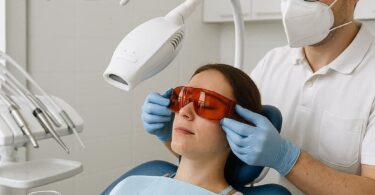
The dentist dims the lights. They put a special wand or light source into your mouth. You will see a blue or white light. The dentist looks through a lens. Healthy tissue looks one color (usually green). Suspicious tissue looks dark or black.
Step 4: Documentation
If everything looks healthy, the dentist notes “Negative screening” in your chart. If they see a dark spot, they do not panic. Most dark spots are nothing (like scar tissue or inflammation). But they will note it for recheck.
Step 5: The Report
The dentist tells you the results immediately. “Everything looks great,” or “I see a small spot on your gum. Let us look at it again in two weeks.”
Insurance and Reimbursement: What Dentists Need to Know
For dental office managers and billers, this section is for you. Billing D0431 can be tricky.
The Medical vs. Dental Cross-Coding Dilemma
Oral cancer is a medical condition. However, it is often caught in a dental setting.
- If you bill D0431 to a dental insurance plan, expect a denial about 40% of the time. Many dental PPOs (Preferred Provider Organizations) classify it as “not a covered benefit.”
- If you bill CPT 0431T (the medical equivalent code) to a medical insurance plan (like Blue Cross or Aetna medical), you might get paid. But not every dentist is enrolled as a medical provider.
Pro Tip for Offices: If a patient has a history of oral cancer or high-risk factors (smoking, drinking, HPV), bill the medical insurance first. Use a diagnosis code like Z12.81 (Encounter for screening for malignant neoplasm of oral cavity).
Documentation Requirements
To get paid for D0431, your notes must be tight. Do not just write “cancer screen.”
Write this:
“Adjunctive screening performed using Velscope Vx. Patient instructed to rinse. Blue light examination conducted. No loss of fluorescence noted on mucosa. No suspicious lesions identified. Patient advised to return in 6 months.”
If you do not mention the technology name or the results, the insurance company will downgrade the code to D0120 (which pays much less).
Who Needs an Oral Cancer Exam?
Everyone. But some people need it more often.
The American Dental Association recommends an annual visual oral cancer exam for all adults over 18. If you use the D0431 advanced screening, once a year is usually sufficient unless you have symptoms.
High-Risk Patients (Should get D0431 every 6 months)
- Tobacco users: Cigarettes, cigars, pipes, chewing tobacco, and vaping.
- Heavy drinkers: More than 15 drinks per week for men, 8 for women.
- HPV-16 patients: The same virus that causes cervical cancer causes throat cancer.
- Previous oral cancer history: If you had it once, you are at risk for recurrence.
- Sun exposure: Lower lip cancer is common in farmers, construction workers, and sailors.
Low-Risk Patients (Annual D0431 is fine)
- Non-smokers who drink only socially.
- Patients under 40 with no family history.
- Those with no HPV diagnosis.
The Technology Behind the Code: Velscope vs. Identafi
Patients often ask, “Why is there a separate code for the light? Can’t you just look?”
Looking is good. Light is better. But they are different services. Here is a quick comparison table.
| Feature | Standard Visual | Velscope (D0431) | Identafi (D0431) |
|---|---|---|---|
| Method | White light and mirror | Blue fluorescence | Multi-spectral (White/Amber/Violet) |
| What it sees | Surface lesions only | Changes in tissue fluorescence (metabolic changes) | Vascular changes (blood flow) |
| Time to perform | 1 minute | 2 minutes | 3 minutes |
| Cost to patient | $0 (included) | $25 – $60 | $30 – $70 |
| False positives | Low | Moderate (can light up food debris) | Low |
Quote from Dr. James R., Oral Surgeon:
*”I have found three early-stage cancers in the last two years using Velscope that I could not see with my naked eye. The patients had no symptoms. D0431 is not a cash grab; it is a safety net.”*
What Happens If the D0431 Exam Finds Something?
Do not panic. Seriously.
Nine times out of ten, the “suspicious” spot is benign. It might be:
- A burned spot from hot pizza.
- A cheek bite while sleeping.
- A canker sore.
- Lichen planus (a harmless rash).
- A blocked salivary gland.
If the light shows a dark area, the dentist has a protocol.
- Re-examine in 14 days. Many sores heal on their own.
- If it persists: The dentist may perform a brush biopsy (using D0431 again, or a more specific biopsy code like D7288).
- If the brush biopsy is positive: You get referred to an oral surgeon for an incisional biopsy (gold standard).
Only the scalpel biopsy gives a definitive answer. Do not assume cancer until the lab report says so.
Common Myths About the Dental Code for Oral Cancer Exam
Let us clear the air. There is a lot of misinformation online.
Myth 1: “D0431 is a scam. Dentists just want more money.”
Reality: While some offices overuse the code, most do not. The equipment costs $5,000 to $15,000. The single-use sheaths cost $5 each. Dentists charge a fee to cover these costs. A responsible dentist will tell you the fee before they do the test.
Myth 2: “If I have D0431 on my bill, I have cancer.”
Reality: Absolutely false. D0431 is a screening code. It is like a mammogram or a colonoscopy. You do the test to rule out cancer. 95% of D0431 exams come back completely clear.
Myth 3: “My dentist doesn’t need a code for this; they just do it for free.”
Reality: They do the visual part for free as part of your checkup. But if they pull out a $10,000 laser or light wand, that is a separate service. You are paying for the technology, not the “looking.”
How to Ask Your Dentist About D0431
Do not be shy. You are the customer. Here is a script you can use.
Before the exam:
*”I see you offer an advanced oral cancer screening. Is that covered under my regular exam code D0120, or will you be using code D0431? If so, what is the out-of-pocket cost?”*
During the exam:
“Are you using fluorescence technology right now, or is this the standard visual exam?”
After the exam (if billed):
“Can you show me in my chart where the D0431 results are documented? I want to make sure my insurance pays for this.”
A good dental office will answer these questions without hesitation. If they get defensive, that is a red flag.
A Complete List of Related Dental Codes
Sometimes, the oral cancer exam involves more than just a light. Here are other codes you might see on a bill related to oral pathology.
| Code | Description | When it is used |
|---|---|---|
| D0120 | Periodic oral evaluation | Routine visual exam (includes basic cancer screening) |
| D0150 | Comprehensive oral evaluation | New patient full exam (includes detailed cancer screening) |
| D0431 | Adjunctive pre-diagnostic test | Velscope, Identafi, or brush biopsy collection |
| D7288 | Brush biopsy – transepithelial sample | Collecting cells via a brush for lab analysis |
| D7286 | Incisional biopsy | Cutting out a piece of tissue (usually by an oral surgeon) |
| D7287 | Excisional biopsy | Removing a whole small lesion |
| D7410 | Excision of benign lesion | Removing a non-cancerous growth |
| D7411 | Excision of malignant lesion | Removing a cancerous tumor (less than 1.25 cm) |
The Future of Oral Cancer Screening
Technology moves fast. The code D0431 was created to cover “adjunctive” tools. But what is coming next?
- Salivary Diagnostics: Soon, a simple saliva rinse will be able to detect DNA markers for oral cancer. That will likely get a new code (maybe D0432 or D0999).
- AI Imaging: Artificial intelligence software that scans intraoral photos and flags suspicious lesions automatically. This will likely be bundled into D0431 or a new adjunctive code.
- Home Screening Kits: Patients might swab their own cheeks at home. If a dentist reviews the result, a telehealth code (D9995 or D9996) might be used instead.
The main takeaway: The code will evolve, but the goal remains the same—catch cancer early.
Step-by-Step Guide: Filing a Claim for D0431
For dental billers: Here is a cheat sheet.
Step 1: Verify eligibility.
Call the dental plan. Ask: “Is D0431 a covered benefit under this patient’s plan? If not, is there a medical benefit we can use?”
Step 2: Get a signed waiver.
If the plan does not cover it, have the patient sign a “Waiver of Liability” (Advanced Beneficiary Notice). It says, “I know my insurance might not pay, and I agree to pay the $45 fee if they deny it.”
Step 3: Use the right diagnosis code.
- Routine screening: Z12.81
- Patient with a lesion: K13.29 (Other disorders of the lip/oral mucosa)
- History of cancer: Z85.81 (Personal history of malignant neoplasm of tongue/oral cavity)
Step 4: Submit with narratives.
Attach a short note: *”Patient is a 25-year smoker. Used Velscope Vx device. No loss of autofluorescence noted. Code D0431 billed for adjunctive screening.”*
Step 5: Follow up.
If denied, appeal. Write: *”D0431 is an ADA-recognized code for early detection of oral cancer. According to the Oral Cancer Foundation, adjunctive screening reduces late-stage diagnosis. Please reprocess.”*
Frequently Asked Questions (FAQ)
Here are the seven most common questions readers ask about the dental code for oral cancer exam.
Q1: Is D0431 the same as a biopsy?
A: No. D0431 is a screening test (like a mammogram). A biopsy (D7286) is a diagnostic test where tissue is removed. A positive D0431 might lead to a biopsy, but they are not the same.
Q2: My dentist used a blue light. Should I see D0431 on my bill?
A: Yes. If they used Velscope, Identafi, or any fluorescence light, they should bill D0431. If they used a standard white curing light or a regular flashlight, that is not D0431.
Q3: Does Medicare cover D0431?
A: Generally, no. Medicare Part B does not cover routine dental exams. However, if a physician orders the oral cancer screening for a medical reason (like a lump in the neck), Medicare might cover it under a medical CPT code, not D0431.
Q4: Can a hygienist perform the D0431 exam?
A: In most states, yes. A registered dental hygienist can perform the screening, but the dentist must interpret the results and sign the chart note. Check your state’s Dental Practice Act.
Q5: How often can I bill D0431?
A: Most insurances allow once per 12 months. High-risk patients (cancer survivors) may need it every 6 months, but you will likely need a pre-authorization.
Q6: What is the difference between D0431 and D0502?
A: D0502 is for cytology (looking at cells under a microscope after a brush). D0431 is for in vivo (in the mouth) screening with light. D0431 happens first. D0502 happens after cells are collected.
Q7: If I refuse the D0431 exam, am I being irresponsible?
A: No. The visual exam (D0120) is the standard of care. The advanced light (D0431) is optional. You can refuse it. However, if you have high-risk factors, it is strongly recommended.
Additional Resources for Readers
You do not have to stop here. For more reliable information, check out these trusted sources.
- The Oral Cancer Foundation: www.oralcancer.org
They offer free screening events and patient support groups. - ADA Center for Evidence-Based Dentistry: www.ada.org/en/resources/ada-library/oral-health-topics/oral-cancer
Read the official research on adjunctive screening tools. - Head and Neck Cancer Alliance: www.headandneck.org
Find a screening location near you.
Internal Link Suggestion for your website:
“Read our related guide: ‘Understanding Your Dental EOB (Explanation of Benefits) – A Patient’s Guide to Codes D0120 to D1999.'”
Important Notes for Readers (Please Read)
Before you call your dentist to argue about a bill, keep these three truths in mind.
- Code does not equal diagnosis. D0431 is just a billing shortcut. It means “we used a cool light.” It does not mean “you are sick.” Do not let a code scare you.
- Not all offices use D0431. Some offices bundle the Velscope cost into their “Exam” fee. Others charge it separately. Both are legal. Always ask before the service.
- Your health is worth more than $50. I know budgets are tight. But skipping an oral cancer exam to save a few dollars is a gamble. If you catch one precancerous lesion early, the treatment is simple. If you wait… the treatment is brutal (surgery, radiation, chemo).
Conclusion: Three Lines to Remember
First: The specific dental code for an advanced oral cancer exam is D0431, used for fluorescence lights or brush biopsies, separate from the routine visual check (D0120).
Second: This screening costs between $25 and $65, is often not covered by basic dental insurance, but is a critical tool for catching oral cancer early when survival rates exceed 80%.
Third: Always ask your dentist which code they are using before the exam, and if you are high-risk (smoker, drinker, HPV-positive), do not skip this potentially life-saving test.
Author: Sarah Jenkins, RDH, Technical Writer
Date: APRIL 22, 2026
Disclaimer: This article is for informational purposes only and does not constitute medical billing advice or legal advice. Dental codes vary by insurance provider and region. Always consult with your dental office’s billing specialist.