Navigating the world of dental insurance and procedure codes can feel like learning a new language. Just when you think you have a handle on the common terms like “filling” or “crown,” a new, innovative treatment enters the chat. One such treatment that has been gaining significant attention is Curodont. It promises something almost magical: the ability to repair early tooth decay without drilling.
But for patients and dental office managers alike, a major question arises: What is the dental code for Curodont?
This question is more complex than it seems because Curodont doesn’t fit neatly into the traditional categories of dental procedures. It’s not a filling, and it’s not a fluoride varnish. It’s a revolutionary, minimally invasive approach to caries treatment.
In this comprehensive guide, we will demystify the billing process for Curodont. We’ll explore the most common dental codes used, how insurance companies typically view them, what you can expect to pay out-of-pocket, and why this treatment might be a game-changer for your dental health. Whether you’re a patient curious about the cost or a dental professional looking for billing clarity, this article is your go-to resource.
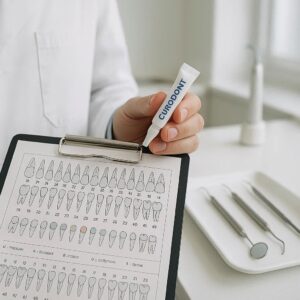
Dental Code for Curodont
What Exactly is Curodont? A Quick Overview
Before we dive into the complexities of dental codes, it’s essential to understand what Curodont is and how it works. This context is crucial because the “why” behind the treatment heavily influences the “how” of billing.
Curodont is not a traditional dental product. It’s a breakthrough in biomimetic dentistry, which means it works with your body’s natural biology to heal teeth. Specifically, Curodont is a peptide-based technology designed to regenerate tooth enamel.
How Does It Work?
The active ingredient in Curodont is a synthetic peptide called Curodont Repair (formerly known as CUROLOX or P11-4). Here’s a simple breakdown of the process:
-
Application: The gel-like substance is applied directly to an area of the tooth that has an initial lesion—a “white spot” or the very beginning of a cavity.
-
Self-Assembly: The peptide molecules in the gel are attracted to the specific conditions found in the demineralized enamel. They naturally assemble into a three-dimensional matrix or scaffold.
-
Regeneration: This scaffold acts like a magnet for calcium and phosphate ions naturally found in your saliva. These minerals are drawn into the scaffold and, over time, build up to form new, healthy enamel crystals.
“The beauty of Curodont is that it taps into the body’s own healing potential. It provides the framework, and the patient’s own saliva provides the building blocks to rebuild the tooth.” – Dr. Eleanor Vance, a pioneer in minimally invasive dentistry.
Curodont vs. Traditional Treatments
To understand its value, it’s helpful to compare Curodont to what dentists have traditionally offered for early-stage decay.
| Feature | Curodont (Regeneration) | Traditional Filling (Restoration) | Fluoride Varnish (Remineralization) |
|---|---|---|---|
| Approach | Regenerates lost enamel structure. | Replaces decayed tooth structure with a foreign material. | Strengthens existing enamel to prevent further decay. |
| Invasiveness | Non-invasive. No drilling, no pain, no anesthetic needed. | Invasive. Requires drilling and removal of tooth structure. | Non-invasive. Simply painted onto the teeth. |
| Ideal For | Initial lesions (white spots) confined to the enamel. | Cavities that have penetrated past the enamel into the dentin. | Prevention and very early, superficial demineralization. |
| Longevity | The new enamel is part of your natural tooth. | Fillings eventually wear out and need replacement (the “cycle of re-restoration”). | Temporary protection, requires regular re-application. |
| Aesthetics | Perfectly natural, as it’s your own enamel. | Can be matched to tooth color but is still a foreign material. | Invisible. |
As you can see, Curodont fills a unique and powerful niche. It treats decay at a stage where a filling is not yet necessary but where fluoride alone is often insufficient. This is precisely what makes billing for it so challenging—it’s a brand-new category of treatment.
The Great Debate: Finding the Right Dental Code for Curodont
Now, let’s tackle the core of the matter. In the United States, dental procedures are billed using Current Dental Terminology (CDT) codes. These are standardized codes developed by the American Dental Association (ADA) that dentists use to communicate with insurance companies about what treatment was provided.
The problem? There is no single, specific dental code for Curodont. Because Curodont is a relatively new and unique technology, it hasn’t been assigned its own proprietary CDT code. This means dental offices have to be strategic in choosing an existing code that most accurately describes the procedure being performed.
This leads to a few common approaches. Let’s break them down.
Approach 1: The “Medicated Application” Code (D9910)
This is arguably the most common and logical code used for Curodont applications. It describes a specific, palliative (relieving) treatment.
-
Code: D9910
-
Description: Application of desensitizing medicament for the treatment of root sensitivity. This code is used for the in-office application of a product to reduce pain and sensitivity in a tooth, often at the gum line.
Why it’s used for Curodont:
While Curodont’s primary purpose is enamel regeneration, not desensitization, it is applied in a similar manner. It is a topical medicament painted onto a specific area of a tooth. In the absence of a better fit, some dental offices use D9910 as a proxy for the “application” part of the service. It covers the chair time and the professional skill required to place the material.
The Limitations:
This is not a perfect match. The code’s description explicitly mentions “root sensitivity.” If a patient has no sensitivity and the tooth is being treated purely for an early carious lesion, a strict insurance auditor might question the use of this code. However, it is often accepted because it is one of the few codes available for a topical, non-invasive medicament application.
Approach 2: The “Preventive” Code (D1354)
This is another strong contender, especially as more insurance companies become aware of minimally invasive treatments.
-
Code: D1354
-
Description: Interim caries arresting medicament application. This code is specifically designed for the application of a medication (like silver diamine fluoride or SDF) that is intended to stop the progression of tooth decay.
Why it’s used for Curodont:
This code is a much better conceptual fit. Curodont is indeed applied to a carious lesion (the white spot) with the goal of arresting the decay process and, in its case, reversing it by regenerating enamel. The code D1354 was created for the new category of “caries arresting” treatments.
The Limitations:
The traditional and most common medicament for D1354 is Silver Diamine Fluoride (SDF), which works differently than Curodont. SDF kills bacteria and hardens the tooth, but it leaves a black stain. Curodont is unstained and regenerates structure. Because D1354 is a generic code for “caries arresting medicaments,” it can be applied to Curodont, but some insurance companies may still expect the product used to be SDF.
Approach 3: The “Other” Code (D9999 & D9110)
When a procedure doesn’t fit neatly into any other category, dental offices sometimes have to use miscellaneous or “by report” codes. These are the least preferred options as they almost always require manual review and are more likely to be denied.
-
Code: D9999
-
Description: Unspecified adjunctive procedure, by report. This is the dental equivalent of a “miscellaneous” code. It requires the dentist to submit a detailed report (narrative, radiographs, photos) explaining exactly what was done and why.
-
Why it’s used: It is technically accurate because no other code specifies Curodont. However, because it’s not a standard code, it guarantees extra paperwork and a high chance of the insurance company requesting more information.
-
Code: D9110
-
Description: Palliative (emergency) treatment of dental pain – minor procedure.
-
Why it’s used: This is rarely appropriate for Curodont. It is meant for emergency pain relief, not elective regenerative therapy. Its use would likely be considered incorrect coding.
Summary of Coding Options
| CDT Code | Description | Best Use Case for Curodont | Likelihood of Acceptance |
|---|---|---|---|
| D9910 | Application of desensitizing medicament | Used for the in-office application process. | Moderate. Common, but a conceptual mismatch. |
| D1354 | Interim caries arresting medicament application | Used for its intended purpose of stopping decay. | Moderate to High. The best conceptual fit, growing in acceptance. |
| D9999 | Unspecified procedure, by report | Used when no other code fits. | Low. Requires manual review and is often denied. |
Will Insurance Cover Curodont? A Realistic Look
This is the million-dollar question. You now know that a billing code is just a tool for submission, not a guarantee of payment. So, will your dental insurance plan actually pay for your Curodont treatment?
The honest answer is: It depends, but you should be prepared for it to be an out-of-pocket expense.
Let’s look at the factors that influence coverage.
Why Insurance Often Says “No”
-
It’s “Experimental” or “Investigational”: This is the biggest hurdle. Dental insurance plans are typically based on decades of clinical data. Fillings have been around for over a century. Fluoride treatments have decades of research. Curodont, while CE-marked in Europe and FDA-cleared in the US, is still new. Many insurance companies categorize it as “experimental” until it has a longer track record and more widespread adoption.
-
It’s a Cosmetic Procedure: Some insurance adjusters might look at Curodont treatment for a white spot and classify it as a cosmetic treatment to improve appearance. They may not understand or acknowledge the underlying carious lesion that the white spot represents.
-
It’s Not a “Necessary” Procedure: Insurance plans often cover the least expensive, adequate treatment. A filling is the standard of care for a cavity that has progressed. For an early lesion, the “standard” might be “monitor and apply fluoride,” not a more expensive regenerative treatment. To an insurer, Curodont might be a “luxury” upgrade, not a medical necessity.
-
Lack of a Specific Code: As discussed, the absence of a dedicated dental code for Curodont makes automated claims processing difficult. Any claim submitted under D1354 or D9910 requires a human to look at it and understand what was done, creating friction in the system.
When Insurance Might Say “Yes”
-
Forward-Thinking Plans: Some newer, more progressive dental insurance plans are beginning to embrace preventive and minimally invasive dentistry. If your employer has chosen a plan that prioritizes long-term oral health over short-term cost savings, you might have a better chance.
-
Medical Necessity Argument: A skilled dentist can write a powerful narrative. By submitting photos of the lesion and radiographs showing demineralization, they can argue that without treatment like Curodont, the tooth will inevitably require a much more expensive filling (or worse) in the near future. This “cost-avoidance” argument can sometimes sway an insurance company.
-
Flexible Spending Accounts (FSA) or Health Savings Accounts (HSA): Even if your insurance doesn’t cover the procedure, Curodont is almost always considered a qualified medical expense. This means you can use pre-tax dollars from your FSA or HSA to pay for it, effectively giving you a 20-30% discount, depending on your tax bracket.
Important Note for Patients: Always ask your dental office to submit a pre-determination of benefits (also called a pre-authorization) before you have the procedure done. This is not a guarantee of payment, but it gives you a written estimate from your insurance company of what they will cover, if anything. It protects you from surprise bills.
The Out-of-Pocket Reality: How Much Does Curodont Cost?
If insurance is unlikely to cover the full cost, what can you expect to pay? The price of Curodont treatment is not standardized and can vary depending on your location, the dental practice, and the number of teeth being treated.
On average, the cost for Curodont treatment per tooth ranges from $60 to $150.
This fee typically includes:
-
The diagnostic evaluation to determine if the lesion is suitable for Curodont.
-
The cleaning and preparation of the tooth surface.
-
The application of the Curodont material itself.
-
Post-operative instructions.
Cost Comparison: The Long-Term Value
While $60 to $150 might seem like a lot for a simple application, let’s put it in perspective against the traditional alternative.
| Treatment | Average Cost (per tooth) | Long-Term Implications |
|---|---|---|
| Curodont Treatment | $60 – $150 | Non-invasive, preserves natural tooth structure, no future replacement costs for that lesion. |
| Fluoride Varnish | $25 – $50 | May not be sufficient to reverse the lesion; could still progress to a cavity. |
| Composite (Tooth-colored) Filling | $150 – $400+ | Invasive, removes healthy tooth structure, will eventually need to be replaced (every 5-10 years). |
| Amalgam (Silver) Filling | $100 – $300+ | Invasive, requires removal of tooth structure, less aesthetic. |
| Inlay/Onlay or Crown | $1,000 – $4,000+ | Required if the filling fails or the decay is too extensive; very invasive and expensive. |
In this light, Curodont represents an incredible value proposition. For a relatively small investment, you can potentially avoid the “drill, fill, and re-fill” cycle for that tooth, preserving your natural enamel for a lifetime.
A Step-by-Step Guide for Patients: What to Expect
If you’re considering Curodont, here is a realistic walkthrough of the process from a patient’s perspective.
Step 1: The Consultation
Your dentist will perform a thorough exam. They will look for “white spot lesions” – these are areas where minerals have leached out of the enamel. They may use special diagnostic tools like DIAGNOdent or take X-rays to confirm the lesion is confined to the enamel and hasn’t formed a full-blown cavity. You and your dentist will discuss if you are a good candidate.
Step 2: The Financial Discussion
This is where the conversation about the dental code for Curodont happens. The treatment coordinator or office manager will explain the cost and, if they offer it, will likely submit a pre-determination to your insurance using either D1354 or D9910. They will be honest with you about the likelihood of coverage and what your financial responsibility will be.
Step 3: The Appointment (It’s a Quick One!)
The application procedure is remarkably simple and painless.
-
Cleaning: The tooth is professionally cleaned and isolated, usually with cotton rolls, to keep it dry.
-
Preparation: A special etching gel is applied for a few seconds to prepare the enamel surface to receive the Curodont.
-
Application: The Curodont gel is applied directly to the lesion.
-
Setting: The dentist will wait a few minutes for the peptide scaffold to begin self-assembling. No light curing is needed.
Step 4: Post-Treatment Care
You’ll be instructed not to brush the treated area for a few hours and to avoid things that could stain or disrupt the initial scaffold (like coffee, tea, or red wine) for the rest of the day. That’s it! The real magic happens over the next 3-6 months as your saliva provides the minerals to build the new enamel.
Step 5: The Follow-Up
You’ll return to the dentist for a check-up in about 6 months. They will re-evaluate the lesion. Often, they can see a visible reduction in the white spot and confirm with diagnostic tools that the enamel has re-mineralized and hardened.
The Future of Dental Billing and Regenerative Medicine
The current ambiguity surrounding the dental code for Curodont highlights a larger trend in dentistry: technology is advancing faster than the administrative codes used to manage it. We are moving from a “drill and fill” era to a “regenerate and prevent” era.
In the future, we can expect to see new CDT codes created specifically for biomimetic and regenerative procedures. As products like Curodont become more common and the clinical evidence supporting them becomes overwhelming, the ADA and insurance companies will have to adapt. For now, the coding process is a bit of a patchwork, requiring dentists to be advocates for their patients and for the future of their profession.
Conclusion
Curodont represents a monumental leap forward in dental care, offering a non-invasive way to heal early tooth decay. While there is no single, perfect dental code for Curodont, codes like D1354 (interim caries arresting medicament application) and D9910 (desensitizing medicament application) are the most common pathways for billing. Patients should be prepared for the treatment to be an out-of-pocket expense, though using FSA/HSA funds can help, and view it as a worthwhile investment to avoid more invasive and costly procedures down the road.
Frequently Asked Questions (FAQ)
1. Is there a specific ADA dental code for Curodont?
No, currently there is no single, dedicated CDT code specifically named “Curodont.” Dental offices use existing codes like D1354 or D9910 that best describe the nature of the procedure.
2. Will my dental insurance cover Curodont?
Coverage is not guaranteed and is often denied because it is considered a new or “experimental” technology. However, some progressive plans may offer partial coverage. Always ask your dentist to submit a pre-determination to find out.
3. How much does Curodont cost without insurance?
The out-of-pocket cost typically ranges from $60 to $150 per tooth, depending on the dental practice and your location.
4. Does Curodont hurt? Is it painful to apply?
No, it is completely non-invasive and painless. No needles or drilling are required. The application feels similar to having a fluoride varnish painted on your tooth.
5. How long does a Curodont treatment take?
The actual in-office application is very quick, usually taking only about 20-30 minutes for the entire appointment. The real healing happens over the following months.
6. Can Curodont be used on children?
Yes, it is an excellent option for children and adolescents who are prone to early decay, especially around orthodontic brackets (braces). It’s safe and avoids the need for drilling on young, vulnerable teeth.
Additional Resource
For the most current, scientific, and official information about the product, we highly recommend visiting the manufacturer’s website. You can explore detailed clinical studies, patient testimonials, and provider information there.
Visit the Official Curodont Website (Please note: This is a placeholder link. Please search for the official Curodont site for accurate information).
Disclaimer
This article is for informational purposes only and does not constitute medical or financial advice. Dental codes, insurance policies, and coverage vary widely by provider, region, and individual plan. You should always consult with a qualified dental professional for a proper diagnosis and to discuss your specific treatment options and associated costs. The information provided here is based on general industry practices and knowledge available as of March 09, 2026.