Navigating the world of dental insurance and procedure codes can often feel like trying to read a map in a foreign language. For dental professionals and even savvy patients, understanding the specific codes for common procedures is essential for smooth office operations, accurate patient communication, and, most importantly, ensuring proper insurance reimbursement.
One area that frequently causes confusion is the billing for hemostatic agents and wound dressings, specifically the collagen plug. If you have ever asked, “What is the correct dental code for a collagen plug?” you are not alone. This guide is designed to clear up that confusion once and for all.
We will walk through the primary code associated with this material, explore when it is used, discuss the nuances of insurance coverage, and provide practical advice for both dental teams and patients. Our goal is to make this topic as straightforward and accessible as possible, so you can focus on what really matters: excellent patient care.
Dental Code for Collagen Plug
Table of Contents
ToggleWhat You Will Learn in This Guide
-
The primary dental code for collagen plugs and its official description.
-
Clinical scenarios where a collagen plug is necessary.
-
The difference between a “surgical supply” and a billable procedure.
-
A comparison of collagen plugs with other hemostatic agents.
-
Practical tips for dental offices to ensure clean claims.
-
Answers to the most frequently asked questions from patients and staff.
Understanding the Primary Code: D7910
Let’s get straight to the point. In the vast majority of cases, the dental code used to bill for the placement of a collagen plug is D7910.
According to the Current Dental Terminology (CDT), the official description for D7910 is:
“Suture of recent small wounds up to 5 cm.”
Wait, you might be thinking, “That sounds like stitches, not a collagen plug.” And you would be right to notice that. This is where a deep understanding of dental coding comes into play. While the literal description refers to suturing, the code has evolved in common practice and insurance interpretation to encompass the repair of wounds and the management of surgical sites, which often includes the placement of hemostatic agents like collagen.
How D7910 Applies to Collagen Plugs
When a dentist performs a surgical procedure—such as a routine extraction, a complex surgical removal of a tooth, or a gum graft—they are left with a wound. To protect that wound, stop bleeding, and encourage healing, they may place a collagen plug directly into the socket or over the graft site.
Because the act of placing this material is part of the wound management process, D7910 becomes the most appropriate code to describe the service of treating that specific site, beyond the primary surgical procedure.
Think of it this way: If the extraction is the main event, the collagen plug placement is the post-event cleanup and protection, and D7910 is the way to note that specific step for the record and for billing.
When is D7910 Typically Used?
You will most commonly see D7910 billed in conjunction with:
-
Simple and Surgical Extractions: After a tooth is removed, a collagen plug is often placed in the socket to control bleeding and preserve the bone structure for a future implant.
-
Biopsies: After a small tissue sample is removed, a plug can help fill the void and promote rapid healing.
-
Periodontal Surgery: Following flap surgeries or crown lengthening, a plug might be used to protect the tissue and aid in hemostasis.
-
Implant Placement: To cover and protect the implant site or to fill a small gap around the implant.
Important Note for Dental Teams: Always check with the specific insurance carrier. While D7910 is the industry standard, some providers have specific internal policies regarding its use with collagen plugs. Some may require photographic evidence or a detailed narrative to prove medical necessity.
Why Use a Collagen Plug? The Clinical Perspective
To truly understand the code, we must understand the material. A collagen plug is not just a fancy piece of gauze. It is a medical device derived from natural collagen sources (often bovine or porcine) that plays an active role in healing.
Here is why a dentist might choose to use one and bill for it using D7910:
-
Hemostasis (Stopping the Bleeding): Collagen is a powerful hemostatic agent. It attracts platelets, causing them to aggregate and form a clot quickly. This is far more effective than relying on the body’s natural clotting mechanism alone, especially in patients on blood thinners.
-
Wound Protection: It acts as a biological bandage, protecting the underlying bone and tissue from food particles, bacteria, and trauma during the critical initial healing phase.
-
Socket Preservation: Perhaps the most significant benefit. By filling the empty tooth socket, the collagen plug helps maintain the volume of the alveolar bone. This prevents the bone from shrinking (resorbing), which is crucial if the patient plans to get a dental implant in the future.
-
Patient Comfort: By stabilizing the clot and protecting the site, collagen plugs can significantly reduce post-operative pain and the risk of a painful condition called “dry socket” (alveolar osteitis).
Collagen Plug vs. Other Materials
To better understand where the collagen plug fits in, let’s look at a quick comparison with other common post-surgical materials. This can also help clarify why a specific code like D7910 is used for the procedure of placing them.
| Material | Primary Function | Resorbable? | Typical Use Case | Common Coding Context |
|---|---|---|---|---|
| Collagen Plug | Hemostasis & Socket Preservation | Yes | Extraction sockets, small defects | D7910 (wound repair) |
| Gelfoam | Hemostasis | Yes | Bleeding control in various sites | D7910 or included in surgical fee |
| Surgical (Cotton) Gauze | Mechanical compression | No | Immediate post-extraction bleeding control | Included in procedure (not billed) |
| Surgical Suture | Wound closure | Yes/No | Closing gum tissue over a site | D7910 (if primary repair) / Included |
| Bone Graft Material | Bone regeneration | Yes | Filling defects to grow new bone | D4265, D7953 (separate codes) |
As you can see, the collagen plug sits in a unique space—it helps with bleeding but also sets the stage for better healing and bone preservation, justifying the specific billing for its placement via D7910.
The Reimbursement Reality: What Patients and Offices Need to Know
This is the part of the article where we get realistic. Knowing the code is only half the battle. The other half is understanding how insurance companies actually treat it.
Is D7910 Always Covered?
The short answer is: Not always. Here is the honest breakdown of the insurance landscape:
-
As a Separate Benefit: Many dental insurance plans consider the management of the surgical site (suturing, placing a plug) to be an integral part of the primary surgical procedure. In their view, if you are paid for a surgical extraction (e.g., D7210 or D7240), the work of closing or protecting the site is included in that fee. Therefore, they will not provide additional payment for D7910.
-
As a Billable Adjunct: Other plans recognize that using advanced materials like a collagen plug goes above and beyond standard post-op care, providing a tangible benefit to the patient (reduced pain, better bone healing). These plans will provide a separate, albeit often small, reimbursement for D7910.
-
Medical Necessity is Key: If a patient has a medical condition (like hemophilia or is on blood thinners such as Warfarin or Eliquis), the use of a collagen plug is no longer just a convenience—it is a medical necessity to prevent a hemorrhagic event. In these cases, the argument for coverage is much stronger, and sometimes the procedure can even be billed to medical insurance.
Advice for the Dental Team: 3 Steps to Smoother Claims
To avoid claim denials and frustrated patients, implement this simple three-step process:
-
The Pre-Treatment Estimate is Your Best Friend: Before the procedure, if you know you will be using a collagen plug and plan to bill D7910, send a pre-determination (pre-treatment estimate) to the insurance company. This will tell you, in writing, exactly what they will cover. It sets the right expectations for everyone.
-
Master the Narrative: In the “remarks” section of your electronic claim, do not just put the code. Add a brief, clear explanation.
-
Good Example: “Post-extraction hemostasis and socket preservation achieved using resorbable collagen plug due to patient’s anticoagulant therapy.”
-
Good Example: “Collagen plug placed in site #30 to prevent alveolar osteitis and maintain bone volume for future implant.”
-
-
Have a Clear Financial Agreement with the Patient: Before the day of surgery, explain the potential costs. Say something like: “We will be using a special collagen material to help you heal faster and with less pain. This material has a cost associated with it. We will bill your insurance, but if they consider it part of the extraction, you may be responsible for this portion. Our office fee for this is $X.”
Advice for the Patient: What to Ask Your Dentist
If your dentist mentions using a “plug” or a “special dressing,” here are the questions you should feel comfortable asking:
-
“Is this material considered part of the extraction cost, or is it a separate fee?”
-
“Will my insurance cover this separate code?”
-
“How will this specific material help my healing process?”
-
“If insurance doesn’t cover it, what is my out-of-pocket cost?”
A transparent conversation prevents surprises on the bill.
Expanding the Scope: Other Codes Related to Wound Management
While D7910 is the star of the show for collagen plugs, it lives in a neighborhood of other codes related to surgery and healing. Understanding these can help you differentiate services.
-
D7911: *”Complicated suture – more than 5 cm.”* If a wound is exceptionally large or requires complex closure techniques, you move to this code.
-
D7912: “Complicated suture – complicated or unusual wound.” This is for wounds that are infected, require draining, or need revision.
-
D4265: “Biologic materials to aid in soft and osseous tissue regeneration.” This is a completely different code used for guided tissue regeneration (GTR) membranes, which are used in conjunction with bone grafts for major regeneration, not simply for socket preservation or hemostasis. It is a common point of confusion, but it is for a different, more involved procedure.
-
D9610: “Therapeutic parenteral drug, single administration.” If a collagen plug is soaked in an antibiotic or other medicament before placement, it might sometimes be referenced here, though the placement itself remains D7910.
The key takeaway is that D7910 is the workhorse code for the service of managing the small surgical site, which includes placing the collagen plug.
Practical Guide: The Procedure and Patient Experience
For patients reading this, the thought of having something “plugged” into your gum might sound intimidating. Let’s demystify what actually happens.
Step-by-Step: What to Expect
-
The Procedure: Whether it’s an extraction or a biopsy, the primary surgery is completed first.
-
Site Preparation: The dentist ensures the site is clean and free of debris.
-
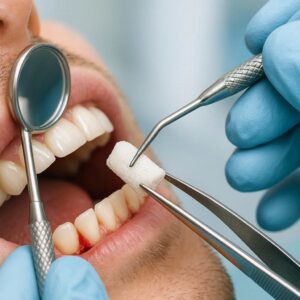
Placement: The collagen plug, which looks like a small, dry, sponge-like piece of material, is gently placed into the wound or socket. It might be trimmed to fit perfectly.
-
Hydration: The dentist will often moisten it with sterile saline or blood. As it gets wet, it becomes soft and conforms to the shape of the wound.
-
Stabilization: Sometimes, a single suture (stitch) is placed over the plug to hold it in place. This suture placement is also part of the D7910 service.
-
Healing: You are done! The plug will completely dissolve on its own over the following days or weeks, depending on the product used. You won’t need to have it removed.
Post-Operative Instructions: What You Need to Do
Your dentist will give you specific instructions, but general care for a site with a collagen plug includes:
-
Do Not Disturb: Avoid touching the area with your tongue or fingers. Let the plug do its job.
-
Gentle Rinsing: Do not swish vigorously for the first 24 hours. After that, use a prescribed mouthwash or warm salt water rinses very gently.
-
Skip the Straw: The sucking motion can dislodge the plug and the protective clot. Avoid straws for at least a week.
-
Soft Foods: Stick to a soft food diet for a few days to protect the site.
-
Expect Some “Bits”: As the plug dissolves, you might see small, gelatinous pieces in your mouth. This is normal—it’s just the material breaking down.
Frequently Asked Questions (FAQ)
Here are some of the most common questions we hear regarding the dental code for collagen plugs.
Q: Is D7910 the only code I can use for a collagen plug?
A: In standard dental coding, yes. While some offices may try to use other codes, D7910 (“Suture of recent small wounds up to 5 cm”) is the most accurate and widely accepted code for the service of placing a collagen plug for wound management and hemostasis.
Q: My insurance denied the claim for D7910. Why?
A: The most common reason is that the insurance company considers wound management to be inclusive to the primary surgical procedure (like the extraction). They believe the fee for the extraction should cover the cost of closing and protecting the wound. It does not necessarily mean the service wasn’t valuable, just that their policy bundles it.
Q: Will I feel the collagen plug dissolving?
A: You likely won’t feel it dissolving in a painful way. You may be aware of its presence for a day or two, similar to how you’d be aware of a healing wound. As it breaks down, you might notice a slightly different texture in the area, but it is generally a very comfortable healing process.
Q: Can a collagen plug fall out?
A: It is possible but not common if placed correctly. If you experience heavy bleeding or trauma to the site, it could become dislodged. If you think your plug has fallen out in the first 24-48 hours, call your dentist. After that, the healing process is likely well underway.
Q: Does a collagen plug hurt when it is placed?
A: No. The area is already numb from the primary procedure. You will not feel the plug being placed at all.
Additional Resources
To ensure you have the most up-to-date information, we recommend consulting the following official sources. Coding guidelines can be updated annually, so it’s vital to refer to the primary source documents.
-
American Dental Association (ADA) – CDT Code Book: This is the official source for all dental codes. Purchasing the latest version of the “Current Dental Terminology” (CDT) manual is essential for any dental practice.
-
Your Dental Insurance Provider’s Provider Manual: Most insurance companies publish detailed manuals for dental offices that outline their specific coding policies, including which codes they consider “bundled” versus “billable.” This is an invaluable resource that is often overlooked.
Conclusion
Understanding the dental code for a collagen plug is a perfect example of how the clinical and administrative sides of dentistry must work together. The primary code, D7910, serves as the bridge between the excellent clinical care of placing a collagen plug to aid healing and the necessary administrative task of documenting and billing for that service. While reimbursement is not always guaranteed, clear communication between the dental team and the patient, combined with accurate coding and a thorough understanding of insurance policies, ensures a smooth and transparent process. Ultimately, the goal is to use these tools to provide the best possible outcome for the patient—a faster, more comfortable recovery with a strong foundation for future oral health.
Author: American Dental Coding Specialists (Reviewed March 2026)
Date: March 09, 2026
Disclaimer: This article is for informational purposes only and does not constitute legal or billing advice. Coding and reimbursement policies vary by insurance carrier and geographic location. Always consult the current CDT manual and the specific policies of your patients’ insurance plans.