If you have ever winced while sipping a hot coffee or eating a scoop of ice cream, you know exactly how disruptive tooth sensitivity can be. For dental professionals, treating this common complaint is a routine part of patient care. However, the administrative side of that care—specifically, billing for it—is often anything but routine.
Finding the correct dental code for a desensitizing agent can sometimes feel like navigating a maze. Use the wrong code, and you risk a claim denial. Fail to document properly, and you might not get paid for a procedure that provided genuine relief to your patient.
Whether you are a dentist, a dental hygienist, a office manager, or a patient curious about the costs on your treatment plan, understanding these codes is essential. This guide will walk you through everything you need to know about dental procedure codes for desensitizing agents, from the standard D9910 to the newer codes for in-office treatments, and how to navigate the tricky world of insurance reimbursement.
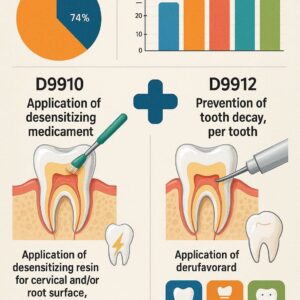
Dental Codes for Desensitizing Agents
What is a Dental Code for Desensitizing Agent?
Before diving into the specifics, let’s establish a baseline. In the United States, dental procedures are documented using the Current Dental Terminology (CDT) code set. These are the codes developed by the American Dental Association (ADA) that dentists use to describe the treatments they provide to patients and insurance companies.
A “dental code for desensitizing agent” is simply the specific alphanumeric code used to bill for the application of medication to a tooth or multiple teeth to reduce pain associated with dentin hypersensitivity.
The Difference Between Desensitizing and Other Treatments
It is important to distinguish desensitizing procedures from other types of dental work. A desensitizing treatment is specifically aimed at reducing nerve pain caused by exposed dentin. It is not the same as:
-
A Restorative Filling (e.g., composite resin): This repairs physical damage (cavities).
-
A Prophylaxis (D1110): This is a routine cleaning to remove plaque and tartar.
-
Fluoride Treatment (D1206/D1208): While some fluoride varnishes can help with sensitivity, their primary purpose is caries (cavity) prevention.
The primary codes we deal with today are focused solely on the management of sensitivity.
The Primary Code: D9910 – Application of Desensitizing Agent
If there is a “workhorse” code in the world of sensitivity billing, it is D9910. This is the code you will use most often, but it comes with specific rules that must be followed.
Official CDT Description
The official description for D9910 is: “Application of desensitizing medicament.”
This is the go-to code for the topical application of a pharmacological agent to reduce pain sensitivity in teeth. This can be in response to cervical sensitivity (sensitivity at the gum line), post-restorative sensitivity, or generalized hypersensitivity.
What Procedures Does D9910 Cover?
D9910 is versatile. It covers the application of various medicaments, including:
-
Oxalates: Often used to plug dentinal tubules.
-
Potassium Nitrate: Commonly found in toothpaste but can be applied professionally.
-
Glutaraldehyde/HEMA: Found in some generation of desensitizers.
-
Resin-based desensitizers: Light-cured primers that seal the tubules.
-
Calcium Phosphate/Calcium Sodium Phosphosilicate (NovaMin) pastes: Professionally applied.
When to Use D9910 (and When Not To)
You should use D9910 when the primary purpose of the visit is to treat sensitivity, or when you are adding a desensitizing agent as a separate, identifiable procedure.
Appropriate scenarios:
-
A patient complains of sharp pain from cold drinks. You isolate the area and apply a desensitizing varnish.
-
After a deep scaling procedure (root planing), you apply a desensitizing agent to the exposed roots.
-
A patient with no cavities but significant wear from brushing has generalized sensitivity, and you apply a desensitizing paste to all affected teeth.
Inappropriate scenarios:
-
You apply desensitizer as part of cementing a crown or placing a filling. In dentistry, this is often considered part of the “global service” of the restoration. You generally cannot bill D9910 separately if the agent is used solely to protect the tooth during the restorative process.
Important Note on D9910:
Most dental insurance plans consider the application of desensitizing agents a patient comfort item. This means that while it is a valid medical/dental procedure, many plans explicitly exclude it from coverage. You must check the patient’s benefits beforehand to avoid surprising them with an unexpected bill.
The New Kid on the Block: D9911
In recent years, the ADA introduced a new code to provide more specificity in billing. This is D9911.
Why Was D9911 Introduced?
The introduction of D9911 was a response to the increasing prevalence of non-carious cervical lesions (NCCLs) and generalized root sensitivity, especially in an aging population that retains their teeth longer. Insurance carriers and dentists needed a way to distinguish between a simple “touch-up” application and a more intensive treatment.
D9910 vs. D9911: Understanding the Difference
The primary distinction between these two codes lies in the extent of the procedure.
-
D9910: Application of desensitizing medicament. This implies application to a single tooth or a limited area.
-
D9911: Application of desensitizing resin or cement, including labial and/or cervical surfaces of multiple teeth (per arch).
Think of it this way:
-
If a patient has one sensitive spot on tooth #29, you use D9910.
-
If a patient has generalized sensitivity along the gum line of all their lower front teeth, and you paint a desensitizing agent across the entire arch, you use D9911.
D9911 implies a more complex, time-consuming procedure that covers a larger surface area. It often involves a resin-based material that might require light curing.
| Feature | D9910 | D9911 |
|---|---|---|
| Description | Application of desensitizing medicament | Application of desensitizing resin or cement (per arch) |
| Scope | Single tooth or limited area | Multiple teeth, entire arch (labial/cervical) |
| Typical Material | Varnishes, oxalates, potassium nitrate pastes | Resins, cements, light-cured barriers |
| Intent | Spot treatment for focal sensitivity | Full-arch management of hypersensitivity |
Desensitizing as Part of a Prophylaxis (Cleaning)
One of the most frequent points of confusion in the dental office is whether you can bill for desensitizer on the same day as a cleaning.
The “Included” Argument
Many insurance carriers operate under the philosophy that applying a desensitizing agent after a dental prophylaxis (cleaning) is a standard part of patient comfort and therefore is included in the cleaning code (D1110 or D4910). They argue that if the cleaning caused the sensitivity, soothing it is part of the procedure.
The “Separate Service” Argument
From a clinical perspective, treating pre-existing, chronic sensitivity is a distinct medical service. If a patient has suffered from sensitivity for months and you take the time to diagnose, select, and apply a specific therapeutic agent, you have performed a service beyond a simple polish.
How to Navigate This:
-
Document Pre-existing Condition: Your chart notes must state that the sensitivity was present before the cleaning began (e.g., “Patient reports history of cold sensitivity. Treatment plan includes application of desensitizing agent post-prophylaxis.”).
-
Use a Different Material: If the material you use for sensitivity is not the same as the prophy paste used for polishing, note that in the chart.
-
Inform the Patient: Always get financial consent. Explain, “Your insurance may not cover this part of the treatment, but it will provide you with weeks of relief.”
Insurance Coverage and Reimbursement Realities
Let’s be realistic: Getting insurance to pay for desensitizing agents is an uphill battle. It is crucial to set expectations for your patients and your front desk team.
Why Insurance Often Denies These Codes
-
Plan Exclusions: Many dental insurance plans are designed primarily to cover “basic” and “major” restorative care. Preventative and “comfort” items like desensitizers are often explicitly listed as non-covered benefits in the insurance policy.
-
Frequency Limitations: Even when covered, payers may limit desensitizing agents to once every 12 or 24 months.
-
Medical vs. Dental Necessity: To be covered, a procedure must be “dentally necessary.” While sensitivity is a clinical condition, many carriers view it as a quality-of-life issue rather than a health necessity, unlike treating an infection (cavity) or gum disease.
Is it Billable to Medical Insurance?
In very specific cases, yes. If the sensitivity is caused by a side effect of cancer treatment (chemotherapy or radiation), or by a diagnosed medical condition like Sjögren’s syndrome (causing severe dry mouth and subsequent root sensitivity), you might be able to bill this to medical insurance.
This requires a different set of codes (CPT codes) and a narrative explaining the medical necessity. This is a complex area often handled by specialized medical billing coordinators.
Step-by-Step: How to Document and Bill Correctly
Proper documentation is your best defense against a denied claim or a audit. Here is a checklist for your clinical notes when using a desensitizing agent code.
The Documentation Checklist
-
Chief Complaint: What did the patient say? (e.g., “Pain when I drink cold water.”)
-
Medical History: Note any relevant conditions (GERD, bulimia, dry mouth) that contribute to sensitivity.
-
Tooth Numbers/Surfaces: Specify exactly which teeth were treated.
-
Material Used: Name the specific product (e.g., “Gluma Desensitizer,” “MI Paste”).
-
Procedure Details: Describe the application steps (e.g., “Isolated teeth with cotton rolls, applied agent via microbrush, allowed to dwell for 60 seconds, gently air dried.”).
-
Pre-existing Condition: “Generalized cervical sensitivity noted prior to treatment.”
Sample Treatment Plan Language
To avoid confusion with patients, use clear language on your treatment plan:
“Desensitizing Treatment (D9910): Application of a therapeutic agent to reduce tooth pain. This procedure is often not covered by dental insurance and is the patient’s financial responsibility. Estimated fee: $XX.”
Alternative and Related CDT Codes
While D9910 and D9911 are the primary codes, there are times when sensitivity is managed through other coded procedures.
D1354: Interim Caries Arrestive Medicament Application
This code is for applying silver diamine fluoride (SDF). While SDF is primarily used to arrest cavities, a major side effect is desensitization. If you are using SDF to treat root sensitivity in an elderly patient, you must choose the code that matches the intent.
-
If the intent is to arrest decay on a root surface, use D1354.
-
If the intent is purely to desensitize a healthy root surface, use D9910.
-
Note: Many dentists use D1354 for sensitivity because some insurance plans cover it more readily than D9910, but this is technically “upcoding” if there is no decay present.
D4921: Gingival Irrigation – Per Quadrant
Sometimes, sensitivity originates in the gums. If you are using a medicated lavage (like chlorhexidine or stannous fluoride) to irrigate the gingival sulcus to reduce inflammation and secondary sensitivity, D4921 is the appropriate code.
D2990: Resin Infiltration
This is a newer technique for treating incipient (beginning) lesions and white spots. It can also seal the tooth surface, reducing sensitivity. This is a higher-fee, more complex procedure than a simple D9910 application.
Patient Communication: Talking About Costs
As a friendly reminder, how you talk to patients about these codes matters. If a patient has paid out of pocket for sensitivity relief, they need to understand the value.
What to say:
“Mrs. Jones, I know you’ve been struggling with sensitivity for a while. I’d like to apply a special medicament to your teeth today that will seal the tiny tubes in your dentin, blocking the pain. This is a separate therapeutic service from your cleaning. While it costs $35, it should provide you with relief for several months. How does that sound?”
What not to say:
“I’m going to put some goop on your teeth. Insurance probably won’t pay for it, so you’ll have to cover it.”
By framing it as a solution to a chronic problem, the fee becomes an investment in comfort, not just a random upcharge.
State Regulations and Payer Policies
It is impossible to write a guide on dental codes without a major disclaimer: Dentistry is local.
While the CDT codes are standardized nationally, how they are interpreted varies wildly by:
-
State Insurance Mandates: Some states have laws requiring insurers to cover certain preventive or minor therapeutic procedures.
-
Individual Payer Policies: Delta Dental in one state may cover D9910 twice a year, while Cigna in another state may never cover it.
-
Medicaid: State Medicaid programs have their own fee schedules and covered codes. Some may cover desensitizing agents for patients with special needs or specific medical conditions; most do not.
Reader Note: Always verify benefits with the specific insurance carrier in your state. Do not rely on a general guide (including this one) to guarantee payment.
Frequently Asked Questions (FAQ)
Here are some of the most common questions we receive about dental coding for sensitivity.
1. Can I bill D9910 for using a desensitizing toothpaste in the office?
No. D9910 implies a professional-grade application of a medicament that provides a therapeutic benefit beyond simple brushing. If you are simply handing a patient a tube of toothpaste, that is a product sale, not a billable procedure.
2. My patient has sensitivity on every tooth. Can I bill D9910 for each tooth?
Generally, no. If you are treating an entire arch, you should use D9911 (per arch) . If you treat the upper arch and the lower arch, you could potentially bill D9911 twice (once for the maxilla, once for the mandible). However, you must check the payer’s policy, as many will only allow one desensitizing procedure per visit.
3. Is D9910 covered by Medicare or Medicaid?
Original Medicare (Part A & B) does not cover routine dental care, so it will not cover D9910. Some Medicare Advantage plans now offer dental benefits, but coverage for desensitizing is rare.
Medicaid coverage is state-specific. Some states may cover it for children (EPSDT benefits) if it is deemed medically necessary, but it is rarely covered for adults.
4. What is the average cost of D9910 without insurance?
The out-of-pocket cost for a desensitizing agent application varies by geographic region and the type of material used. Typically, you can expect a fee ranging from $25 to $75. D9911, being a more complex procedure covering an entire arch, usually ranges from $50 to $150 per arch.
5. Can a hygienist perform and bill for D9910?
Yes, in most states, a registered dental hygienist (RDH) can apply desensitizing agents under the general supervision of a dentist. The procedure is still billed under the dentist’s provider number. Always check your state’s Dental Practice Act for supervision levels.
Additional Resources
For the most up-to-date information on coding, it is best to go straight to the source.
-
American Dental Association (ADA) – CDT: The official website for purchasing the current CDT manual and browsing coding updates. Visit ADA CDT
Conclusion
Navigating the world of dental billing codes doesn’t have to be a headache. The key takeaway is that D9910 is your standard code for single-tooth sensitivity treatment, while D9911 is designed for full-arch applications of resin-based desensitizers. Success in reimbursement relies heavily on proper documentation, understanding your patient’s unique insurance plan, and setting clear financial expectations upfront. By mastering these codes, you ensure your practice is compensated for the valuable comfort you provide to your patients.
Disclaimer: The information provided in this article is for general informational purposes only and does not constitute legal, billing, or professional advice. Coding requirements, coverage policies, and reimbursement rates are subject to change and vary by payer, geographic location, and individual patient plans. You should always consult with your billing department, the relevant insurance carrier, and the current ADA CDT manual for the most accurate and up-to-date information applicable to your specific situation.
Author: Dental Billing Experts Team
Date: March 09, 2026