Dealing with a dental abscess is no walk in the park. The throbbing pain, the swelling, the pressure—it’s a situation that demands immediate attention. If you’re reading this, you’re likely a patient trying to understand your treatment plan or a dental professional looking for a clear coding refresher.
Understanding the dental code for draining an abscess is crucial. It’s the bridge between the clinical procedure a dentist performs and the language insurance companies use to process claims. Getting it right ensures proper reimbursement for the dentist and maximum coverage for the patient.
But here’s the thing: it’s rarely as simple as one single code. The code used depends entirely on the specifics of the procedure. Is the dentist just making a small cut to let the pus out? Are they accessing the infection through the root of the tooth? Is the tooth being saved or removed?
In this guide, we will strip away the jargon and walk you through the most common dental procedure codes used for incision and drainage of an abscess. We’ll look at what they mean, when they are used, and how they affect your out-of-pocket costs.
Please Note: This article is for educational purposes only and does not constitute medical or billing advice. Always consult with your dental provider and insurance company regarding your specific situation.
Dental Code for Draining an Abscess
What is a Dental Abscess? A Quick Overview
Before we dive into the codes, it helps to understand what is actually happening inside your mouth. A dental abscess is essentially a pocket of pus caused by a bacterial infection. Think of it as your body’s way of trying to wall off an infection to keep it from spreading.
There are two main types you’ll hear about:
-
Periapical Abscess: This happens at the very tip of the tooth’s root. It usually starts from an untreated cavity, a crack, or trauma that allows bacteria to get into the pulp (the soft center of the tooth where the nerves and blood vessels are). The infection kills the pulp and travels down to the root tip.
-
Periodontal Abscess: This starts in the gum tissues and the bone that support the tooth. It’s often a complication of advanced gum disease (periodontitis), where bacteria get trapped in a deep pocket between the tooth and gum.
The treatment for both is essentially the same: drainage. You have to release the pus and relieve the pressure to eliminate the infection. How a dentist achieves this drainage determines the code they will use.
The Primary Dental Codes for Draining an Abscess
In the world of dental coding, we use the Current Dental Terminology (CDT) codes, maintained by the American Dental Association (ADA). These are the standard for dental claims in the United States.
When it comes to draining an abscess, two codes dominate the conversation: D7510 and D7520.
Here is a breakdown of the main codes you will encounter.
| Code | Description | Common Use Case |
|---|---|---|
| D7510 | Incision and drainage of abscess – intraoral soft tissue | Draining a gum boil or swelling in the soft tissue, but not involving the bone. |
| D7520 | Incision and drainage of abscess – intraoral soft tissue – complicated | Draining a deeper infection that involves the bone, often requiring more time and skill. |
| D7511 | Incision and drainage of abscess – intraoral soft tissue – subsequent | A follow-up drainage procedure, often to place a drain or keep the area open. |
| D3220 | Therapeutic pulpotomy (excluding final restoration) | Removing the infected pulp in the crown of a primary (baby) tooth to drain an abscess. |
| D3310 | Endodontic therapy (root canal) – anterior tooth | Cleaning out the entire root canal system to relieve pressure and drain infection from within a front tooth. |
| D3320 | Endodontic therapy (root canal) – premolar tooth | Same as above, but for bicuspid teeth. |
| D3330 | Endodontic therapy (root canal) – molar tooth | Same as above, but for back teeth with multiple roots. |
| D7140 | Simple extraction | Removing a tooth that is easily visible and accessible. |
| D7210 | Surgical extraction | Removing a tooth that is broken down, impacted, or requires bone removal. |
[!IMPORTANT]
Why are root canals and extractions on this list? Because sometimes, draining an abscess isn’t a separate procedure. The act of accessing the tooth for a root canal or pulling the tooth automatically releases the pressure and pus. In these cases, you wouldn’t bill a separate “drainage” code. The extraction or root canal code is the primary code, as it is the definitive treatment.
D7510 vs. D7520: What’s the Difference?
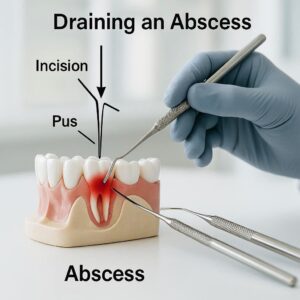
This is the most common point of confusion. Both codes are for “Incision and Drainage” (I&D) of an intraoral soft tissue abscess. That means the dentist is making a cut (incision) in your gum to let the pus out.
The key difference lies in the depth and complexity.
D7510: Incision and Drainage of Abscess – Intraoral Soft Tissue
Think of this as the “simple” or “superficial” drainage code. It is used when the abscess is confined to the soft tissue of the gum. The infection hasn’t yet eroded into or significantly involved the underlying bone.
-
What it looks like: A localized, painful swelling on the gum. The dentist numbs the area, makes a small incision with a scalpel, and the pus drains out. They may irrigate (wash out) the area with saline.
-
Recovery: Immediate relief is common. The patient is usually sent home with warm salt water rinses and possibly antibiotics.
-
Reimbursement: Typically lower than D7520, as it is a less complex procedure.
D7520: Incision and Drainage of Abscess – Intraoral Soft Tissue – Complicated
This code is reserved for a more serious infection. It is used when the abscess has penetrated deeper, involving the facial spaces or the bone (osteitis). These infections can cause significant swelling of the face (cellulitis) and can be medically dangerous.
-
What it looks like: Significant facial swelling, possibly difficulty opening the mouth (trismus), and severe pain. The procedure is more involved. The dentist may need to make a larger incision, bluntly dissect (separate tissues) to reach deep pockets of infection, and often places a drain—a small piece of rubber or gauze—to keep the incision open so pus can continue to drain for a day or two.
-
Recovery: The patient is closely monitored, almost always placed on antibiotics, and needs to return for a follow-up visit to have the drain removed.
-
Reimbursement: Higher than D7510 due to the increased skill, time, and risk involved.
Think of it this way:
-
D7510 is for draining a pimple on your gum.
-
D7520 is for draining a deep, angry infection that is making your whole face swell up.
Step-by-Step: What Happens During an Incision and Drainage Procedure?
If your dentist tells you they need to perform an I&D (likely using code D7510 or D7520), here is a realistic rundown of what you can expect.
-
Examination and X-Ray: The dentist will first examine the area and likely take an X-ray. This is to determine the source of the infection. Is it from a dead tooth? A gum pocket? This step is critical for definitive treatment planning.
-
Anesthesia: The dentist will apply a topical gel to numb the surface, then inject a local anesthetic (like lidocaine) near the area. Here’s an honest truth: Numbing an area full of infection can be tricky. The acidic environment of the pus can neutralize the anesthetic, making it less effective. The dentist may need to inject around the perimeter or use different techniques. You might feel some pressure, but sharp pain should be minimal.
-
Incision and Drainage: A small, precise scalpel incision is made into the most fluctuant (soft) part of the swelling. You will see a rush of pus—often mixed with blood—come out. The relief of pressure is usually immediate.
-
Irrigation: The dentist will flush the cavity with a sterile saline solution to wash out as much debris and bacteria as possible.
-
Drain Placement (if needed): For a D7520 procedure, the dentist may place a small drain. It will be sutured loosely in place or simply tucked into the incision site.
-
Post-Op Instructions: You will be given strict instructions. These include:
-
Warm Salt Water Rinses: To encourage further drainage and soothe the tissue.
-
Antibiotics: A prescription to help your body fight the systemic infection.
-
Pain Management: Recommendations for over-the-counter or prescription pain relievers.
-
Follow-up: You will need to return in 24-48 hours to check the site and, if a drain was placed, have it removed.
-
“The most important thing to remember about an I&D is that it is often a ‘staging’ procedure. It makes you comfortable and controls the immediate crisis, but it doesn’t fix the underlying problem. The tooth or gum issue that caused the abscess still needs to be addressed, whether through a root canal, gum surgery, or extraction.” — A common sentiment among general dentists.
When Drainage Isn’t a Separate Code: Root Canals and Extractions
This is where a lot of patients get confused when looking at their dental claim forms. They might have had an abscess drained, but the code on the form is D3310 (a root canal). Why?
Because the definitive treatment code supersedes the incidental drainage code.
Let’s look at two scenarios:
Scenario A: The “I&D First” Approach
A patient comes in with a massive gum swelling. The tooth is sensitive, but it’s not clear if it’s savable yet. The primary goal is to get the patient out of pain and stop the infection from spreading.
-
Procedure: The dentist performs an incision and drainage (D7510) to relieve the pressure. The patient is sent home with antibiotics.
-
Coding: The claim is submitted with D7510. The patient is scheduled for a follow-up visit to assess the tooth for a root canal or extraction once the acute infection subsides.
Scenario B: The “Definitive Treatment” Approach
A patient comes in with a known, non-vital (dead) tooth that has an abscess. The tooth is restorable, and the patient wants to save it.
-
Procedure: The dentist starts the root canal treatment. They drill an access hole through the crown of the tooth, into the pulp chamber. As soon as they enter the chamber, the pressure is released, and pus drains out through the tooth itself. They clean and shape the canals.
-
Coding: The claim is submitted with D3310 (or D3320/D3330). You cannot bill D7510 separately, because the drainage was an inherent part of the root canal procedure. The insurance company considers the payment for the root canal to include the work of draining the abscess.
The exact same logic applies to an extraction. If a tooth is pulled because of an abscess, the drainage happens as a result of removing the tooth. You bill the extraction code, not a separate I&D code.
Understanding Your Insurance Coverage
Navigating insurance coverage for an emergency procedure like this can be stressful. Here’s what you need to know.
What is a “Medically Necessary” Procedure?
Insurance companies pay for “medically necessary” treatment. An abscess is a clear-cut case of medical necessity. It’s an active infection that poses a health risk. Therefore, the emergency drainage procedure (D7510 or D7520) is almost always a covered benefit under a dental insurance plan.
Deductibles and Coinsurance
Even though it’s necessary, your coverage still applies.
-
Deductible: This is the amount you must pay out-of-pocket before your insurance starts to pay. If you haven’t met your annual deductible yet, you will likely have to pay for the procedure up to that amount.
-
Coinsurance: After the deductible is met, you are responsible for a percentage of the bill, and the insurance pays the rest. For example, if your plan pays 80% for basic procedures like I&Ds, you would pay the remaining 20% coinsurance.
-
Annual Maximum: This is the total dollar amount your insurance will pay in a year. An emergency visit will eat into that maximum, leaving less for other planned work later in the year.
Will My Medical Insurance Cover It?
This is a gray area. Generally, dental insurance is for teeth and gums, and medical insurance is for the rest of the body. However, if an abscess causes a severe, life-threatening infection (like Ludwig’s Angina) that requires hospitalization, intravenous (IV) antibiotics, and surgery in a hospital operating room, then your medical insurance would likely become the primary payer. This is rare, but it happens.
[!NOTE]
A Tip for Patients: When you call to schedule your emergency appointment, ask the front desk, “Can you please verify my insurance benefits for an emergency visit and a procedure code D7510?” They can give you an estimate of your out-of-pocket cost based on your specific plan.
Frequently Asked Questions (FAQ)
Here are answers to some of the most common questions patients have about dental abscess drainage and the associated codes.
Q: Is there a single “universal” dental code for an abscess?
A: No. There is no one-size-fits-all code. The correct code depends entirely on the treatment provided. It could be D7510 for a simple gum boil, D7520 for a deep infection, or a root canal code (D3310-D3330) if the drainage is done from inside the tooth.
Q: Why does my dentist want to do a root canal instead of just draining it?
A: Draining the abscess (I&D) relieves the immediate pressure, but it’s like letting air out of a tire that has a nail in it—the problem isn’t solved. If the infection originated from a dead nerve inside the tooth, that dead tissue must be removed via a root canal. Otherwise, the abscess will simply return. The I&D is a bandage; the root canal is the cure.
Q: The code on my bill is D7510, but my dentist also pulled the tooth. Is that right?
A: Probably not. As we discussed, if the tooth was pulled, the drainage was part of that procedure. You should expect to see an extraction code (like D7140 or D7210) on the claim, not a separate I&D code. If you see both for the same tooth on the same day, it’s worth asking your dentist’s office for clarification, as this could lead to a claim denial.
Q: Can a dentist charge more than the insurance “allowed amount” for a D7510?
A: It depends on whether the dentist is “in-network” or “out-of-network” with your plan. If they are in-network, they have a contract that prevents them from charging you more than the plan’s allowed amount. If they are out-of-network, they may bill you for the difference between their fee and what the insurance pays.
Q: My dentist used a laser to drain the abscess. Is there a different code?
A: Great question. The CDT codes are generally “procedure-based,” not “technology-based.” So, if the procedure was an incision and drainage of a soft tissue abscess, you would still use D7510 or D7520, regardless of whether the incision was made with a traditional scalpel or a dental laser. The method doesn’t change the code for the service rendered.
Additional Resources
Understanding dental codes can feel like learning a new language. For further reading and the most up-to-date information, we recommend consulting the ultimate authority.
-
The American Dental Association (ADA) CDT Code Book
This is the official resource for all dental procedure codes. It provides the full descriptors and guidelines for their proper use. It’s a technical manual, but it’s the gold standard for dental professionals.
Conclusion
Dealing with a dental abscess is painful and stressful, and understanding the paperwork shouldn’t add to that burden. The key takeaway is that the dental code for draining an abscess isn’t a single magic number. It’s a range of codes, primarily D7510 for simple gum infections and D7520 for complicated deep-space infections. Remember that often, the definitive treatment—a root canal or extraction—is itself the method of drainage, replacing the need for a separate I&D code. By understanding these basics, you can have more informed conversations with your dentist and a clearer picture of your insurance claim.