If you’ve recently taken your child to the dentist and been told that a baby tooth needs to come out, you might have glanced at the treatment plan and seen a jumble of numbers and letters. Understanding those codes can feel like deciphering a secret language.
Whether it’s for an insurance claim, estimating costs, or simply satisfying your own curiosity, knowing the correct dental code for the extraction of a baby tooth is incredibly helpful. This guide is designed to walk you through everything you need to know about these codes, the procedures they represent, and what to expect for your little one.
We’ll keep things simple, friendly, and thorough, so by the time you finish reading, you’ll feel confident and informed.
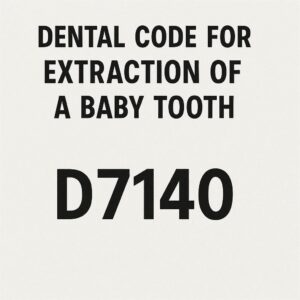
Dental Code for Extraction of a Baby Tooth
What Are Dental Procedure Codes (CDT Codes)?
Before we dive into the specific code for baby teeth, let’s take a step back and understand what these codes actually are.
Dental codes, formally known as CDT Codes (Current Dental Terminology) , are a standardized system created by the American Dental Association (ADA). Every few years, they release a new version (like CDT 2024, CDT 2025, etc.) with updates and new codes.
Think of them as a universal language for dentists and insurance companies. Every single procedure a dentist performs—from a simple exam to a complex surgery—has a unique five-character code that starts with the letter “D.” This ensures that when your dentist sends a claim to your insurance, the insurance company knows exactly what procedure was done and can process the claim correctly.
Why Do These Codes Matter to You, the Parent?
You might not need to memorize them, but understanding them helps you in several ways:
-
Insurance Clarity: You can verify what your insurance plan covers. Some plans cover extractions fully, while others cover a percentage.
-
Cost Estimates: When you receive a treatment plan, the code clarifies what the dentist is proposing, allowing you to ask informed questions about the cost.
-
Record Keeping: It helps you understand your child’s dental history and the procedures they’ve had.
-
Advocating for Your Child: If you have a high-deductible plan or no insurance, knowing the code allows you to call different dental offices to compare prices for the exact same procedure.
The Primary Code: D7140
When it comes to a routine, uncomplicated extraction of a baby tooth, the most common code you will see is D7140.
Let’s break down exactly what this code means.
What is D7140?
The full description for code D7140 is: “Extraction, erupted tooth or exposed root (elevation and/or forceps removal).”
In plain English, this means the tooth is already visible in the mouth (it has erupted), and the dentist can remove it using standard dental instruments like elevators (to loosen the tooth) and forceps (to gently pull it out). It’s considered a “simple” or “routine” extraction.
When is D7140 Used for a Baby Tooth?
This code is appropriate in the vast majority of cases involving primary teeth. For example:
-
The Wiggly Tooth: Your child has a tooth that’s been loose for weeks, but it just won’t fall out on its own. The dentist can use a topical numbing gel or local anesthetic and gently lift it out.
-
Over-Retained Tooth: Sometimes, a baby tooth’s roots don’t dissolve (resorb) as they should, and it remains firmly in place even though the permanent tooth is trying to come in behind it. This creates a “shark tooth” situation. The dentist will need to extract the stubborn baby tooth to make room for the permanent one.
-
Severe Decay: If a baby tooth has a large cavity that is too big for a filling or crown, and it’s causing pain or risking infection, an extraction is the best option.
-
Abscess or Infection: If a baby tooth has become infected at the root (a dental abscess), it often needs to be removed to clear the infection and prevent it from affecting the developing permanent tooth underneath.
What Happens During a D7140 Procedure?
For a child, the experience is designed to be as stress-free and painless as possible. Here’s a step-by-step walkthrough:
-
Examination and X-ray: The dentist will first examine the tooth and review any x-rays. The x-ray is crucial to see the shape of the roots, the position of the permanent tooth underneath, and to ensure no infection is present.
-
Anesthesia: The area around the tooth will be numbed. For children, this often involves a topical gel that tastes like bubblegum or fruit, applied first to numb the surface. Then, a local anesthetic (like lidocaine) is injected. Many pediatric dentists also use techniques to distract the child or use “the wand,” a computer-controlled device that makes the injection feel slower and more comfortable.
-
Loosening the Tooth: Once the area is numb, the dentist uses a dental elevator. This is a small, thin instrument that is gently worked between the tooth and the bone to slightly expand the socket and loosen the tooth’s attachment.
-
Removal: Finally, the dentist uses dental forceps to grasp the tooth and gently rock it free. Because the roots of baby teeth are often shorter and designed to be absorbed, they usually come out quite easily.
-
Post-Procedure Care: The dentist will place a piece of gauze over the extraction site and ask your child to bite down on it for a few minutes to stop the bleeding. They will then give you, the parent, instructions for the next 24 hours.
Important Note for Parents: It is vital to tell the dentist your child’s complete medical history, including any heart conditions, bleeding disorders, or medications they are taking. This ensures the dentist can plan the safest possible procedure.
Other Relevant Extraction Codes for Primary Teeth
While D7140 is the workhorse code for simple extractions, there are other situations that require a different code. It’s helpful to know the difference so you aren’t surprised by a treatment plan.
D7111: Extraction of a Coronal Remnant
This code is specifically for: “Extraction of a coronal remnant – primary tooth.”
What does that mean? A “coronal remnant” is essentially a baby tooth that has decayed so severely that the crown (the part you can see above the gum) has crumbled away, leaving only the roots or fragments of the tooth structure behind.
-
Why it’s different: In this case, the dentist can’t grab the tooth with forceps. The procedure may involve removing the soft decay first, then using special instruments to carefully retrieve the remaining root tips. It’s often slightly more complex than a routine extraction of a whole tooth.
-
Insurance Impact: Some insurance plans may reimburse for D7111 at a different rate than D7140, as it is often considered a bit more time-consuming.
D7210: Surgical Extraction
This code is for: “Surgical extraction of an erupted tooth requiring elevation of mucoperiosteal flap and removal of bone and/or section of tooth.”
This is a significant step up in complexity. While it’s less common for baby teeth, it can happen.
-
Why it’s different: A “surgical” extraction is necessary when the tooth cannot be simply pulled out. The dentist may need to make a small incision in the gum (a flap) to access the tooth better. They might also need to remove a small amount of bone surrounding the tooth or even cut the tooth into sections to remove it.
-
When it’s used for a baby tooth:
-
Dilacerated Roots: If a baby tooth’s roots are curved or hooked (dilacerated), they can snap off during a simple extraction. To prevent this, a surgical approach might be planned from the start.
-
Ankylosed Tooth: This is a condition where the tooth’s root has actually fused to the surrounding bone. It will be completely immobile. Trying to pull it out with forceps could cause a jaw fracture. A surgical approach is required to carefully separate the tooth from the bone.
-
Fractured Tooth: If a tooth breaks during an attempted simple extraction and the root is left behind, the dentist may need to perform a surgical procedure to retrieve the root tip.
-
D7140 vs. D7111 vs. D7210: A Quick Comparison
To make it clearer, here is a simple table comparing these three common codes for baby tooth extraction.
| Feature | D7140 (Simple Extraction) | D7111 (Coronal Remnant) | D7210 (Surgical Extraction) |
|---|---|---|---|
| Description | Removal of a fully visible tooth. | Removal of a badly broken-down tooth. | Surgical removal requiring incision/bone removal. |
| Common Reason | Loose tooth, “shark tooth,” mild decay. | Severe decay where only roots remain. | Ankylosed tooth, curved roots, fractured root tip. |
| Complexity | Low to Moderate. | Moderate. | High. |
| Instruments | Elevators and forceps. | May require decay removal and root tip picks. | Scalpel, bone burs, elevators, forceps. |
| Recovery | Typically very quick and easy. | Slightly longer due to possible gum irritation. | Longer, with more post-op discomfort expected. |
How Much Does a Baby Tooth Extraction Cost? (Insurance & Self-Pay)
The cost of extracting a baby tooth can vary wildly depending on where you live, the type of dentist you see (general vs. pediatric), and the complexity of the procedure.
Typical Price Ranges
-
Simple Extraction (D7140): For a simple extraction, you can typically expect to pay between $150 and $300.
-
Coronal Remnant (D7111): Because of the extra effort involved, this code often falls in the same range or slightly higher than a simple extraction, roughly $175 to $350.
-
Surgical Extraction (D7210): This is the most expensive option. The cost can range from $250 to $600 or more for a single tooth.
The Role of Dental Insurance
Most dental insurance plans follow a 100-80-50 structure for preventive, basic, and major services.
-
Preventive (e.g., cleanings, exams): Usually covered at 100%.
-
Basic (e.g., fillings, simple extractions): Usually covered at 70-80%.
-
Major (e.g., crowns, surgical extractions): Usually covered at 50%.
Extractions (D7140, D7111, D7210) generally fall under “Basic” or “Major” services. You will need to check your specific plan. If you have a deductible, you will need to pay that amount first before your insurance starts to pay its share.
Example: If a D7140 extraction costs $200 and your plan covers basic services at 80% after a $50 deductible:
-
You pay the first $50 (deductible).
-
The remaining balance is $150.
-
Insurance pays 80% of $150 = $120.
-
You pay the remaining 20% = $30.
-
Total out-of-pocket cost = $50 + $30 = $80.
Options if You Don’t Have Insurance
-
Dental Savings Plans: Many dentists offer in-house membership plans or accept third-party dental discount plans. You pay a low annual fee and receive 15-30% off all procedures.
-
Dental Schools: If you live near a dental school, this can be an excellent option. Student dentists, supervised by experienced faculty, perform procedures at a significantly reduced cost.
-
Community Health Centers: Federally qualified health centers (FQHCs) often have dental clinics that provide services on a sliding fee scale based on your income.
The Importance of Baby Teeth: Why Extraction is Sometimes Necessary
It’s a common question: “Why bother fixing or extracting a baby tooth? It’s just going to fall out anyway.”
This is a critical misconception. Baby teeth, also known as primary teeth, serve several vital functions:
-
Placeholders for Permanent Teeth: They hold the space in the jaw for the permanent teeth that are developing underneath. If a baby tooth is lost too early, the neighboring teeth can tilt or drift into the empty space. This closes the gap, and when the permanent tooth tries to come in, there’s no room for it. This leads to crowding and orthodontic problems later on.
-
Aid in Chewing and Nutrition: Healthy teeth are essential for chewing food properly. Children with painful teeth may avoid eating, leading to poor nutrition.
-
Enable Clear Speech: Teeth are crucial for forming sounds correctly. Missing front teeth can lead to speech impediments, like a lisp, that may require speech therapy to correct.
-
Self-Esteem and Social Development: A healthy smile helps children feel confident. Pain or visible decay can affect their social interactions and willingness to smile.
So, when is an extraction the right choice? Dentists will always try to save a tooth with a filling or a crown if possible. However, extraction becomes the best option when:
-
The decay is too extensive to restore with a filling or crown.
-
There is a severe infection (abscess) that could damage the permanent tooth bud.
-
The tooth is causing significant pain that can’t be resolved otherwise.
-
The tooth is preventing the permanent tooth from erupting (like in the “shark tooth” scenario).
The “Shark Tooth” Phenomenon: A Special Extraction Case
One of the most common reasons for extracting a baby tooth in school-aged children is the appearance of a “shark tooth.”
This happens when the permanent tooth starts to come in behind the baby tooth, instead of directly underneath it where it would dissolve the root. This creates a double row of teeth, resembling a shark’s mouth.
Should You Pull It or Leave It?
In many cases, if the baby tooth is loose, you can encourage your child to wiggle it themselves. Once it falls out, the tongue will usually push the permanent tooth forward into its correct position over time.
However, if the baby tooth is not loose, it needs to be extracted by a dentist. If it’s left in place, the permanent tooth will continue to come in behind it, leading to a misaligned bite. The extraction is usually a very simple D7140 procedure. The baby tooth often pops right out because its roots haven’t resorbed, but the ligament holding it in is often weaker.
Preparing Your Child for a Tooth Extraction
The idea of a dental procedure can be scary for a child (and for parents!). A little preparation can go a long way.
What to Say (and Not Say)
-
DO use positive language. Say things like, “The dentist is going to help your tooth take a nap so it doesn’t wiggle anymore,” or “We’re going to the dentist to make your mouth healthy and strong.”
-
DO NOT use scary words. Avoid words like “pain,” “shot,” “needle,” “pull,” or “drill.” These can create unnecessary anxiety.
-
Read a book. There are many excellent children’s books about visiting the dentist that can help normalize the experience.
-
Role-play. Pretend to be the dentist and count their teeth with a toothbrush. Then, let them be the dentist and check your teeth.
What to Expect on the Day of the Procedure
-
Comfort Items: Bring their favorite stuffed animal or blanket for comfort.
-
Distraction: Many pediatric dental offices have TVs on the ceiling or offer headphones. Tablets or phones loaded with a favorite show can be a great distraction.
-
Stay Calm: Children are incredibly perceptive. If you are anxious, they will pick up on it. Take deep breaths, smile, and project an air of calm confidence. Your presence is their biggest source of comfort.
Post-Extraction Care for Children (The “After” Guide)
Proper care after the extraction is vital for healing and preventing complications. Your dentist will give you specific instructions, but here is a general guide for the first 24-48 hours.
The First 24 Hours: The Critical Period
-
The Gauze: Keep the gauze pad your child bites on in place for about 30-45 minutes after leaving the office. This pressure helps a blood clot form in the socket, which is essential for healing.
-
No Rinsing or Spitting: Do not let your child rinse their mouth vigorously or spit forcefully for 24 hours. This can dislodge the protective blood clot.
-
No Straws: Absolutely no drinking from a straw for at least a week. The sucking action can also dislodge the clot, leading to a painful condition called “dry socket.”
-
Soft Foods: Stick to a soft food diet. Good options include:
-
Yogurt
-
Applesauce
-
Mashed potatoes
-
Smoothies (eaten with a spoon, not a straw)
-
Pudding
-
Lukewarm soup
-
-
Pain Management: If your child is uncomfortable, you can give them children’s ibuprofen (Advil, Motrin) or acetaminophen (Tylenol) according to the package directions and your dentist’s advice. Ibuprofen is often preferred as it also helps reduce inflammation.
-
Ice Pack: If there is any swelling, apply an ice pack wrapped in a thin towel to the outside of the cheek for 15 minutes on, 15 minutes off.
-
Cleaning: Do not brush the teeth immediately next to the extraction site. You can gently brush the rest of their teeth. After 24 hours, you can have them gently rinse with a warm salt water solution (1/2 tsp salt in a cup of warm water) a few times a day, especially after meals.
After 24 Hours: Getting Back to Normal
-
You can usually introduce more solid foods as your child feels comfortable.
-
You can resume normal brushing and flossing, being gentle around the extraction site for a few more days.
-
Watch for signs of complications, such as:
-
Bleeding that won’t stop.
-
Severe, worsening pain after a couple of days (a possible sign of dry socket, though rare in young children).
-
Fever or signs of infection (pus, increasing swelling).
-
Frequently Asked Questions (FAQ)
Here are some of the most common questions parents have about baby tooth extractions.
1. Will my child be put to sleep for the extraction?
It depends on the child’s age, anxiety level, and the complexity of the extraction. Most simple extractions (D7140) are done using only local anesthetic (numbing). For more complex cases (D7210), for very anxious children, or for extracting multiple teeth, options like nitrous oxide (laughing gas), oral sedation, or even general anesthesia (where the child is completely asleep) may be discussed.
2. Is pulling a baby tooth the same as pulling an adult tooth?
The general concept is the same, but the procedure is often easier. The roots of baby teeth are shorter, thinner, and designed to be absorbed by the body. This often makes the extraction faster and less traumatic than pulling an adult tooth.
3. What happens if a piece of the root breaks off?
Dentists take x-rays before the extraction to see the root shape and try to prevent this. However, sometimes a small root tip can break, especially if the tooth was decayed. If it’s a tiny fragment and there’s no infection, the dentist may choose to leave it, as the body will often absorb it over time. If it’s large or if there’s an infection, they may need to perform a surgical procedure (D7210) to retrieve it.
4. My 4-year-old needs a tooth pulled. Will this affect their permanent teeth?
The dentist would only recommend an extraction if it’s necessary to protect your child’s overall health. Leaving a severely infected baby tooth can damage the permanent tooth bud developing underneath it. The dentist will take x-rays to ensure the developing permanent tooth is healthy. As for space, your dentist may discuss a “space maintainer,” which is a small appliance that holds the gap open until the permanent tooth is ready to come in.
5. Can I just pull my child’s loose tooth at home?
It’s generally best to let a very loose tooth fall out on its own or be gently wiggled out by the child. You should never use force to pull a tooth that isn’t ready. If a tooth is hanging by a thread, a clean tissue and a quick, gentle twist by you or your child is usually fine. However, if there’s resistance, swelling, or pain, or if it’s a “shark tooth” situation, see a dentist.
6. Does insurance cover the cost of a baby tooth extraction?
Most dental insurance plans that include pediatric benefits will cover a portion of the cost. As mentioned above, simple extractions (D7140) are typically covered as a basic service. Always check with your specific provider to understand your coverage, deductible, and co-pay.
Conclusion: Navigating Your Child’s Dental Health with Confidence
Understanding the dental code for the extraction of a baby tooth—most commonly D7140—is a simple yet powerful tool for any parent. It transforms a confusing line item on a bill into a clear picture of the procedure your child needs, helping you navigate insurance, understand costs, and have more informed conversations with your dentist. While the thought of your child undergoing any procedure can be stressful, knowing what to expect, from the reason for the extraction to the post-care routine, can make the entire process smoother and calmer for both you and your little one.
Additional Resource
For the most up-to-date information on dental codes and pediatric dentistry guidelines, you can visit the American Academy of Pediatric Dentistry (AAPD) website. They have a section for parents with excellent resources.
Visit the American Academy of Pediatric Dentistry
Disclaimer
The information provided in this article is for general informational and educational purposes only and is not a substitute for professional medical or dental advice. Always seek the advice of your dentist, pediatrician, or other qualified health provider with any questions you may have regarding a medical condition or treatment. The specific dental code and treatment plan for your child must be determined by a qualified professional after a thorough examination.