If you are reading this, you are probably standing at the threshold of a significant decision: getting braces or Invisalign for yourself or your child. It’s an exciting time, but it often comes with a confusing side dish of paperwork, jargon, and numbers. Among all the terms your orthodontist’s office throws at you, one phrase stands out: the general orthodontic insurance code.
You might see it on a treatment plan as “D8080” or hear it referred to as “comprehensive orthodontic treatment.” It sounds technical, and frankly, it is. But understanding this specific code is the key to unlocking what your insurance will actually pay for and what you will have to cover out of pocket.
Insurance codes are the secret language of the dental world. They are the standardized way your orthodontist tells the insurance company, “This is the procedure we performed, and this is why we need to be paid.” For you, the patient, knowing what this code means is like having a decoder ring. It helps you understand your benefits, avoid unexpected bills, and compare treatment costs effectively.
In this guide, we will strip away the complexity. We will look at what the general orthodontic insurance code really means, how it impacts your finances, and how to navigate the insurance maze with confidence. We are not here to give you medical advice or guarantee coverage, but to arm you with the knowledge to ask the right questions and make informed decisions.
Let’s turn that confusion into clarity.
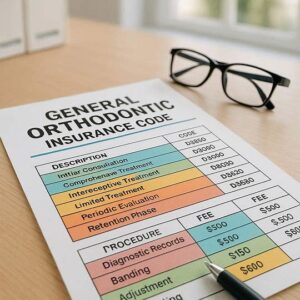
General Orthodontic Insurance Code
What Is an Orthodontic Insurance Code?
Before we dive into the specifics of the “general” code, we need to lay a foundation. Imagine walking into a massive library with millions of books but no numbering system. Finding the one you want would be impossible. The dental world would be that chaotic library without a standardized coding system.
The CDT Code: The Dental Dictionary
In the United States, dental procedures are standardized using a system called the Current Dental Terminology (CDT) code. This is a set of codes maintained by the American Dental Association (ADA) that describes every procedure a dentist or orthodontist might perform. Every time you get a cleaning, a filling, or braces, a specific CDT code is assigned to that service.
These codes ensure that whether you are in California or Maine, your insurance company understands exactly what “a comprehensive oral exam” means. They are the bridge between the clinical work done in the chair and the financial transaction handled by the insurance company.
D8000 – D8999: The Orthodontic Neighborhood
Within the vast library of CDT codes, orthodontic procedures live in a specific neighborhood: the D8000 – D8999 range. This is where you will find everything related to moving teeth and correcting bites. Codes in this range cover everything from the initial visit to the retention phase after the braces come off.
-
D8010 – D8025: These codes are typically for limited treatment. Think of a child who has a simple issue with a few front teeth, or an adult fixing a single tooth that shifted. It’s a smaller, more focused project.
-
D8030 – D8080: These codes cover the heavy lifting.
-
D8070 is often used for interceptive orthodontic treatment in children. This is Phase 1 treatment, usually done while the child still has baby teeth, to make room for permanent teeth or correct a developing bite issue.
-
D8080 is the one we are here to talk about: the comprehensive orthodontic treatment code.
-
Understanding this neighborhood helps you see that not all orthodontic work is created equal in the eyes of your insurance company. They categorize treatment based on complexity and scope, and that categorization dictates how much they are willing to pay.
The Star of the Show: The General Orthodontic Insurance Code (D8080)
Now, let’s shine a spotlight on the main event: the general orthodontic insurance code. Its official CDT name is D8080 – Comprehensive Orthodontic Treatment of the Adolescent Dentition.
But don’t let the word “adolescent” fool you. While it is technically named for teenagers, this is the code used for most full-mouth orthodontic treatments for patients of all ages—children, teens, and adults—who are done with primary (baby) teeth and have most of their permanent teeth.
Think of D8080 as the “all-inclusive package.” It is used when the goal is to correct a malocclusion (a bad bite) involving all the teeth in both the upper and lower jaws.
What “Comprehensive” Really Means
The key word here is comprehensive. It implies that the treatment plan is holistic and aims to correct the entire bite, not just a few crooked teeth. When an orthodontist submits a claim using the D8080 code, they are telling the insurance company:
“I am undertaking a full-mouth correction for this patient. This involves diagnosing, treating, and managing the entire dentition to achieve a functional and stable result.”
Because it is comprehensive, it is typically a one-time benefit per person. You don’t get a new set of comprehensive orthodontic benefits every few years. Most plans will cover comprehensive treatment only once in a lifetime.
When Is This Code Used?
You will see the D8080 code applied in situations involving:
-
Crowding: When there isn’t enough room in the jaw for all the teeth to align properly.
-
Spacing: Gaps between teeth that need to be closed.
-
Overbite/Deep Bite: When the upper front teeth overlap excessively with the lower front teeth.
-
Underbite: When the lower teeth protrude past the upper teeth.
-
Crossbite: When some upper teeth close inside the lower teeth.
-
Open Bite: When the front teeth don’t make contact when the back teeth are closed.
-
Alignment for Cosmetic Reasons: Even if the bite is technically functional, comprehensive treatment is used to straighten teeth for a better smile.
D8080 vs. Other Common Codes
To truly understand the scope of D8080, it helps to compare it to its “neighbors.”
| CDT Code | Procedure Name | What It Typically Means | When It’s Used |
|---|---|---|---|
| D8080 | Comprehensive Orthodontic Treatment of the Adolescent Dentition | Full-mouth braces or aligners to correct the entire bite and alignment. | Patients with most or all of their permanent teeth. The standard for most orthodontic cases. |
| D8070 | Comprehensive Orthodontic Treatment of the Transitional Dentition | Often called “Phase I” or “Interceptive” treatment. | Younger children (ages 7-10) who still have baby teeth. Aims to correct developing problems early. |
| D8010 | Limited Orthodontic Treatment of the Primary Dentition | Treatment involving baby teeth only. | Rare. Usually for very young children with specific issues. |
| D8020 | Limited Orthodontic Treatment of the Transitional Dentition | A focused correction for a specific issue, like moving one or two teeth, while the patient still has some baby teeth. | A child who needs a specific problem fixed, but not a full Phase I treatment. |
| D8030 | Limited Orthodontic Treatment of the Adolescent Dentition | A focused correction for a specific issue in a teenager or adult, such as aligning a few anterior teeth for cosmetic reasons. | When only a small section of the mouth needs treatment, not the entire arch. |
As you can see, D8080 is the comprehensive package, while others are more like “a la carte” items or early intervention plans.
How Insurance Handles the D8080 Code
Now for the part that hits your wallet. Knowing the code is one thing; understanding how your specific insurance plan applies it is another. Orthodontic benefits are often structured very differently from general dental benefits (like cleanings and fillings).
It’s Not a Copay; It’s a Percentage
For a standard filling, you might have a copay. For orthodontics, insurance typically uses a percentage model. Once your deductible is met (if your plan has one for orthodontics), the insurance company will pay a percentage of the total treatment cost, and you pay the rest.
Here is a realistic breakdown of what that might look like:
-
Total Treatment Cost (Doctor’s Fee): $6,000
-
Insurance Coverage Percentage: 50%
-
Insurance Benefit Paid: $3,000
-
Patient Responsibility: $3,000
However, there is a critical twist: the “Lifetime Maximum.”
The Orthodontic Lifetime Maximum
This is arguably the most important number on your insurance card regarding braces. The Orthodontic Lifetime Maximum is the absolute highest dollar amount your insurance plan will ever pay for orthodontic treatment (usually for the D8080 code).
While a general dental plan might have an annual maximum of $1,500 that resets every year, an orthodontic lifetime maximum is a one-time pool of money. Common lifetime maximums range from $1,000 to $2,500, though some premium plans may go higher.
Let’s revisit our example with the lifetime maximum in mind:
-
Total Treatment Cost: $6,000
-
Insurance Coverage Percentage: 50% of the total cost.
-
Lifetime Maximum: $1,500
If the insurance company calculates 50% of the total cost, that comes to $3,000. However, because your plan has a lifetime maximum of $1,500, they will only pay up to that cap. In this scenario, you would be responsible for the remaining $4,500, not $3,000.
Important Note for Readers: Always confirm whether your benefit is calculated as a percentage of the total fee with a cap or simply a flat dollar amount. This varies widely between plans.
The Age Limitation Clause
Many insurance plans place restrictions on orthodontic benefits based on age. It is very common for plans to only cover comprehensive orthodontic treatment (D8080) for dependent children under the age of 19 or 26.
For adults, some plans offer no orthodontic coverage at all. Others might have a separate, lower lifetime maximum for adults, or they may only cover adults if the treatment is deemed medically necessary to correct a severe functional problem (like a debilitating malocclusion that affects chewing), rather than purely for cosmetic reasons.
If you are an adult seeking treatment, this is the very first question you need to ask your HR department or insurance provider: “Does my plan cover orthodontic treatment for adults?”
Medical Necessity: The Gatekeeper
Insurance companies don’t just hand out money for braces because you want a prettier smile. They require proof of medical necessity. To approve coverage for the D8080 code, the orthodontist must submit diagnostic records (x-rays, photos, and study models) along with a claim form that justifies why the treatment is necessary.
They use a standardized scale called the Handicapping Labio-Lingual Deviation (HLD) Index or a similar state-mandated index. This index scores the severity of your malocclusion. Conditions like a cleft palate, severe overbites that damage the roof of the mouth, or crossbites that could lead to gum disease typically score high enough to be approved easily. Mild crowding for cosmetic reasons might be deemed “not medically necessary” and denied coverage, even if the plan technically offers orthodontic benefits.
Breaking Down Your Orthodontic Treatment Plan
When you receive a treatment plan from your orthodontist’s office, it’s a legal and financial document. Let’s look at a mock-up of what a section of that plan might look like, focusing on our star code.
Sample Treatment Plan Excerpt
Patient: Jane Doe
Procedure: D8080 – Comprehensive Orthodontic Treatment
Description: Full upper and lower fixed appliances (braces) or clear aligner therapy to correct malocclusion.
Total Fee for Service: $5,950
Estimated Insurance Breakdown:
-
Insurance Plan: PPO Dental Plus
-
Orthodontic Benefit: Covered (50% up to $1,500 lifetime max)
-
Estimated Insurance Payment: $1,500 (This is the plan’s maximum, not 50% of the total fee)
-
Patient Estimated Portion: $4,450
Payment Options:
-
Pay in Full: 5% discount if paid within 30 days. Total: $4,227.50
-
Monthly Payment Plan: $300 down payment, followed by 24 monthly payments of $180. (No interest if paid on schedule).
Terms:
-
This estimate is valid for 90 days.
-
Fees include all visits during active treatment, routine adjustments, and one set of retainers upon completion.
-
Fees do not include broken appliances, lost retainers, or replacement of aligners.
This simple document contains a wealth of information. It tells you exactly what the general orthodontic insurance code covers, how your specific insurance applies, and what your financial responsibility is. Don’t just glance at it; study it. If something doesn’t make sense, ask.
Factors That Influence the Cost of D8080 Treatment
You might wonder why the cost associated with the D8080 code can vary so much from one practice to another or even from one patient to another. The code itself is standard, but the treatment and the price are not. Several factors come into play:
-
Geographic Location: Just like rent and real estate, the cost of living in your area directly impacts the fees a practice must charge to stay open. Orthodontic treatment in a major metropolitan area on the coast will almost always be more expensive than in a rural town in the Midwest.
-
Type of Treatment: Is the treatment traditional metal braces, ceramic (clear) braces, or Invisalign? Some providers charge a premium for aesthetic options like Invisalign or lingual braces (braces behind the teeth).
-
Complexity and Duration: A simple case of minor crowding that takes 12 months is going to cost less than a complex surgical case involving extractions and elastics that takes 30 months. The D8080 code covers both, but the professional fee reflects the increased chair time and expertise required for the complex case.
-
The Orthodontist’s Experience and Expertise: A board-certified orthodontist with decades of experience may charge a higher fee than a newer provider. You are paying for their skill, precision, and ability to handle complications.
-
Practice Overhead: A state-of-the-art office with the latest 3D imaging technology and a large support staff has higher overhead costs, which can be reflected in the fees.
Maximizing Your Orthodontic Insurance Benefits
You pay your premiums every month. Now it’s time to make sure you get the most out of them. Here is a checklist of actionable steps to take when navigating your insurance for D8080 coverage.
Step 1: Read Your Benefits Summary (The “SPD”)
This is a boring document, but it’s your bible. Find your Summary Plan Description (SPD) or benefits booklet. Look for the section on “Orthodontic Benefits.” You are searching for specific answers to these questions:
-
Is there coverage for D8080?
-
Is there a waiting period before orthodontic benefits kick in?
-
What is the orthodontic lifetime maximum?
-
Is there a deductible for orthodontics?
-
What is the coinsurance percentage (e.g., plan pays 50%, you pay 50%)?
-
Are there age limitations?
-
Do I need a pre-authorization?
Step 2: Get a Pre-Treatment Estimate (Pre-Authorization)
This is non-negotiable. Before any treatment begins, ask your orthodontist’s office to submit a pre-authorization (sometimes called a pre-determination) to your insurance company. They will send the records, the D8080 code, and the proposed fee.
The insurance company will then send back a document stating what they will pay and what you will owe based on your plan’s terms. This is not a 100% guarantee of payment, but it is a very reliable estimate. It protects you from nasty surprises down the road.
Step 3: Understand Your FSA or HSA
If you have a Flexible Spending Account (FSA) or Health Savings Account (HSA), you can use these tax-advantaged dollars to pay for your orthodontic treatment. You can pay your deductible, your down payment, and your monthly installments with pre-tax money, saving you a significant amount. If your treatment spans two calendar years, you can strategically plan your FSA contributions to cover the costs.
Step 4: Use Your Full Benefit Year
Since orthodontic treatment is a long-term project, it doesn’t matter when you start, as the benefit is a lifetime maximum. However, if you have a Flexible Spending Account (FSA) that is “use it or lose it,” starting treatment at the end of the year can be a smart way to use up those funds for your down payment.
Step 5: Ask About Prompt Pay or Family Discounts
Many orthodontic offices offer a discount (often 3-5%) if you pay your entire portion of the fee upfront. Also, if you are getting treatment for more than one family member, always ask about a multi-family-member discount. These are not always advertised, but they are common.
Common Questions Patients Have About the D8080 Code
Navigating insurance can feel like a game of 20 Questions. Here are some of the most frequent queries we hear, answered clearly.
Q: The code says “adolescent dentition.” I am an adult. Can my orthodontist still use this code for me?
A: Yes, in most cases. While the official name specifies “adolescent,” the D8080 code is the industry standard for any comprehensive full-mouth orthodontic treatment, regardless of the patient’s age, once the permanent teeth are in. The key is whether your insurance plan covers the code for adults. That is a plan-specific rule, not a coding rule.
Q: My insurance says they cover 50% of orthodontics. Does that mean I only pay half of my bill?
A: Not necessarily. You must check your “lifetime maximum.” If your total fee is $6,000, 50% would be $3,000. But if your lifetime maximum is $1,500, the insurance company will stop at $1,500, and you are responsible for the remaining $4,500. Always look at both the percentage and the maximum.
Q: If I have dental insurance through work, does it automatically include orthodontics?
A: No. Orthodontic coverage is often a rider or an add-on to a standard dental plan. Some employers choose to offer it, and some do not. You must check your specific plan details to confirm if orthodontic benefits are included.
Q: I had braces as a teen. If my teeth have shifted, can I get insurance to pay for a second round of comprehensive treatment?
A: This is very unlikely. Since the benefit is a “lifetime” maximum, most plans will not pay for comprehensive treatment (D8080) a second time. However, if the shifting is minor, your orthodontist might be able to bill it under a limited treatment code (D8030 or D8020) . Some plans might have a separate, smaller lifetime benefit for limited retreatment. You would need to check your plan and get a pre-authorization.
Q: My orthodontist said I need Phase 1 treatment for my child. Is that D8080?
A: No, it is not. Phase 1 treatment, done while a child still has baby teeth, is typically billed under D8070 (Comprehensive Treatment of the Transitional Dentition) . This is important because some insurance plans have a separate, smaller lifetime max for Phase 1 treatment, and then a full max for Phase 2 (D8080) later. If your orthodontist accidentally bills Phase 1 as D8080, it could use up your child’s entire lifetime orthodontic benefit before they even get their permanent braces. Always ensure the correct code is used for your child’s stage of treatment.
Realistic Expectations: What D8080 Coverage Means for You
Let’s be realistic. The goal of orthodontic insurance is not to make your treatment free. It is designed to offset a significant portion of the cost. Very few plans cover 100% of orthodontic fees.
Think of your orthodontic insurance benefit as a helpful voucher. For example, if your benefit is a $1,500 lifetime maximum, that is $1,500 you don’t have to pay. That is a substantial help. But you should still plan on financing the remaining balance, which is typically thousands of dollars.
The true value of the insurance code system is clarity. When your orthodontist submits the D8080 code and your insurance company responds, it removes the guesswork. You get a clear picture: “This is the total cost. This is what your insurance will contribute. This is your remaining balance.” It allows you to budget, plan, and move forward with confidence.
The Orthodontic Journey: Beyond the Code
While the general orthodontic insurance code is the key that unlocks the financial door, it’s important to remember what lies beyond it: the journey to a healthier smile. The code is a tool for administration, but the treatment itself is a partnership between you and your orthodontist.
Once the insurance paperwork is sorted, your focus can shift entirely to the process:
-
The excitement of choosing the color of your bands or the type of aligners.
-
The discipline of wearing rubber bands or keeping aligners in for 22 hours a day.
-
The minor discomfort after an adjustment that signals your teeth are moving.
-
The triumphant day the braces come off and you see your new smile.
Understanding the insurance side of things simply clears the path so you can enjoy the journey without financial anxiety hanging over your head.
Conclusion
Understanding the general orthodontic insurance code (D8080) is your first step toward a stress-free orthodontic experience. It is the standardized language that defines comprehensive, full-mouth treatment, allowing you to decode your benefits, estimate your costs, and plan your finances. By knowing the difference between a coverage percentage and a lifetime maximum, and by insisting on a pre-authorization, you take control of the process and set realistic expectations.
Frequently Asked Questions (FAQ)
1. What does the general orthodontic insurance code D8080 cover?
It covers comprehensive orthodontic treatment to correct a malocclusion (bad bite) involving all the teeth. This includes the diagnosis, placement of appliances (braces or aligners), all regular adjustments, and typically a set of retainers after treatment is complete.
2. How much does insurance usually pay for the D8080 code?
It varies wildly. Most plans pay a percentage (like 50%) of the total cost, up to a set “lifetime maximum” amount (commonly between $1,000 and $2,500). You are responsible for the remaining balance.
3. Is the D8080 code only for children and teenagers?
No. While the official name includes “adolescent,” it is the standard code used for comprehensive treatment for patients of any age who have their permanent teeth. However, you must check if your specific insurance plan covers orthodontics for adults.
4. What is the difference between D8080 and D8070?
D8080 is comprehensive treatment for patients with their permanent teeth (adolescent/adult). D8070 is comprehensive treatment for patients in the “transitional dentition” phase, meaning they still have a mix of baby and permanent teeth. D8070 is often used for Phase 1 or interceptive treatment in younger children.
5. How can I find out exactly what my insurance will pay for my braces?
The most reliable way is to have your orthodontist’s office submit a pre-treatment estimate or pre-authorization to your insurance company. They will use the D8080 code and your diagnostic records to get an official, estimated breakdown of benefits from the insurer.
Additional Resource
For the most authoritative and up-to-date information on dental procedure codes, you can visit the American Dental Association’s page on CDT (Current Dental Terminology):
ADA CDT Code Information (This link leads to the official source for coding standards.)
Disclaimer: This article is for informational purposes only and does not constitute legal, financial, or medical advice. Insurance policies vary significantly by provider, employer, and location. You should always consult with your specific insurance carrier and your orthodontist to verify the details of your personal coverage and treatment plan.