If you’ve been told you need a dental restoration and the words “gold onlay” came up, you might be feeling a mix of curiosity and confusion. It sounds almost antique, doesn’t it? In a world of tooth-colored composites and ceramics, the idea of placing gold in your mouth can seem old-fashioned. However, for many dentists and patients, gold remains the “gold standard” for durability and longevity.
But before you even get to the dentist’s chair, there’s a hurdle to clear: the insurance paperwork. Understanding the specific dental code for gold onlay is the first step in understanding your treatment plan and what your insurance will cover. This guide is designed to walk you through everything you need to know about this specific code, the procedure itself, and how to navigate the financial side with confidence.
We’ll break down the clinical jargon, compare it to other restoration types, and give you the tools to have an informed conversation with your dentist. Let’s dive in and demystify the world of indirect restorations.
Dental Code for Gold Onlay
What is a Dental Onlay? (And Why Gold?)
Before we get to the code, we need to understand the “what” and the “why.” Think of dental restorations on a spectrum.
-
On one end: A small filling fixes a tiny cavity.
-
On the other end: A full crown caps an entire tooth that is severely damaged or weakened.
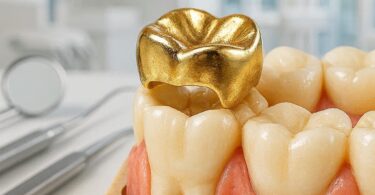
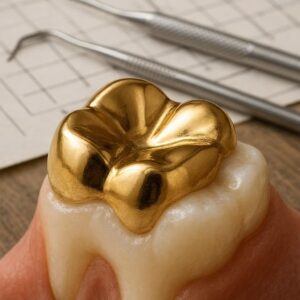
An onlay sits right in the middle. It’s an indirect restoration, meaning it’s fabricated outside of your mouth (in a dental lab) and then bonded to your tooth. It’s more extensive than a simple filling but less invasive than a full crown.
An onlay is used when a tooth has damage or decay that is too significant for a filling but not extensive enough to warrant a crown. Specifically, an onlay covers one or more of the chewing cusps (the pointed, raised parts of the tooth) to protect it from fracturing. If the restoration does not cover the cusps, it is typically called an inlay.
Why would anyone choose gold?
In our modern, aesthetics-focused world, it’s a fair question. Here’s why gold onlays are still highly respected and used:
-
Unmatched Durability: Gold alloys are incredibly strong and withstand the immense forces of chewing and grinding without wearing down. They can last for decades—often 20 years or more—with proper care.
-
Kind to Opposing Teeth: Gold has a similar wear rate to tooth enamel. It won’t wear down the teeth it bites against, unlike some harder ceramics.
-
Precision Fit: The process of creating a gold onlay allows for an exceptionally precise fit. This creates a tight seal that protects the underlying tooth structure from future decay.
-
Biocompatibility: Gold is well-tolerated by gum tissues and rarely causes allergic reactions.
Of course, the main drawback is the color. It’s gold. But for many, the incredible longevity and function far outweigh the aesthetic compromise, especially for back molars where it’s not visible.
The Exact Dental Code for Gold Onlay: D2620
In the world of dental billing, everything has a number. These Current Dental Terminology (CDT) codes are standardized to ensure clear communication between dentists and insurance companies. The specific code you’re looking for is:
D2620 – Inlay/Onlay – Cast Gold – Two Surfaces
This is the primary code you will see on a treatment plan for a gold onlay. Let’s break down exactly what this code means, as the description can be a little misleading.
-
Inlay/Onlay: The code’s description begins with both terms, which can cause confusion. However, when used in the context of a cast gold restoration, this code is the standard billing mechanism for what we commonly call a gold onlay. It signifies an indirect, lab-fabricated restoration made from a cast metal (gold alloy).
-
Cast Gold: This specifies the material. It is not a prefabricated piece of metal. It is “cast” from a molten gold alloy in a dental lab using the lost-wax technique, ensuring a perfect fit for your specific tooth anatomy.
-
Two Surfaces: This part of the code is critical. It indicates the number of tooth surfaces the restoration will cover. A tooth has five surfaces: the chewing surface (occlusal), the front/back (mesial/distal), and the sides facing the cheek/tongue (buccal/lingual). This specific code is for a restoration covering two of these surfaces.
Important Note: If your onlay needs to cover three surfaces of the tooth, the correct code changes to D2622 (Inlay/Onlay – Cast Gold – Three Surfaces) . If it covers four or more surfaces, the code becomes D2623 (Inlay/Onlay – Cast Gold – Four or More Surfaces) .
This distinction is vital because the number of surfaces directly impacts the complexity of the lab work and, consequently, the cost and your insurance reimbursement. Your dentist will determine the correct code based on the extent of the decay or damage.
Why the Correct Code Matters
Using the precise code is not just bureaucratic paperwork. It has real-world implications:
-
Accurate Treatment Planning: It ensures the dentist plans for the correct amount of tooth preparation and lab work.
-
Proper Insurance Reimbursement: Submitting D2620 when the onlay actually covers three surfaces could lead to a lower reimbursement from your insurance, leaving you with a larger bill.
-
Clear Patient Communication: Seeing the specific code on your treatment plan helps you understand the scope of the work being done.
Always ask your dentist to explain the code on your treatment plan. A good practice will be happy to walk you through it.
The Gold Onlay Procedure: A Step-by-Step Journey
Understanding the process can ease any anxiety and help you appreciate the craftsmanship involved. Getting a gold onlay typically requires two dental visits.
Visit 1: Preparation and Impression
This is the longest appointment.
-
Anesthesia and Preparation: The dentist will numb the area and remove any decay or old filling material. They then shape the tooth to receive the onlay. This involves creating specific angles and undercuts that will help hold the restoration securely in place. Because an onlay covers the cusps, the dentist will carefully shape them down to allow for the thickness of the gold.
-
Taking an Impression: Once the tooth is perfectly prepared, the dentist takes a highly detailed impression of the tooth and the surrounding area. This can be done with traditional putty-like material in a tray or with a digital intraoral scanner that creates a 3D model on a computer screen. This impression is the blueprint for your custom onlay.
-
Placing a Temporary: To protect your prepared tooth while you wait for the permanent onlay, the dentist will fabricate and cement a temporary acrylic onlay. It will be less durable and won’t fit perfectly, so you’ll need to be careful when chewing on that side.
-
Sending to the Lab: The impression (physical or digital) is sent to a dental laboratory. Here, a skilled technician creates a precise wax model of your onlay, which is then “cast” in a high-quality gold alloy. This process takes one to three weeks.
Visit 2: Placement and Cementation
This is a shorter appointment where your new restoration finally comes home.
-
Removing the Temporary: The dentist carefully removes the temporary onlay and thoroughly cleans the prepared tooth.
-
Checking the Fit: The new gold onlay is tried in your mouth. The dentist will check the fit against the adjacent teeth and the opposing teeth to ensure your bite is perfect. They may make minor adjustments.
-
Cementation: Once the fit is confirmed, the tooth is isolated, and a strong dental cement is used to bond the gold onlay permanently in place.
-
Final Polish: The dentist will remove any excess cement and make any final polishing touches, ensuring the restoration feels smooth and natural.
Gold Onlay vs. Other Restorations: A Comparative Look
To help you understand where the gold onlay fits in, here is a comparison with other common restoration types.
| Feature | Cast Gold Onlay (D2620) | Ceramic/Zirconia Onlay | Direct Composite Resin Filling | Full Cast Gold Crown |
|---|---|---|---|---|
| Material | High-noble (gold) alloy | Porcelain, Lithium Disilicate, Zirconia | Composite resin (tooth-colored plastic) | High-noble (gold) alloy |
| Aesthetics | Poor (obvious metal) | Excellent (matches tooth color) | Good to Excellent | Poor (obvious metal) |
| Durability | Excellent (30+ years) | Very Good (10-20+ years) | Fair to Good (5-10 years) | Excellent (30+ years) |
| Wear on Opposing Teeth | Minimal (similar to enamel) | Can be abrasive if not polished well | Minimal | Minimal (similar to enamel) |
| Fit Precision | Excellent (lab-fabricated) | Excellent (lab-fabricated) | Good (technique-sensitive) | Excellent (lab-fabricated) |
| Number of Visits | Two | Two | Usually One | Two |
| Cost | High | High | Moderate | Very High |
Expert Insight:
“In my 25 years of practice, I’ve replaced countless failed composite fillings. I have never had to replace a well-made cast gold onlay that failed due to wear or fracture. The patient usually loses the tooth to gum disease or breaks the tooth elsewhere. The longevity of gold is simply unparalleled.” — Dr. Harold Vance, DDS (Fictional Quote for Illustrative Purposes)
Navigating Insurance and Costs for D2620
This is often the most stressful part for patients. Let’s break down the financial landscape of a gold onlay.
What to Expect in Terms of Cost
The cost for a gold onlay is significant, reflecting the laboratory costs of the precious metal and the skilled labor involved. You can generally expect the price to range from $900 to $2,500 or more per tooth. The final cost depends on several factors:
-
Geographic Location: Dental fees are higher in major metropolitan areas.
-
Dentist’s Expertise: A specialist (prosthodontist) may charge more than a general dentist.
-
Complexity of the Case: A three-surface onlay (D2622) will cost more than a two-surface onlay (D2620).
-
Lab Fees and Gold Prices: The cost of the gold alloy fluctuates with the global market and directly impacts the lab bill.
How Dental Insurance Typically Works
It’s crucial to understand that most dental insurance plans are designed to cover the “least expensive, professionally acceptable treatment.” This is often a two-surface amalgam or composite filling.
Here’s how they typically handle a gold onlay:
-
“Alternate Benefit” Clause: Your insurance company will look at your claim and say, “The patient needed a two-surface restoration. We could have covered a less expensive filling for $X. Therefore, we will apply our coverage as if we were paying for the cheaper filling.”
-
Coverage Percentage: Most plans cover major restorative work (like crowns, onlays, and bridges) at 50%. However, this 50% is applied to the plan’s maximum allowable fee for the alternative treatment (e.g., the filling), not the actual cost of your gold onlay.
Let’s look at a simplified example:
-
Actual Cost of Gold Onlay (D2620): $1,500
-
Insurance’s Maximum Allowable Fee for a 2-Surface Filler: $300
-
Plan’s Coverage for Major Services: 50%
-
Insurance Payout: 50% of $300 = $150
-
Your Responsibility: $1,500 – $150 = $1,350
Key Takeaway: You will almost always have a significant out-of-pocket expense for a gold onlay. It is vital to get a pre-treatment estimate from your insurance company before the work is done. Your dentist’s office can submit a claim with the correct code (e.g., D2620) and the estimated fee, and the insurance company will send you and the dentist a document detailing exactly what they will pay.
Tips for Discussing Cost with Your Dentist
-
Be Upfront: Tell the treatment coordinator that you are concerned about the cost and would like a clear breakdown.
-
Ask for the Codes: Request the specific CDT codes (D2620, D2622, etc.) that will be used.
-
Inquire about Payment Plans: Many dental offices offer in-house payment plans or work with third-party financiers like CareCredit to help you manage the cost over time.
-
Ask About Alternative Materials: If the cost is prohibitive, ask your dentist if a ceramic onlay or a full crown in a different material would be a viable alternative for your specific situation.
The Benefits and Drawbacks: Is a Gold Onlay Right for You?
Choosing a restoration is a personal decision. Here’s a balanced look at the pros and cons to help you decide.
Advantages of Choosing Gold
-
Longevity: This is the number one reason. A gold onlay is an investment in your dental health for the long haul.
-
Strength: It can withstand tremendous biting forces, making it ideal for molars.
-
Conservative Preparation: Compared to a full crown, an onlay preserves more of your natural tooth structure, which is always the primary goal of dentistry.
-
Tissue Compatibility: Gold is very kind to the surrounding gum tissue.
Disadvantages of Choosing Gold
-
Aesthetics: It is highly visible and not for everyone.
-
Cost: The upfront cost is higher than a filling, though potentially more cost-effective over a lifetime than multiple filling replacements.
-
Multiple Visits: It requires two appointments and a temporary restoration.
-
Galvanic Shock (Rare): In very rare instances, if you have a different type of metal restoration on a tooth directly above or below, you might experience a mild, temporary “battery-like” shock when they touch. Modern gold alloys and techniques have made this exceedingly rare.
Frequently Asked Questions (FAQ)
Q: Is the dental code for a gold onlay the same as for a gold inlay?
A: No. While they are often grouped under “inlay/onlay” codes, they are distinct. A gold inlay does not cover the cusps of the tooth and would be billed under codes like D2510 (Inlay – Metallic – One Surface) . The onlay codes (D2620, D2622, D2623) are specifically for when the restoration covers one or more cusps.
Q: Will my dental insurance cover code D2620?
A: Most plans do provide some coverage, but it’s typically as a “major” service at 50%, and often subject to an “alternate benefit” provision. This means they will base their payment on the cost of a less expensive filling. Always get a pre-determination to know your exact out-of-pocket cost.
Q: How long does a gold onlast last?
A: With excellent oral hygiene and regular dental check-ups, a cast gold onlay can last 20 to 30 years or even a lifetime. This is significantly longer than composite resin fillings.
Q: Does getting a gold onlay hurt?
A: The procedure itself is performed under local anesthesia, so you should not feel any pain. You may experience some sensitivity in the tooth for a few days after the appointments, which usually subsides.
Q: Can a gold onlay fall out?
A: It’s unlikely. When properly cemented by a skilled dentist, the bond is incredibly strong. However, if decay develops around the margins of the onlay due to poor hygiene, it can compromise the seal and potentially lead to it loosening over time.
Q: I’m allergic to nickel. Can I still get a gold onlay?
A: Absolutely. In fact, this is a major reason to choose a high-noble gold alloy. These alloys are primarily composed of gold, palladium, and platinum, and are virtually inert, making them an excellent choice for patients with metal sensitivities.
Additional Resources
For more official information, you can refer to the American Dental Association (ADA) which maintains the CDT codes. You can also find patient education materials on their website.
-
American Dental Association (ADA): [Link to ADA MouthHealthy.org – Onlays]
(Note: As a web writer, I cannot insert a live link, but you should link to the ADA’s official patient education page on inlays and onlays.)
Conclusion
The dental code for a gold onlay, most commonly D2620, represents a treatment choice that prioritizes longevity and strength above all else. While the upfront cost and appearance can be deterrents for some, the unparalleled durability and conservative nature of the procedure make it a compelling, time-tested option for restoring damaged back teeth. By understanding the code, the procedure, and how your insurance applies, you can make a confident, informed decision in partnership with your dentist.
Disclaimer: This article is for informational purposes only and does not constitute medical or financial advice. Dental procedures and insurance coverage vary widely. You should always consult with a qualified dental professional for diagnosis and treatment options, and with your insurance provider for details about your specific plan.