Navigating the world of dental insurance and coding can sometimes feel like learning a second language. For dental professionals, accurate coding is not just about getting paid; it’s about legally and ethically documenting the sophisticated care provided to patients. Among the more complex procedures to code are those involving guided tissue regeneration (GTR).
If you’ve ever stared at a treatment plan, wondering whether to use D4266 or D4267, or if you’ve had a claim denied and weren’t sure why, you are in the right place. This guide is designed to demystify the dental code for guided tissue regeneration. We’ll walk through what GTR is, the specific codes you need to know, how to differentiate them, and the documentation strategies that lead to successful reimbursement.
Whether you are a seasoned office manager, a dentist looking to refine your billing knowledge, or a dental student eager to learn the ropes, consider this your friendly, comprehensive handbook.
What is Guided Tissue Regeneration (GTR)? A Quick Refresher
Before we dive into the numbers and modifiers, let’s make sure we are all on the same page about the procedure itself. Understanding the “what” and “why” behind the treatment makes choosing the correct code infinitely easier.
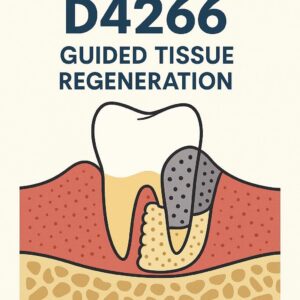
Guided tissue regeneration is a surgical procedure that aims to regenerate lost periodontal structures—specifically, the bone, periodontal ligament, and cementum—that support your teeth. In cases of severe gum disease (periodontitis), the bone and tissue supporting the teeth can be destroyed, leading to deep pockets and, eventually, tooth loss.
Dental Code for Guided Tissue Regeneration
How does GTR work?
Think of it as creating a protected environment for your body to heal itself. During the procedure, a dentist or periodontist places a barrier membrane between the gum tissue and the root of the tooth.
-
The Problem: Gum tissue cells heal much faster than bone and ligament cells. If left unchecked, the speedy gum cells would fill the defect first, preventing the regrowth of the more complex supporting structures.
-
The Solution: The membrane acts as a physical barrier. It keeps the fast-growing gum tissue out of the defect site, giving the slower-growing bone and ligament cells the time and space they need to regenerate. This membrane is often referred to as a “barrier.”
There are two main types of membranes:
-
Non-resorbable: These are made of materials like Teflon and require a second surgery to remove them.
-
Resorbable: Made from natural or synthetic materials that your body gradually absorbs over time, eliminating the need for a second removal procedure.
Sometimes, GTR is combined with a bone graft (a procedure known as guided bone regeneration or GBR), where bone replacement material is placed in the defect to further encourage regeneration. The choice of code depends on the specific combination of procedures performed.
Important Note: GTR is a highly technique-sensitive procedure and is typically reserved for specific types of defects around teeth. It is distinct from procedures focused solely on bone grafting for implant site development, which have their own set of codes.
The Core Dental Codes for Guided Tissue Regeneration
Now, let’s get to the heart of the matter. The American Dental Association (ADA) CDT (Current Dental Terminology) manual provides the standardized codes we must use. For GTR, there are three primary codes you need to understand. Each one describes a slightly different clinical scenario.
The key to choosing the right code lies in answering two questions:
-
Is this a one-stage or two-stage procedure?
-
Am I placing a membrane by itself, or am I also placing bone graft material?
Here is a breakdown of the codes you will use most frequently.
D4266 – Guided Tissue Regeneration – Resorbable Barrier, Per Site
This code is used when you place a resorbable membrane that does not need to be surgically removed later.
-
What it describes: The surgical placement of a barrier that will naturally break down and be absorbed by the body over time. The code is defined as “per site,” meaning per tooth, implant, or surgical site.
-
Typical Scenario: A patient has a deep periodontal defect around a tooth. You perform flap surgery to access the defect, debride (clean) the area, and then place a collagen membrane (a common type of resorbable barrier) over the defect before suturing the gum tissue back into place. The membrane works its magic and then dissolves.
-
Key Takeaway: One surgery. One placement. No removal.
D4267 – Guided Tissue regeneration – Non-resorbable Barrier, Per Site
This code is used when you place a non-resorbable membrane. Because this membrane will not dissolve, a second procedure is required to remove it.
-
What it describes: The surgical placement of a barrier made of a material like dense polytetrafluoroethylene (d-PTFE). The code is also defined as “per site.”
-
Typical Scenario: A complex defect requires a long, predictable healing time. You choose a non-resorbable membrane for its structural integrity. You place the membrane during the first surgery. Then, after several months of healing, you perform a second, minor surgery to remove the membrane.
-
Key Takeaway: This code only covers the placement. The removal is a separate procedure billed with its own code (often D4268, which we’ll cover next). This is a two-stage process.
D4268 – Surgical Removal of Non-resorbable Barrier
This is the companion code to D4267. You cannot use D4267 without eventually using D4268, and you cannot use D4268 if you never placed a non-resorbable barrier (billed with D4267).
-
What it describes: The surgical procedure to retrieve and remove a non-resorbable membrane. This is a distinct surgical entry and requires its own anesthesia and surgical time.
-
Typical Scenario: Several months after the initial GTR procedure (D4267), the patient returns. You reopen the surgical site, locate and carefully remove the d-PTFE membrane, and then suture the tissue closed again.
-
Key Takeaway: This code is never billed on the same day as D4267. It is always a separate claim on a future date of service.
The Bone Graft Connection: D4261 and D4265
GTR is often performed in conjunction with a bone graft to enhance the regenerative result. When this happens, you need to code for both parts of the procedure. You cannot “bundle” them into one code.
-
D4261: This is the code for the bone graft itself. The full description is “Bone replacement graft – retained natural tooth – first site.”
-
D4265: This is the code for the biologic materials that aid in soft and osseous tissue regeneration. This includes things like enamel matrix derivative proteins (e.g., Emdogain) or platelet-rich plasma. It is often used in conjunction with, or instead of, a membrane.
When you perform a bone graft and place a membrane, you would typically bill D4261 (for the graft) and either D4266 or D4267 (for the membrane) for the same site on the same date of service.
Critical Coding Rule: Most payers will not allow you to bill for a separate “surgical access” code (like a flap procedure, D4240) on the same day as a GTR or bone graft procedure. The access surgery is considered a necessary part of the primary procedure and is included in its reimbursement. The only exception is the initial assessment and documentation of the defect.
D4266 vs. D4267: Making the Right Choice
Confusion between D4266 and D4267 is one of the most common reasons for claim denials. Let’s put them side-by-side to make the distinction crystal clear.
| Feature | D4266 – Resorbable Barrier | D4267 – Non-resorbable Barrier |
|---|---|---|
| Membrane Type | Collagen, synthetic polymers that dissolve. | d-PTFE, titanium-reinforced PTFE. |
| Number of Surgeries | One. Placement only. The body handles removal. | Two. Placement surgery, then a separate removal surgery. |
| Removal Code | Not applicable. | D4268 (billed at a later date). |
| Patient Experience | No second surgery needed. Generally preferred by patients. | Requires a second procedure, but may be necessary for complex cases. |
| Typical Reimbursement | Generally higher than D4267 for the initial procedure, as it includes the “removal” cost in the global fee. | The combined reimbursement of D4267 + D4268 is often higher, reflecting the two procedures. |
| Documentation Focus | Type of membrane, reason for choice (e.g., patient comfort, defect size). | Type of membrane, justification for non-resorbable choice (e.g., need for space maintenance, longer healing). |
How to Decide
-
Choose D4266 if you are placing a membrane that will dissolve on its own. This is the more common scenario in modern periodontics.
-
Choose D4267 if you are placing a membrane that is designed to stay in place and will require a surgical removal appointment. You must be prepared to document why this specific membrane was the best choice for the patient’s clinical situation.
Step-by-Step: How to Document for GTR Codes
Excellent documentation is your best friend when it comes to insurance claims. A well-documented chart not only justifies the medical necessity of the procedure but also provides a clear roadmap for anyone reviewing the claim. Here is what your documentation should include for GTR procedures.
1. Pre-Operative Documentation (The Justification)
Before you even pick up a scalpel, your records must show why GTR is necessary.
-
Periodontal Charting: Full-mouth pocket depths, bleeding on probing, furcation involvement, and mobility scores. This establishes the diagnosis of periodontitis.
-
Radiographs: High-quality periapical or vertical bitewing images that clearly show the extent of bone loss. Crucially, these images must demonstrate the morphology of the defect. Is it a 2-wall, 3-wall, or circumferential defect? Certain defect types are more predictable for GTR, and insurers look for this.
-
Diagnosis: A clear narrative statement, such as: “Generalized severe chronic periodontitis with a localized 10mm probing depth and a 3-wall intrabony defect on the mesial of tooth #19.”
-
Treatment Plan Rationale: A brief note explaining why GTR was chosen. For example: “GTR planned for tooth #19 to attempt regeneration of supporting bone and ligament in a contained 3-wall defect, improving long-term prognosis.”
2. Operative Report (The Procedure)
This is the note you write immediately after the surgery. It should read like a story of what happened.
-
Procedure Performed: Clearly state the codes (e.g., D4261 & D4266).
-
Anesthesia: Type and amount used.
-
Detailed Description:
-
“Following administration of local anesthesia, full-thickness mucoperiosteal flaps were reflected facial and lingual on tooth #19.”
-
“The area was degranulated, and the defect was thoroughly debrided. All granulation tissue was removed, and the root surface was scaled and planed to a smooth, hard consistency.”
-
“The intrabony defect was measured to be 6mm in depth.”
-
“Freeze-dried bone allograft (FDBA) was hydrated and carefully compacted into the bony defect (D4261).”
-
“A [Brand Name] resorbable collagen membrane was trimmed to size and placed over the graft and defect, extending 2-3mm beyond the margins of the defect (D4266).”
-
“The flaps were repositioned and sutured with 4-0 chromic gut suture to achieve primary closure.”
-
-
Membrane Specifics: If using a non-resorbable membrane for D4267, document the brand and lot number, and note why this specific type was necessary (e.g., “A titanium-reinforced d-PTFE membrane was used to maintain space under the membrane in this large defect.”)
3. Post-Operative Documentation (The Follow-up)
-
D4267 & D4268 Specifics: If you placed a non-resorbable membrane, your post-op notes for the removal surgery (D4268) should clearly state that the membrane was found, removed in one piece, and that the site was healing well.
-
Healing Notes: Document suture removal, any complications (e.g., membrane exposure), and the patient’s recovery progress.
Pro-Tip: Intra-operative photographs are worth their weight in gold. A photo of the defect before grafting, the graft in place, and the membrane placed over it provides undeniable proof of the procedure’s complexity and necessity.
Common Reasons for Claim Denials and How to Avoid Them
Even with perfect coding, claims can be denied. Here are the most frequent pitfalls associated with GTR coding and how to navigate them.
Denial 1: “Procedure is considered part of another procedure.”
-
The Issue: The insurer says the GTR is included in the payment for the flap surgery or the bone graft.
-
The Reality: This is often incorrect. GTR is a distinct, additional procedure. However, if you bill a flap procedure (e.g., D4240) on the same line or same day, it may be auto-denied by the system.
-
The Solution: Do not bill a separate flap procedure. The surgical access is inherent to the GTR/bone graft. If you are using a paper claim, ensure the GTR code is listed as the primary procedure. If you get a denial, be prepared to appeal with literature showing GTR is a separate, billable service.
Denial 2: “Limitation of benefits.”
-
The Issue: The patient’s plan has a low annual maximum, and the cost of the GTR procedure has exhausted it.
-
The Solution: This requires patient communication, not an insurance appeal. Always provide a clear treatment plan and financial estimate before the procedure. Discuss how the patient’s benefits apply and what their out-of-pocket responsibility will be.
Denial 3: “Not a covered benefit.”
-
The Issue: Some basic dental plans explicitly exclude surgical periodontal procedures like GTR, considering them “specialist” services or not “medically necessary.”
-
The Solution: Always verify benefits before treatment. Call the insurance company and ask specifically: “Is code D4266 a covered benefit for this patient’s plan?” If it’s not covered, you can still proceed with the treatment, but you’ll need the patient to sign an informed consent acknowledging they are financially responsible.
Denial 4: “Lack of medical necessity.”
-
The Issue: The insurer doesn’t believe the procedure was needed based on the documentation provided.
-
The Solution: Go back to the documentation section. Ensure your pre-op X-rays clearly show the intrabony defect and that your probing depths are recorded. In your appeal letter, explain why saving the tooth with regeneration is a better option than extraction.
GTR and Implant Site Development: A Note on GBR
It’s important to distinguish between GTR around a natural tooth and Guided Bone Regeneration (GBR) for implant placement. While the biological principle is similar—using a membrane to exclude soft tissue and promote bone growth—the coding is different.
-
For a tooth: Use D4266, D4267, D4261.
-
For an implant site (site development before implant placement): You would use codes from the “Implant Services” section.
-
D6104: Bone graft at time of implant placement.
-
D7953: Bone replacement graft for ridge preservation – per site. (Often used for socket grafting after extraction).
-
D4266 or D4267 can be used in implant therapy, but the context matters. If you are placing a membrane over a graft in a socket or a ridge defect to prepare for a future implant, you would typically use the codes from the implant section or consult your local payer’s guidelines, as some prefer the D4266 code for this as well. The key is consistency and clear documentation of the treatment goal.
-
Reader Note: Always check with your local Medicare Administrative Contractor (MAC) or major insurance carriers for specific LCDs (Local Coverage Determinations) or guidelines, as coverage for these procedures can vary significantly by region and plan type.
Frequently Asked Questions (FAQ)
Q: Can I bill for a bone graft and a membrane on the same tooth on the same day?
A: Yes, absolutely. This is a common and appropriate combination. You would bill the bone graft code (D4261) and the appropriate membrane code (D4266 or D4267) for the same site. Payers expect this.
Q: My patient’s insurance denied D4266, saying it should have been D4267. What do I do?
A: First, double-check your records. Did you use a resorbable or non-resorbable membrane? If you used a resorbable membrane, D4266 is correct. The denial may be a simple processing error. File an appeal and include the manufacturer’s information for the membrane you used, stating clearly that it is a resorbable barrier, justifying the use of D4266.
Q: What is the typical reimbursement for D4266?
A: Reimbursement varies wildly based on your geographic location and the patient’s specific insurance plan. There is no single “usual” fee. It is best to check the specific fee schedule for the insurance plan you are billing. As a reference point, it is generally higher than a simple flap procedure and reflects the complexity and material cost of the membrane.
Q: Do I need to use a specific modifier if I do GTR on multiple teeth?
A: The codes are defined as “per site.” So if you perform GTR on two non-adjacent teeth, you would bill the code twice, once for each site. Some payers may want you to use a different tooth number on each line of the claim. For adjacent teeth treated in the same surgical field, some payers may consider this one “site,” while others may allow for multiple sites if the defects are distinct. This is a gray area; check with the specific payer’s guidelines. Good documentation is key.
Q: What happens if a resorbable membrane gets exposed during healing?
A: This is a potential complication. You must document this in the patient’s chart. Note the date of exposure, the size of the exposed area, and the treatment rendered (e.g., chlorhexidine rinses, more frequent recalls). This documentation is vital if the final outcome is compromised and you need to justify your post-operative care. It does not typically change the coding.
Conclusion
Mastering the dental code for guided tissue regeneration is a journey of understanding both the clinical procedure and the administrative language used to describe it. By distinguishing between a resorbable (D4266) and a non-resorbable (D4267) barrier, correctly linking the bone graft (D4261), and maintaining impeccable documentation, you set your practice up for success. Accurate coding ensures that you are fairly reimbursed for the advanced, skill-intensive care you provide, allowing you to continue offering life-changing regenerative therapy to your patients.
Disclaimer: This article is intended for informational purposes only and does not constitute legal or billing advice. Coding rules, coverage policies, and reimbursement rates are subject to change and vary by payer, geographic location, and individual patient contract. Always refer to the current CDT manual published by the American Dental Association and verify benefits and requirements with the specific insurance carrier before rendering treatment.
Author: Professional SEO Web Content Writer
Date: March 14, 2026