If you have ever sat in a dentist’s chair and heard the front office staff discussing “codes” after a procedure, you know it can sound like a foreign language. For patients and even some dental professionals, understanding the specific codes used to bill for procedures is a challenge.
One of the most common points of confusion revolves around the dental code for root removal. Whether you are dealing with a simple extraction where the root comes out with the tooth, a surgical procedure where the root is sectioned, or the removal of a residual root tip (known as a root tip pick), the codes differ significantly.
This guide is designed to demystify these codes. We will walk you through the Current Dental Terminology (CDT) codes, explain what they mean in plain English, and help you understand what to expect during these procedures.
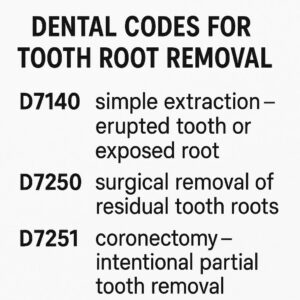
Dental Codes for Tooth Root Removal
What is a Dental Code?
Before diving into the specifics of root removal, it is helpful to understand what dental codes are. Dental codes, officially known as CDT (Current Dental Terminology) codes, are a set of standardized codes developed by the American Dental Association (ADA). Every dental procedure, from a routine cleaning to a complex surgery, has a corresponding five-character alphanumeric code starting with the letter “D.”
Why do these codes matter?
-
Insurance Billing: They are the language of dental insurance. Your claim cannot be processed without the correct code.
-
Treatment Clarity: They provide a standardized way for dentists to document exactly what procedure was performed.
-
Patient Understanding: When you receive an Explanation of Benefits (EOB) from your insurance, these codes explain what was done and what was paid.
The Confusion Around Root Removal Codes
The phrase “root removal” is a broad term. In dentistry, it can mean several different things:
-
A routine extraction where the entire tooth, crown, and roots are taken out.
-
A surgical extraction where a tooth is broken into pieces, and the roots are removed separately.
-
The removal of a root tip that was left behind from a previous extraction.
-
A root amputation where one root of a multi-rooted tooth is removed, but the rest of the tooth remains.
Because of these nuances, there isn’t just one single dental code for root removal. The correct code depends entirely on the complexity of the procedure and the condition of the tooth.
The Primary Dental Codes for Root Removal
Let’s break down the most common CDT codes used for procedures involving the removal of tooth roots. We will look at them in a comparative table for easy reference, and then dive into the details of each.
Comparative Table: Root Removal Codes at a Glance
| CDT Code | Procedure Description | Typical Use Case | Surgical vs. Non-Surgical |
|---|---|---|---|
| D7140 | Extraction, erupted tooth or exposed root | A loose tooth, a tooth fully visible in the mouth, or a root surface that is exposed. Simple forceps removal. | Non-Surgical |
| D7210 | Extraction, erupted tooth requiring removal of bone and/or sectioning of tooth | A tooth that is solid and difficult to remove, requiring the dentist to cut the tooth into pieces or remove some bone. | Surgical |
| D7250 | Removal of residual tooth root (surgical) | A root tip left behind from a previous extraction, often discovered on an x-ray. | Surgical |
| D7240 | Removal of impacted tooth – soft tissue | An impacted wisdom tooth where the crown is covered only by gum tissue. | Surgical |
| D7241 | Removal of impacted tooth – partial bony | An impacted wisdom tooth where part of the crown is encased in bone. | Surgical |
| D7242 | Removal of impacted tooth – complete bony | An impacted wisdom tooth completely encased in jawbone. | Surgical |
| D3920 | Odontoplasty (enameloplasty) or root amputation | A periodontal procedure where an entire root of a multi-rooted tooth is cut off and removed. | Surgical |
D7140: Extraction, Erupted Tooth or Exposed Root
This is the most basic code for tooth removal. It is considered a non-surgical or routine extraction.
-
When is it used? The tooth is visible in the mouth and can be removed using simple instruments called elevators and forceps. The dentist rocks the tooth back and forth to widen the socket until it comes out.
-
Root Removal Context: This code applies when the entire tooth, including its root(s), is removed in one piece, or when the tooth is so loose that it comes out with little effort. It is also used for the removal of a root that is already exposed, meaning the crown has broken off, but the root is visible above the gum line and can be grasped with forceps.
D7210: Surgical Extraction
This is one of the most frequently used codes and is a common point of confusion with D7140. D7210 is a surgical extraction.
-
When is it used? This code is used when a tooth is erupted (visible) but cannot be removed with simple forceps alone. The procedure involves one or more of the following:
-
Sectioning the tooth: The dentist uses a drill to cut the tooth into pieces (usually separating the roots) to make removal easier and less traumatic.
-
Removing bone: The dentist may need to remove a small amount of bone surrounding the tooth to allow it to be elevated out of the socket.
-
Elevation of the tooth: Often, a flap of gum tissue is raised to access the tooth.
-
-
Root Removal Context: For root removal, this is the code you will see when a molar (which has multiple roots) is broken or decayed. Because the roots are curved or the tooth is fragile, the dentist must cut it into sections and remove each root separately. This is a classic example of surgical root removal.
D7250: Removal of Residual Root
Imagine you had a tooth extracted years ago, but a tiny tip of the root was left behind. Sometimes, the body tolerates this fragment. Other times, it can cause an infection or a cyst. The procedure to go back and remove that leftover piece is billed under D7250.
-
When is it used? This is a purely surgical procedure. The dentist makes an incision in the gum to locate the residual root tip, removes the bone covering it if necessary, and extracts the fragment.
-
Root Removal Context: This code is specifically designed for removing a root that is not attached to a crown or the rest of the tooth. It is a “re-entry” procedure to clean up a previous extraction site.
The “Wisdom Tooth” Codes (D7240 – D7242)
Impacted wisdom teeth (third molars) are a special category of root removal because the teeth are often still forming or are encased in bone. These codes are always surgical.
-
D7240 (Soft Tissue Impaction): The tooth is covered only by gum tissue. The dentist makes an incision in the gum to expose the tooth and remove it. The roots may be separated if necessary.
-
D7241 (Partial Bony Impaction): Part of the tooth is still encased in jawbone. The dentist must remove some bone to access the tooth, then often sections it to remove the roots safely.
-
D7242 (Complete Bony Impaction): The tooth is entirely encased in the jawbone. This is the most complex extraction, requiring significant bone removal to access and extract the tooth and its roots.
D3920: Root Amputation
This is a different concept entirely. Root amputation is not about removing a whole tooth; it is about saving a tooth.
-
When is it used? This procedure is performed on a multi-rooted tooth (like an upper molar). If one of the roots has severe bone loss or infection but the rest of the tooth and its other roots are healthy, the dentist may perform a root amputation. They will cut off and remove the diseased root while leaving the crown and healthy roots in place. The tooth is then treated with a root canal and restored, often with a crown.
-
Root Removal Context: Here, the code refers to the selective removal of a root to preserve the overall tooth structure.
Important Note for Patients: Your dentist will always choose the code that most accurately reflects the work performed. While insurance companies have guidelines, the final decision on the code is based on the clinical situation and the complexity of the procedure.
What Determines Which Code Your Dentist Uses?
You might wonder, “If my tooth is broken down to the gum, why is it D7210 and not D7140?”
The answer lies in the complexity. Insurance companies and the ADA define a surgical extraction (D7210) by the need for the dentist to modify the tooth or the bone. Here is a list of factors that push a procedure into the surgical category:
-
Tooth Structure: The tooth is fractured or decayed below the gum line, leaving no “crown” for the forceps to grasp.
-
Root Morphology: The roots are curved, hooked, or hyper-cementosed (excessively bulbous). They won’t come out with simple pulling.
-
Tooth Fragility: The tooth is brittle and likely to break during a simple extraction, necessitating a planned surgical approach to remove the roots piece by piece.
-
Bone Density: The bone is very dense and firmly holds the tooth, requiring bone removal.
-
Proximity to Nerves/Structures: To protect the inferior alveolar nerve (in the lower jaw) or the sinus cavity (in the upper jaw), the dentist may need to carefully section the tooth to remove the roots in a safer direction.
Understanding Your Dental Benefits for Root Removal
Insurance plans often categorize procedures into three classes. Understanding this can help you interpret your Explanation of Benefits (EOB).
-
Class A (Preventive/Diagnostic): Cleanings, exams, x-rays. Usually covered at the highest percentage (80-100%).
-
Class B (Basic/Restorative): Fillings, simple extractions (like D7140). Usually covered at a moderate percentage (70-80%).
-
Class C (Major/Surgical): Surgical extractions (like D7210, D7250), root canals, crowns, bridges, dentures. Usually covered at the lowest percentage (50-60% or less), and you will likely have a higher out-of-pocket expense, such as a deductible and co-insurance.
Example Scenario:
-
Procedure: Simple extraction of a loose tooth. Code: D7140. Insurance Class: Basic. Patient Pays: ~20-30% after deductible.
-
Procedure: Surgical extraction of a decayed molar requiring sectioning. Code: D7210. Insurance Class: Major. Patient Pays: ~50% after deductible.
What to Expect During a Surgical Root Removal
If your dentist has told you that you need a surgical extraction (for root removal), here is a friendly overview of the process to help ease any anxiety.
-
Anesthesia: The area will be numbed with a local anesthetic. For more complex cases, your dentist may offer sedation options to help you relax.
-
Incision (Flap): The dentist will gently lift the gum tissue away from the bone to expose the tooth and roots. This is a “flap.”
-
Bone Removal (Ostectomy): Using a high-speed handpiece (drill), a small amount of bone may be removed to expose the tooth’s surface or to create space for elevation.
-
Tooth Sectioning: The dentist will use the drill to cut the tooth into sections. For a lower molar, they might cut it into two halves. For an upper molar, they might separate all three roots.
-
Elevation and Removal: Each root section is individually elevated out of the bone. This minimizes trauma and preserves as much bone as possible.
-
Debridement and Closure: The socket is thoroughly cleaned of any debris or infection. The gum flap is then placed back into its original position and sutured (stitched) closed.
-
Recovery: You will be given post-operative instructions, which typically include biting on gauze to control bleeding, applying ice packs to reduce swelling, and taking prescribed or over-the-counter pain medication.
Additional Resources and Patient Tips
Navigating dental procedures can feel overwhelming, but being informed is the best way to advocate for your health.
Here are a few helpful tips:
-
Ask for a Pre-Estimate: Before the procedure, ask your dentist’s office to send a “pre-determination” or “pre-estimate of benefits” to your insurance company. This will tell you exactly how much the insurance will pay and what your portion will be.
-
Review Your EOB: When you get your Explanation of Benefits from your insurance company, check the code listed. It should match what your dentist told you. If you have questions, call your dentist’s billing coordinator.
-
Don’t Let the Code Scare You: If you see “surgical extraction” on your paperwork, it doesn’t necessarily mean you are having major surgery. It simply means the dentist needed to use more advanced techniques to safely remove the root(s).
Frequently Asked Questions (FAQ)
1. Is there a specific dental code for “root tip removal”?
Yes. The most accurate code for this is D7250 (Removal of residual tooth root) . This is specifically used for a surgical procedure to remove a root fragment left from a prior extraction.
2. Why is my extraction being billed as D7210 instead of D7140?
If your tooth broke off at the gum line, or if the dentist had to cut the tooth into pieces to remove the roots, the procedure meets the definition of a surgical extraction (D7210). It is more complex than a simple forceps removal.
3. Will my insurance cover the removal of a residual root (D7250)?
Most dental insurance plans cover D7250, but it typically falls under Major/Restorative (Class C) services. This means your insurance will likely cover a lower percentage (e.g., 50%) after you have met your annual deductible. Always check your specific plan details.
4. What is the difference between D7210 and D7250?
-
D7210: Removal of a tooth that is still present in the mouth, but requires surgery to get it out (bone removal or sectioning).
-
D7250: Removal of a root tip that is already left behind in the jaw from a previous extraction. The tooth is not there anymore.
5. Can a dentist use D7140 if the tooth is broken off?
Only if the root is fully exposed and the dentist can easily grab it with forceps and remove it without any incisions or sectioning. If the gum has grown over the edge of the broken tooth, or if the root is deep in the bone, it must be billed as a surgical extraction (D7210).
Conclusion
Understanding the dental code for root removal is more than just insurance jargon; it is about understanding your own healthcare. While there is no single code that covers every scenario, the codes D7140, D7210, and D7250 cover the vast majority of cases involving the removal of tooth structure below the gum line. By being aware of these distinctions, you can have a more informed conversation with your dentist about your treatment plan and better understand your insurance benefits. The key takeaway is that the code reflects the complexity of the procedure performed, ensuring that the unique challenges of your dental health are accurately documented and billed.
Disclaimer: This article is for informational purposes only and does not constitute medical or legal advice. Dental codes and insurance policies are subject to change and vary by provider. Always consult with your qualified dentist or dental insurance provider for advice regarding your specific situation.