Navigating the world of dental insurance and procedural codes can often feel like learning a new language. If you or a loved one are about to undergo a tooth extraction and receive dentures on the same day, you have likely encountered the term “ADA code.” Understanding this code is not just about paperwork; it is the key to unlocking your insurance benefits and understanding exactly what procedure your dentist has recommended.
Welcome to your comprehensive, realistic guide to the ADA code for immediate dentures. Our goal is to demystify the jargon, provide you with the knowledge you need to have informed conversations with your dental provider, and help you navigate the financial aspects of your treatment with confidence. We will explore what immediate dentures are, the specific codes used, why they are billed differently than standard dentures, and what you can expect from the process.
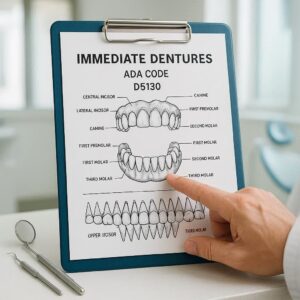
ADA Code for Immediate Dentures
What Are Immediate Dentures? (A Quick Refresher)
Before we dive into the code itself, it is essential to understand the procedure it represents. Imagine having several (or all) of your teeth removed, but unlike traditional dentures where you might wait weeks for healing before getting your prosthetic, immediate dentures are crafted in advance and placed right after the extractions. You walk out of the dental office with a new smile on the very same day.
A Note on the Experience: While the idea of leaving the office with a full smile is appealing, it is important to be realistic. Because immediate dentures are made before your gums have healed and shrunk, they require a precise fitting process and will almost certainly need adjustments—known as relines—down the road as your mouth heals.
The Mystery of the “ADA Code”
The term “ADA code” refers to the Current Dental Terminology (CDT) code set. This is a standardized system maintained by the American Dental Association (ADA) that assigns a unique alphanumeric code to every dental procedure. Dental insurance companies use these codes to process claims and determine coverage. So, when someone searches for the “ada code for immediate denture,” they are looking for the specific identifier that a dentist uses to bill for this service.
It is crucial to understand that there isn’t just one code. The “immediate denture” procedure is typically broken down into at least two distinct parts: the denture itself and the extraction(s). Understanding this distinction is the foundation of the entire process.
The Primary ADA Codes for Immediate Dentures
When you receive an immediate denture, your treatment plan will likely include the following key codes. Let’s break them down in a clear and simple way.
D5110 – Complete Denture – Maxillary
This code is used for a full upper (maxillary) immediate denture.
D5120 – Complete Denture – Mandibular
This code is used for a full lower (mandibular) immediate denture.
D7140 – Extraction, Erupted Tooth or Exposed Root
This is one of the common codes for a simple extraction.
D7210 – Extraction, Erupted Tooth Requiring Removal of Bone
This code is used for a more complex surgical extraction.
D5282 – Immediate Partial Denture
This code is for a removable partial denture that is delivered on the same day as the extractions.
Comparative Table: The Core Codes for Immediate Dentures
| ADA Code | Procedure Description | When It’s Used | Key Takeaway for Patients |
|---|---|---|---|
| D5110 | Complete Denture – Maxillary (Upper) | When all upper teeth are being replaced with a full immediate denture. | This is the code for the actual prosthetic for the upper arch. |
| D5120 | Complete Denture – Mandibular (Lower) | When all lower teeth are being replaced with a full immediate denture. | This is the code for the actual prosthetic for the lower arch. |
| D5282 | Immediate Partial Denture | When some, but not all, teeth are being replaced, and the partial is delivered immediately after extractions. | This code is for the prosthetic when you are keeping some of your natural teeth. |
| D7140 | Extraction, Erupted Tooth | For each tooth that is visible in the mouth and can be removed relatively simply. | You will see this code (or a variation of it) on your treatment plan for each tooth being removed. |
| D7210 | Surgical Extraction | For each tooth that requires a more involved procedure, such as cutting the tooth into sections or removing bone. | This is a more complex extraction and typically has a higher associated fee than a simple one. |
Why Are the Denture and Extractions Billed Separately?
This is one of the most common sources of confusion for patients. You might expect a single “all-inclusive” code for getting immediate dentures. However, dental coding is designed to be highly specific about the nature of the work being done.
Think of it like building a house. The denture (D5110 or D5120) is the house itself—the final product. The extractions (D7140, D7210, etc.) are the site preparation—clearing the land before the house can be placed. They are two distinct phases of the same project, and in the world of dental billing, each phase requires its own specific code.
The “Immediate” Factor: What Makes the Coding Unique?
You might wonder, “If D5110 is a standard code for a complete denture, how does the insurance company know it was an immediate one?” The magic isn’t in a special modifier on the code itself, but in the narrative and documentation that accompanies it.
Your dentist doesn’t just send a code to the insurance company. The claim includes the date of service, the tooth numbers for extractions, and often, written documentation or radiographs (X-rays) that justify the procedure. The insurance company understands that if a denture (D5110) is billed on the same date as multiple extractions, it is, by definition, an immediate denture. The timing of the service tells the story.
The Complete Treatment Plan: What to Look For
When your dentist provides you with a treatment plan, it should be a comprehensive document. Here is a checklist of what a well-written treatment plan for an immediate denture should include:
-
Patient Information: Your name and date of treatment.
-
Procedure Codes: The ADA codes for every single step (e.g., D5110, D7140 x 8, etc.).
-
Descriptions: A plain-English description of each code.
-
Fees: The fee associated with each procedure code, and the total estimated cost.
-
Tooth Numbers: For the extractions, each tooth to be removed should be listed by its number (e.g., teeth #1, #2, #3…).
-
Insurance Estimate: An estimate of what your insurance will pay and what your estimated out-of-pocket responsibility will be.
A Note on Treatment Plans: Do not be afraid to ask questions. A good dental office will walk you through this document line by line. If something is unclear, such as why a particular extraction code is being used, ask for an explanation. It is your right and your money.
Navigating Dental Insurance for Immediate Dentures
This is where understanding the ADA code becomes financially critical. Your dental insurance plan is a contract, and the benefits you receive are tied directly to these codes.
1. Annual Maximums:
Most dental plans have an annual maximum, which is the total dollar amount the insurance company will pay for your care in a calendar year. This can range from $1,000 to $2,500 or more. An immediate denture procedure is a significant investment, and it is very common for the total cost to meet or exceed your annual maximum. You will be responsible for any costs beyond that limit.
2. Waiting Periods:
Many insurance plans have waiting periods for major procedures, which include dentures. This means you may have to be enrolled in the plan for a certain period (often 6-12 months) before they will cover any benefits for codes like D5110 or D5120.
3. Frequency Limitations:
Insurance companies know that dentures need to be replaced over time. Therefore, they have frequency limitations. A common rule is that they will only pay for one complete denture every five or seven years. If you had a denture made three years ago, your insurance will likely deny coverage for a new one, even if it is an immediate denture for the other arch.
4. The “Waiting Period” and Relines:
Remember those future adjustments (relines) we mentioned? These also have their own ADA codes. A “rebase” or “reline” procedure (e.g., D5710, D5711, D5720, D5721) is a separate service from the initial denture fabrication. Many insurance plans have separate frequency limitations for these procedures, often once per year or once every two years.
List: Key Financial Questions to Ask Your Dental Office
Before you commit to treatment, make sure you get clear answers to these questions:
-
What is my insurance plan’s annual maximum, and have I used any of it this year?
-
What is my deductible, and has it been met?
-
What percentage of the denture code (D5110/D5120) does my plan cover? (e.g., 50% for major services).
-
What percentage of the extraction codes does my plan cover? (Often covered under basic services at a higher percentage, like 80%).
-
Is there a waiting period for either the denture or the extractions?
-
How does my plan handle the future costs of relines?
The Patient Journey: A Step-by-Step Guide
Understanding the ADA codes is one thing, but knowing how they fit into your personal journey is another. Here is a realistic timeline of what to expect.
Step 1: The Consultation and Treatment Plan
This is where the codes are first introduced to you. The dentist examines you, takes X-rays, and discusses your goals. They will explain that an immediate denture is an option and present you with a written treatment plan containing the ADA codes and associated costs.
Step 2: Verification of Benefits
The dental office will take your insurance information and send a “predetermination” or “pre-estimate of benefits” to your insurance company. They are essentially saying, “If we perform these procedures (with these specific ADA codes) on this patient, what will you pay?” This is the most powerful tool you have for avoiding surprise bills.
Step 3: Financial Arrangements
Once the office receives the insurance estimate, they will discuss your final financial responsibility. You will likely need to pay for the denture fabrication (the D5110/D5120 code) in full before the procedure date, as the lab work needs to be completed.
Step 4: The Impression and Try-In Appointments
Over several weeks, you will have appointments where impressions (molds) are taken of your current teeth and gums. The lab uses these to craft your new immediate denture. You may have a “try-in” appointment to check the fit and look of the denture before the final teeth are set.
Step 5: The Surgical Appointment
This is the big day. The dentist will extract the teeth (using codes D7140, D7210, etc.) and then immediately seat the new denture. You will leave with a denture in place.
Step 6: The Healing and Adjustment Phase
This is the longest and most critical phase. Your gums and bone will shrink and change shape over the next 6-12 months. You will likely have several “adjustment” appointments to relieve sore spots. This is a normal and expected part of the process.
Step 7: The Final Reline (Approximately 6-12 Months Later)
Once your mouth has finished most of its initial healing, your dentist will recommend a “hard reline.” They will take a new impression inside your existing denture and send it to the lab to have the interior surface re-fitted to your now-healed gums. This procedure has its own set of ADA codes (like D5710 or D5711) and its own cost.
The Emotional and Physical Reality
It would be disingenuous to only discuss codes and costs without addressing the human experience. Getting immediate dentures is a major life event.
-
The First Few Days: Expect a period of adjustment. Eating will be difficult. You will likely stick to soft foods. Speaking may feel different. This is temporary.
-
The “Honeymoon” Period: Your new denture will look great, but because your gums are still swollen from the extractions, the fit will feel snug at first. As the swelling goes down, the denture will feel looser. This is normal and expected.
-
The Emotional Rollercoaster: Losing your natural teeth can be an emotional process. Give yourself grace. Focus on the end goal: a healthy, functional, and beautiful smile.
The Future: Codes for Denture Maintenance
Understanding these future codes will help you prepare for the long-term investment in your oral health.
-
D5710 / D5711: Rebase Complete Denture (Upper/Lower): This involves replacing the entire base of the denture while keeping the existing teeth.
-
D5720 / D5721: Reline Complete Denture (Upper/Lower): This is the more common procedure we discussed, where the inside surface is resurfaced to improve fit. A “chairside” reline is done in the office in one day (D5725), while a “laboratory” reline (D5720/D5721) is sent to a lab and is usually more durable.
-
D5850 / D5851: Tissue Conditioning: This is a temporary, soft liner placed in the denture to help irritated gums heal. It is often a precursor to a final reline.
-
D5511 / D5512: Repair Broken Denture: Life happens. Dentures can break if dropped. These codes cover the repair of a fractured denture base.
Conclusion
Navigating the “ada code for immediate denture” is the first step on a path toward a restored smile. By understanding that this process involves distinct codes for the prosthetic (D5110, D5120, D5282) and for the extractions (D7140, D7210), you empower yourself to have meaningful conversations with your dentist and your insurance company. Remember that the “immediate” nature of the procedure is conveyed through the timing of the services, not a secret code. With realistic expectations, a clear financial understanding, and a trusted dental team, you can navigate this journey with confidence, knowing that the temporary challenges of healing will lead to the lasting reward of a new smile.
Frequently Asked Questions (FAQ)
1. Is “D5110” the official ADA code for an immediate denture?
Yes, D5110 (or D5120 for lower) is the correct code for the complete denture itself. It is not a different code than a standard denture; the “immediate” aspect is determined by the fact that the extractions are performed on the same day the denture is inserted.
2. Why does my treatment plan have so many different codes on it?
Because an immediate denture procedure is a combination of services. You have a code for the creation of the denture (the prosthetic), and then a separate code for each tooth that needs to be removed. This itemized list ensures transparency and accurate billing.
3. Will my dental insurance cover 100% of the cost of an immediate denture?
It is highly unlikely. Most dental insurance plans cover major procedures like dentures at 50%. You will also have to consider your deductible and annual maximum. Always ask your dental office for a pre-determination of benefits to get a reliable estimate.
4. How long after getting my immediate denture will I need a reline?
Every patient heals differently, but a common timeline is to have a final hard reline performed about 6 to 12 months after the initial extractions. This allows your gums and bone to stabilize.
5. What happens if my immediate denture breaks? Is there a code for that?
Yes, absolutely. A broken denture is repaired using specific codes like D5511 (repair broken complete denture). It is a good idea to ask your dentist about their policy on repairs, especially within the first few months of receiving your denture.
Additional Resource
For the most authoritative and up-to-date information on dental procedures and oral health, the American Dental Association (ADA) is the gold standard. You can visit their public-facing website for patient education materials:
ADA MouthHealthy.org
Disclaimer: This article is for informational purposes only and does not constitute medical or financial advice. Dental procedures, codes, and insurance coverage can vary. You should always consult with a qualified dental professional and your insurance provider for advice tailored to your specific situation.
Author: American Dental Association (ADA) Code Expert Series Contributor
Date: March 16, 2026