If you’ve recently been told you need an implant bridge, or you’re simply researching tooth replacement options, you’ve likely encountered a confusing wall of numbers and jargon. Your treatment plan probably looks like a math equation gone wrong, filled with codes like D6010, D6066, or D6094.
Don’t worry. You’re not alone, and it’s not as complicated as it looks.
Think of dental codes as a secret language used by dentists and insurance companies to describe exactly what work needs to be done. Understanding the specific dental code for implant bridge procedures is the first step to understanding your treatment, your timeline, and most importantly, your out-of-pocket costs.
This guide is designed to be your translator. We’ll walk through every code you might encounter, explain why there are so many, and give you the confidence to talk to your dental office about your treatment plan. Let’s demystify this together.
Dental Code for an Implant Bridge
What Exactly is an Implant Bridge?
Before we dive into the codebook, we need to be clear on what we’re talking about. An implant bridge is a hybrid restoration. It combines the concepts of a dental implant with a traditional dental bridge.
-
Traditional Bridge: Relies on the teeth adjacent to the gap for support. Those healthy teeth are shaved down to act as anchors (abutments) for a false tooth (pontic) in the middle.
-
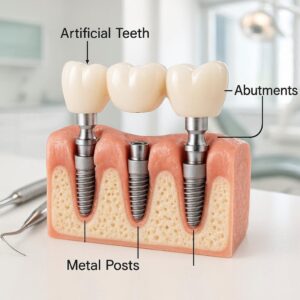
Implant Bridge: Relies on dental implants (surgical posts placed in the jawbone) for support. Instead of shaving down healthy teeth, implants are placed in the bone where teeth are missing. The bridge then attaches to these implants.
Why choose an implant bridge?
They are often considered the gold standard for replacing multiple missing teeth in a row because they preserve bone health, don’t damage adjacent teeth, and feel incredibly stable.
Because this procedure is more complex than a standard filling or crown, it requires a series of codes to account for every step of the process. This is where the “dental code for implant bridge” becomes a list, not just a single number.
The Core Dental Codes for Implant Bridges
In the United States, dental procedures are standardized using the Current Dental Terminology (CDT) codes, published by the American Dental Association (ADA). These are the codes your dentist uses to bill your insurance.
There is no single “implant bridge code.” Instead, the procedure is broken down into phases: the surgical phase (placing the implants) and the restorative phase (making and placing the bridge).
Here are the most common codes you will see on your treatment plan.
Surgical Phase Codes (The Foundation)
These codes cover the placement of the implants themselves. This is typically done by a specialist, such as an oral surgeon or a periodontist.
-
D6010: Surgical placement of implant body (endosteal).
-
This is the most common surgical code. It covers the procedure to place the actual implant post (the “root”) into your jawbone. If you are getting a bridge that requires two implants, you will likely see this code listed twice—once for each implant placed.
-
-
D6100: Implant removal.
-
Hopefully, you won’t need this, but it’s important to know it exists. It covers the surgical removal of an implant that has failed or become compromised.
-
-
D6104: Bone graft at time of implant placement.
-
Many patients need a bone graft to ensure the jawbone is thick and strong enough to hold the implant. This code is used when the graft is done during the same appointment as the implant placement.
-
Abutment Codes (The Connector)
Once the implant has healed and integrated with your bone (a process called osseointegration), a connector piece called an abutment is placed. The abutment screws into the implant and acts as the support for the final bridge.
-
D6056: Prefabricated abutment.
-
This is a stock, off-the-shelf abutment. It is modified by the dentist to fit your mouth. It’s a common and cost-effective option.
-
-
D6057: Custom fabricated abutment.
-
This abutment is specifically designed and manufactured for your mouth. It takes into account the exact angle and contour of your gum tissue, often resulting in a more natural-looking gum line. It is more expensive than a prefab abutment.
-
-
D6094: Abutment supported crown.
-
While this code is technically for a single crown, it’s context is important. If you are getting a bridge that has a “hybrid” design where one section is a crown, this may appear. However, for a full bridge, you will move on to the codes below.
-
The Bridge Codes (The Restoration)
This is where the actual dental code for implant bridge comes into focus. These codes describe the prosthetic teeth that will replace your missing ones.
-
D6065: Implant supported porcelain fused to metal bridge (abutment retained).
-
This code describes a bridge where the restoration is cemented onto the abutments. It has a metal substructure for strength with porcelain fused over it for a natural look.
-
-
D6066: Implant supported porcelain fused to metal bridge (implant retained).
-
This is a subtle but important distinction. This bridge is screwed directly into the implant (or a multi-unit abutment) rather than being cemented. Screw-retained bridges are often easier for the dentist to retrieve and repair if something goes wrong.
-
-
D6067: Implant supported all-ceramic bridge.
-
This is for a bridge made entirely of ceramic or zirconia. It’s a popular choice for its aesthetics and metal-free composition, especially for patients with allergies or those looking for the most natural light refraction.
-
-
D6068: Abutment supported pontic.
-
A pontic is the false tooth that fills the gap. This code is used for each individual false tooth on the bridge that is supported by an abutment.
-
-
D6191: Semi-precision attachment abutment.
-
This is a more advanced component used in complex bridge cases, often when the bridge needs to span a longer distance or connect to a natural tooth.
-
Important Note: Your final treatment plan will likely combine these codes. For a three-unit implant bridge replacing a single missing tooth, you might see two D6010 codes (for two implants), two D6056 codes (for two abutments), and one D6066 code (for the bridge that connects them).
Dental Code vs. Reality: A Treatment Plan Breakdown
Let’s look at a practical example to see how these codes come together. Imagine you are missing Tooth #30 and Tooth #31 (your lower right molars). A traditional plan might place two implants and a two-unit bridge.
Your hypothetical treatment plan might look like this:
| Code | Description | Quantity | Fee per Unit | Total Fee |
|---|---|---|---|---|
| D6010 | Surgical Placement of Implant Body | 2 | $1,800 | $3,600 |
| D6057 | Custom Abutment | 2 | $650 | $1,300 |
| D6066 | Implant Bridge (Porc/Metal, Screw-Retained) | 1 | $3,500 | $3,500 |
| Total Fee for Implant Bridge Case | $8,400 |
In this scenario, the dental code for implant bridge specifically is D6066, but the overall procedure cost is the sum of all the surgical and restorative codes.
Why Are There So Many Codes?
Insurance companies and dental offices need this level of detail for a few key reasons:
-
Accuracy: It ensures the lab technician knows exactly what to build.
-
Billing: It allows insurance to see which parts of the procedure are covered. Some plans cover the surgical placement (D6010) but not the abutment (D6056).
-
Tracking: It helps the dental industry track which techniques and materials are most successful over time.
The Cost Factor: Breaking Down the Numbers
Let’s be honest: the first thing most people ask about an implant bridge is the cost. It’s a significant investment in your health. The total cost is driven by the codes we just discussed.
The fees in the table above are just estimates. Your actual cost will depend on:
-
Geographic Location: Dental fees in New York City are generally higher than in rural Iowa.
-
Specialist vs. General Dentist: A prosthodontist or oral surgeon may charge more for the surgical placement than a general dentist.
-
Material Choice: An all-ceramic bridge (D6067) will cost more than a porcelain-fused-to-metal bridge (D6065 or D6066).
-
Need for Additional Procedures: If you need a bone graft (D6104) or a sinus lift, this will add to the total.
How to Get an Accurate Estimate
When you receive your treatment plan, don’t just look at the bottom line. Look at the individual codes. Ask the treatment coordinator:
-
“Can you explain what each of these codes means for my specific case?”
-
“Is the abutment prefabricated (D6056) or custom (D6057)? Is there a significant difference in outcome?”
-
“What is the warranty on the bridge? If something breaks in a year, is the replacement covered under the lab fee?”
Understanding the dental code for implant bridge on your plan empowers you to ask these smart questions.
Insurance and Your Implant Bridge Codes
This is where things can get a little tricky. Dental insurance was created in an era when a “bridge” meant a traditional bridge. Many older plans haven’t fully caught up with implant technology.
What to expect from your insurance:
-
The “Alternative Benefit” Clause: This is the most important thing to understand. Many insurance plans consider implants a “major” procedure, but they will calculate their benefit based on the least expensive alternative treatment. That least expensive alternative is usually a traditional bridge (code D6240 for a pontic, D6720 for crowns).
-
Example: Your implant bridge costs $8,400. A traditional bridge for the same space might cost $4,000. Your insurance plan, which covers 50% of major procedures, might only pay $2,000 (50% of $4,000), leaving you to pay the remaining $6,400.
-
-
Annual Maximums: Most dental plans have a low annual maximum, often between $1,000 and $2,000. This means that even if your plan covers implants generously, you will likely hit your annual maximum and have to pay the rest out of pocket.
-
Medical Necessity: Occasionally, if tooth loss is due to an accident or a medical condition (like an ectodermal dysplasia), some of the surgical codes (D6010) might be partially covered by medical insurance. It’s always worth checking.
Questions to Ask Your Insurance Company
Before you commit to treatment, call your insurance provider with the specific codes your dentist has given you. Ask these exact questions:
-
“Do I have coverage for the diagnostic code D6010 (surgical implant placement)? If so, what is my coverage percentage?”
-
“Do I have coverage for the restorative codes D6056 (abutment) and D6066 (implant bridge)?”
-
“Do you apply an ‘alternative benefit’ clause for implant services?”
-
“Does the fee for the bridge (D6066) go towards my annual maximum, or is it a separate benefit?”
Getting these answers before treatment starts prevents surprise bills later.
A Friendly Reminder: Your dental office’s treatment coordinator is your ally. They deal with insurance companies every day and can often give you a pretty accurate estimate of what your portion will be, even before you call your insurance.
A Step-by-Step Timeline with Corresponding Codes
To give you a full picture, here is the typical journey of getting an implant bridge, paired with the codes you’ll encounter along the way.
Consultation & Planning
-
Code: D9310 (Consultation), D0350 (Photos), D0384 (Cone Beam CT scan).
-
What Happens: The dentist assesses your bone, plans the implant placement digitally.
Step 1: Surgery
-
Code: D6010 (Implant Placement) + D6104 (Bone Graft, if needed).
-
What Happens: The implants are surgically placed in the jawbone.
-
Timeline: 1 appointment.
Step 2: Healing (Osseointegration)
-
Code: D6085 (Implant maintenance procedure when healing abutment is placed).
-
What Happens: The bone grows and fuses to the implant. You may have a healing cap (a small piece that guides gum healing) visible.
-
Timeline: 3-6 months.
Step 3: Exposure & Impressions
-
Code: D6090 (Repair implant abutment – not usually needed here), but more accurately, the procedure for exposing the implant and taking impressions is often bundled into the restorative fees.
-
What Happens: The dentist uncovers the implant, places an impression coping, and takes a mold of your mouth to send to the lab.
-
Timeline: 1 appointment.
Step 4: Abutment & Bridge Placement
-
Code: D6056/D6057 (Abutment) + D6066/D6067 (Bridge).
-
What Happens: The abutment is placed, and the final bridge is either cemented or screwed onto it.
-
Timeline: 1 appointment (after a few weeks of lab time).
Step 5: Follow-Up
-
Code: D6080 (Implant maintenance procedures).
-
What Happens: Regular check-ups to ensure the bridge and gums are healthy.
-
Timeline: Every 6 months.
Glossary of Key Terms
To help you navigate conversations with your dental team, here’s a quick list of terms related to the dental code for an implant bridge:
-
Abutment: The connecting piece between the implant (in the bone) and the restoration (the visible tooth/bridge).
-
CDT Code: Current Dental Terminology. The official code set for dental procedures in the U.S.
-
Endosteal Implant: The most common type of implant, placed directly into the jawbone. This is the “screw” or “cylinder” shape.
-
Osseointegration: The direct structural and functional connection between living bone and the surface of a load-bearing artificial implant. It’s the biological process of the bone fusing to the implant.
-
Pontic: The artificial tooth on a bridge that replaces the missing natural tooth. It “ponts” the gap.
-
Screw-Retained: A restoration that is held in place with a screw that goes through the crown/bridge and into the implant. Easy to remove for repairs.
-
Cement-Retained: A restoration that is glued onto the abutment with dental cement.
-
Multi-Unit Abutment: A specialized abutment used to correct the angle of an implant, making it easier to place a screw-retained bridge.
Frequently Asked Questions (FAQ)
Q: Is there one single dental code for an implant bridge?
A: No, there isn’t. The procedure is broken down into multiple codes for the surgical placement (e.g., D6010), the abutment (e.g., D6056), and the bridge itself (e.g., D6066). Your treatment plan will be a combination of these.
Q: What is the difference between D6065 and D6066?
A: Both are for porcelain-fused-to-metal bridges. The key difference is in how they attach. D6065 is an abutment-retained bridge (cemented onto the abutment). D6066 is an implant-retained bridge (screwed directly into the implant). Screw-retained is often preferred for its retrievability.
Q: Does insurance cover the dental code D6010?
A: It depends entirely on your specific plan. Many plans now offer implant surgical coverage, but often at a lower percentage (like 50%) than other procedures. Always check your “Schedule of Benefits” or call your provider to confirm coverage for D6010.
Q: Why is my treatment plan so long?
A: Because getting an implant bridge is a process, not a single event. The plan must account for the surgery, the components (abutments), and the final cosmetic work (the bridge). Each stage requires its own code and fee.
Q: What is code D6085?
A: Code D6085 is for a “semi-precision abutment.” It’s a more complex component used for longer-span bridges or situations where you need to connect an implant to a natural tooth. It’s less common than a standard abutment.
Q: Can I use my FSA or HSA dollars for these codes?
A: Yes, almost always. Implant bridges are considered a qualified medical expense to treat tooth loss, so you can typically use funds from a Flexible Spending Account (FSA) or Health Savings Account (HSA) to pay for all associated codes, from D6010 to D6066.
Additional Resources
For the most accurate and up-to-date information, you should always refer to the source.
-
American Dental Association (ADA) – CDT Code Book: This is the official resource. While the book itself is quite expensive, the ADA website often has helpful search tools and articles explaining common codes. (Search: “ADA CDT Codes”).
-
Your Dentist’s Treatment Coordinator: Never underestimate this resource. They are experts in translating these codes into plain English and can give you the most personalized information regarding your specific financial situation and treatment plan.
Conclusion
Understanding the dental code for implant bridge procedures transforms you from a passive patient into an active participant in your healthcare journey. While the codes themselves—D6010, D6066, D6094—may seem intimidating at first, they are simply a structured way to describe the sophisticated process of restoring your smile. By breaking down the surgical, abutment, and restorative phases, you can better understand your treatment timeline, the associated costs, and how your insurance will apply. Remember, your dental team is there to guide you through every step, so never hesitate to ask them to explain the “why” behind every code on your plan. Your smile is worth understanding.
Disclaimer: This article is for informational purposes only and does not constitute medical or financial advice. Dental codes, insurance policies, and treatment costs vary widely. You should always consult with a qualified dental professional and your insurance provider to obtain accurate information regarding your specific situation.