Walking into a dental office can sometimes feel like navigating a foreign country. You are in the chair, the dentist looks in your mouth for a few minutes, and then the front desk hands you a bill with codes that look more like airplane seat numbers than medical procedures.
If you have ever gone in for a quick check on a sore tooth or a specific issue, you have likely encountered the dental code for limited exam.
Understanding this code is not just about satisfying curiosity. It is about understanding your insurance Explanation of Benefits (EOB), knowing what you are paying for, and ensuring that your dental health is being properly documented.
In this guide, we will strip away the confusion. We will look at what a limited exam actually is, the specific code used (D0140), how it differs from other exams, and what you need to know before you leave the house.
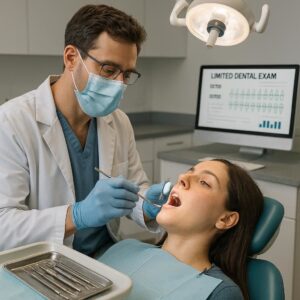
Dental Code for Limited Exam
Table of Contents
ToggleWhat Is a Limited Exam in Dentistry?
Before we dive into the code, let us talk about the “why.” In the dental world, not all check-ups are created equal.
A limited exam is exactly what it sounds like: an evaluation that is focused on a specific problem. It is not the comprehensive head-to-toe (or tooth-to-tooth) overview you get at your annual check-up.
Think of it like taking your car to the mechanic. A comprehensive exam would be the full service where they check the oil, rotate the tires, and inspect the brakes. A limited exam is when you go in because you hear a strange squeaking noise every time you turn left. The mechanic is only looking at that specific issue.
Common Reasons for a Limited Exam
You will most often encounter this type of appointment when:
-
You have a toothache and need the dentist to identify which tooth is causing the pain.
-
A filling or crown broke, and you need an assessment of the damage.
-
You have a localized swelling or bump on your gums.
-
You are a new patient seeking emergency relief before committing to a full office.
-
You are experiencing sensitivity to hot or cold.
The goal here is diagnosis of a specific complaint. It is problem-focused and time-sensitive.
The Official Dental Code for Limited Exam: D0140
In the world of dental billing, everything is standardized using the Current Dental Terminology (CDT) codes. These codes are maintained by the American Dental Association (ADA) and are used by insurance companies to determine what they will pay for.
The specific dental code for a limited exam is D0140.
According to the CDT manual, D0140 is officially defined as:
“Evaluation of a patient for a specific dental problem, which may be reported separately or in conjunction with another procedure.”
Breaking Down D0140
Let’s look at what this code actually covers during your appointment.
-
The Evaluation: This includes the dentist listening to your history (the “chief complaint”), visually inspecting the affected area, and possibly performing tests like tapping on the tooth (percussion) or applying air to test sensitivity.
-
The Diagnosis: The dentist will form a preliminary opinion on what is wrong.
-
The Presentation of Findings: The dentist will explain what they see and recommend next steps.
Important Note: D0140 is specifically for the evaluation. It usually does not include x-rays, and it certainly does not include the actual treatment (like a filling or extraction). If the dentist takes an x-ray to diagnose your problem, that x-ray will likely be billed separately under its own code (for example, D0220 for an intraoral x-ray of a single tooth).
D0140 vs. D0120: What is the Difference?
This is where most of the confusion happens. You have your routine check-up code, D0120, and your problem-focused code, D0140. They look similar, but they serve very different purposes.
To help you visualize the difference, here is a comparison table:
| Feature | D0120 (Periodic Oral Evaluation) | D0140 (Limited Oral Evaluation) |
|---|---|---|
| Purpose | Routine, ongoing assessment of overall oral health. | Problem-focused assessment of a specific complaint. |
| Frequency | Typically every 6 months or as part of a recall visit. | As needed for emergencies or specific issues. |
| Scope | Comprehensive look at teeth, gums, bite, and oral cancer screening. | Focused only on the area of the problem. |
| X-Rays | Usually accompanied by a full series or bitewings. | Usually not included; may require one small “spot” x-ray. |
| The “Vibe” | Your standard cleaning check-up. | “I have a toothache and I need help right now.” |
Why the Distinction Matters
From a patient perspective, this distinction is crucial for two reasons:
-
Insurance Coverage: Most dental insurance plans cover two D0120 exams per year (every six months) at 100%. However, they might have a separate, smaller allowance for D0140 exams. If you go to the dentist with a toothache and they bill a D0120, your insurance might reject it because it is not your six-month check-up.
-
Cost: Because a D0140 is often an unscheduled, acute visit, it might have a different fee than a routine check-up. Knowing this can help you anticipate costs if you are walking in with an emergency.
The Emergency Exam: D0140 in Action
The most common use of the dental code for limited exam is in emergency situations. Let’s walk through a realistic scenario to see how this code works in the real world.
A Realistic Patient Scenario
The Problem: It is a Saturday morning, and you wake up with a throbbing pain in your lower right jaw. You call a dental office that advertises emergency hours.
The Appointment:
-
Check-in: You arrive and explain you have a toothache. The front desk notes that this is an emergency/problem-focused visit.
-
The Exam (D0140): The dentist seats you and asks, “Where does it hurt?” You point to the area. The dentist looks specifically at that area, noting some redness and possibly a small cavity. They tap on the tooth; you jump. They establish that the pain is likely coming from that specific tooth.
-
The X-Ray (D0220): To see what is happening below the gum, the dentist takes a small, focused x-ray of just that tooth. They see decay reaching the nerve.
-
The Diagnosis & Treatment Plan: The dentist diagnoses irreversible pulpitis (inflammation of the nerve). They explain you need a root canal. They may place a temporary sedative filling to help with the pain, which would be a separate treatment code.
-
The Bill: At the front desk, you will see charges for:
-
D0140: The evaluation to find the problem.
-
D0220: The x-ray of the tooth.
-
D9910: (Possibly) the application of a desensitizing medicament.
-
As you can see, the D0140 code is just the starting point of the financial and clinical transaction.
What is Not Included in a Limited Exam?
To avoid surprises on your bill, it is helpful to know what the D0140 code does not cover.
-
Treatment: The actual fixing of the problem (fillings, crowns, extractions) is separate.
-
X-rays: As mentioned, these are almost always billed in addition.
-
Comprehensive Treatment Planning: If the dentist finds a secondary issue during the limited exam (like gum disease), they will likely recommend a separate comprehensive evaluation (D0150) to address that, especially if you are a new patient.
-
Cleaning (Prophylaxis): If you come in for a toothache and ask for a cleaning while you are there, the cleaning will be billed separately under a different code (D1110).
D0140 for New Patients: A Special Case
Here is a common situation: You move to a new city and suddenly crack a tooth on an olive pit. You have not established a “regular” dentist yet. You call a local office and explain you are a new patient with an emergency.
In this case, the dentist will almost certainly perform a D0140 limited evaluation. They cannot ethically perform a full comprehensive exam (D0150) on you if you are in pain and need immediate relief. The priority is to stop the pain.
However, they will likely recommend that you schedule a comprehensive exam and full set of x-rays once the emergency is resolved to establish a baseline for your overall health.
Important Note for Patients: If you are a new patient seeing a dentist for an emergency, be prepared for two separate appointments. The first (D0140) is to fix the acute problem. The second (D0150) is to get to know you as a patient and create a long-term health plan.
Insurance Coverage and Limitations
Insurance can be tricky, but here is the general rule of thumb regarding coverage for D0140.
Most dental insurance plans fall into the “100-80-50” structure. They cover:
-
100% of preventative care (like D0120 exams and cleanings).
-
80% of basic restorative care (like fillings).
-
50% of major care (like crowns and bridges).
Where does D0140 fit? It usually falls under diagnostic care, which is often grouped with preventative care. This means many plans will cover a D0140 at 100%, just like a regular check-up.
However, there is a catch: frequency limits.
While a D0120 is usually limited to twice a year, a D0140 may have its own limitation, such as once per year, or it may count toward a broader “diagnostic” frequency limit. If you have already used your two routine exams and you come in with an emergency, your insurance might cover it, or they might apply it to your deductible.
Always ask the front desk:
“Since this is a limited exam for my toothache, can you check my insurance to see if D0140 is covered separately from my regular cleanings?”
A good billing coordinator will do this for you without you having to ask, but it never hurts to be proactive.
What to Expect During Your Appointment
If you are scheduled for a D0140 limited exam, here is a simple checklist of what will likely happen to prepare you mentally and financially.
Before the Appointment
-
Describe your symptoms clearly: When you call, tell them exactly what is wrong. “I have a sharp pain when I drink cold water” is better than “My tooth hurts.” This helps them schedule the right amount of time.
-
Confirm the nature of the visit: Ask, “Is this considered an emergency or problem-focused visit?”
-
Have your insurance card ready.
During the Appointment
-
Be precise: Point to the exact area. The dentist will rely on your description to guide their examination.
-
Expect focused questions: They will ask when the pain started, what makes it worse, and if it keeps you up at night (a classic sign of nerve issues).
-
Diagnostic tests: The dentist may tap on teeth, use a cold stimulus, or check your bite on a specialized tool. This is all part of the D0140 evaluation.
After the Appointment
-
Get a clear breakdown: Before you leave, ask for a printout of the procedures performed today.
-
Understand the “next steps”: The D0140 gives you a diagnosis. Now you need a plan for treatment. Make sure you understand the proposed treatment, the urgency, and the cost.
-
Schedule the follow-up: If you need a filling or extraction, schedule it before you leave. Pain has a funny way of disappearing once you leave the chair, only to return later.
The Importance of Accurate Coding
You might wonder why we have to be so specific about a code. Why can’t the dentist just call it a “check-up”?
Accurate coding is the foundation of ethical dentistry and functional insurance. If a dentist were to bill a comprehensive exam (D0150) for a 5-minute look at a chipped tooth, they would be committing insurance fraud. Conversely, if they bill a limited exam (D0140) when they actually performed a full head and neck cancer screening and full mouth evaluation, they are undervaluing their own work.
For you, the patient, accurate coding ensures:
-
Your insurance records are accurate. This prevents future claims from being denied due to incorrect history.
-
Your medical record is accurate. Your chart should reflect exactly what happened during your visit.
-
You are charged fairly. You pay for the service you actually received.
Conclusion
Navigating dental codes doesn’t have to be a headache. The dental code for limited exam, D0140, is simply the dental profession’s standardized way of saying, “We took a focused look at a specific problem.”
Whether it is a sudden toothache, a broken filling, or a mysterious bump, D0140 is the code that initiates the diagnostic process. It is the bridge between your pain and the solution. By understanding that this code is distinct from your routine cleaning (D0120) and that it usually excludes x-rays and treatment, you empower yourself to have smarter conversations with your dentist and your insurance company.
Next time you find yourself in the chair with a specific complaint, you will know exactly what is happening when the dentist picks up their explorer and starts asking questions. You are experiencing a D0140—and that is the first step toward getting better.
Frequently Asked Questions (FAQ)
Q: Is a limited exam the same as an emergency exam?
A: They are very similar. While D0140 is the code for a problem-focused evaluation, in a dental office it is often referred to as an “emergency exam.” The key point is that it is for a specific problem, not a routine check-up.
Q: Will I have to pay for a limited exam if I need treatment on the same day?
A: Yes, you will typically be charged for both the evaluation (D0140) and any treatment performed (like an extraction or temporary filling). The evaluation is a separate service from the treatment itself.
Q: How often can I have a D0140 procedure done?
A: This depends entirely on your dental insurance plan. Some plans cover it once a year, some cover it twice, and some may group it with your routine exams. Check with your benefits coordinator.
Q: Does D0140 include x-rays?
A: No. The code is specifically for the clinical evaluation. If the doctor needs an x-ray to diagnose your problem, it will be billed separately under a code like D0220 (intraoral, per first image) or D0230 (each additional image).
Q: My dentist looked at my whole mouth during my emergency visit. Can they still bill D0140?
A: Possibly. If the primary reason for the visit was a specific complaint, and the dentist’s evaluation was focused on resolving that complaint, D0140 is appropriate. However, if they performed a comprehensive evaluation of your overall dental health, a different code (D0150) might be warranted. You can always ask your dentist to explain the coding on your bill.
Additional Resource
For the most authoritative information on dental coding straight from the source, you can visit the American Dental Association’s page on CDT codes. Please note that access to the full code set requires purchase, but their overview provides excellent context.
[Visit the American Dental Association (ADA) CDT Website](https://www.ada.org/en/publications/cdt)
Disclaimer: This article is for informational purposes only and does not constitute legal, billing, or medical advice. Dental coding practices and insurance coverage vary by provider and location. Always consult with your dental insurance provider or a qualified dental billing professional for specific advice regarding your situation.